
What is Halving?
Bitcoin #halving is a Bitcoin block reward halving event every 210,000 blocks. It occurs in a predetermined manner in the Bitcoin code and helps limit the supply of Bitcoin.
The first Bitcoin halving took place on November 28, 2012 and reduced the block reward from 50 BTC to 25 BTC. The second halving took place on July 9, 2016 and reduced the block reward from 25 BTC to 12.5 BTC. The third halving took place on May 11, 2020 and reduced the block reward from 12.5 BTC to 6.25 BTC. The fourth halving is expected to occur on May 29, 2024 and will reduce the block reward from 6.25 BTC to 3,125 BTC.
Bitcoin halving may affect Bitcoin price. In general, before the halving the Bitcoin price rises and after the halving the Bitcoin price falls. This is because before the halving, the supply of Bitcoin increases as miners produce more Bitcoin, and after the halving, the supply of Bitcoin decreases as miners produce less Bitcoin.
However, it cannot be said that the #Bitcoin halving always affects the Bitcoin price. For example, after the 2012 halving, the Bitcoin price increased significantly in 2013, but after the 2016 halving, the Bitcoin price decreased significantly in 2017.
Bitcoin halving is one of the most important features of Bitcoin. Bitcoin halving helps limit the supply of Bitcoin and may affect the price of Bitcoin.
When is the Bitcoin Halving Effect Felt?
The halving that took place in 2016 can be seen in the chart below. The time from the peak to the bottom after the halving occurs is indicated in green, and the time from the peak to the bottom is indicated in red.
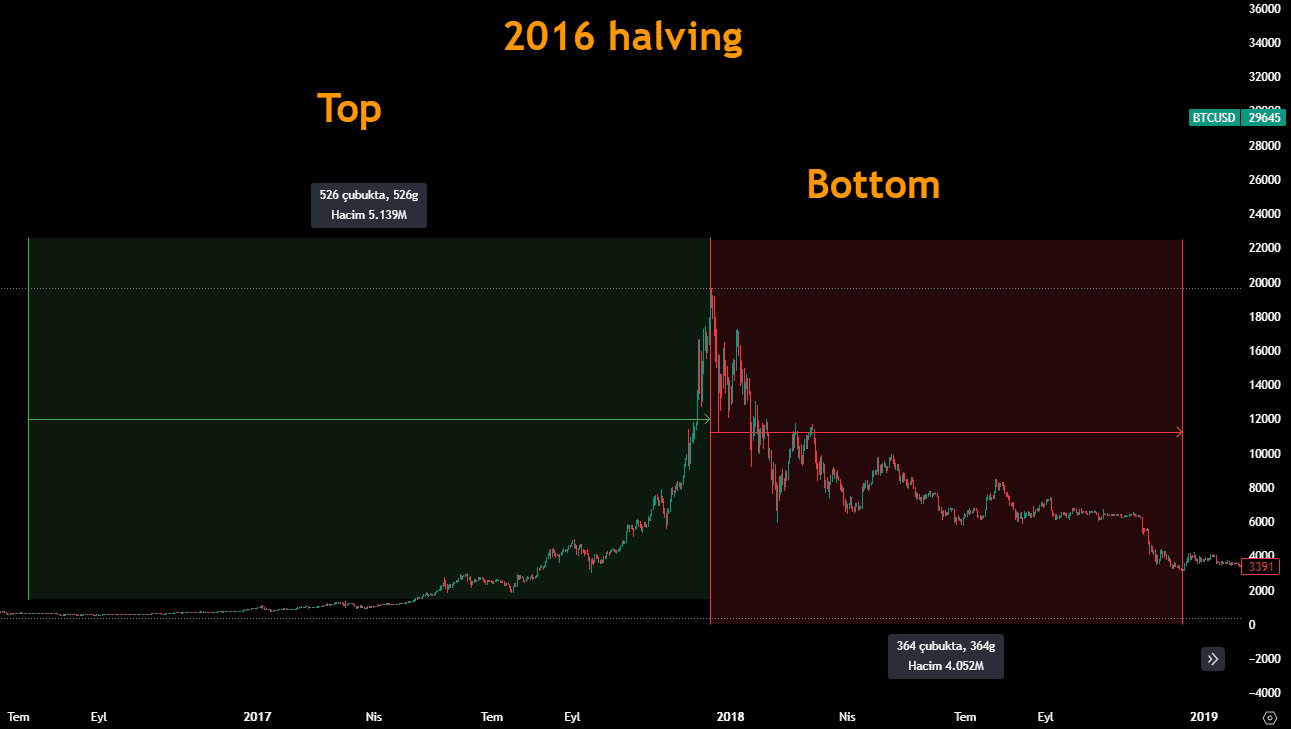
After the halving in 2016, it took 526 days for the Bitcoin (BTC) price to reach the ATH level of 19,650 USD.
The bottom point came 363 days after the ATH level of 19,650 USD.
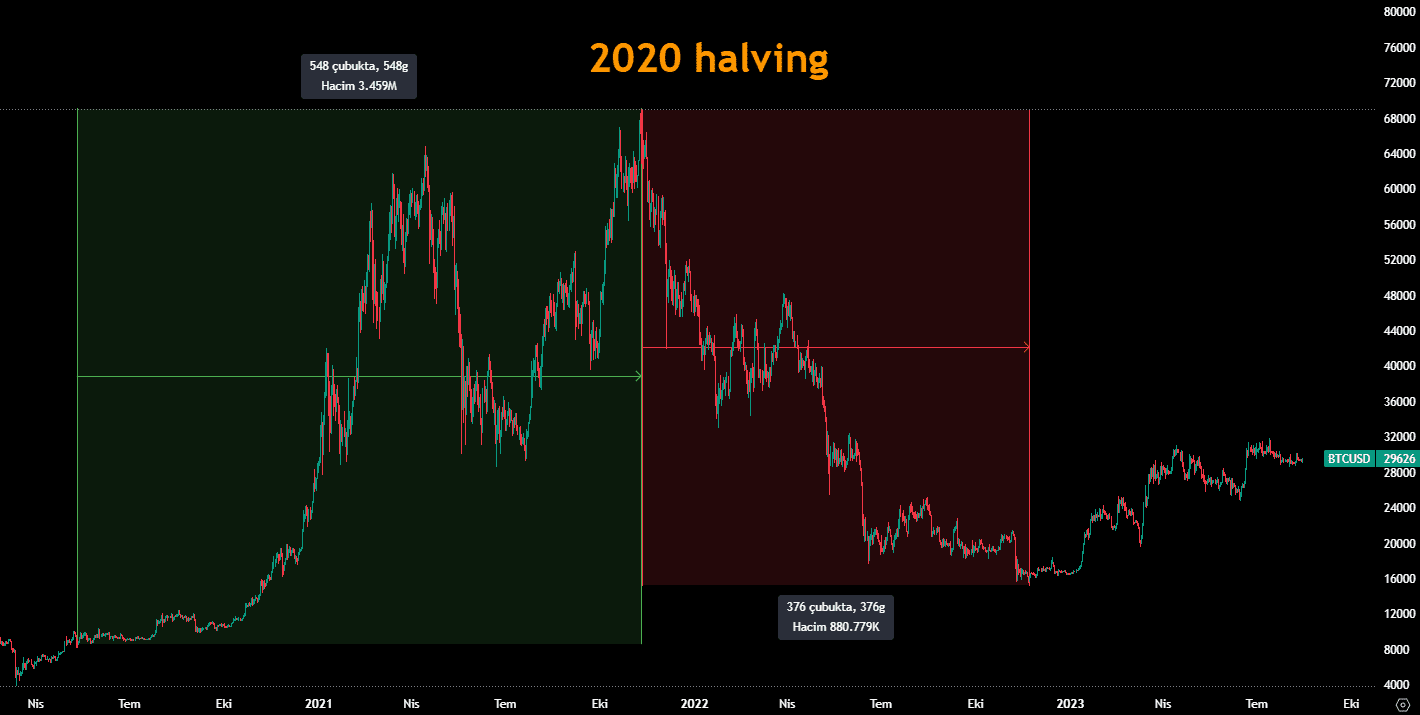
After the halving in 2020, it took 548 days for the price of Bitcoin (BTC) to reach the ATH level of 69,000 USD.
The bottom point came 376 days after the ATH level of 69,000 USD.