


Today I will talk about a project with great potential, which is also the leading project of the Polkadot ecosystem. Because the sectors have not rotated recently, when I talked about GLM before, didn’t I analyze some of the reasons (the first market value is relatively low, and it is easy to attract investors). first, the fundamentals of the project must be pretty good; the second one is not very famous, and cannot be a project that has been cut off for a long time, such as fil; the third one is to look for the next YGG, AKT, DODO, C98, these coins have experienced sharp rises and falls recently. The project we are talking about today is moonbeam (GLMR), with a current market value of US$160 million and a ranking of approximately 150+.
Introduction
Founded in 2019 by Derek Yoo of Pure Stake, Moonbeam is a blockchain middleware for developers on Polkadot, dedicated to providing development tools and networks that are compatible with existing Ethereum. Moonbeam provides a complete EVM-compatible environment and Web3-compatible API to build a bridge with Ethereum. As a parachain on the Polkadot network, Moonbeam benefits from the shared security of the Polkadot Relay Chain and connectivity with other Polkadot-related chains. However, since Polkadot’s relay chain itself does not have smart contracts, Moonbeam just bridges this shortcoming. Moonbeam is a smart contract chain on Polkadot that is compatible with Ethereum. With the help of Moonbeam smart contracts and compatibility with the Ethereum development toolset Flexible, bridge-based integration to quickly build Dapps that work with users and assets on remote chains.
Moonbeam is committed to providing the simplest development environment and the richest developer integration, attracting more mature projects in the Ethereum ecosystem to bridge into the Polkadot ecosystem. At the same time, as a bridge connecting Ethereum and Polkadot, Moonbeam can realize the integration of Ethereum and Polkadot. Free conversion and flow of assets on the card chain.
Recently, the market sector has rotated, and Layer 2 has become popular. In fact, Moonbeam not only integrates the EVM virtual machine, it can even be called a highly specialized Ethereum Layer 1.5. The Moonbeam platform has additional features such as on-chain governance, mortgage and cross-chain integration. Features extend the basic Ethereum feature set.
Vision
The future will be a multi-chain future, with many chains and many users and assets on these chains. Moonbeam aims to serve these new types of assets and users that exist on two or more chains.
Existing smart contract platforms are designed to serve users and assets on a single specific chain. By providing cross-chain smart contract functionality, Moonbeam allows developers to move existing workloads and logic to Moonbeam and extend the reach of their applications to new users and assets on other chains.
Moonbeam’s cross-chain integration is accomplished by becoming a parachain on the Polkadot network. The Polkadot network provides integration and connectivity between sidechains connected to the network and other non-Polkadot chains such as Ethereum and Bitcoin via bridges.
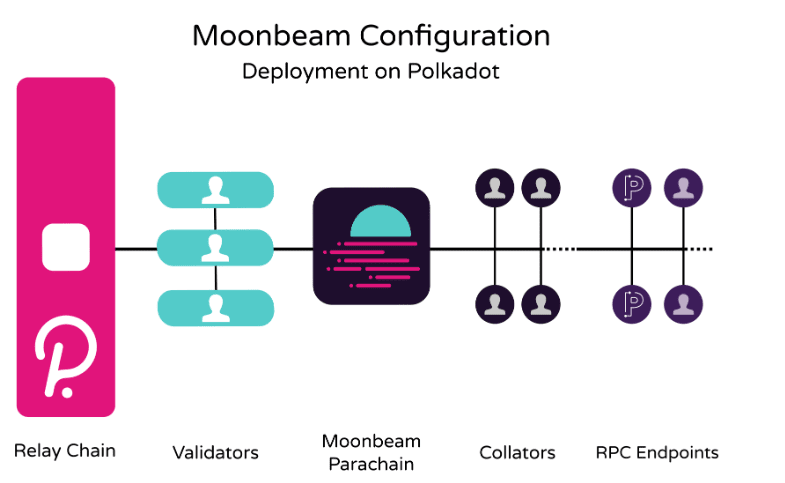
Moonbeam Features
Moonbeam provides an Ethereum-like environment on top of Substrate (rather than a geth-based solution). This allows developers to easily redeploy their existing smart contracts, using the same tools and integrations they already use, while also leveraging the modern underlying framework upon which all Polkadot parachains are built.
The Moonbeam network enables developers with Solidity or vyper-based smart contracts to “go multi-chain” and extend their influence into the Polkadot ecosystem. Polkadot’s blockchain ensures seamless sharing of workloads on new layers.
Through Moonbeam, developers can port their existing Ethereum DApps to Polkadot or easily create new permissionless decentralized applications (DApps) using familiar Ethereum development tools. The tools on Moonbeam ensure that there are minimal changes when front-end dapps are moved between chains.
By using Moonbeam, Ethereum developers (which is the largest market for existing blockchain developers) will be able to bypass scalability challenges due to the fees and limitations of the Ethereum network.
underlying framework
Moonbeam is a smart contract blockchain platform created with the Rust programming language based on the Substrate framework. The Substrate framework provides a rich set of blockchain creation tools, including an execution environment that can implement general state transfer functions, and a series of pluggable module designs that implement various blockchain subsystems.
Through multiple existing Substrate framework modules, Moonbeam can provide important blockchain services and functions, including core blockchain data structures, peer-to-peer networks, consensus mechanisms, accounts, assets, balances, etc. During runtime, special behaviors and functions such as cross-chain token integration can be implemented through customized modules and logic. For the modules that have been called, Moonbeam will maintain a close connection with the upstream Substrate coding library, patching vulnerabilities, enhancing functions, and adding new features at any time.
ecology
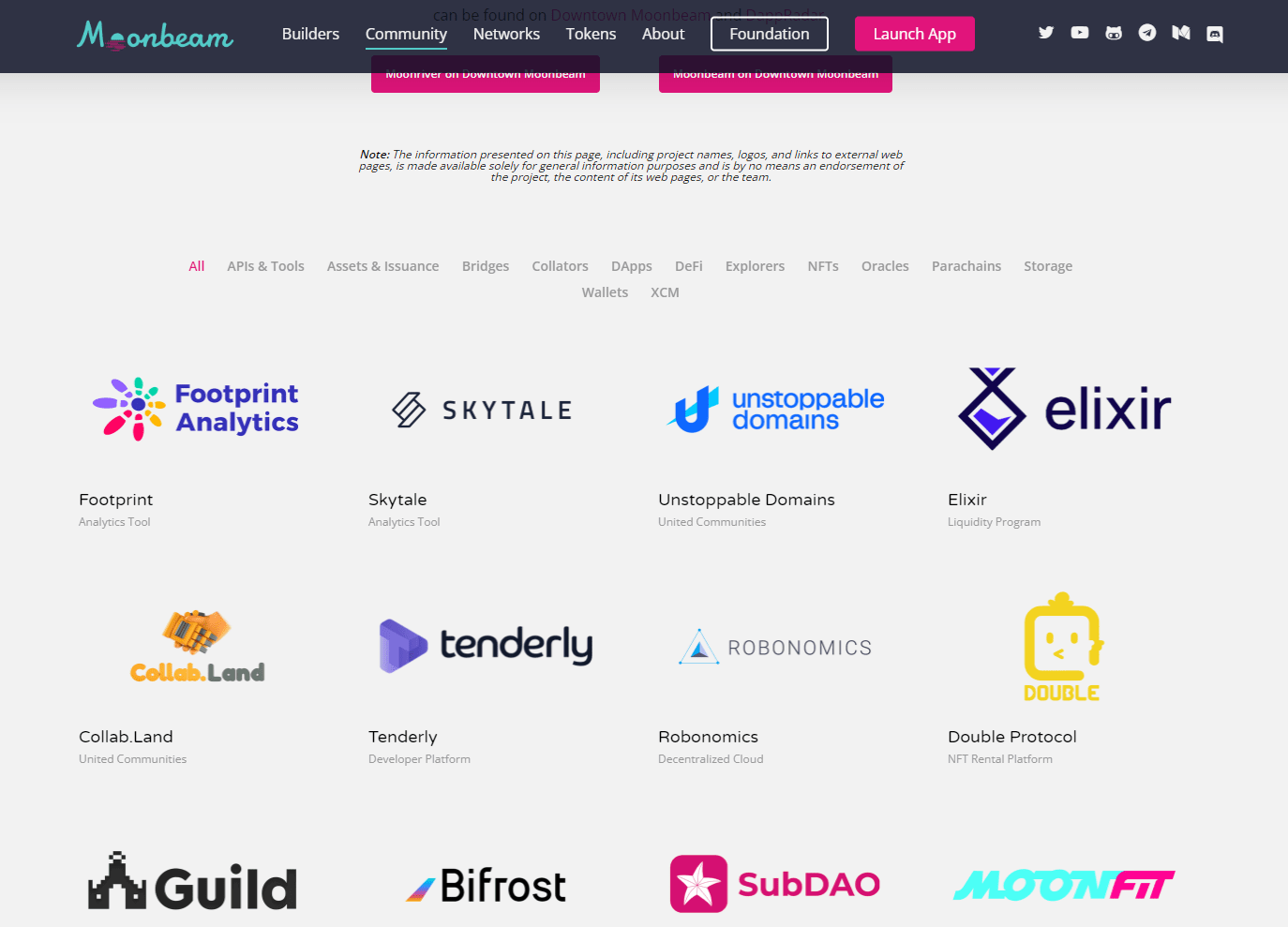
I checked on the official website and found that there are quite a lot of applications, with a total of 190+ applications in various types, including tools, asset insurance, bridges, defi, browsers, nft, oracles, storage, and wallets.
Token information
GLMR is Moonbeam’s utility and governance token with the following use cases:
Transaction fees: Users can use GLMR to pay transaction fees and execute smart contracts.
Mortgage: Users can mortgage GLMR to become a validator or delegate, participate in network consensus, and receive GLMR rewards.
Governance: GLMR token holders will be able to nominate council members and participate in voting on the network.
Liquidity mining: Provide liquidity to decentralized exchanges (DEX) built on the Moonbeam blockchain to earn part of the exchange fees.
Token Inflation / Deflation Design Moonbeam targets an annual inflation rate of 5% with no cap on the token supply.
The purpose of Moonbeam inflation is to meet the ongoing security needs of the network. The main security budget item is the ongoing payment of parachain slot fees and incentives for collation staff to provide collation services to support the Moonbeam network. Of the 5% inflation rate, 1% will be used to incentivize organizers, while 1.5% will be used to build a Hue chain bond reserve to accumulate on the chain fund to pay for the Hue chain slot in perpetuity. The remaining 2.5% will be distributed to users who own GLMR tokens.
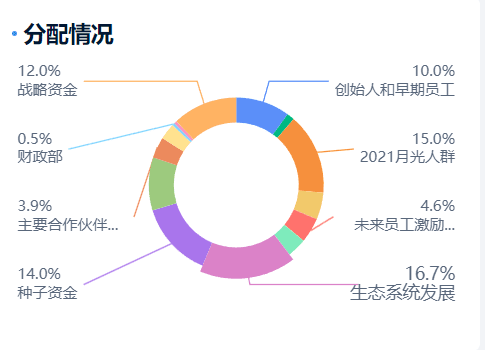
The first issuance will be in January 2022. The crowdfunding price is $0.2500. The current supply is 1,033,220,429 GLMR. The current currency price is 0.23, which has been broken. The team’s currency holding ratio is relatively high, 10+12+0.5+4.6+16.7=43.8%, which is too high.
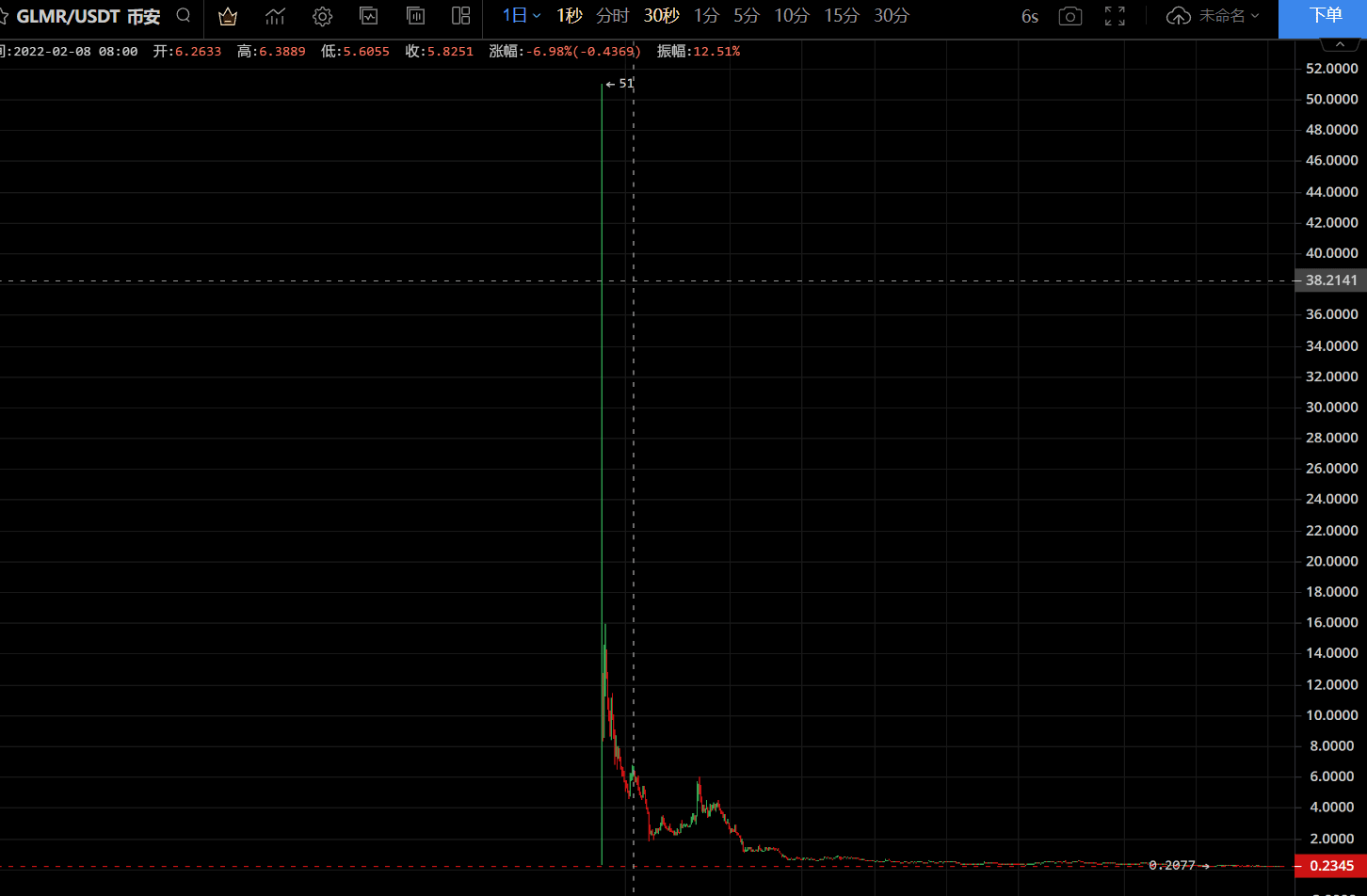
Finally, let’s summarize. This project can be said to be Ethereum on the Polkadot chain. Because Polkadot does not support smart contracts, this is a good solution to the problem of migrating applications from Ethereum to Polkadot. And it’s not just Ethereum, because we know that many chains are actually compatible with EVM, but this is all based on the future era that is based on multi-chains and Polkadot. We know that the emergence of L2 has greatly solved the speed problem of Ethereum. More and more people think that there may not be so many chains, and a few may be enough, so this is a problem. There is also the fact that the project team currently has too many coins in their hands, and it feels like a Chinese project, because both the official website and the documents support Chinese, so we should pay attention to this point. We mentioned three points at the beginning. Right, currently he meets at least 2 points, but the last point is not satisfied, that is, the project side has a higher proportion of currency holdings, but in any case, it is now at an all-time low.