

The novel and abstract concept of Intent-centric has been very popular recently. Not only has it been listed as the top focus area by the leading venture capital firm Paradigm, but a project called Bob the Solver has also received a lot of attention at the ETHCC conference in Paris. Next, I will launch a series of investment research articles to help you understand it systematically and deeply from the aspects of popular analysis of concepts, analysis of alpha projects, business logic outlook, and potential changes in the DeFi industry. 🧵
Hilights (I): Understanding intent-centric in a simple and easy way
-What exactly is intent centric?
-Why is the core of the Intent layer a programmable feature?
-Use carpooling as an example to understand it in a simple way?
Intent-centric Protocol and infra literally means intent-centric protocol and infrastructure.
This concept quickly became popular thanks to Paradigm and EthCC conferences, but it is not new. For example, Account Abstraction, UniswapX on-chain + off-chain transaction paradigm, etc. all belong to this category and can be classified as layer 2 of Rollup Intent. In fact, before Paradigm proposed this concept, projects including Anoma dappOs Essential were doing similar things, but they regarded the intent layer as a module and did not involve the concept of AIGC. With Paradigm's flag-waving, this track may usher in a new wave of narratives.
What is intent-centric?
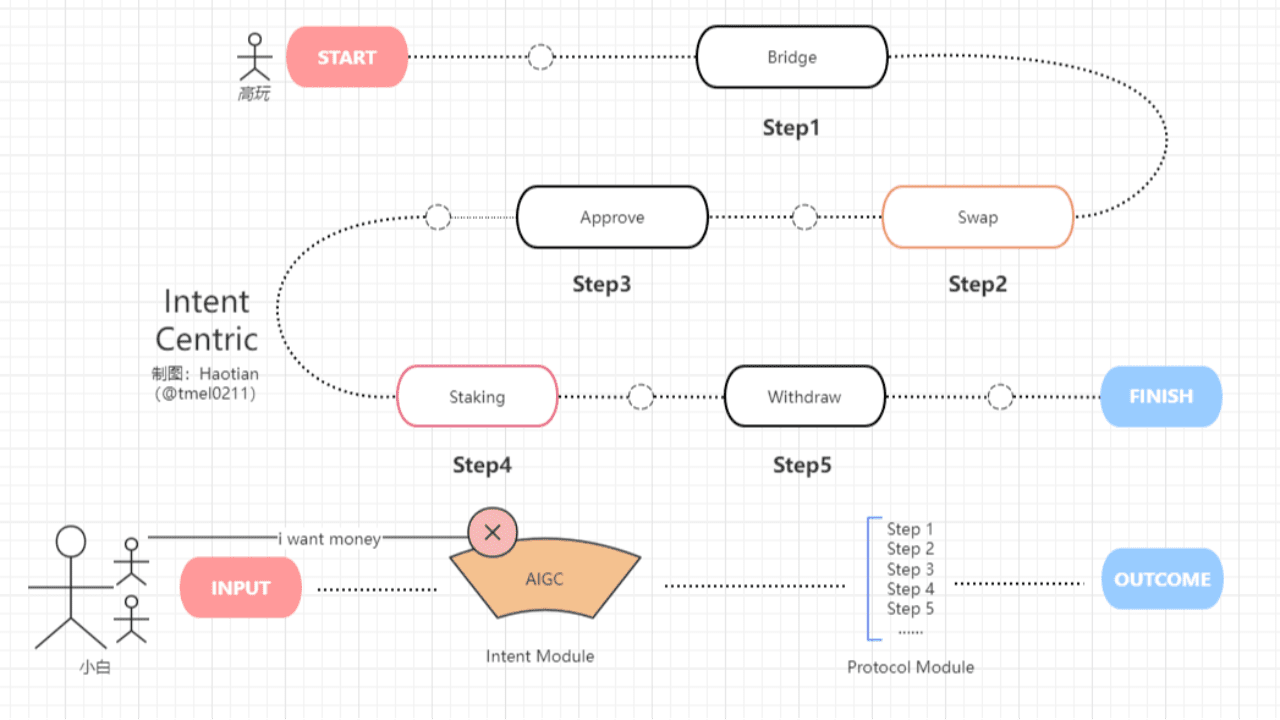
Simple understanding: In the past, to complete a complex DeFi operation, users may have to register a wallet, configure the RPC of each chain, go through the cross-chain bridge, and perform a series of operations such as Approve, Swap, and Staking. The whole process is complicated, burns gas, and has high security risks, which is extremely unfriendly to ordinary users. After the intent-centric infrastructure is improved, after the user registers the wallet, he communicates the "intention" with AIGC, and then the AIGC AI auxiliary tool helps him complete various DeFi operations. The user only needs to issue instructions and sign an Approve instruction. Following this line of thought, is it easy to understand? Intent-centric is an intermediate layer embedded between users and DeFi infra, which can give DeFi the same user experience as CeFi and lower the threshold for users to participate in DeFi.
-Why is the core of the Intent layer a programmable feature?
Intent is an abstract concept. For example, a user may say that "making money" is his intention. How can a satisfactory deal be achieved with current AI technology? At the beginning, it is difficult for most users to express their intentions. Similarly, it is also difficult for AIGC to capture user needs. It is difficult to match a relatively satisfactory demand. Therefore, the purpose of programming is to reduce the friction between the two parties of the transaction.
In my opinion, the intent that can be used as input data to AI must meet the following requirements: Programmable features: A general intent-centric framework is: User -> Intent interaction layer -> Protocol layer.
The intent interaction layer is responsible for programming user needs. For example, a user intends to make money with 1 ETH on the Ethereum chain. He wants to go to a Swap protocol on zkSync to take out 50% of the funds as LP and participate in Pool ETH/USDC. The remaining assets will be transferred to Starknet. The gas fee should be saved as much as possible and it can be completed within three days. The safety of funds is the first priority. (Users need to input valid programmable intent)
After the intent layer is programmed: Execute steps: Bridge --> Swap --> Approve --> withdraw; Operation time: monitor the low peak of gas within 3 days; Path Route selection: select a top-level Swap pool to avoid the risk of running away, select a three-party cross-chain bridge, and transfer assets to Starknet. The Protocol layer is responsible for executing the request issued by the intent layer, matching compatibility and adapting compatibility. For example, what kind of protocol combination is the optimal solution? For example, common cross-protocol incompatibility issues, how to integrate and connect, etc. At present, the DeFi protocol seems to be highly combinable, but there are many Lending and Swap products, which are very isolated. The Aggregator has optimized path selection based on interest rates, etc., but the scenario is also limited. With the current smooth combination of the protocol layer, friction is inevitable after an intent command is issued, such as gas consumption exceeding user expectations, or mistakenly entering the running away protocol. In the future, if the intent middle layer becomes a common module, it will inevitably drive the protocol layer to further expand the possibility of combination and compatibility between protocols. (The outcome will satisfy the user's intent, but there will inevitably be friction)
Anyway, a mature intent-centric link will output the user's effective input and the outcome that maximizes the match of the user's reference but cannot avoid friction.
-Use carpooling as an example to help you understand it in a simple way?
Everyone has used Didi to hail a taxi. In layman's terms, the Didi App is an intent-centric taxi resource allocation and dispatching center. When a user calls a taxi, it is a process of inputting an intent into Didi. Didi can program the user's taxi route, and then match the highly similar users of the same industry according to the time, and give priority to drivers with good reputations according to the evaluation, which will naturally help the user save money in the end. But this is just the user's preference for saving money. If the user prefers comfort and high-end, Didi will provide a business car. If the user does not want to share a car but wants to save money, Didi will recommend a fixed price model and select willing drivers to take the order. The business scenario of taking a taxi is very similar to that of doing transactions, with different users, different consumption habits, different traffic conditions, and so on. Imagine the various possibilities of this taxi scenario, then look at the intent-centric concept, and then associate the allocation and dispatch of future DeFi transaction resources. The imagination space can be imagined.
Note: Many friends have suggested that I write articles in a more popular way to cater to new users. I will try to explain intent-centric in a simple way and explore early alpha projects. I hope you can like and forward this article, give me a follow, and help me learn more. Thank you.
Next issue (Part 2): In-depth analysis of several intent-centric projects. Reference: https://twitter.com/tmel0211/status/1687759002451795968?s=20