

Original author: @thirdweb
Original translation: @BitalkNews
The zkEVM is bringing Ethereum to the masses. But with so many options, which one is best? We compare Polygon zkEVM (+ 2.0), zkSync Era, Linea, Scroll, and Taiko. This is your ultimate guide to the zkEVM.
A quick recap:
zkEVM is a layer 2 network that processes transactions and sends proofs back to Ethereum. They use zero-knowledge proofs (ZK) and EVM compatibility to reduce the computational load on Ethereum (L1) and improve scalability without sacrificing security or decentralization.
But not all zkEVMs are the same, there are different types of zkEVMs:
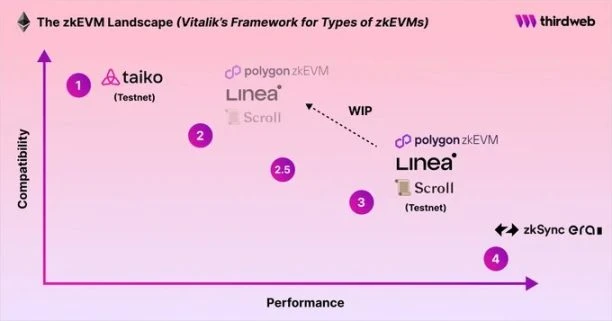
Vitalik has a great framework showing the pros and cons of each type, from Ethereum equivalent (Type 1) to EVM compatible (Type 4). The main tradeoff is EVM compatibility vs. performance:
So which zkEVM is the best? We compared the most popular options:
→ Polygon zkEVM (+ 2.0)
→ zkSync Era
→ Line
→ Scroll
→ Taiko
Let’s break them down.
Polygon 2.0 (zkEVM Validium)
In June 2023, Polygon Labs proposed upgrading Polygon PoS to the zkEVM validium.
Polygon PoS has a strong ecosystem:
→ 2B+ TVL (on-chain assets)
→ Tens of thousands of dApps
→ About 2.5 million transactions/day
Migrating PoS to the zkEVM validium will preserve its network effects and low fees without impacting its existing applications, user, and developer experience. But doesn’t Polygon already have zkEVM?
Polygon considers 2.0 (its proposed zkEVM validium) to be a lower-cost, higher-throughput version of its Polygon zkEVM Rollup.
Rollups use Ethereum to publish transaction data and verify proofs, inheriting its security and decentralization. But there are trade-offs:
The downside of Rollup is that publishing transaction data to Ethereum is expensive and limits throughput. Validium provides similar security guarantees as Rollup (ZK proofs guarantee the validity of transactions), but transaction data is provided off-chain.
This gives Validiums two main advantages over Rollup:
Fees are lower because they do not consume expensive Ethereum Gas (block space that stores transaction data)
Higher scalability, as the throughput of Rollups is limited by the amount of transactions that can be published to Ethereum
The trade-off for Validium is that they must ensure transaction data availability outside of Ethereum, which can be challenging. But Polygon PoS’s existing 100+ validators can serve as a highly secure and reliable guarantee of data availability.
So why use Polygon zkEVM?
Polygon zkEVM
Polygon zkEVM is a Type 3 ZK-Rollup. It aims to be EVM-equivalent — which means greater scalability when working with existing Ethereum tooling and clients (by retaining EVM opcode compatibility).
Currently, Polygon PoS (2.0) and Polygon zkEVM rollup are the two public networks of the Polygon ecosystem. This will remain the case after the upgrade: one as a rollup and the other as Validium.
But why not just deprecate Polygon zkEVM?
Polygon 2.0 and Polygon zkEVM complement each other: Polygon zkEVM (Rollup) has slightly higher fees and slightly lower throughput, but provides the highest level of security. This is best suited for applications that handle high-value transactions (such as DeFi).
On the other hand, Polygon 2.0 (zkEVM validium) will provide the highest scalability. This is best suited for applications with high transaction volumes and low fees (e.g. Web3 games, social)
The Polygon zkEVM mainnet was launched in March 2023, and the current TVL on the network is about $54 million. Built on Polygon zkEVM: https://thirdweb.com/polygon-zkevm
zkSync Era
zkSync Era is currently a type 4 zkEVM, though it may add EVM bytecode compatibility over time. Era (its mainnet) was built by Matter Labs and launched in March 2023, with a current TVL of ~$450M and 27M transactions in the past month.
zkSync does not aim to be EVM equivalent, but rather to increase the speed of proof generation through its custom virtual machine (VM). It natively supports Ethereum cryptographic primitives, simplifies testing of Hardhat plugins, and improves user experience through native account abstraction.
zkSync Era uses its LLVM compiler to convert Solidity, Vyper, and Yul code into executable code on the zkSync VM, and plans to be compatible with Rust and C++ in the future. It has a powerful L1-L2 contract messaging system to help developers pass data between contracts on Ethereum and zkSync.
The upcoming zkPorter integration in zkSync will give users the choice of:
- High-security zkRollup accounts, with fees reduced by about 20 times compared to Ethereum
- zkPorter accounts with stable transaction fees and different security models, allowing for flexible user experiences
For data availability, zkSync Era publishes state differences instead of transaction inputs — providing data compression and integration with zkPorter.
As the only type 4 zkEVM on this list, its custom virtual machine enables certain features (as well as increased scalability) on zkSync Era.
For example: zkSync Era enhances the developer experience by natively supporting account abstraction using its custom virtual machine. However, EVM equivalent chains cannot natively support account abstraction, they implement it through Ethereum's ERC-4337.
The downside of type 4 zkEVM is the lack of compatibility - development processes need to be adjusted to build applications on zkSync. Building on zkSync Era: https://twitter.com/thirdweb/status/1666119985520066561
Line
Built by ConsenSys (creator of MetaMask, Truffle, and Infura), Linea is currently a type 3 zkEVM. With native MetaMask wallet and Truffle developer toolkit integration, its Alpha mainnet was launched in July 2023 and has accumulated $50 million in TVL.
Linea is unique in that it is able to execute unchanged native bytecode according to the Ethereum Virtual Machine specification. Its goal is to provide a type 2 zkEVM in the future, ensuring near-full compatibility with Ethereum while maintaining scalability.
Linea does not use a transpiler or custom compiler. It directly uses Solidity compiled bytecode to generate ZK proofs for smart contracts, reducing the risk of errors and hacker attacks. For users, this means Ethereum-like security with much lower transaction costs.
Built on Linea: https://thirdweb.com/linea
Scroll zkEVM
Scroll is a zk-Rollup on Ethereum, currently a type 3 zkEVM, with plans to transition to type 2.
Its long-term goal is to prioritize EVM compatibility and decentralization over fast ZKP generation, moving to a type-1 zkEVM.
A successful Type 1 is the ultimate form of EVM compatibility, decentralization, and scalability — essentially replicating Ethereum L1. But as we’ve seen from Ethereum itself, this is much harder to achieve.
Currently, Scroll’s alpha testnet is a type 3 zkEVM and is open to the public. Building on Scroll: https://thirdweb.com/scroll-alpha-testnet
Taiko
Similar to Scroll, Taiko is a generalized zk-Rollup that aims to be a type-1 native zkEVM. Taiko takes a different approach to being type-1 than Scroll, prioritizing decentralization over speed from the start:
Scroll is gradually increasing EVM compatibility (starting with type 3 testnets) and making its sorter and prover more decentralized when the mainnet launches. Despite the slower ZKP generation, Taiko decentralized these components from the beginning and maximized EVM compatibility.
Taiko's type 1 testnet is currently available. Building on Taiko: https://thirdweb.com/taiko-grimsvotn-l2
Using Vitalik’s framework: → Taiko: Type 1 (testnet launch) → Polygon zkEVM: Type 3 (mainnet launch + plan to migrate to type 2) → Linea: Type 3 (mainnet launch + plan to migrate to type 2) → Scroll: Type 3 (testnet launch + plan to switch to type 1) → zkSync Era: Type 4 (mainnet launch)
In summary, L2 development and adoption is key to the future of Ethereum + solving blockchain scalability issues. Each zkEVM has unique advantages and faces unique challenges, but they all play a key role in enabling an accessible web3 ecosystem.
Source link