


Today I will talk about a relatively good project, which is also in the oracle track. I have always emphasized that chainlink is very important, and I have emphasized it many times in various places (in DEFI projects, WeChat groups, interactive Q&A, etc.). Now you can see that link's growth is still very strong, right? So if you hold on to something valuable, it will definitely increase. The one I am talking about today is API3, which should have made some improvements in the oracle field. The current market value is more than 90 million US dollars, ranking 220+. You must know that link's market value is already 4 billion, so api3 still has at least 50 times of growth imagination space, so let's see if there is any.
Introduction
API3 is a data oracle that enables APIs to provide data directly to blockchain applications without the need for third-party middlemen. They use dAPI to represent the new generation of decentralized APIs.
dAPI is a secure, cost-effective solution that provides traditional API services to smart contracts in a decentralized manner. It consists of the following elements:
● Multiple APIs, where the term “API” refers not only to technical interfaces but also to the services provided by real businesses;
● A decentralized network of first-party oracles, i.e. oracles operated by the API providers themselves;
● A decentralized governance entity to oversee the oracle network.
API3 is the native token of the project. Current use cases of API3 include:
Insurance Staking Pool: API3 stakers provide security insurance to oracle users, protecting against potential financial losses due to oracle failures. Stakers will be able to receive staking rewards paid in API3 tokens.
Governance: API3 holders can propose governance proposals and vote on them.
Oracle flaws
Decentralized oracle network solutions use third-party oracles because API providers are generally unable to operate their own oracle nodes. This positions third-party oracles as expensive middlemen and creates an additional attack surface. (Problems with third-party oracles: fragility, middleman taxes, ineffective redundancy, lack of transparency)
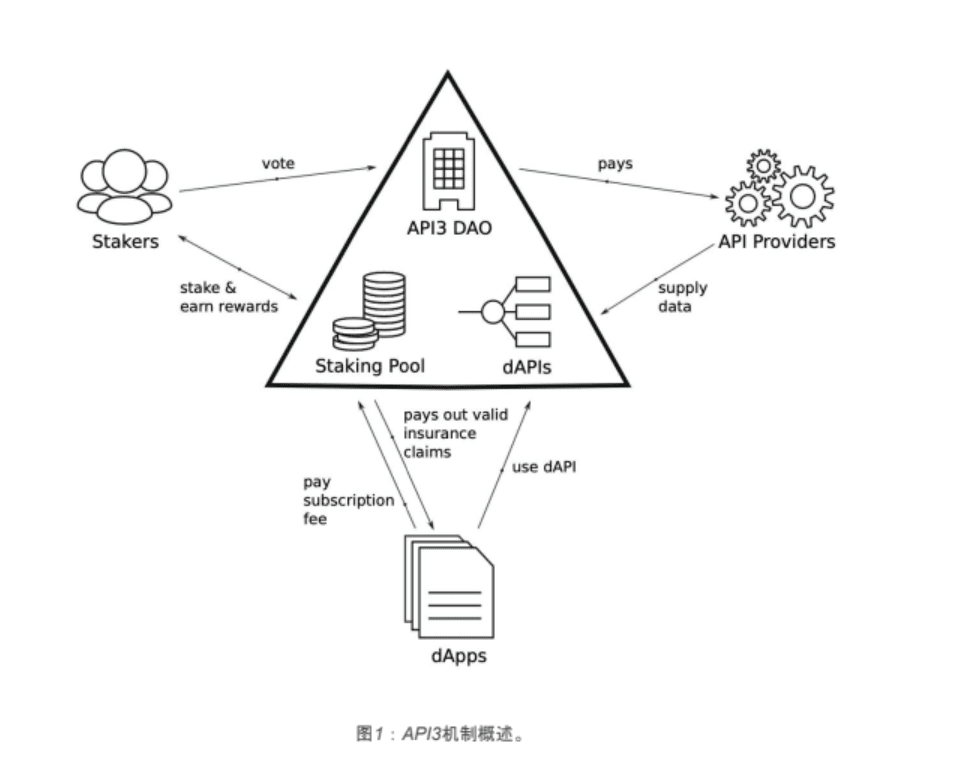
To eliminate these issues and enable API providers to further participate in the ecosystem, API3 data sources will consist of first-party oracles operated by API providers. This will be made possible by Airnode, a fully serverless oracle node designed to require no expertise, maintenance, or repair from API providers. The resulting dAPI will be cost-effective and secure against attacks from third parties in the middle.
The project consists of the following main components:
Beacons: Lightweight first-party data streams that reduce costs and scale data access in Web3.
Airnode: Web3 middleware that connects web APIs directly to smart contracts. One way to look at Airnode is as a lightweight wrapper around a web API, enabling it to communicate with smart contract platforms without the overhead or hassle of paying for tokens. In terms of the level of involvement required by API providers, using Airnode can be likened to using an API gateway that makes APIs accessible over the web, rather than operating a blockchain node as a sideline. In fact, our goal is to make Airnode as ubiquitous and commonplace for APIs as using an API gateway, which will enable API3 to use a large number of first-party oracles.
Project Vision
It will allow smart contract platforms to leverage APIs to build meaningful applications in a truly decentralized and trust-minimized manner.
Market demand
As decentralized applications begin to provide meaningful services in areas such as decentralized finance, these applications increasingly need to use traditional web APIs to receive data or trigger events. However, general oracle solutions fail to properly solve the API connection problem because they are too general and misleading.
Project Solutions
In API3, there are no middlemen, and data providers can operate their own nodes and earn profits. This is like Pinduoduo, which has no middlemen and is directly from manufacturers to users. In order to achieve this function, API3 has designed a core component Airnode similar to API gateway. API providers only need to perform some simple DNS configuration like setting up API gateway in cloud service providers to achieve the purpose of directly providing data to smart contracts, and only need to deploy once, and no maintenance is required in the future.
Technical features
Several obvious features:
API service providers directly act as oracles, which reduces the number of middlemen to a certain extent and makes data services smoother and more real-time.
The credibility of API data is provided and guaranteed by the DAO composed of pledgers. Once a problem occurs, API users (dAPPs) can obtain compensation.
The role of the staker becomes a power and responsibility object, weighing the game of rewards and responsibilities
dAPI is a secure, cost-effective solution that provides traditional API services to smart contracts in a decentralized manner.
Project implementation mechanism
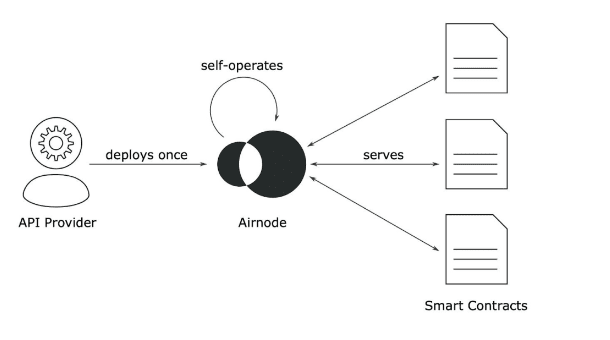
There are four roles here:
1.dAPPs: serving users;
2. Stakers: managers and guarantors. Stakers stake API3 tokens in the staking pool managed by API3, provide insurance premiums, and obtain governance rights of API3 DAO and a share of API subscription fees;
3. API3 DAO: manage API sources and manage staking pools;
4.API provider: provides API data for API3 DAO.
Briefly explain its business process:
1. Stakers stake API3 tokens to the staking pool, provide insurance for the staking pool, and obtain governance rights of API3 DAO.
2. API3 DAO selects better service providers from among many API providers to join the aggregator.
3. dAPP subscribes to dAPI services, pays subscription fees, obtains data or services, and stakers receive a share of the subscription fees.
If there is a problem with the API data (fake or otherwise), the dAPP can obtain insurance claims from the collateral pool, and the stakers pay the price.
Financing
API3 has completed a $3 million private round of financing led by Placeholder, with participation from Pantera, Accomplice, CoinFund, Digital Currency Group, Hashed, and others.
Token Allocation
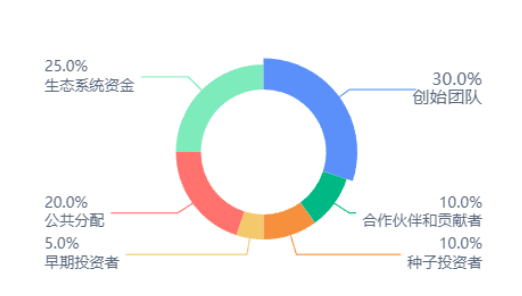
The first issuance time is 2020-12-01, the current supply is 125,790,899 API3, and the circulation is 56,547,601 API3. The current price is 1.2 USD, and the turnover rate is very high. It also exploded yesterday. At the peak, it was 10 USD (in April 21). The team took 30%, and the ecosystem still had 25%. In fact, they took all of it, which is a bit high.

Finally, we conclude that API3 connects decentralized applications with a large amount of data and services provided by traditional Web APIs, thereby expanding the applicability of blockchain without sacrificing decentralization. This will be achieved through dAPIs - fully decentralized and blockchain-native APIs - which will be set up, managed and monetized at scale by API3 DAO.
The API3 solution is designed with a variety of features in mind. One of the most important is security. dAPI does not rely on third-party oracles, which is a constant and significant risk factor in alternative solutions. In addition, the dAPI insurance service provides its users with quantifiable and trustless security guarantees, further solidifying API3 as the most secure solution for decentralized applications to receive API services.
The second quality of the API3 solution is robustness at multiple levels. Airnode uses serverless technology, which is highly resistant to downtime. The API3 oracle is designed to be robust, as it is a stateless node design that is not susceptible to errors or adverse network conditions. In addition, dAPI will be governed by a DAO, which can provide a strong risk mitigation framework by maintaining a self-regulating balance of risk and reward through carefully designed incentives.
dAPIs eliminate middlemen, allowing them to gain a third quality, cost-effectiveness. They do not have to pay a middleman tax, which is a fee paid to third-party oracles to incentivize them to resist attempted attacks. Additionally, data feeds composed of first-party oracles do not require excessive redundancy at the oracle level. By using fewer oracles to achieve the same level of decentralization, dAPIs can save a lot of GAS costs.