


SSV stands for Secret Sharing Validator. It is a concept proposed by two Ethereum developers, CarlBeek and adiasg, in an article discussing the failure of the ETH2.0 validator.
The core concept of SSV is to fragment the verifier's private key and give it to multiple operators, which is equivalent to the logic of multi-signature. After continuous discussion and development, SSV was extended and upgraded to DVT, so SSV is the predecessor of DVT. SSV It is also a technical term, and the ssv_network we are talking about today directly named itself SSV because it is a practitioner of the SSV (Secret-Shared-Validator) concept. This is such a relationship.

Distributed key generation DKG is a cryptographic process that allows multiple machines (multiple operators) to use the same verifier private key. As mentioned before, there are four steps to becoming a POS verification node: apply for certification, pledge ETH, and obtain private keys. key (equivalent to your certificate of deposit) and run the machine. Therefore, to implement DVT, we must first solve how to allow multiple machines to share a private key. DKG allows each participant to own part of the private key, thereby preventing one party from directly accessing and controlling the entire private key.
The private key sharing of BLS signatures is a mechanism that implements multi-party aggregate signatures, that is, it can combine all the signatures in the block into a single signature. Because DKG allows the private key to be held by multiple fragments, then when a signature is required, The signatures of multiple people are aggregated into one signature, just like a key being split into four parts and kept separately. When it is necessary to open the door, the four pieces are put together and glued together before being inserted into the keyhole.
Multi-party secure computing MPC was proposed by Yao Qizhi, the founder of the famous Tsinghua Yao Class, in 1982. It means that participants use private data to participate in confidential calculations and jointly complete a certain computing task without revealing their own private data. Everyone should also follow the MPC wallet concept. We are all familiar with it, so MPC technology is also needed to allow each private key fragment holder to complete the reconstruction of private key generation without leaking their own data.
Everyone should be familiar with Istanbul Byzantine Consensus IBFT. A node of DVT is arbitrarily selected as the leader, responsible for block proposals and other work. If the vast majority of validators believe that the block is valid, it will be added to the zone. in the blockchain. If the leader selected during the consensus process goes offline, IBFT will perform a fast leader replacement and select another DVT node to assume that role
We understand DVT technology. ssv_network is a decentralized validator DVT infrastructure based on this implementation. It is a layer 0 solution and thus becomes the decentralized infrastructure of the Ethereum POS layer. It enables the validator to Run by multiple operators, rather than just 1 which is the current industry standard, on which developers choose to build their dapps and protocols.
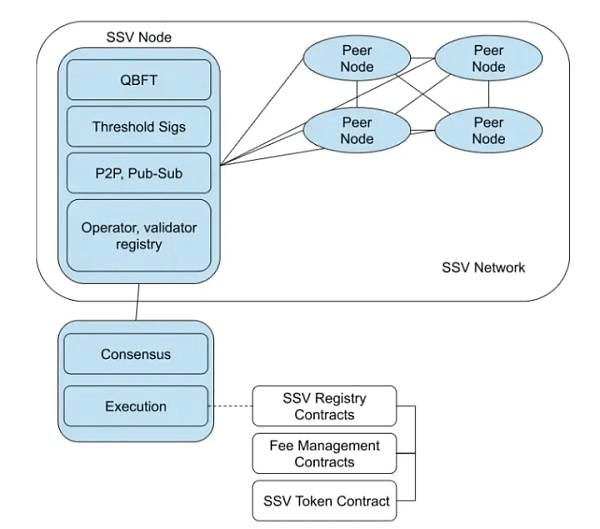
It combines the complete completion process of staking as follows, which is mainly divided into 3 steps. The pledger must first select a group of 4 operators as my escrow, and then send my private key as the verifier to KeyShares to perform the DKG just mentioned. Wait for the process, and finally send a broadcast to a group of operators I selected to register them into the network, and their economic model is also integrated here, and pledgers can pay SSV tokens as management and operation fees.
Finally, to summarize at the market level, although Lido is currently the leader in the field with a very low pledge threshold, centralization in web3 is the original sin. Lido must solve this problem. SSV is the head project of the decentralized node verification protocol. The current LIDO pledge address and total number: 17.6 million ETH, with a total value of 31.4 billion US dollars, while the current market value of SSV is only 300 million US dollars, and the role of the token is the same as that of most pledged DAOs, which is the role of governance, and the role of users in You need to pay when using a validator, and this fee is paid with SSV. 80% of the SSV fee paid will go to the validator and 20% to dao.
So as far as SSV technology is concerned, this must be the general trend. After SSV matures, LIDO will definitely turn to SSV technical solutions, because once the centralized service provider runs away, it will be a devastating blow to him, so SSV and LIDO are not mutually exclusive. SSV serves these pledge service providers. This is a positive cycle, so as long as SSV works hard, the current market value range is still a low valuation range, because there will be more and more people in the future. More ETH will be pledged, and this is also true from the data.