


Today we are going to talk about a popular L2 project that was recently launched. In fact, we talked about it before when we talked about BITDAO. It was launched a few days ago, and its market value skyrocketed. It is Mantle, and its current market value is about 1.7 billion US dollars, ranking 30+ in market value, completely surpassing ARB and OP which are also L2. So what advantages does it have that can make its market value higher than the two kings of L2? Let’s take a look today.
Mantle is a Layer 2 solution based on Ethereum. It adopts a unique modular design concept and successfully achieves a major breakthrough in scalability. Mantle is not only an improvement on Ethereum's Layer 2 solution, but also a promotion and upgrade of the entire Web3 ecosystem. Its modular architecture, data availability, multi-party computing, and decentralized sorting functions are being combined into a promising technology stack, injecting new vitality into the blockchain industry.
Rollup is currently the most mainstream Layer 2 expansion solution. It achieves expansion by submitting a summary of transactions on the chain, and can maintain the security and decentralization of the chain. However, Rollup still cannot perfectly solve the blockchain trilemma. For example, Optimistic Rollup uses an optimistic execution method, which requires waiting for the execution of transactions off-chain before submitting the status on the chain, so the processing speed is slow. Although ZK Rollup avoids executing transactions off-chain, it requires the calculation and verification of zero-knowledge proofs, so it requires more computing resources.
Mantle is also a Layer2 expansion solution for Rollup, but it is an upgrade based on the original Layer2 solution and introduces modular design into Layer2 technology for the first time. Mantle divides the blockchain network into three layers: Ethereum handles settlement and consensus, EigenLayer is used for data availability, and Mantle handles execution. This layered design can greatly increase network speed and reduce gas fees. At the same time, Mantle combines a modeled framework with improved data availability features to re-examine the interactions between many moving parts in the blockchain, including data availability, performance, and security. Unlike other Layer2 solutions, Mantle's modular architecture not only promises super scalability, but also guarantees top-level security.
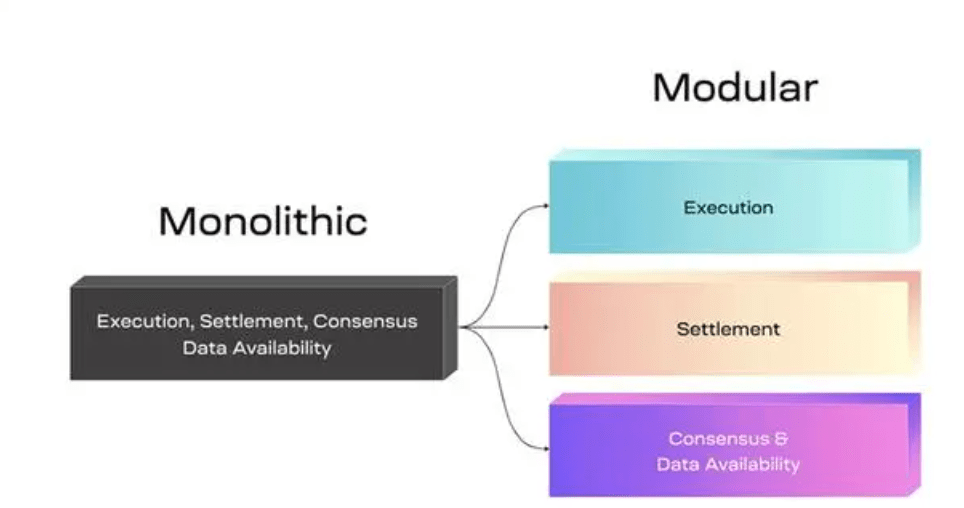
Modular architecture
Mantle Network adopts a modular approach to chain design. While a single blockchain performs transaction execution, consensus, settlement, and storage at the same network layer, these processes are handled by separate modules on the Mantle network. In its initial mainnet version, Mantle Network acts as a smart contract Rollup with modular data availability. Therefore,
• Mantle’s execution layer provides an EVM-compatible environment for transaction execution, where the sequencer generates blocks on L2 and sends state root data to L1
• Consensus and settlement are performed on L1 Ethereum
• Data availability services are provided to network participants via Mantle DA powered by EigenDA technology, which stores callback data that would be published to L1 in a traditional rollup
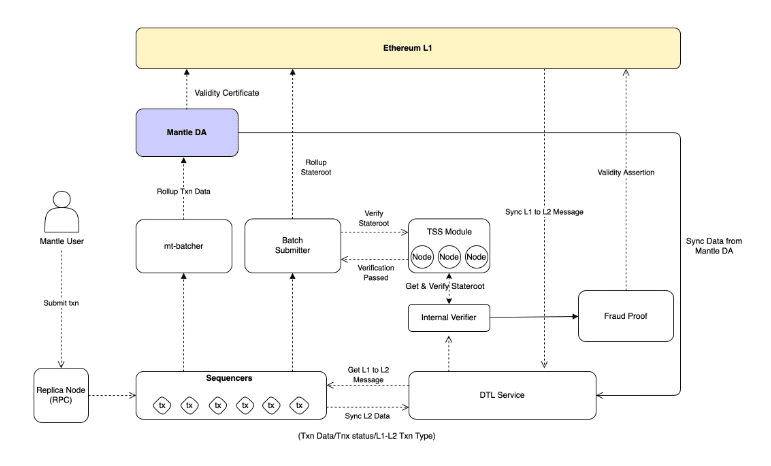
How is Mantle different from other L2 solutions?
Modular Data Availability: By using EigenLayer, Mantle is able to increase transaction throughput beyond traditional L2. Accessible data availability also means that Mantle can increase throughput without compromising security and reducing node operational overhead. This reduces validator processing requirements and promotes decentralization.
Multi-party computation (MPC): Mantle uses MPC to minimize the trust risk of L2 execution results. Using the threshold signature scheme (TSS) technology, dedicated nodes contribute multi-party signatures to improve the correctness of off-chain transaction execution results. It enables the challenge period of withdrawal to be shortened.
Decentralized Sequencer: Mantle will decentralize its sequencer to provide secure and trustless block production. By rotating a permissionless set of sequencers, Mantle will reduce the potential for single points of failure or censorship on the network. Mantle will decentralize its sequencer over time to provide secure and trustless block production.
Mantle also solves two major problems facing optimistic rollups.
The first is the single point of failure that a highly centralized sorter can cause.
The second is the current 7-day fraud proof challenge period. By implementing multi-party computation (MPC), Mantle reduces the challenge period to 1-2 days. Passing nodes will independently verify blocks and increase overall confidence.
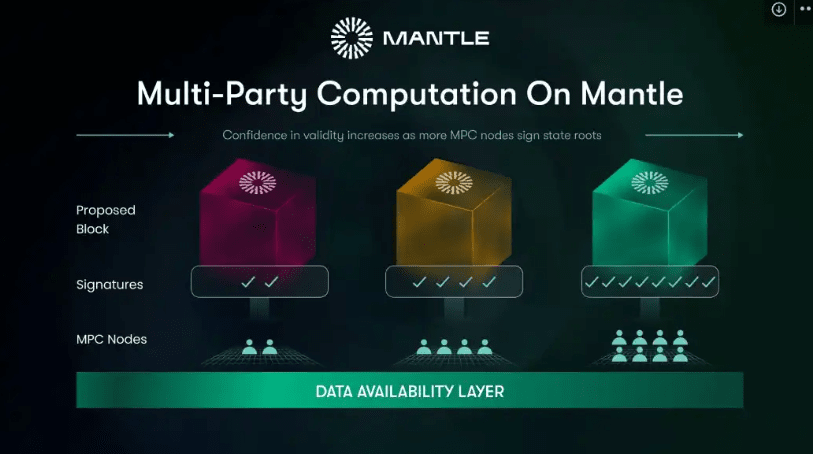
Node roles in Mantle:
Sequencer
Receive and record transactions sent by users in real time.
Produce blocks on L2.
Aggregate transactions to produce a batch with an execution state root.
Get blocks verified by the MPC network.
Broadcast block data (L1 and L2) across the network.
Multi-party computation (MPC) nodes
"Sign" the transaction batches generated by the Sequencer and send them to L1.
After verification, batch multi-party computation is broadcasted over the L2 network.
Rollup Validator
Synchronize aggregated data from Mantle's trusted sorter.
Verify the state root committed by the Sequencer on L2.
A fraud proof is initiated when invalid state data is found.
Provide aggregated data to users.
DA Node
Select the replica responsible for storing Mantle transaction data so that it is ready for access when necessary.
The commitment is made by signing the block data they provide using the BLS signature scheme which guarantees its availability. These signatures are verified by the EigenDA contract on Ethereum.
BITDAO
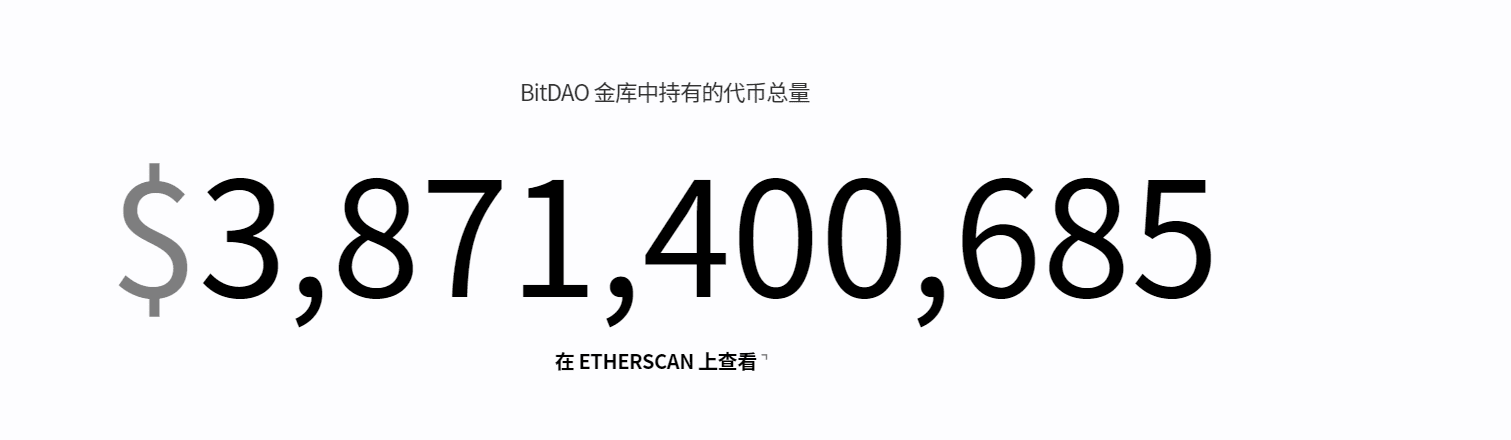
As the largest DAO organization at present, it is also the son of Bybit. Its treasury has 3.8 billion US dollars in reserve assets and raised 230 million US dollars in mid-June 21. Mantle is also the first project recommended by BIT. It is not an exaggeration to call it the grandson of Bybit. The grandfather is rich, the father is rich, and the grandson can be poor.
team
Bybit was founded by Ben Zhou, CEO of Bybit, and other well-known members of the crypto community (such as Sreeram from EigenLayer, Dow Jones, and Cooper Midroni) to solve the scalability problem of Ethereum. So with the CEO leading the team, this project should not be underestimated.
ecosystem
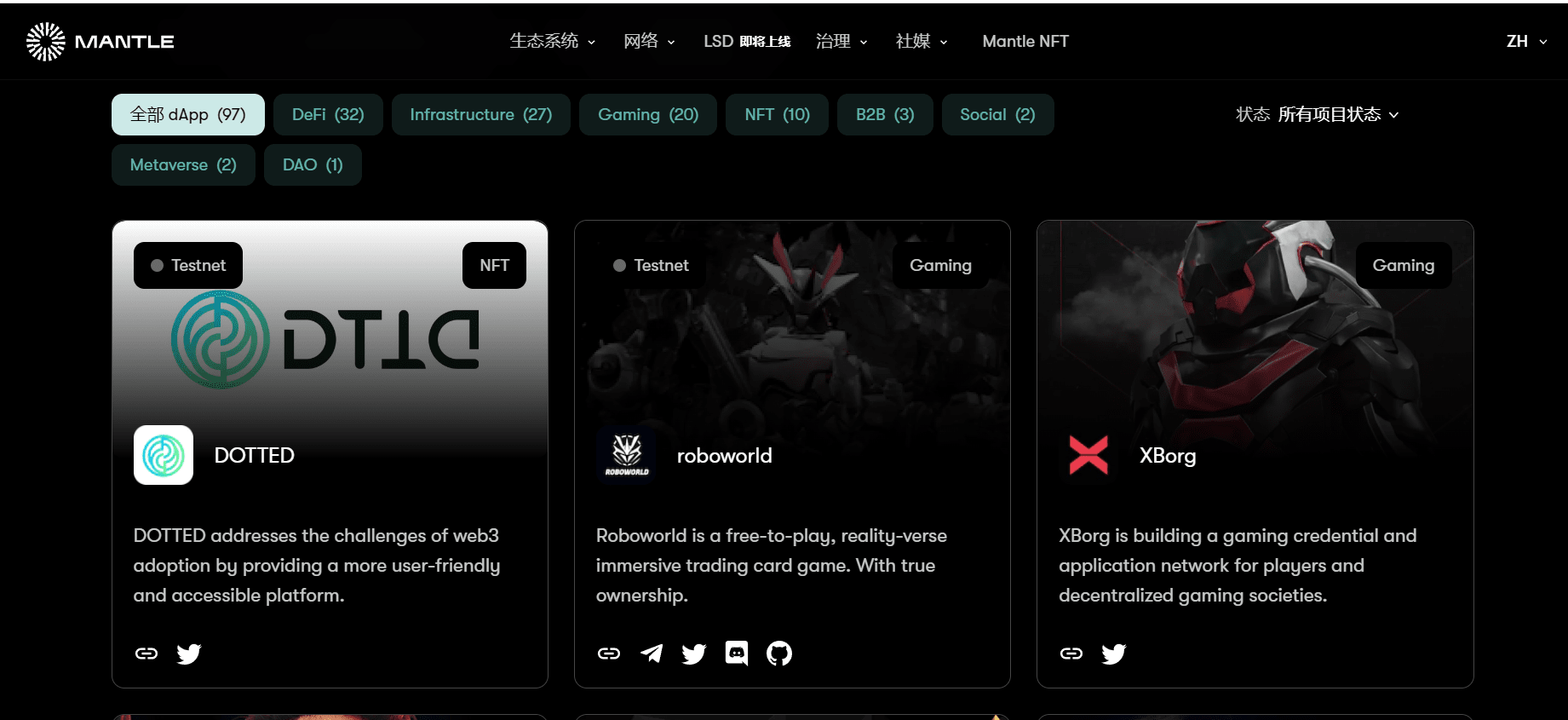
Mantle currently has 97 projects referenced on its ecosystem page (https://mantle.xyz/ecosystem). A large portion of them are in the gaming space, with only a few DeFi/infrastructure projects.
Token Allocation
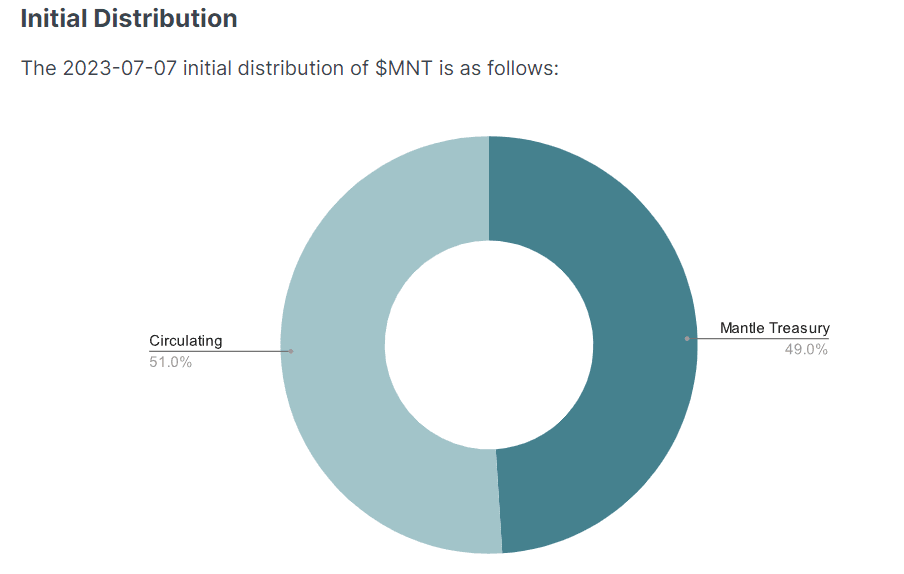
The first issuance time is 2023-07-17, the maximum supply is 6,219,316,768 MNT, the circulation rate is 29.64%, and the opening price on the first day is $0.25; the current price is $0.52, which has doubled, but the current token distribution is still relatively general, and most of them are still in their own hands. Because there are still several proposals, the final distribution will be determined.
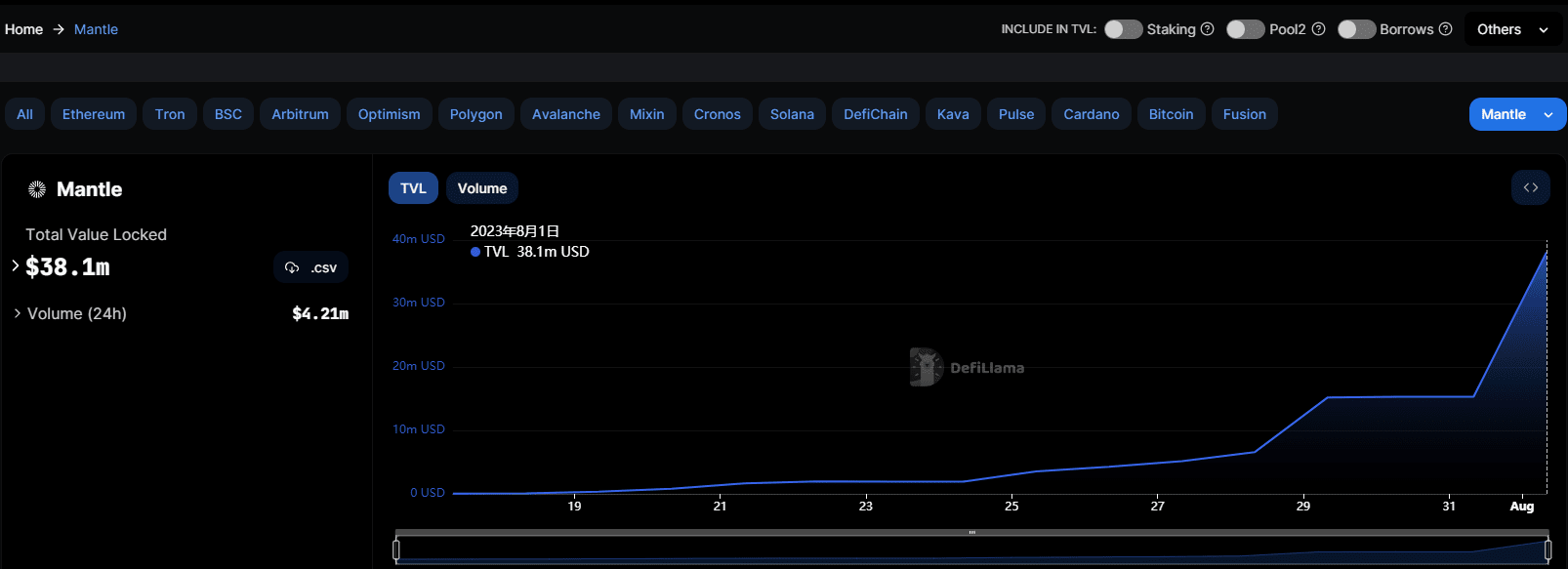
Currently, the TVL on the chain has also increased sharply, reaching 38 million US dollars.
Finally, we conclude that although the project has a rich father and it is more convenient to do things, the competition in the L2 track is still very fierce. OPtimism and Arbitrum use OPtimistic rollup, and Zksync and Starknet use Zk-Proof. Base built on OP Stark, EVM-compatible chain Linea launched by Consensys, Zk-EVM launched by Polygon, etc., and the launch of L2 is essentially to improve the scalability of ETH and reduce costs. Although you have made some innovations based on L2, the gap is not big at present. You have fallen behind several kings of the same level in terms of applications and on-chain data, so this road is still relatively long, and your current market value is already very high in L2, so from the current fundamentals, it is beyond expectations. At least I think it is a reasonable range that the market value cannot exceed OP, that is, OP is currently 1 billion US dollars, so the price of the currency is cut in half, which is a more reasonable price range.