


Today we continue our AI special. We have talked about several AI projects. Let’s review them. The first one is AGIX, which is an AI platform. It is not bad. Then there is TAO, which is bitsensor focusing on the ML field. It is also good. The team has been working hard silently. Then there is FET. I think its positioning is vague and general. Then there is NMR, which is a very good and imaginative new management model for hedge funds. Then there is Unibot, a Telegram project that is more like MASK. If we compare it with MASK’s 270 million, it already has 330 million. However, Telegram has more users than Twitter, so 100 million is also in the normal range. Let’s get back to the topic. The project we are talking about today is a machine learning platform.
Cortex-CTXC currently has a relatively low market value of only 30 million US dollars, ranking 380+. So if it has great potential, then a 10-fold increase to 300 million US dollars is a very simple thing, right? A 100-fold increase would be 3 billion US dollars, which is a project with great imagination.
1 Introduction
The current challenge with executing machine learning programs on traditional blockchains is that virtual machines are extremely inefficient when running any significant machine learning model. As a result, most people believe that running AI on blockchains is impossible.
The goal of Cortex is to build a truly decentralized AI autonomous system that provides the most advanced machine learning models on the blockchain, which users can infer using smart contracts on the Cortex blockchain. One of the goals of Cortex is to implement a machine learning platform that allows users to post tasks and submit AI DApps on the platform.
The Cortex project adds support for artificial intelligence algorithms to smart contracts by expanding the underlying instruction set of smart contracts and enhancing the storage layer, allowing anyone to add artificial intelligence capabilities to smart contracts. At the same time, Cortex also proposes an incentive mechanism for collective collaboration, allowing anyone to submit and optimize models on Cortex, and model contributors can be rewarded.
The Cortex project goes a step further on the basis of Ethereum, breaking the barriers between blockchain systems and artificial intelligence, and introducing unprecedented functions such as classification, prediction, and generation of AI models to blockchain systems. Greater breakthroughs bring more challenges. In order to cope with the burden of artificial intelligence applications in blockchain systems in terms of computing, storage, and networking, Cortex has proposed a series of solutions:
• Implement MRT model conversion technology to fix traditional AI models;
• Proposed Cortex virtual machine CVM to implement on-chain AI inference computing;
• Introducing TorrentFS P2P file storage system to solve the storage problem of AI models and data;
On the other hand, since AI technology requires large-scale data and massive computing power, which have a clustering effect and are mainly controlled by large companies, a monopoly trend will be formed in the foreseeable future and has already taken shape. To this end, the Cortex system provides a decentralized AI model market, where users can share AI models and gain benefits from them, allowing more people to freely enjoy the power of AI technology.
2 Core Architecture
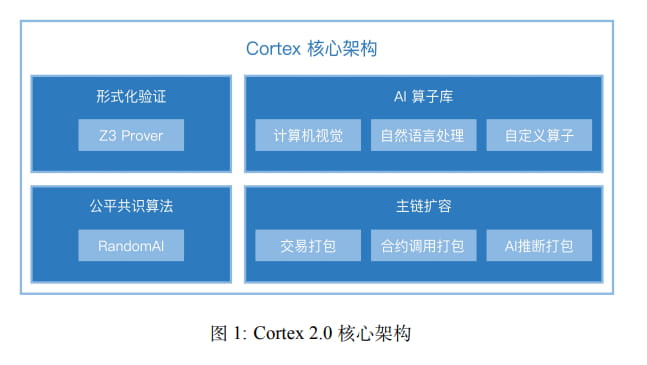
In order to build a more complete public chain that supports AI models, Cortex 2.0 needs to optimize AI model inference and public chain. On the one hand, it needs to meet the correctness of AI model execution on the chain and the completeness of its functions. On the other hand, it needs to optimize the existing Cortex chain in terms of consensus and performance. The core architecture of Cortex 2.0 is shown in Figure 1, which mainly includes the following technical breakthroughs:
1. Formal verification: The AI operator is formalized and verified for correctness through the Z3 prover [10] to ensure that the inference results of the AI model by all nodes in the Cortex system are consistent and correct.
2. AI operator library: Further improve the underlying operator library of AI models supported by Cortex, so that Cortex can realize inference work of more AI models.
3. Consensus algorithm: Design the RandomAI proof-of-work algorithm to further improve the decentralization of Cortex.
4. Performance improvement: Through zero-knowledge proof technology, we will gradually realize the packaging of transfer transactions, smart contracts, and AI inference, and improve the performance of the Cortex main chain.
2.1 Formal Verification: Z3Prover
Since the instruction execution and calculation results in the smart contract virtual machine on the blockchain are part of the consensus mechanism, this requires that the instruction operations in the virtual machine are deterministic and reproducible. Cortex 1.0 integrates the AI model inference operation as a basic instruction (INFER | IFNERARRAY) into the virtual machine execution engine (CVM), which derives the two important characteristics that AI inference operations should have on the blockchain: determinism and reproducibility.
2.2 On-chain AI inference engine: a more complete operator library
The CVM Runtime project library defines a series of operator sets and their implementations, and gives a strict mathematical description definition, stipulating that the operator outputs a deterministic result according to the operator calculation logic under a given input. The supported operator set refers to the existing mainstream deep learning framework architecture, combined with the network structure involved in the commonly used AI model, and includes necessary operator sets such as convolution, full connection, activation function, etc. At present, the CVM Runtime model execution framework developed by Cortex Labs can support computer vision CV research such as image classification and object recognition, as well as some natural language processing NLP tasks.
2.3 Fair Proof of Work: RandomAI
The idea of one machine, one vote in the cryptocurrency community has not been realized. The reason is that the special design of ASIC has greatly improved the computing acceleration ratio. The community and academia have explored many memory bottleneck algorithms to make mining more friendly to graphics cards and CPUs without spending a lot of money to buy professional mining equipment. The results of community practice in recent years show that Ethereum's DaggerHashimoto and Zcash's Equihash are relatively successful algorithms that practice the graphics card priority principle.
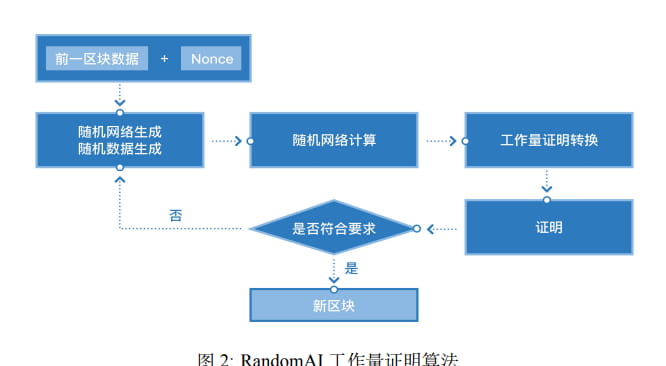
The Cortex chain will further adhere to the one-machine-one-vote priority. The Cortex 1.0 version adopts a proof-of-work scheme based on CuckooCycle [18] to narrow the gap in acceleration ratio between CPUs and mining machines. In the Cortex 2.0 version, the RandomAI proof-of-work algorithm will be examined and designed to further ensure the fairness of the consensus algorithm.
2.4 Main chain expansion: zero-knowledge proof trilogy
In the field of blockchain, in order to ensure the decentralization and security of blockchain systems, performance bottlenecks have always troubled relevant researchers. In order to improve the performance of blockchain, the main solutions currently include replacing consensus protocols, DAG, zkRollup, sharding, side chains, etc. Due to the limitations of the CAP theorem of distributed systems, directly expanding the blockchain will be a trade-off, making a compromise between system consistency, availability, and durability. Cortex Labs conducted in-depth research on the expansion problem, hoping to improve the performance of the network without sacrificing core security assumptions, and finally selected the zkRollup expansion solution.
Overall structure
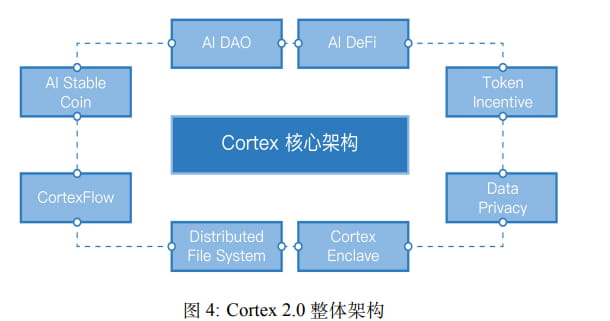
In order to better serve AI model developers and AI application developers, Cortex 2.0 provides more abundant technical components in addition to the core framework, forming a complete AI framework and application ecosystem to help users better enjoy the convenience brought by the AI blockchain.
project team
At present, it is a Chinese project. CEO Chen Ziqi graduated from Tsinghua University with a bachelor's degree in civil engineering. He later studied in the United States and obtained a master's degree in civil engineering from Carnegie Mellon University and a master's degree in computer science from the University of California, Santa Cruz. In the birthplace of early AdaBoosting and Online Learning, he studied machine learning theory and various algorithm applications, including Go algorithms, under the tutelage of David P. Helmbold. He once worked as a chief research scientist at SFTC in the United States, responsible for finite element mesh generation methods for aerospace and weapons research and development. With first-line e-commerce entrepreneurial experience and blockchain industry experience, he is the founder of Waterhole.io Beijing Suishi Technology Co., Ltd. He is proficient in mining pools, computing power, wallets and other businesses, and has a deep understanding of mining machines, consensus algorithms and public chain ecology. He provides computing power for cryptocurrencies such as Bitcoin, Ethereum, and Zcash.
CTO was recommended to the Department of Computer Science at Tsinghua University through physics and biology competitions, and obtained a bachelor's and master's degree. He is an expert in distributed systems. He has worked at Baidu and Alibaba, and is the architect of a search engine (so.com) and recommendation engine with a daily PV of over 100 million. He is a serial entrepreneur and has worked in many startups, involved in search engines, recommendation engines, artificial intelligence, financial technology and other fields. His first company, Wolong Cloud, was acquired by Alibaba. Later, he joined Beijing Machine Learning Information Technology Co., Ltd. as CTO, developing systems such as recsys, chatbot, and medical image recognition. Later, he joined Pony.ai, an unmanned vehicle startup, and the angel round has received investment from Sequoia and IDG. He has served as the chief scientist of the Bit Fund, a blockchain researcher, a consultant to many blockchain technology companies, an early investor in Bitcoin and Zcash, and an investor in Bitfinex, the world's largest Bitcoin exchange. He has a strong interest in quantum computing, nuclear fusion and computational neuroscience.
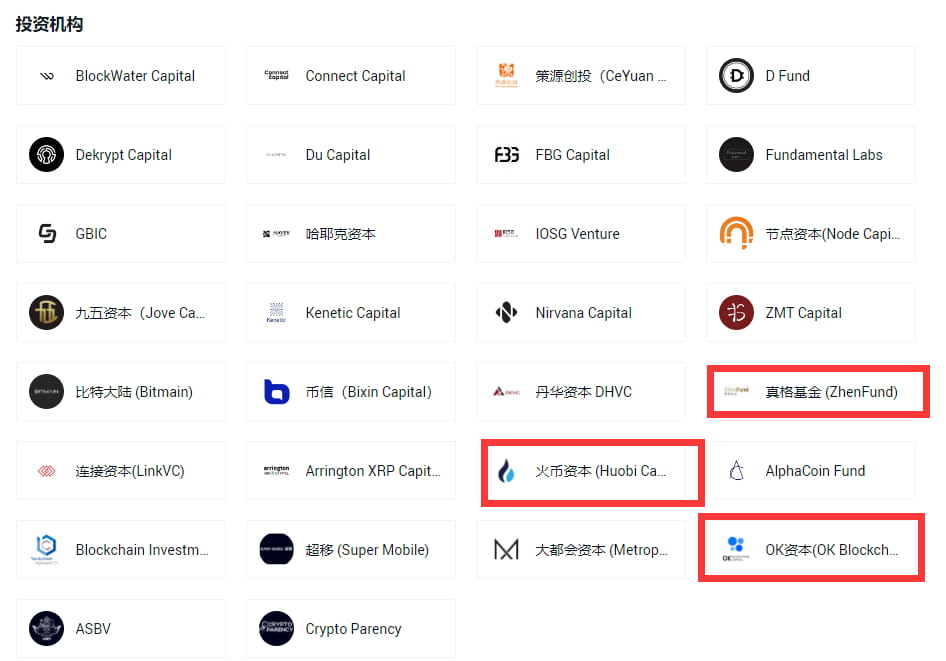
Financing
This year, Cortex received $35 million in Series B funding. The Series A funding has not yet been found.
Token Allocation
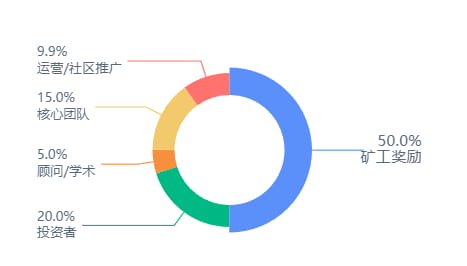
The maximum supply is 299,792,458 CTXC, and the circulation rate is 68.39%. The first issuance time was 2018-04-17, and the crowdfunding price was $0.5800. The current coin price is $0.15. The peak was $2.4 in 2018. Their team took about 15%, and the operation and promotion took 10%, which is about 25%. This ratio is not too much, but not too little.
Finally, let's summarize. The current market value of Guoran's AI blockchain project is still relatively low. They received 40 million US dollars in financing, and now the market value is only 30 million US dollars. The current price is even lower than the ICO price in 2018. However, the progress is relatively slow at present. The current AI projects generally progress slowly. Give it some time. At least for now, this one is in a value trough.