


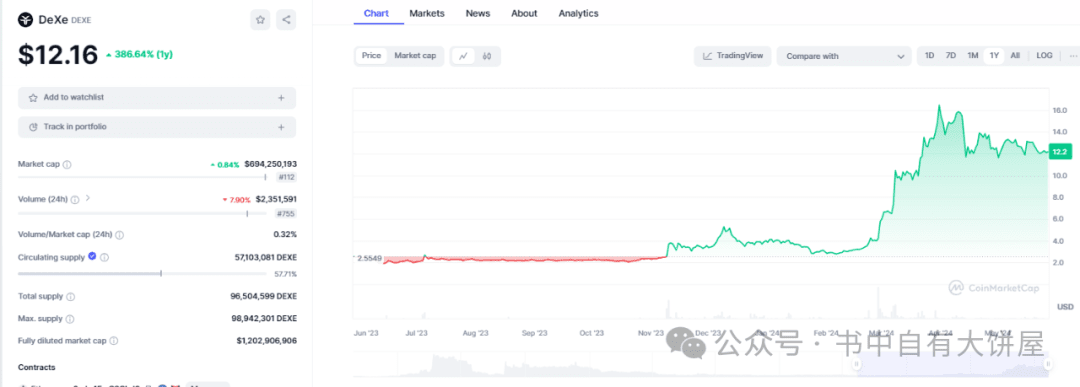
Today we continue to look at the project, which also came out of the last bull market and has now entered the top 200. It currently has a market value of 700 million US dollars and ranks 112th. It is also a DAO solution project called Dexe. It has risen 7-8 times from the bottom range. Let's see if it works.
1. Vision
1. True decentralization
Today’s DAOs tend to favor centralized control when managing their treasuries. Dexe is paving a path for DAOs to manage their own treasuries, driving development through innovative automation and transparent proposal execution mechanisms. Dexe is moving away from a situation where multi-signature power is held by a few people.
2. Meritocracy vs. Plutocratic
In Dexe's vision, the number of tokens does not completely determine power. Instead, Dexe has designed a system that gives diminishing returns to voting rights as holdings increase, ensuring that no single entity can dominate. In addition, Dexe amplifies the voices of proven experts (who can receive delegated votes from the community and the treasury), but constrains them through duties.
3. Incentive Model
Every member of a DAO should feel that their time and efforts are meaningful.
4. Seamless infrastructure
DeXe Protocol DAO has carefully created a smart contract library to make it easy for users to create DAO contracts.
2. Introduction
DeXe Protocol (“the Protocol”) is an innovative open-source DAO builder with a library of over 50 contracts that is continuously developed and enhanced by the community and contributors. The DeXe Protocol DAO governs the Protocol with the goal of creating and advancing cutting-edge solutions for developing functional, transparent and decentralized DAOs, and building efficient decentralized governance mechanisms.
This contract library includes comprehensive governance contracts, multiple voting models, reward distribution, decentralized treasury management, token delegation, various proposal templates, execution contracts, parameter settings, the ability to integrate custom proposals and custom voting systems, etc. These smart contracts naturally integrate together like building blocks of high-level builders.
Every smart contract on DeXe Protocol is open source. Therefore, independent teams and developers can take any part of the protocol and implement it in their own way, making the use cases endless.
3. Proposal Process
All must go through a proposal process, which generally includes the following steps (specific details may vary):
1) Initiation phase
Any DAO member who has enough governance tokens in their wallet can submit a proposal. The proposal must include:
- Short title;
- A concise description of the proposal;
- Other parameters specific to each proposal type.
2) Discussion and voting phase
Once a proposal is published, DAO members can vote on it. Members must vote on a proposal before accessing the current voting results to prevent bias in the decision-making process.
For a vote to be considered successful, both of the following conditions must be met:
- Achieve a minimum quorum according to preset settings;
- The majority voted “in favor of the proposal”.
3) Validator voting (optional)
Your DAO may need a second round of voting, conducted only by current validators.
4) Execution
Once the main voting phase and validator votes are complete and the above approval conditions are met, execution can be performed through the relevant execution contract. To initiate the execution, one of the DAO members should find the accepted proposal and execute it. This requires a transaction, but the DAO can set a small reward to cover the transaction fees of executing the proposal.
5) Reward Distribution
If the DAO setup includes rewards for voting and creating proposals, these rewards will be distributed after execution and need to be claimed.
Off-chain operations
Certain proposals cannot be implemented through transactions alone and may require off-chain operations. These operations may include involving third-party experts, such as conducting audits, involving lawyers, developers, etc.
4. Technical Architecture
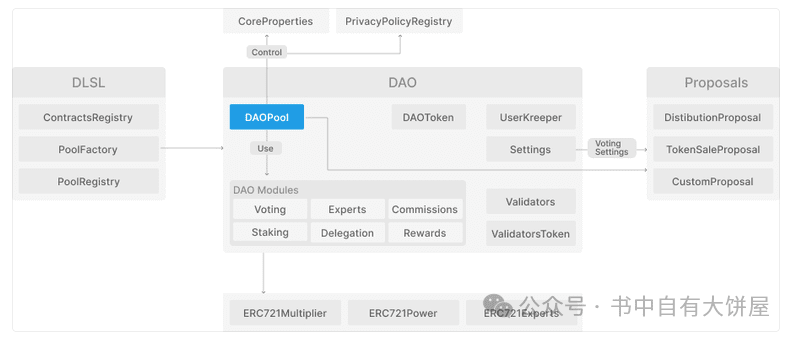
Pool tokens determine membership in the DAO community, giving users the right to vote and participate in the collective decision-making process. In addition, token holders can propose ideas, which are approved or rejected by other DAO members (i.e. governance).
DLSL
This is the meta level where all contracts and DAOs are recorded and DAOs are created through the protocol.
- ContractsRegistry - A smart contract registry used by all DAOs built through the protocol.
- PoolFactory - Where new DAOs are created.
- PoolRegistry - A registry of all DAOs created through the protocol.
KNIFE
Once the DAO is created through the PoolFactory smart contract, it is deployed to the DAO module of the Dexe’s smart contract.
- DAOPool - the central governance smart contract for every DAO.
- DAOToken - The DAO decides on the creation and registration of tokens for applications/creations.
- UserKeeper - Registry of DAO user wallets.
- Settings - Contains all current settings for the DAO (can be changed via proposals).
- Validators - A registry of validators for this DAO.
- ValidatorsToken - Validators earn tokens for validator-only voting.
DAO Module
Inside the DAO, there are six main processes, divided into six smart contracts:
- Voting - The contract that manages voting and its various aspects.
- Experts - Contains important meritocracy rules and mechanisms in the DexeDAO governance model.
- Commissions - Incentives only work if everyone is compensated fairly and money flows well; it’s the smart contract that contains the fee rules.
- Staking - Smart contract that tracks staking schedule and rewards.
- Delegation - Smart contracts that track complex delegation formulas, making efficient governance possible and rewarding.
- Rewards - Smart contract focused on tracking and correctly distributing rewards.
suggestion
When the DAOPool smart contract performs a voting function, the internal logic turns to the proposal module. The Settings smart contract also participates through its voting settings component.
- DistributionProposal - Most types of fund distributions (from salary compensation to partnership investments) go through this smart contract.
- TokensaleProposal - Token sales have complex mechanics that require a separate smart contract to manage them.
- CustomProposal - DAO members are free to define new types of proposals, and this smart contract helps them do that.
External Tokens
DAOs can be governed by tokens, NFTs, or both. The following smart contract modules are specifically designed for them.
- ERC721Multiplier - A generic voting power multiplier for governance NFTs (as ERC-721 tokens) is defined and documented here.
- ERC721Power - Depending on the NFT holder's state and behavior within the DAO, the actual voting power of their governance NFT can vary, which is defined and recorded in this smart contract.
- ERC721Experts - Special voting rights to manage expert sub-DAOs when applicable.
Safety
The protocol has been audited by well-known security companies, including Cyfrin, CertiK, Ambisafe, Hacken, and multiple audits by developers associated with the protocol development. Reports of these audits can be viewed. The protocol contract library has been through more than 1,000 unit tests, integration tests, and simulation tests, achieving 100% coverage.
5. Contract Structure
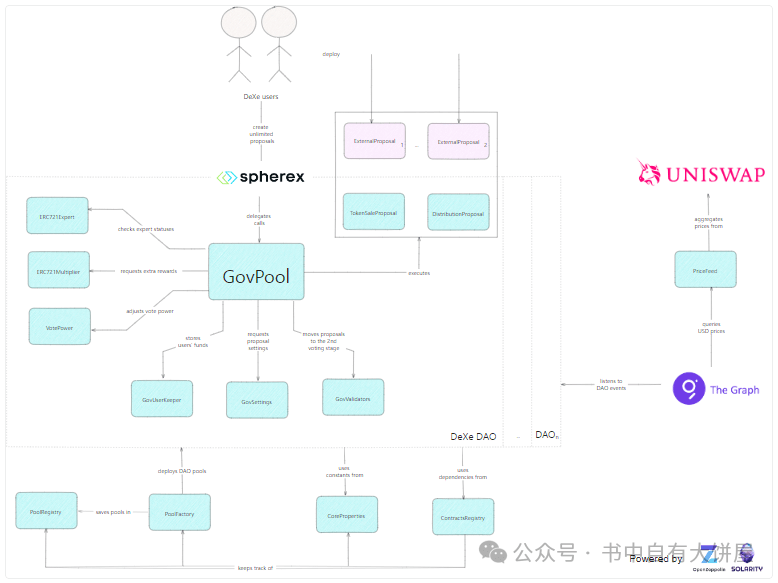
DEXE contracts provide a powerful and efficient structure for creating and interacting with decentralized autonomous organizations (DAOs). The system consists of multiple contracts and is divided into three main groups: core contracts (core), governance contracts (gov), and factory contracts (factory).
Components
1. Core Contract
Core contracts play a vital role in the functionality of the platform. The ContractsRegistry contract acts as a central hub that keeps track of all important contracts, ensuring that the system can be easily upgraded and allowing for smooth integration of required tools. Another core contract, CoreProperties, is responsible for storing common system constants that all modules follow. When a new DAO is established, it uses these set values to ensure consistency and reliability across the DEXE ecosystem.
2. Factory Contract
The factory contract performs several important functions. First, the PoolRegistry maintains a list of all user-created pools and allows all pools to be upgraded in the same transaction using the Beacon Proxy pattern. The PoolFactory contract enables anyone to deploy a pool. When you create a pool using this contract, it is automatically added to the registry. This makes the process simple and allows anyone to easily participate in the creation and management of pools in the system.
3. Governance Contract
Each DAO consists of four different governance contracts that perform specific roles.
The GovPool contract serves as a shared space for users to participate in the governance process. Users can propose ideas, vote on proposals, receive rewards for their participation, and observe the implementation of decisions.
-VotePower contract allows users to convert their voting power. In its basic variant, it adjusts the user's voting power based on whether the user is an expert and the amount of pool assets delegated. This enables users to strengthen their voting power and thus receive higher rewards.
- The GovUserKeeper contract acts as a secure custodian to protect the user's funds during the voting process. It ensures that funds are stored securely and used prudently only for voting purposes. The system supports four token standards for user deposits and voting: ERC20, ERC721, ERC721Enumerable, and ERC721Power, the latter being a unique token standard where each NFT has its own energy that changes dynamically based on collateral and time.
-GovValidator contract is a must for proposals that require two-phase voting. After reaching a quorum in the first phase, these proposals will move to the validator vote. The validator list is managed by each DAO itself. Validators use a specific GovValidatorsToken, which contains the snapshot logic.
The GovSettings contract stores configuration settings that define how proposals are handled within the governance pool.
Token Economy
The launch time is 2020-10-06, the total amount is 98,942,301, the current circulation is 57,103,081, the circulation rate is 58%, the current exchange rate is 12 US dollars, the peak is $34.5729 (2021-03-15), the token distribution foundation 33%, the team 20%, partners 16%, dividends 10%, transaction rewards 10%, sales 5%, and the market 5%. They kept saying that the rich ruled, but they took 50% themselves.
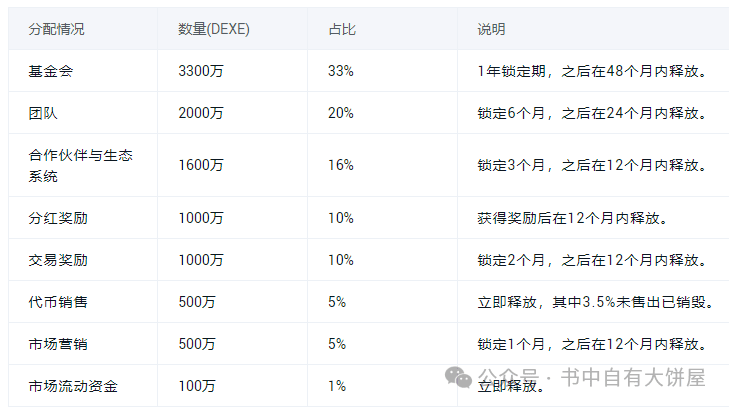
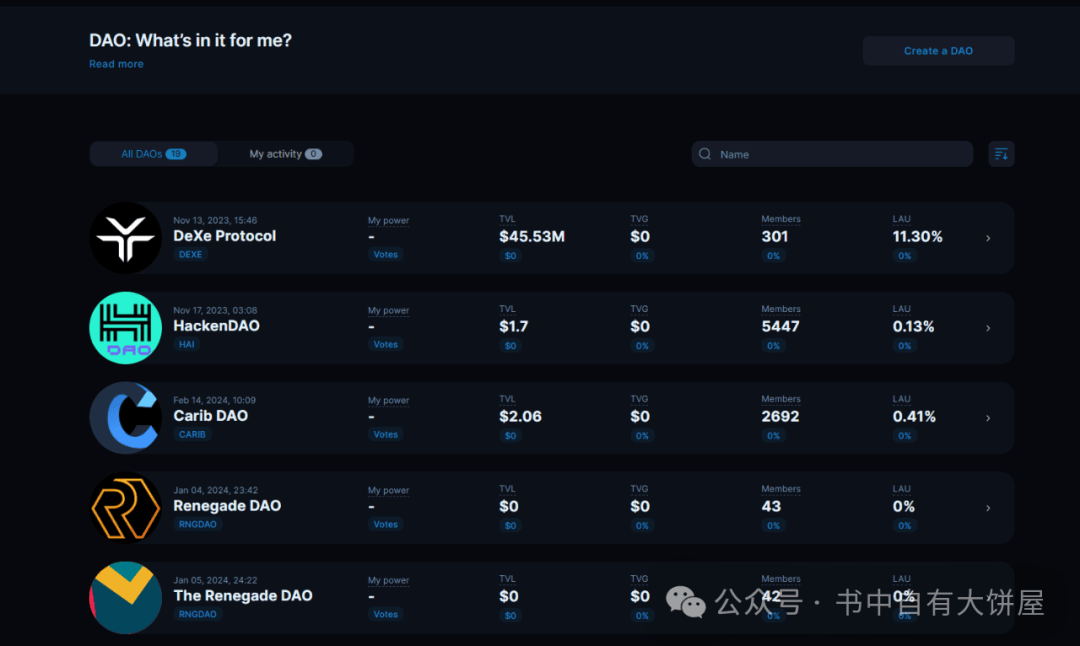
Finally, let's summarize this project. We have talked about several DAO creation projects before, such as ANT. It was popular before, and then it went down. Now it seems to have risen back a little, but it has not broken the previous high. This project is the same. It is not a new project. It is just a capital rotation. Because the overall fundamentals look very ordinary, there are indeed many DAO projects in Dashbord, but none of them have TVL. Only his own DAO has TVL, so this is ridiculous. No one uses your things, so you are almost certainly a pseudo-demand project. What's funny is that he said he wanted to subvert the DAO way, but he is still ruled by the rich, so he can only close it and move on to the next project. #内容挖矿