


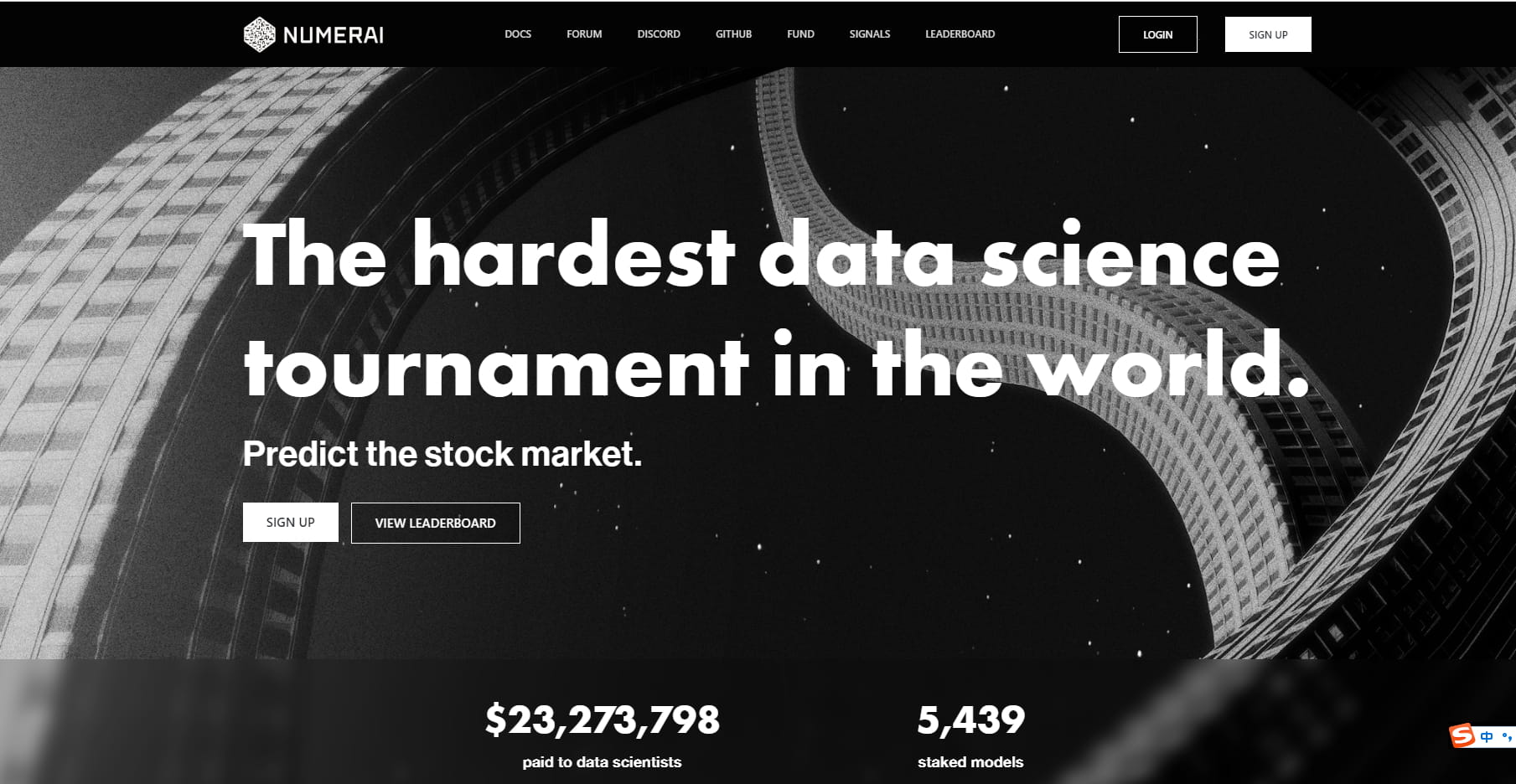
Today we continue to talk about AI-themed projects. The project we are talking about today is very interesting and different from the previous AI project fields. Today we are talking about NMR, a tool that uses machine learning to predict the stock market. It is also a great innovation (why we say that, we will see later). The current market value is also very low, only more than 82 million US dollars, and it is currently ranked 230+.
Introduction
Traditionally, hedge funds are highly competitive, rarely engage in collaborative activities or information sharing, and possess proprietary, expensive, and unshareable data. Hedge funds are structurally opposed to crowdfunding and decentralization because this is the basic lifeblood of each hedge fund company.
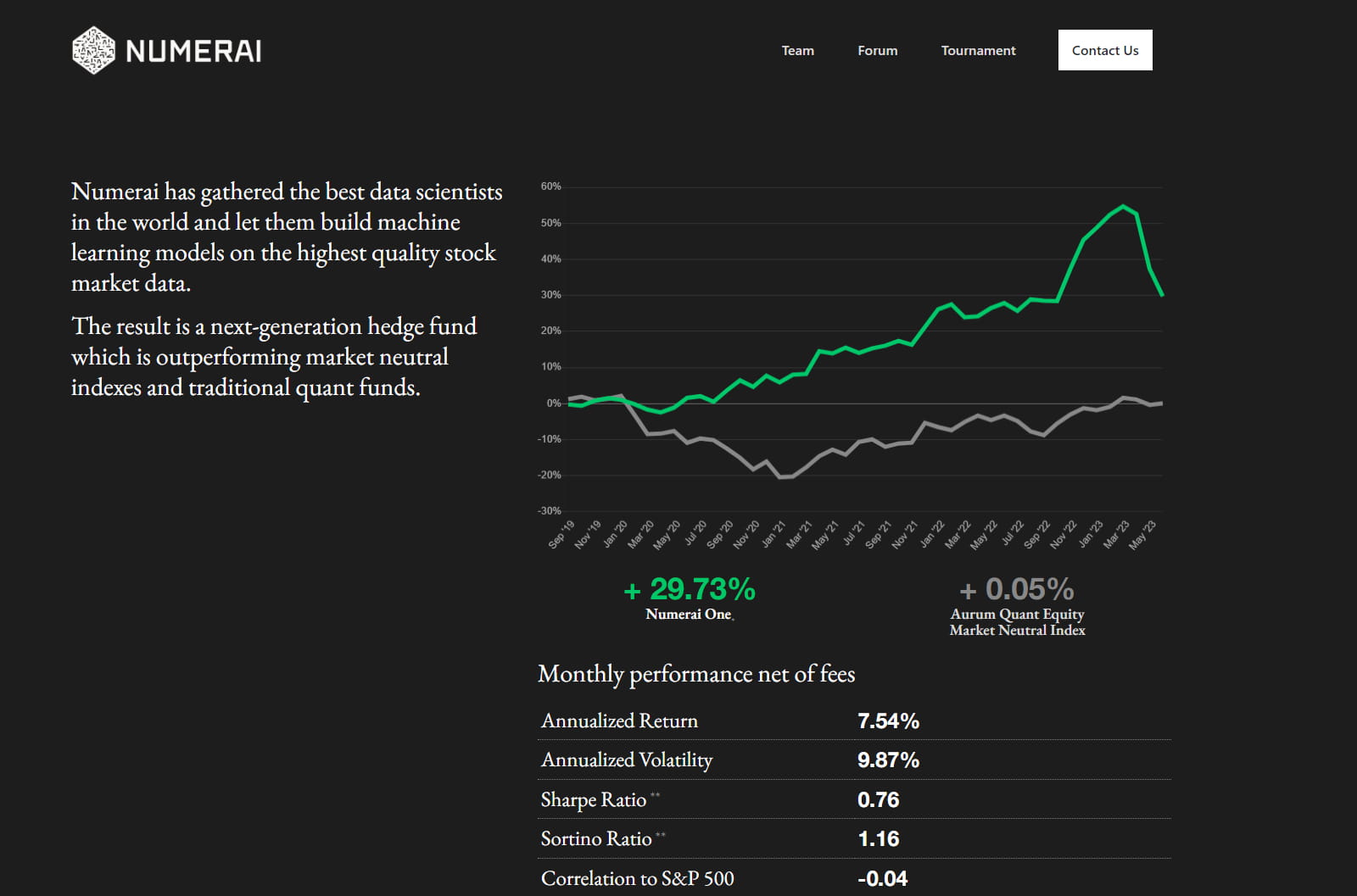
NUMERAI is a hedge fund that facilitates a large global community of anonymous data scientists (thousands of people) to make predictions about future prices, leveraging the power of distributed intelligence, machine learning, blockchain, and tokenization to create a completely new management model for hedge funds, one that is powered by the intellectual contributions of thousands of people.
Numerai first encrypts its trading data and then shares the encrypted data with data scientists - this way, scientists have no chance to copy the fund's trading strategies. However, the company will carefully design the encrypted data so that scientists can build models based on the data and use this to gain more benefits in trading. The higher the scientist's score, the more tokens he can get. Numerai cannot be used as currency to buy goods on the market. It is only used to incentivize scientists to build successful machine learning models and then make profits through trading in the real market. If scientists make a profit from the transaction, they can get Numeraire tokens and win a Bitcoin "bonus"; if the transaction is a loss, they will not be able to receive a "salary", and the company will also "destroy" the Numeraire tokens that belong to them.
NUMERAI has introduced many innovations to address these limitations. NUMERAI has issued one million NUMERAI tokens issued on the Ethereum blockchain to its 12,000+ data scientists for guaranteed rewards in predictive model building competitions.
As shown on the official website, what users see are normalized (converted to numbers between 0 and 1). When you see feature 1, you can't be sure whether it is the Nasdaq index or the price of gold, and you can't be sure which day's trading data it is. But you can model based on such data, and when you make your own predictions, numerai can decipher the real results.
Users only need to download the data set, build their own model and fit it to historical data, then use the data for the new data set, make a prediction, and upload the prediction.
Numerai doesn’t mention the exact encryption technology it uses, but homomorphic encryption (processing homomorphically encrypted data to produce an output that, when decrypted, is the same as processing the original, unencrypted data in the same way) can achieve the same effect.
The effect of encryption technology
Users do not understand the information behind the data set, nor do they know what their predictions are for. Therefore, their models are worthless without the data provided by the platform. This fuzzy treatment of data lowers the barriers to participation and facilitates the participation of data scientists from other industries. You do not need to know any financial knowledge, you just need to know how to build models and how to analyze data.
Similarly, this also makes the platform inseparable from users. Because only the user knows the model, the user only uploads the prediction results made by the model, and the model belongs to the user. The platform does not know and cannot obtain it. Without the user's model, the platform cannot make a profit.
Because the data source is not perceived by the user, numerai can enter a wide range of financial markets, regardless of whether the liquidity is high or low, as long as it can bring the highest returns. All they need to do is provide users with encrypted data, and strategies will be automatically generated in the competition.
After decrypting the prediction results, numerai will decide the amount of funds to trade based on the user's prediction history and the deposit paid (reflecting the confidence in their own results). Because each competition lasts for a week, it will use the prediction results to verify in the first few days of the week, and combine historical backtesting and the latest verification to decide the strategy to be used for trading. When it makes a profit in the market, it will return a part of the profit to the user according to the proportion.
Staking
Another small improvement is staking, which is used to express confidence in the prediction results. Because if the prediction is done at zero cost, users can randomly combine millions of results, and they can get rewards as long as they guess one correctly. Therefore, staking increases the cost of users to commit evil, and a large amount of staking indicates that users are confident, which also allows the platform to allocate more funds to corresponding strategies based on risks.
Blockchain
Using NMR, the token issued by numerai, will certainly help numerai reduce the amount of capital investment. Cryptocurrency used as payment protects the privacy of users and facilitates global users to participate in the competition. However, other cryptocurrencies can also achieve the effect of protecting privacy and allowing global participation.
Fund Raising
Although numerai has great strategic advantages as a hedge fund company, it also faces the challenge of fundraising. Hedge fund companies generally do not sell funds to the public, but are only open to institutions and individuals who meet asset requirements and other conditions. The advantage of this fund for a small number of investors is that it is easy to manage and protect their own trading strategies. Because high-net-worth individuals often have higher education, hedging strategies are easier for them to understand. In this way, fund companies have a higher degree of freedom in choosing investment targets and can do big things with ease.
However, Numerai cannot explain its trading strategy well. This is because the model belongs to the user, and Numerai does not know the specific strategy adopted by the model. It only knows that the model has strong predictive ability. This is a black box. Although it has strong capabilities, it faces an unknown internal structure and has a higher degree of uncertainty about the future. Therefore, it may face some challenges in fundraising.
Application Scenario
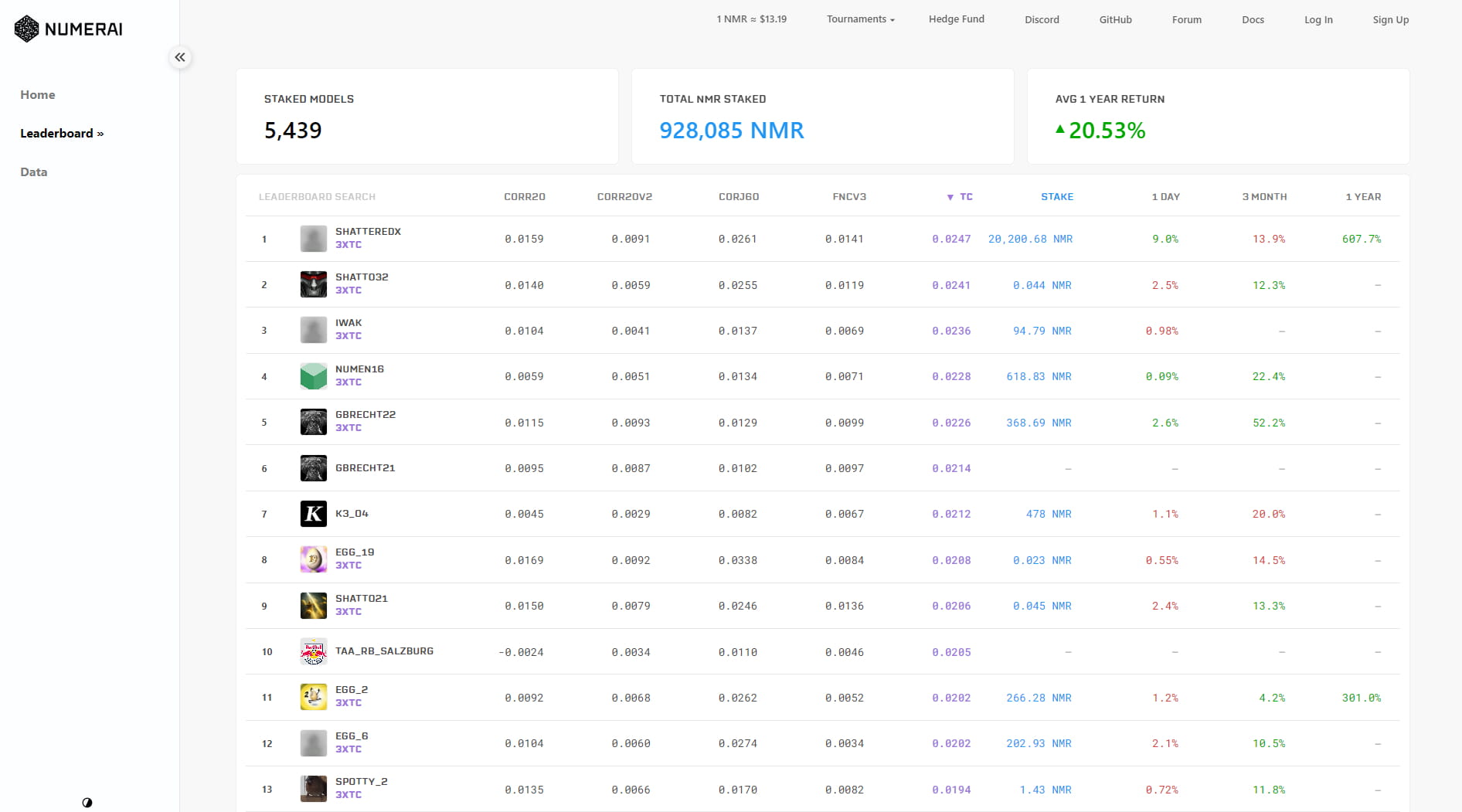
Every user on Numerai has the opportunity to stake NMR tokens on their predictions to express their confidence in the model. If their predictions are good, they earn money and their NMR is returned. If their predictions are bad, their NMR is destroyed.
The most important usage metric for users is whether the largest gainers of NMR are also the largest holders, i.e. whales are users. This is exactly what is happening with Numerai.
If you go to Numerai’s leaderboard and sort by career earnings in NMR, you can see that 7 of the top 15 NMR earners currently hold NMR. So nearly half of the players with the largest NMR holdings are accumulating on a weekly basis. I don’t know of a single cryptocurrency project where the token is so widely and frequently used by its largest holders.
Numeraire Effect
Numerai asks data scientists to stake NMR on their models because only good models will gain and accumulate. This is also happening.
When Numerai users submit predictions, they also submit predictions on the test set. Users do not get feedback on their performance on this test set, and they don’t even know what our data represents; this ensures that the results on this test set are rigorous.
Financing
Numerai, a hedge fund competition platform, announced that it has raised $100 million in new funding for its artificial intelligence hedge fund. Its founder Richard Craib said that Numerai is backed by former Renaissance Technologies executive Howard Morgan and now manages nearly $300 million after receiving new grants from an endowment fund and several managers in the United States. The company also recently raised $10 million from investors such as Union Square Ventures.
Token Allocation
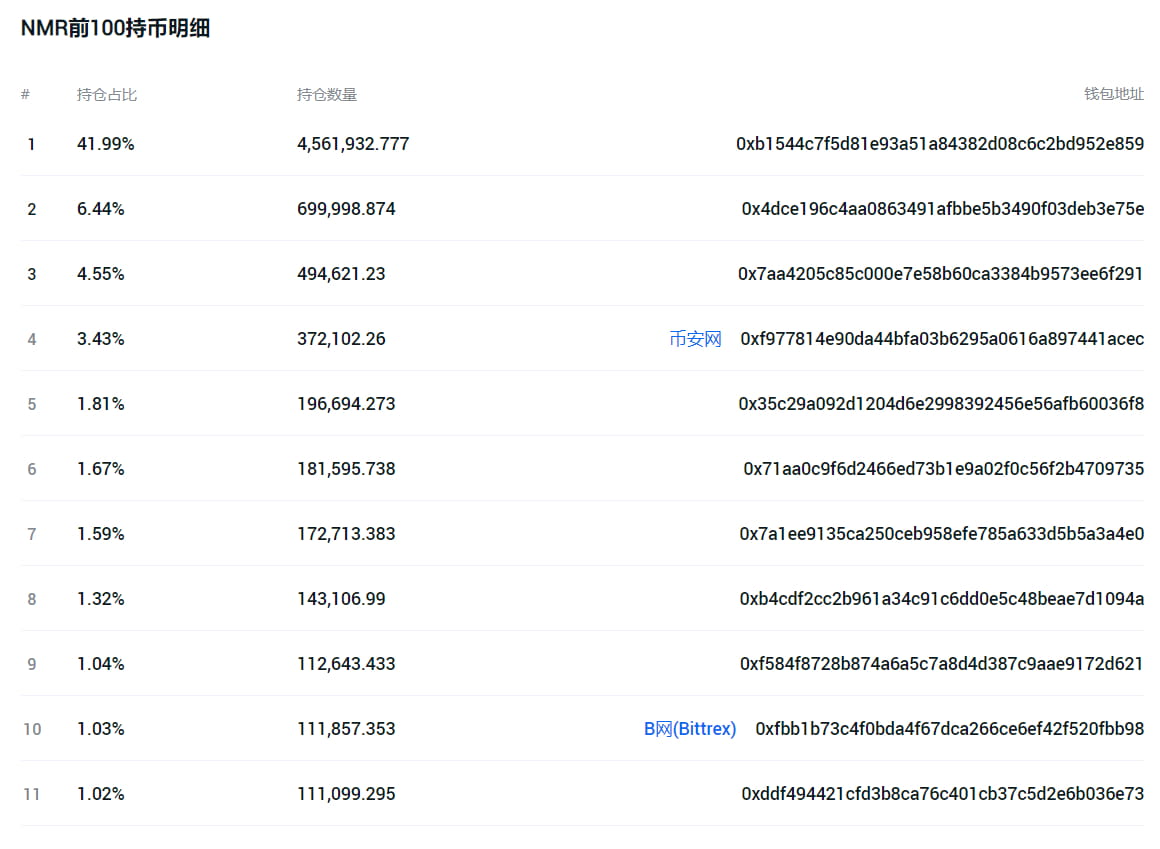
The first issuance time was 2017-02-21, the maximum supply is 11,000,000 NMR, the circulation rate is 53.53%, and the current price is 13 USD. The highest price in history was 168 USD in 2017. So it has fallen by more than 90%, and it has not climbed back up after so many years, and the distribution has not been found. From the top 100 addresses of coin holders, there are still many whales, who are scientists. So retail investors still need to be cautious.
Finally, let's summarize. The NMR model is really very innovative and interesting. I am personally very interested in this kind of project. You know, the world is always being disrupted by various marginal innovations. Although I don't know much about hedge funds, using blockchain + AI to make some innovations and challenges is a great project in itself. If you have the ability, you can participate in their scientist program. For retail investors, I think we should have a deeper understanding of the profitability of this hedge fund in recent years. The current return rate on the official website is 20%. I don't know how much the return of a good hedge fund can be. Friends can go and investigate.