


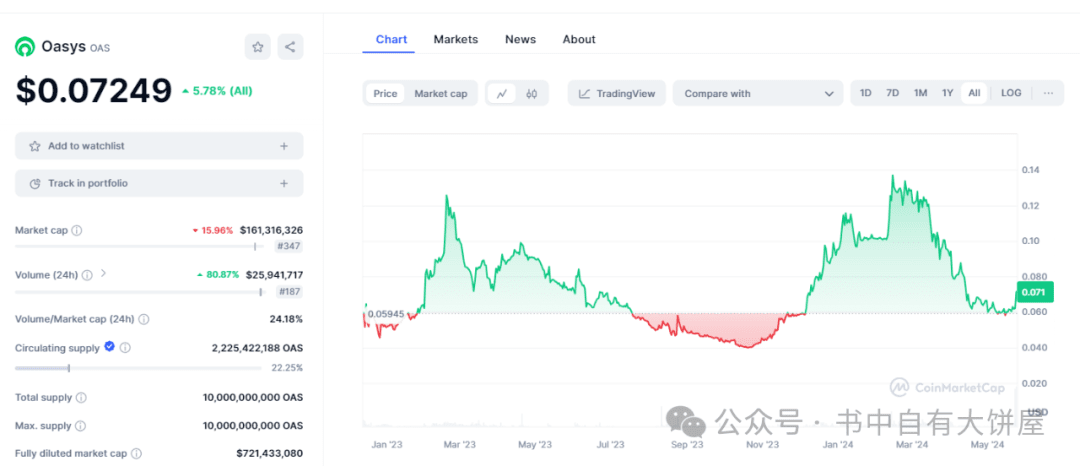
Today we continue to look at a project that has been quite popular recently. It is also a public chain for blockchain games, OASYS. Its current market value is 160 million US dollars, and its overall FDV is around 600 million US dollars, ranking 300+. This market value is actually quite low. If the project fundamentals are good, it actually has great potential.
1. Introduction
Oasys is a public blockchain focused on gaming. Launched with the support of famous gaming companies (Ubisoft, SEGA, COM2US, etc.), it aims to revolutionize "blockchain gaming".
2. Market Trends
Blockchain Market
The global blockchain market grew from US$1.49 billion in 2020 to US$4.9 billion in 2021. It is expected to grow to US$67.4 billion by 2026 at a compound annual growth rate of 68.4%.
The NFT and gaming sectors, in particular, have experienced significant growth. The annual growth rate of the NFT market reached 5438% in 2021, and the total transaction volume of the top ten NFT markets climbed to US$23.9 billion.
Game Market
The gaming market is broken down as follows: PC games at $35.9 billion, console games at $49.2 billion, and mobile games at $90.7 billion, with mobile games accounting for more than half of the total.
The global games market will continue to grow in the coming years and is expected to exceed $200 billion by the end of 2023. The games market is expected to grow at a compound annual growth rate of 7.2% to $204.6 billion between 2019 and 2023.
Global Game Market Forecast
Global Game Market in 2021
The number of gamers is also expected to grow steadily, with the global gamer population growing at a compound annual growth rate of 5.6% between 2015 and 2023 and expected to exceed 3 billion by 2023.
A large portion of this growth will come from mobile gamers. The gamer population in regions such as Asia Pacific, the Middle East and Africa, and Latin America is expected to continue to grow in the coming years due to market growth in these regions.
3. Oasys Features
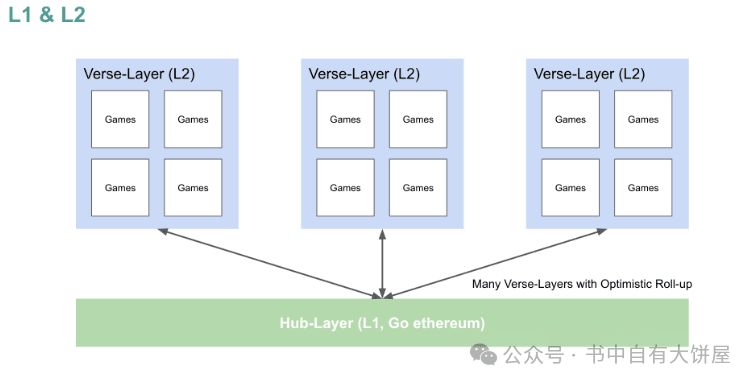
Oasys adopts EVM-compatible protocol and introduces the unique Oasys architecture. The architecture consists of multiple layers: a highly scalable Layer 1 Hub layer and a special Layer 2 Verse layer that uses Ethereum’s Layer 2 scaling solution.
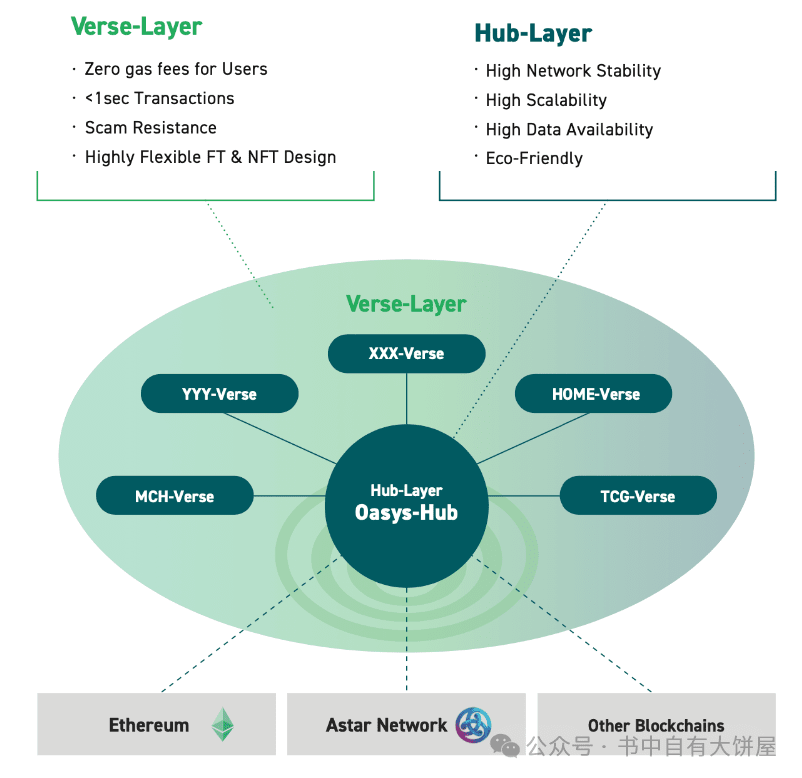
Oasys eliminates the 7-day challenge period in Optimistic Rollups, allowing transactions to be approved instantly like Web2 products. This is faster than any other blockchain and layer 2 solution.
In addition, since all Oasys data is stored in the Hub layer, high data availability is achieved and can be fully recovered even if the Verse layer is lost.
Hub Layer (Layer 1)
1. High network stability
The block time is set to 15 seconds, the same as Ethereum, which is sufficient to transmit data to globally distributed nodes. The Hub layer is resilient enough to connect thousands of Verse layers without causing network failures due to node issues.
2. High scalability
In principle, the Hub layer is only used for FT, NFT, Bridge, and Rollup contracts, so only the Verse layer will experience heavy traffic. As an exception, with governance approval, some contracts may be deployed on the Hub layer, but these contracts are controlled by governance, so the stability of the blockchain is not affected. In addition, when publishing Verse layer transactions to the Hub layer, Rollup is used to minimize the number of transactions on the Hub layer. This makes scalability independent of the increase in Verse layer transaction volume.
3. High data availability
Transaction data on the Verse layer (Layer 2) is reflected on the Hub layer (Layer 1), so any event in the Verse layer is verifiable.
5. Environmental protection
Oasys is an eco-friendly blockchain that does not consume unnecessary energy due to its PoS-based consensus mechanism, so developers' gas fee costs will be minimized.
4. Technical introduction:
1. Hub layer
The Hub layer is Oasys’s layer 1 EVM-compatible public blockchain. The node implementation is based on a minimally modified fork of geth (Go Ethereum) and adopts PoS (Proof of Stake) as the consensus algorithm. The public nature of the blockchain operation is ensured by allowing users to become node operators (validators). In order to provide a stable blockchain network, in principle the execution of applications is left to the Verse layer. The Hub layer is limited to limited uses such as processing transaction batch aggregation, FT/NFT management, bridge information management, etc. As an exception, with governance approval, some contracts may be deployed on the Hub layer, but these contracts are controlled by governance, so the stability of the blockchain is not affected.
2. Mining
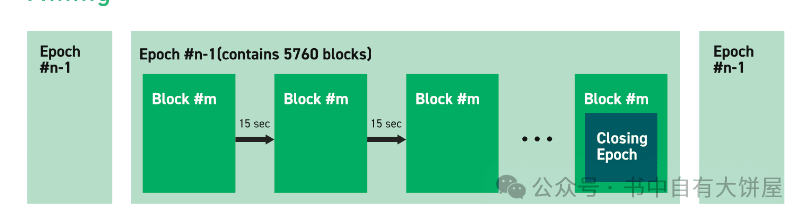
The Hub layer stores data collected on Oasys securely and stably, but does not run applications directly. To ensure that information is stably propagated to globally distributed nodes, a block is generated every 15 seconds to avoid too short a block time.
Block generation is performed by nodes called validators, who are selected by PoS (weighted random ordering) based on the number of staked OAS tokens. A time period called an epoch is set every 5760 blocks (approximately a day). When the last block of each epoch is executed, the staking reward for that epoch is determined, and the next validator (including new validators or the exit of existing validators) is determined. Validator information is managed by a special validator contract.
3. Validator
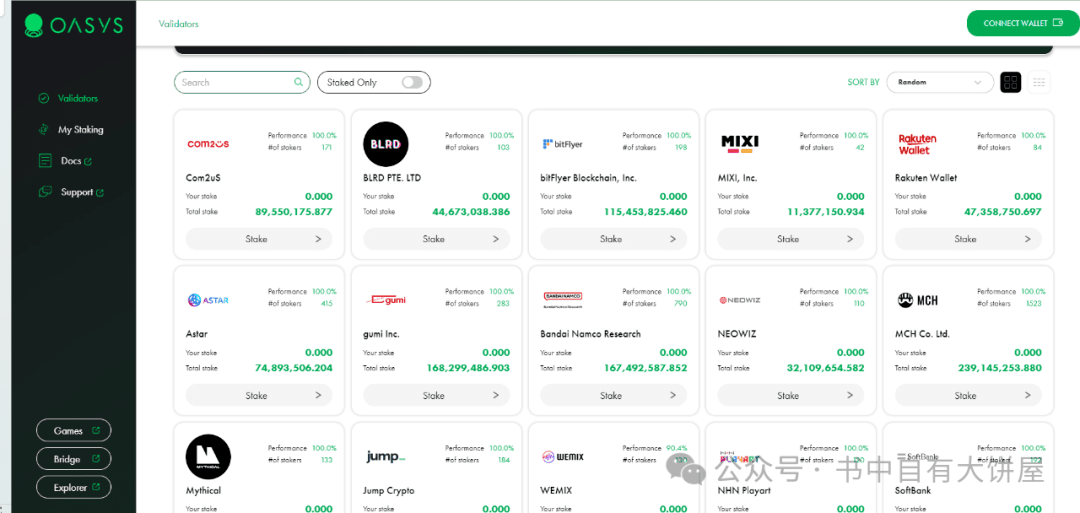
Anyone who stakes at least 10 million OAS through the validator contract can become a validator. First, a validator candidate registers its address to the validator contract. OAS token holders can then stake to any validator or validator candidate's address and can unstake at any time. Staking and unstaking will be reflected in the last block of this epoch. A validator candidate can become a validator starting from the next epoch by declaring themselves as a validator and having 10 million OAS or more staked at their address. Conversely, if the total staked amount is less than 10 million OAS, the validator will be automatically removed from the next epoch.
The validator signs the block using the registered address. If the validator is unable to serve for some reason, the next validator will perform the block generation work that the validator has not completed. The staking reward is determined in each epoch based on the validator's operation time. For example, if the validator is inactive for a long time, it will not be able to receive the staking reward. However, the staked OAS will not be damaged. If the validator fails to generate blocks more than the threshold number of times, it will be considered inactive and excluded from block generation.
4. Smart Contracts
New smart contracts are not allowed to be deployed on the Hub layer by design. Only smart contracts accepted by Oasys will be deployed. Transaction execution can be performed by paying OAS gas fees. Accepted smart contracts include those related to FT/NFT, Rollup, and Bridge.
5.Verse Layer
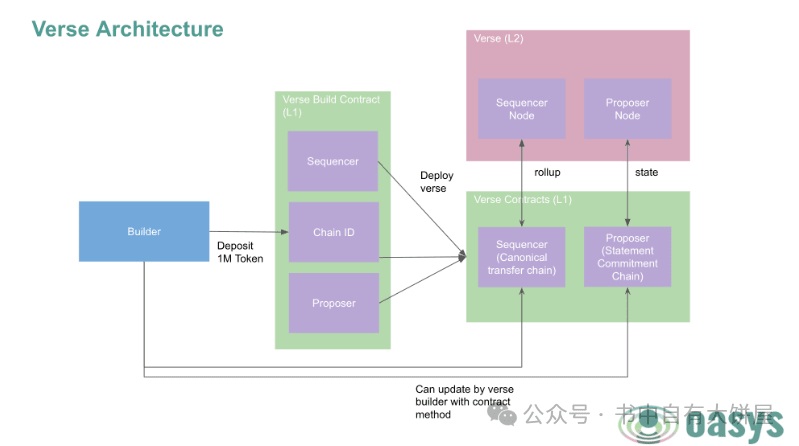
The Verse layer is Oasys’s layer 2 blockchain. Currently the only supported implementation by Oasys is Optimism. Optimism’s node implementation was forked and only the minimal modifications necessary were added. In most cases, the Verse layer is expected to operate as a permissioned layer 2.
V. Ecosystem
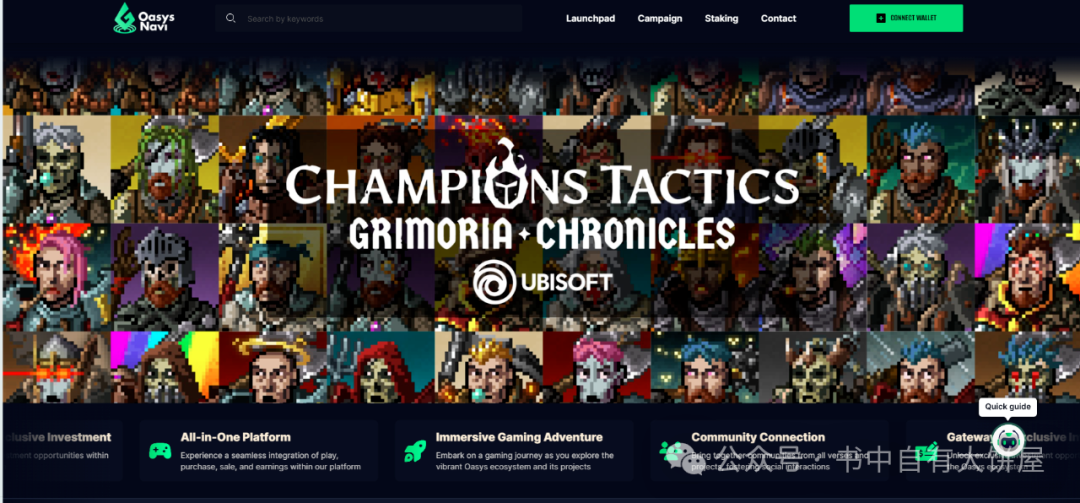
Ubisoft’s upcoming turn-based fantasy RPG, Champion Tactics: Grimorian Chronicles, is using blockchain elements from Oasys. While Ubisoft conducted its first free NFT minting on the Ethereum mainnet, this is still compatible with its Oasys initiative.
DoubleJump Tokyo’s pixel-style NFT fantasy game My Crypto Heroes is using Oasys’ “Verse” layer and has completed over 33 million transactions across over 684,000 crypto wallets as of January 17, 2024.
The NFT-powered game Ryuzo, co-developed by Bandai Namco Research, is also running on Oasys. Gaming giant Bandai Namco has partnered with Oasys to develop an AI-powered virtual pet game centered around a series of NFT-based digital creatures called RYU. Ahead of the launch, Oasys airdropped 10,000 digital NFT eggs, or MARYU, among the first NFT holders of the “Oasyx” project.
DoubleJump Tokyo is also developing a game based on Sega's old IP, "Three Kingdoms War", which also chose to use Oasys as its blockchain platform.
Com2us and XPLA’s game Summoners War: Chronicles is also using Oasys’ blockchain capabilities. Additionally, Bandai Namco released an experimental AI-driven NFT virtual pet game in 2023.
6. Custom Tokens (vFT/vNFT)
Each developer can issue vFT/vNFT in their own L 2. This token standard has the characteristic that it can only be used in a specific L 2. Therefore, it cannot cross chains and cannot be used in other L 2.
As an in-game currency, vFT cannot be exchanged back to legal tender and can only be used in the game. vNFT can protect the IP of NFT, such as preventing NFT from being used for unintended purposes and preventing counterfeiting. For example, a developer can create an NFT that can only be used in its own L2.
Highly interoperable tokens (oFT/oNFT)
oFT/oNFT are tokens created at the Hub layer, and their characteristics are that they can be used in the entire Oasys ecosystem (Verse layer and Hub layer) and across chains to other chains (such as Ethereum).
This gives the game developer a lot of flexibility. By utilizing both oFT/oNFT and vFT/vNFT, the developer can open only some in-game tokens to user groups outside of its own L2, such as character NFTs for in-game characters as vNFTs and land or items as oNFTs.
7. Token Economy
The first issuance time is December 22, with a total of 10,000,000,000 tokens. Currently, 2,225,422,188 are in circulation, with a circulation rate of 22%. The current exchange rate is 0.07 US dollars, and the current peak is $0.141 (2024-02-13). The token distribution is 38% for the ecosystem, 21% for staking rewards, 15% for development, 14% for early contributors, and 12% for the foundation. The release is almost a linear release in 36 months.
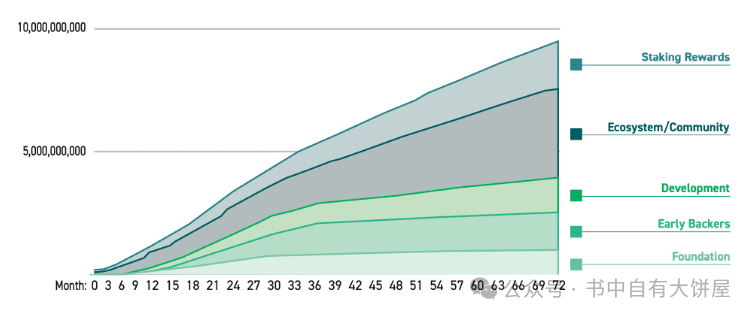
Finally, let me summarize this project. This project is also a project that came out of the standard bear market. There have been two peaks before, one in February 2023 and the other in February 2024. I guess it was because two games were launched in cooperation with large game companies. In fact, looking at the overall technical aspects, it is relatively general and not a very distinctive public chain. At present, the only relatively powerful thing is that it has cooperated with many large game companies, which are also very powerful characters in web2. Being able to cooperate with them, the business of this project party is still relatively powerful (at least I have not seen other public chains of chain games have such strong business cooperation). In fact, the current price has not risen much from the price it went online. The online price is 0.05, and the current price is 0.07. In fact, it’s okay. The previous two peaks were also because the volume was a bit large and it has been unlocked. The biggest problem at present is that there are still a lot of unlocked tokens, and the token strategy is still mentioned in the planet. #内容挖矿 #链游