

作者: Elena L, Zixu H, Eocene Research
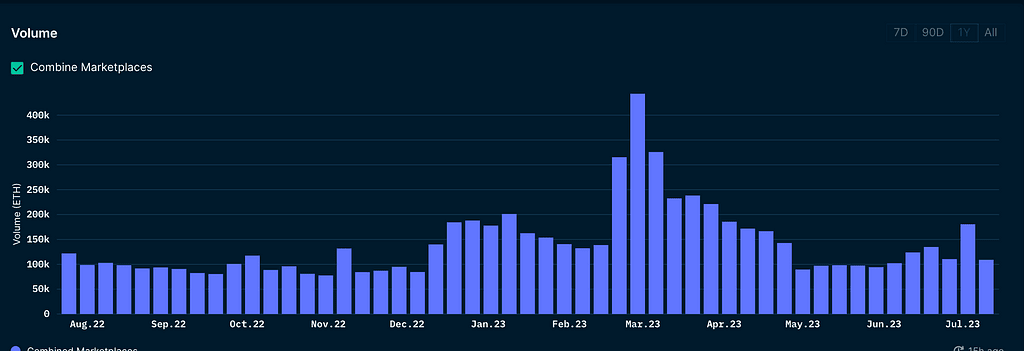
In the previous article "Data Reveals Whether the Growth of the NFT Market in 2023 is Due to the Entry of New Funds or the Involution of Old Funds", we mentioned that thanks to Blur's successful airdrop incentive activities, the NFT market ushered in a short boom in early 2023, especially between February and May, when the funds invested in the NFT market increased by 60% month-on-month. However, the latest data shows that after reaching a peak in February and March 2023, NFT trading volume began to decline - NFT has entered a bear market again.
Some have pointed out that the growth of the NFT market typically lags behind the growth of cryptocurrencies by one to two quarters, so with the recent growth of cryptocurrencies, NFTs may soon flourish again. However, we believe that the recent bear market is not only due to cyclical industry lows, but also due to some fundamental problems that directly lead to the sluggishness of the NFT market.
In this article, we will first present the specific performance of the recent bear market in the NFT market with data, and then analyze the main reasons hindering the growth of the NFT market.
Data from various dimensions reveal that the NFT market is shrinking
1. Volume, Sales, and Wallets are all on a downward trend
It is worth emphasizing that in addition to the weekly trading volume being basically the same as that of the bear market in 2022, the number of transactions and the number of active wallets have both significantly decreased compared to 2022, which means that the trading activity and participation in the NFT market The number of investors is at its lowest level in the past year.
NFT Trading Volume
NFT transaction count and active addresses
2. The value of blue-chip NFT series continues to plummet
The Blue-Chip-10 and NFT-500 indices provided by Nansen measure the total market capitalization of the blue-chip/top NFT series, thereby reflecting the general performance of the entire NFT market. Both indices have continued to decline significantly since April this year, with the combined market value of blue-chip/top NFTs evaporating 70-80% directly from the peak in February.
Blue - Chip -10 Index
NFT-500 Index
3. The investment in the NFT market is decreasing by 20%-40% month by month
We calculated the monthly investment funds in the NFT market from February to June 2023 based on the method used to calculate the investment funds in the NFT market in previous articles. The data shows that the amount of funds invested in the NFT market has been significantly decreasing every month (except for a small increase from May to June). Funding levels in June were only 40% of February levels.
Monthly investment
The above indicators reflect that the NFT market is experiencing a decrease in traders, a decrease in trading activity, a shrinking investment, and a drop in prices. All dimensions together show that the NFT market is facing stagnation and even shrinking.
Three main reasons for the sluggish NFT market
1. Using the “Bid for Airdrop” mechanism to stimulate liquidity on the demand side is inherently flawed
Blur launched the Airdrop incentive mechanism at the end of 2022, mainly rewarding loyal users who list (place sell orders) and bid (place buy orders) on Blur. In the early days of the mechanism, many veteran NFT players believed that this would be a strategy that could effectively drive NFT liquidity, and the market also confirmed this view in the early stage — — From Blur Season 1 to the beginning of Season 2, the market liquidity and trading volume have been significantly improved.
However, shortly after Airdrop Season 2 began, the situation began to take a sharp turn — after the transaction volume of the entire NFT market peaked in February 2023, it showed a continuous downward trend.
In addition, the prices of several blue-chip NFTs also plummeted in the following months — BAYC lost 60% of its market value, Doodles fell 70%, and Moonbirds even fell 80%! Many participants in the airdrop activities lost a huge amount of money due to the decline in the value of NFTs ("buy high and sell low"), and the points rewards obtained in the airdrop obviously could not make up for the loss of this part of the funds. Therefore, although the short-selling activities are still ongoing, many players have chosen to withdraw.
In a market with good liquidity, market prices are usually more stable, that is, they will not fluctuate violently due to transactions. Blur's original intention was to increase the liquidity of the NFT market by encouraging bidding, which was a good starting point, but the prices of most series not only did not stabilize, but even spiraled downward as mentioned above.
Since placing a bid in Blur's airdrop event can get potential Blur token airdrop rewards, most bidders do not really want to buy NFTs, but just hope to get airdrop rewards. When they "unfortunately" take over NFTs, most people will ship them as soon as possible, and most of the time they will sell them at a lower price than when they bought them; this makes the floor price of NFTs drop, and the price level of Bids drops accordingly, so bidders will sell NFTs at a lower price — — This vicious cycle causes the prices of many NFT series to spiral downward, which is completely contrary to "high liquidity and stable prices."
The fundamental reason for this phenomenon is that the bids on Blur are not real market demand, which to a certain extent shows that the participants in the airdrop activities are not optimistic about most NFTs, mainly because most NFTs lack long-term intrinsic value.
Although Blur's incentive mechanism did not create real liquidity, it has important guiding significance for the subsequent "how to achieve real liquidity of NFT". Blur's Airdrop Season 2 is still ongoing, but the NFT market has fallen into fatigue. This is because many players suffered heavy losses in the early stage of Airdrop Season 2, so they chose to withdraw from the event, or they learned from the lessons of their predecessors and later players participated more cautiously. Regardless of the reason, it shows that the airdrop incentive mechanism cannot provide continuous and healthy liquidity for the NFT market.
The total market value of NFTs has dropped significantly as Blur season 2
2. Most project owners lack experience in market value management
Blur's incentive mechanism not only attracts people who want to earn Blur tokens, but also attracts a lot of malicious arbitrage funds.
A typical example of "malicious arbitrage" in the Blur airdrop: an arbitrageur will first buy a large number of tokens of an NFT series at a low floor price, and then list these tokens at a higher price, thereby raising the floor price. At the same time, they will place "fake" buy orders on Blur close to their list price, while other players who want to earn points (aka miners) will place orders in the 2nd and 3rd tiers to reduce the probability of "unfortunately" taking over the NFT. Since these miners do not know that the top bidders are actually the ones who place the sell orders, and the ones who place the sell orders (list) can choose the bidders who take over the NFTs in their hands, when the bid pools in the 2nd and 3rd tiers are deep enough, arbitrageurs will sell a large number of NFTs in their hands to these miners.
These malicious arbitrageurs usually repeat the same operation for several rounds, but each time the price is raised higher than the previous one, in order to avoid the tokens sold in the previous round being dumped back into their hands at a high price. In this way, these arbitrageurs can "buy low and sell high" to make a profit.
Arbitrageurs generally hold a certain amount of funds (tens to hundreds of ETH), so they can profit from this "game", but many NFT series (especially those issued before Blur launched the reward mechanism) did not anticipate the occurrence of such malicious arbitrage. Therefore, in most cases, they did not reserve enough NFTs and funds to cope with the huge amount of funds from their counterparts, and ultimately were unable to control the market and save the project's market value.
3. Many NFT projects lack long-term intrinsic value, so prices are extremely vulnerable to market panic
This may be the most fundamental reason why the NFT market is in a growth dilemma.
When NFTs first experienced a lot of hype in 2020 and 2021, the project had an ambitious roadmap that promised to bring real value to holders of its NFT series.
However, two years later, the roadmaps of many NF T projects have become empty checks, and their promises have not been fulfilled, and they have not brought real value to holders. Although some project parties are doing things, when making peripherals such as T-shirts and dolls, and holding some IRL meetups, the value they bring to holders does not match the high price of the NF T series, and they also lack innovation.
These reasons make most NFT projects lack real intrinsic value, resulting in fewer and fewer users making value investments and long-term holdings in NFTs, ultimately making the NFT market increasingly a "speculator's market."
How to revive the NFT market
Based on an in-depth study of the reasons for the decline of the NFT market, we put forward some ideas on revitalizing the NFT market.
First of all, we should be committed to creating an NFT ecosystem with real value. This means that NFT project owners should continue to bring real value to holders, so as to achieve the sustainable development of NFT. At the same time, the plummeting prices of a large number of NFT series in this bear market are not necessarily a bad thing, because "big waves wash away the sand" can clean up low-quality and inactive projects, while encouraging other project owners to do practical things and improve innovation; and those series that really work hard and continue to create value for NFT holders and the entire NFT ecosystem, although the price may be temporarily affected by Blur's mining mechanism, we believe that they can still persist. For example, although Moonbirds was hit hard by malicious short selling, I personally still have great hope for the PROOF team because they have been creating value through high-quality content.
Secondly, project owners should be aware of the importance of market value management. After the Blur airdrop event, the importance of market value management for NFT projects has become clear. In order to avoid repeating the same mistakes, project owners should prepare enough tokens in advance, master the funds and relevant knowledge, and be able to take timely action to control the market and save the project's market value when the NFT price is maliciously manipulated again.
Finally, the NFT market needs to think seriously about how to effectively bring healthy and sustainable liquidity to NFTs. We believe that the key to creating real liquidity is that project creators no longer focus on short-term benefits and ignore long-term value, but focus on real value creation to stimulate real demand. We already have a lot of great products and protocols (such as Blur's pro-trader trading platform,
Finally, let's talk about liquidity. First of all, we are not short of products that improve liquidity: Blur's pro-trader trading platform, other liquidity improvement products such as NFT fragmentation protocol, NFT lending protocol, etc. are all very good products. But the basic reason for the poor liquidity is that most projects have no real value, resulting in low market demand. Therefore, we believe that the key to creating real liquidity is that the project party no longer focuses on short-term interests and ignores long-term value, and focuses on real value creation, thereby stimulating real market demand and attracting value investment.
Although the recent stagnation of the NFT market is disappointing, there is still a long way to go before the true value of NFT is realized, but we believe that with the joint efforts of multiple parties, the road ahead will be bright. But after discovering the root problems, we can work hard to solve them.