
Chapter 1: Crypto Market Overview
lost second quarter

As of the end of the second quarter, the global cryptocurrency market capitalization reached $1.17 trillion, up 48% year-to-date. Interestingly, the total market capitalization in Q1 and Q2 was similar, almost making Q2 look like a failed quarter in the crypto world.
Q2 also lacked a strong market narrative compared to Q1. In the first quarter, the market experienced more significant developments, such as the doubling of Bitcoin prices, the rise of L2s like Arbitrum and ZkSync, and a more active NFT market driven in part by product upgrades and the launch of the Blur token. The second quarter failed to produce any similar breakthrough developments. Instead, the second quarter witnessed different trends, such as “memecoin season” and the rise of BRC20 tokens, which, while noteworthy, did not match the level of excitement generated by the previous quarter.
The CMC Crypto Fear and Greed Index started the year around 30 (fearful) but ended the first half at around 52 (neutral), indicating a significant improvement in market sentiment.
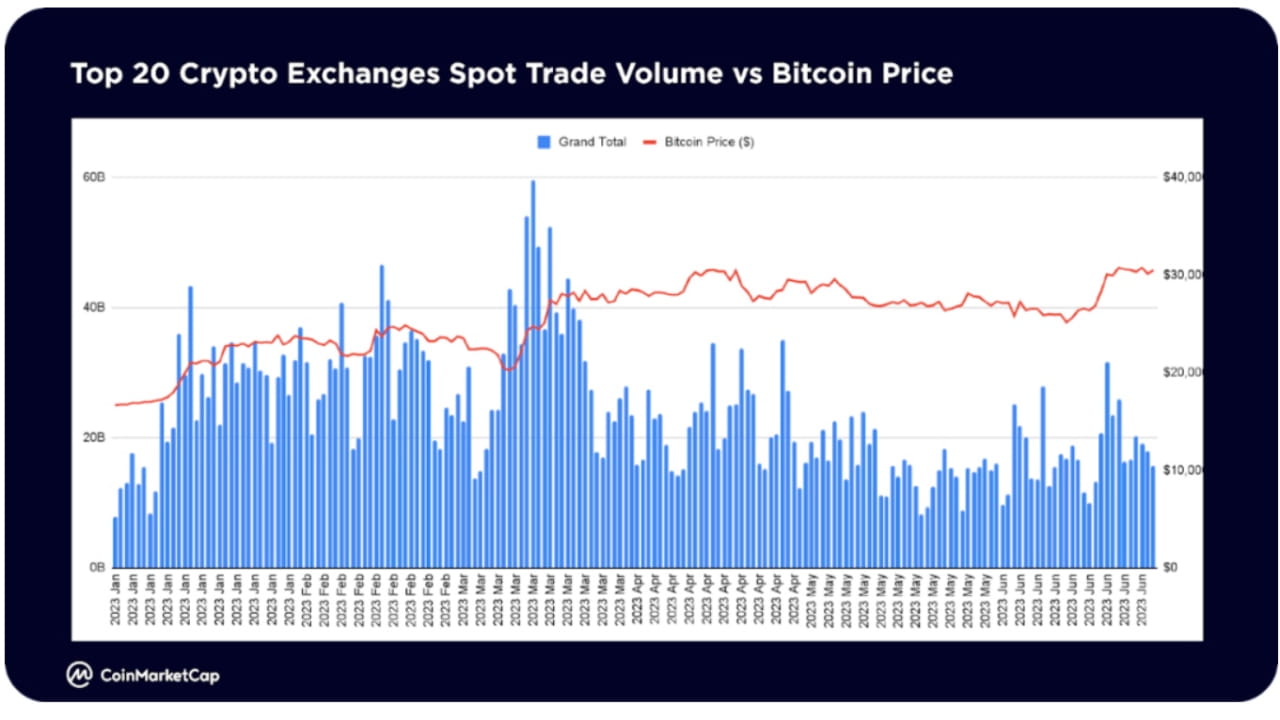
Total spot trading volume on the top 20 cryptocurrency exchanges peaked in March and fell by about 36% month-on-month, reaching about $523 billion per month by the end of June, nearing hibernation.


In a challenging market, certain sectors have seen significant growth in market value so far this year. VR/AR (704%) and AI & Big Data (323%) have been leading the market, while blue-chip DeFi projects and infrastructure are making a strong comeback. Some of these sectors include lending (149%), derivatives (75%), storage (86%), interoperability (58%).
Notably, the Memes section has added more than 260 new coins so far this year, making it the most active section for newly listed coins. Artificial Intelligence and Big Data ranks second with 61 new tokens, while DeFi ranks third with 47 new tokens year-to-date.


Meme is the most eye-catching sector this year. In April and May 2023, the speculative "Memecoin Season" spearheaded by PEPE caused a significant increase in the number of views in the industry.
DeFi is the second most watched area, showing continued interest in the first half of 2023
Collectibles and NFTs received significant traction in the first three months, largely due to Blur Season 1 airdrops, but views declined in the second half of the first half
Artificial intelligence and big data are new entrants in the most talked about areas in 2023; with the launch of OpenAI's ChatGPT, the development of artificial intelligence began to take off in the first quarter of 2023. June saw resurgence of interest in AI-related tokens

The Memes industry has generated the greatest interest, especially in the last three months of the first half of 2023. This was mainly driven by PEPE, which saw an explosive increase of more than 3,700 times from April to May. After pulling back from its May highs, PEPE has rebounded nearly 100% from its mid-June lows. Memecoins from previous meme cycles, such as DOGE, SHIB, and BabyDoge, remain the most popular in the space
After the network's successful Shapella upgrade on April 12, which allowed the withdrawal of staked ETH on the beacon chain, smart contract interest remains primarily focused on Ethereum (ETH). Cardano (ADA) has also attracted significant interest, possibly due to technological developments such as scaling solution Hydra and governance proposal CIP 1694
Interest in the DeFi space is mainly focused on Terra Classic (LUNC), likely due to events such as Binance’s destruction of 2.65 billion LUNC tokens (valued at $236,000) and TFL’s release of cross-chain yield trading protocol Alliance
Following the AI narrative in February and March, interest in AI and big data returned in a big way in June. SingularityNET (AGIX) and Fetch.ai (FET) had the highest views, rebounding nearly 40% from their mid-June lows.

PEPE joins other established memecoins Dogecoin and Shiba Inu, joining the list of coins with the most watchlist additions by CMC users
Apart from blue chips, other tokens are primarily Ethereum Layer-2 scaling solutions such as Polygon, Arbitrum or competing Layer-1s such as BNB and Solana

The most engaged segments on the CMC community (account likes, posts, comments) are memes, coinciding with the most viewed segments. The speculative memecoin season of April and May saw explosive gains in tokens like PEPE, SNEK, LADYS, and more.
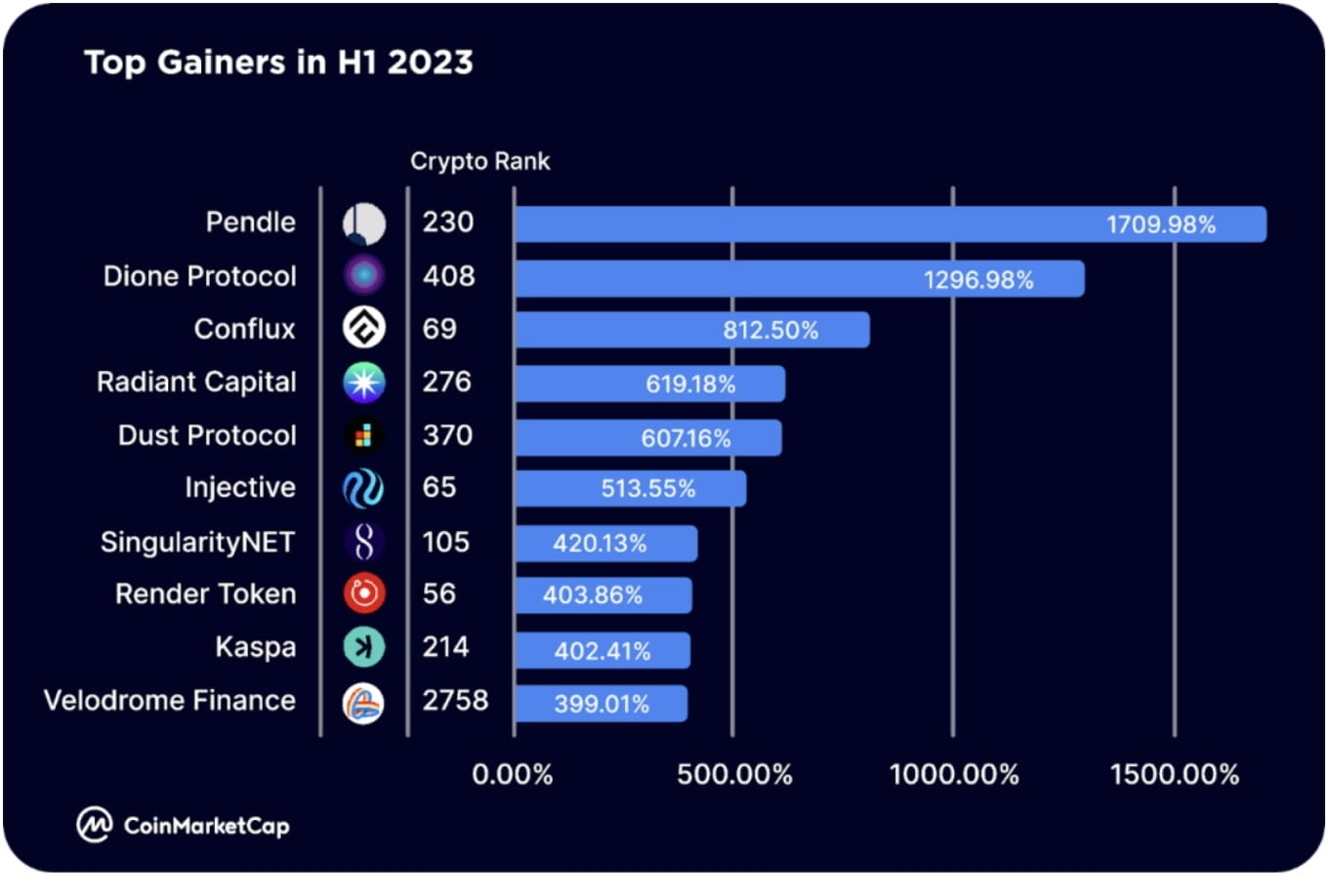
Top gainers in the first half of 2023 include Arbitrum ecosystem tokens such as Pendle (PENDLE), which was listed on the Binance Launchpool and expanded to BNB Chain; Radiant Capital (RDNT), which was also deployed on BNB Chain and will expand to Ethereum; and Optimism ecosystem tokens such as Velodrome Finance (VELO), which launched V2 on June 23
Other top gainers include first-tier blockchains, including Dione Protocol (DIONE), a "renewable energy-enabled L1 blockchain in development" that recently launched its Odyssey Testnet beta Conflux (CFX ), the blockchain is part of Hong Kong’s narrative as “China’s only regulatory-compliant, public and permissionless blockchain,” and Injective (INJ), an L1 blockchain purpose-built for finance, that powers the IBC ecosystem Launched the first Solana SVM rollup.
Other top gainers include AI-related tokens such as SingularityNET (AGIX) and Render (RNDR).
Chapter 4: Key themes for the second half of 2023
Bitcoin ETF

In June 2023, BlackRock, the world's largest asset management company, applied for a Bitcoin spot ETF, triggering strong expectations that the U.S. SEC would approve a Bitcoin spot ETF. Other industry pioneers such as Valkyrie, Fidelity, ARK Invest and 21 Shares have also applied. Seeking approval for something like a Bitcoin ETF. If these ETFs are approved, they could unlock demand from large institutional investors by offering regulated asset allocation products. Globally, current cryptocurrency ETFs and ETPs have an asset value of $9.5 billion. Once U.S. markets unlock with the approval of a new Bitcoin spot ETF, a surge in demand for Bitcoin could push its price significantly above all-time highs.
Decentralized public infrastructure network
Another trend is decentralized physical infrastructure (DePIN), which provides solutions for shared access to physical assets or services such as warehousing and data networks. Builders and users are incentivized by tokens, and access is facilitated by staking, burning, or purchasing tokens/NFTs.
Although still in the early stages of expansion, the DePIN landscape already includes several notable players, including Helium (decentralized wireless infrastructure), IoTeX (Internet of Things hub), Arweave, and Filecoin (decentralized storage).
real assets
Today, there is an ecosystem of projects focused on making RWA transactable on-chain. These protocols primarily include credit market protocols such as Maple Finance and Goldfinch, which allow businesses to use DeFi to obtain financing and loans.
Instead, other platforms are now starting to focus on the tokenization of RWA, including real estate, collectibles, stocks, intellectual property, etc., which can then be traded on-chain with less friction.
We expect the RWA space to further stratify in the second half of 2023 and beyond, with the first consumer-ready products likely to be launched before the end of the year.
Liquid pledged derivatives
Activity in Liquidity Staken Derivatives (LSD) has grown significantly in the first half of 2023, mainly due to the Ethereum Shapella upgrade, with market leaders such as Lido and Rocket Pool each increasing their total value locked (TVL) by 138% in the first half of the year. % and 220% in 2023.
By the end of June, the LSD platform had captured more than a third of Ethereum’s TVS, with Lido capturing nearly 75% of the share at its peak.

The first half also saw dramatic growth in the related LSDfi space, with platforms such as Pendle, Lybra and Flashstake seeing their TVLs rise during this time. This spread is likely to continue through the remainder of 2023.
Re-staking
Following the launch of EigenLayer, re-hypothecation emerged as a promising theme in the first half of 2023. EigenLayer is a middleware platform that allows staked ETH or liquidity staked ETH tokens to be reused on the consensus layer.
This allows users to earn additional revenue by re-staking their assets elsewhere, while providing a new market for shared security – helping projects and services bootstrap new trust networks and enhance their security.
In June 2023, EigenLayer’s restaking smart contract was deployed and reached its maximum limit within a day of mainnet launch, indicating considerable demand for the restaking service.
The platform will soon increase its LST re-staking capabilities, which will become the focus of the re-staking space and potentially open the floodgates for a new wave of projects.
zkSync
In 2023, zkSync became a popular Ethereum-based Layer-2 solution and competed heavily with existing Ethereum Optimistic Rollups, including Optimism and Arbitrum.
As a zero-knowledge rollup (zkRollup) solution, zk-Sync uses zero-knowledge technology to offload traffic from Ethereum to an efficient second layer. Not only does this help increase Ethereum’s throughput, but it also enables a range of new applications.
In March 2023, zkSync launched the alpha mainnet, and zkSync Era became the first zkEVM to reach the mainnet development stage. According to L2beat, the total value locked (TVL) on the platform has grown significantly since launch, reaching $686 million by the end of the first half of 2023. It ranks behind Arbitrum ($5.66B) and Optimism ($2.12B).
The platform has over 1.1 million unique wallets and has recorded and counted 1.38 million transactions.
With a zkSync airdrop potentially imminent and a slew of projects set to launch on the platform, zkSync is expected to be a key player in 2023.
Modular Blockchain (Celestia)
Currently, most layer-1 blockchains are single-chain—execution, data availability, security, and consensus are all on one chain. This leads to a series of limitations around efficiency due to the blockchain trilemma of decentralization, security, and scalability.

Modular blockchains like Celestia aim to address this challenge by dividing the blockchain into three layers: execution, settlement, consensus, and data availability. It provides developers with a modular data availability and consensus layer that dApps and sidechains can leverage to guide development.
Meanwhile, other platforms have emerged offering modular execution environments and settlement layers – including Rollkit (settlement) and Fuel (execution).
Together, these platforms and more can help improve existing blockchains overall—including Ethereum and Solana.
FTX bankruptcy news
FTX depositors have been left in limbo for months after last year's collapse as it was unclear how much of the nearly $9 billion shortfall could be filled in the liquidation process.
In January of this year, news broke that more than $5 billion in liquid assets had been backed up from various sources, with this figure set to grow to over $7.3 billion by April 2023, providing some much-needed relief to FTX clients.
With the process now moving in the right direction, the restructuring firm handling the case recently contacted creditors and gave them a "customer deadline" of September 29, 2023.

Additionally, the FTX legal team is currently considering restarting the cryptocurrency exchange. Although it is unclear whether this will require the use of debtor assets or raising new funds from elsewhere.
Despite recent progress, debtors will not receive payments until at least the second half of 2024.
Chapter 5: Cryptocurrency Users Around the World

In the first half of 2023, regional differences in interest in various cryptocurrency niches and industries were not significant.
Bitcoin (BTC) remained the most viewed cryptocurrency across all regions in the first half of 2023, similar to the trend seen in the fourth quarter of 2022. This is also reflected in Bitcoin’s dominance relative to altcoins (BTC.D), which rose from 40.09% at the beginning of the year to 50.39% by the end of the first half of 2023, a gain of 25%. This could be attributed to events such as BlackRock’s iShares Spot Bitcoin ETF filing and the upcoming Bitcoin halving around March 2024.
The Shiba Inu (SHIB) remains a popular memecoin across all regions, along with Dogecoin (BabyDoge) in South America, Asia, and Africa. As the new entrant to the most viewed cryptocurrency in every region, PEPE’s explosive growth has caught the attention of cryptocurrency traders and speculators in all regions except South America.
Meanwhile, Ethereum (ETH) remains a popular currency in most regions outside of Asia and Africa, while Ethereum scaling solutions like Polygon (MATIC) and Arbitrum (ARB) are in South America respectively. and other areas are receiving attention.
Countries/Regions with the Most CMC Users

The United States continues to dominate in terms of global distribution of cryptocurrency users. 17.4% of traffic in the first half of 2023 came from US users, with users in India, Turkey, Germany, Brazil and Vietnam accounting for 7.90%, 7.40%, 6.98%, 6.75% and 6% respectively.
The vast majority of the remaining traffic comes primarily from users in Europe and Asia.