


Table of contents
1. Key points
2. Background
3. From applications to infrastructure: Seeking game exposure
4. Overview
5. Industry Outlook and Competition Landscape
6. Argument
7. Different Voices
8. Conclusion
9. Show
10. References
The concept of Web3 gaming and the Metaverse gained significant traction during the last market cycle, enabling users to own, buy and sell digital assets with verifiable ownership. This lays the foundation for creating a game economy on-chain, enhancing the value of game assets and allowing players to monetize their skills. However, with the advent of artificial intelligence and new L1 and L2 blockchains entering the market, this narrative has lost a lot of traction over the past few months.
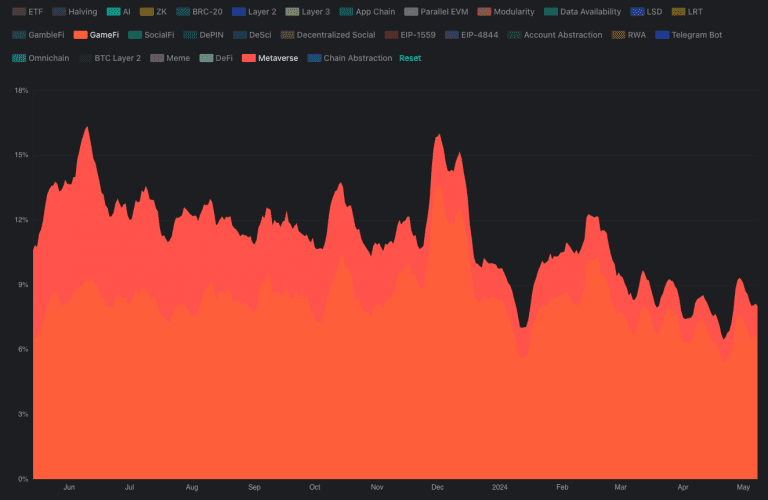
Source: kaito.ai - Metaverse and GameFi narrative share has declined over the past 12 months and currently accounts for ~7% of the total.
Within this market sector, Axie Infinity demonstrates how large the total addressable market (TAM) for gaming digital assets is. The price of $AXS surged from $3 in June 2021 to a local high of $82 in September, ultimately reaching an all-time high of $157 in November.
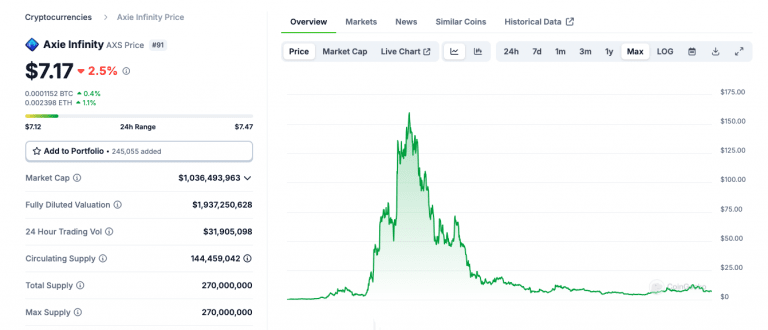
Source: Coingecko - $AXS Price Trends
While we have witnessed more heated topics in the crypto space since the beginning of the year, such as artificial intelligence, second layer solutions, meme coins or re-staking, we believe that the increase in active wallets and users in GameFi has not received enough attention. This provides us with a window to get ahead of what may become one of the strongest topics later in this cycle. While Ronin has been growing steadily, its growth has been relatively quiet. We believe that if cryptocurrencies want to surpass the highs of previous cycles, we need to get regular consumer adoption.
Key Takeaways
The attention and hype have left the Web3 gaming space, and now more real users account for a larger share of value in the on-chain gaming ecosystem.
The Ronin cross-chain bridge hack and Axie Infinity’s fall from grace may have hindered the recent development of the Ronin chain, which has not received the attention it deserves from crypto investors.
The Ronin ecosystem has received strong support from renowned investors such as a16z and Animoca Brands in multiple funding rounds1, totaling $311 million.
Now, a series of new games are being launched on Ronin, and the distribution mechanisms and incentives of these games are designed to attract a large number of users. Users holding $RON may also be eligible for airdrops from ecosystem games.
Ronin’s user base has grown significantly, which we believe is a key leading indicator to start driving the flywheel effect of more users attracting more developers, ultimately driving greater demand for $RON.
Ronin is a "tools and shovels" investment that gives us exposure to the broader gaming market while diversifying the risks associated with individual games.
Investing in $RON provides an opportunity to benefit from the overall growth of the Web3 gaming sector, with Ronin serving as a core platform supporting currently popular games and potential future success.
background
Ronin Chain is designed for gaming applications. Developed by Sky Mavis, the team behind Axie Infinity, it aims to not only speed up transactions and reduce costs for end users, but also provide features that make it easier to get started, such as the Ronin Wallet.
Sky Mavis is a technology-focused gaming studio founded in early 2018 by a team including Trung Nguyen (CEO with a background in software engineering) and Aleksander Leonard Larsen (COO and Growth Officer with extensive gaming industry experience). The studio’s popularity is largely due to their success with Axie Infinity, which relied heavily on the advantages provided by the $AXS token, becoming one of the pioneers in crypto gaming and one of the most successful games.
High-profile investors such as a16z, Animoca Brands, Binance, Paradigm, etc. supported Sky Mavis in 4 rounds of financing (1 seed round and 3 early-stage rounds), with a total financing of US$311 million (the largest round was US$152 million).
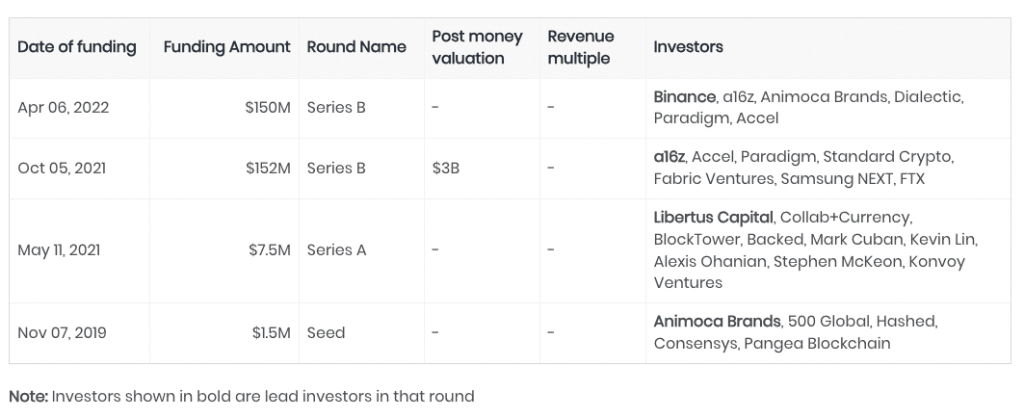
Source: tracxn - Binance was the lead investor in Sky Mavis’ latest funding round, which took place on April 6, 2022.
The development of Ronin was driven by the need to solve the scalability and transaction cost issues that Axie faced in its early days. However, there is a larger vision behind Ronin to enhance its value proposition by building a broader Web3 gaming ecosystem.
In terms of competition, we have witnessed the explosive growth of games, NFTs, and the metaverse during the last bull market, led by projects such as Axie Infinity, The Sandbox, and Decentraland. Specifically, on October 28, 2021, Facebook officially announced its name change to Meta, which further promoted the development of this trend.
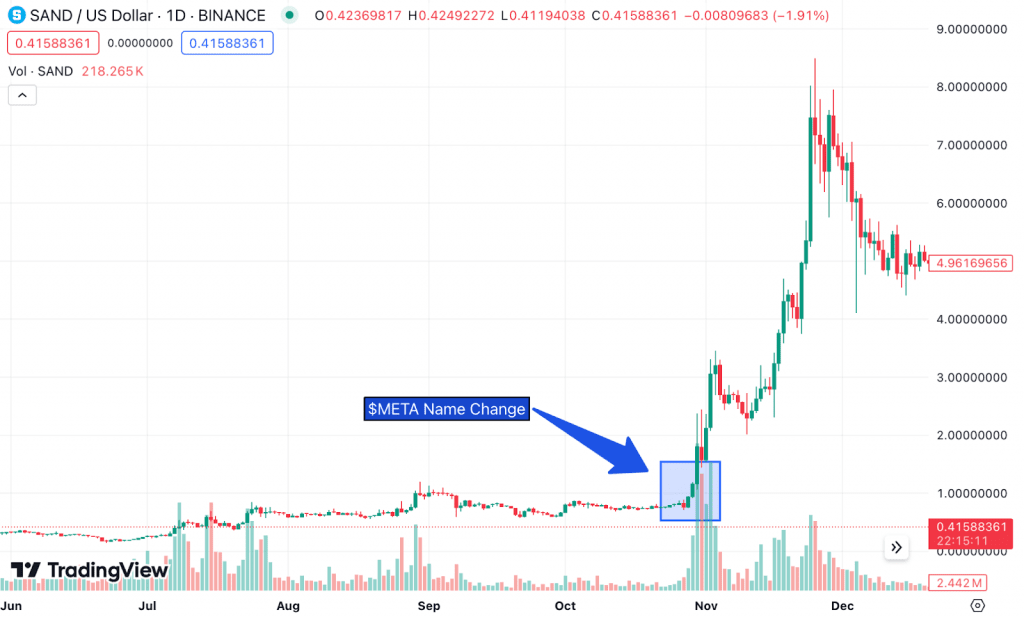
Source: TradingView - $SAND’s price peaked after the Facebook rebrand, with the price increasing by over 800% in less than a month.
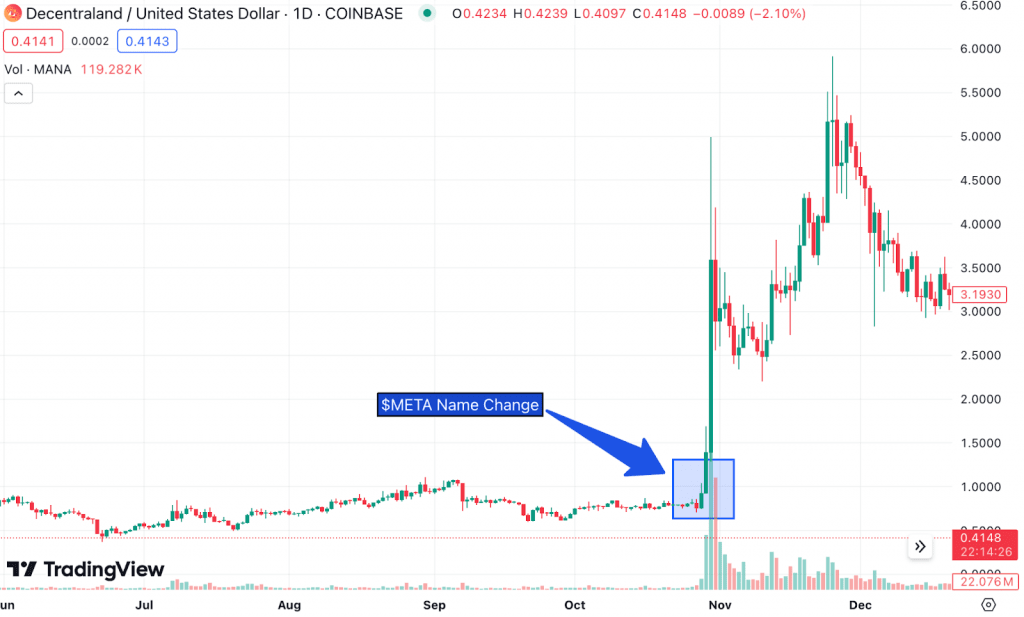
Source: TradingView - $MANA’s price surged 5x, coinciding with Facebook’s rebranding announcement.
While many are betting all their chips on the Metaverse driving blockchain mass adoption, that view is now fading. Mindshare is still being suppressed, and projects working at the intersection of gaming and crypto are still in their early stages, with limited products and low user engagement. In the current environment, the general consensus is that SocialFi and apps like Farcaster or FriendTech are a more effective way to enter the crypto space than Web3 games.
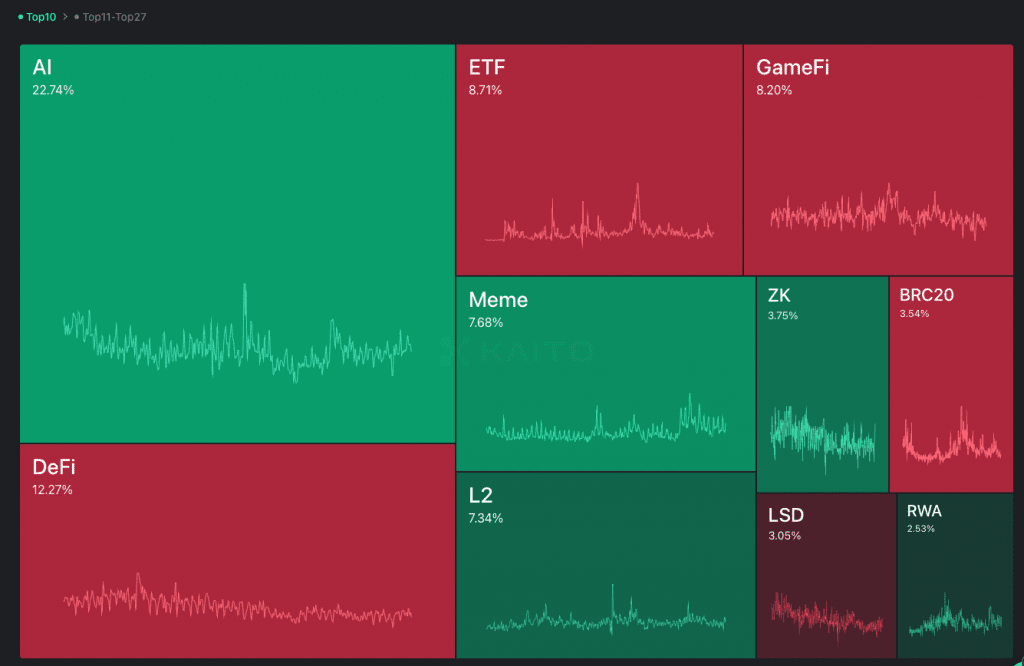
Source: kaito.ai - GameFi accounted for 8% of total crypto narrative share over the past 12 months.
However, despite slower market acceptance, some of the market leaders of the previous cycle have learned their lessons and are ready to recover. Axie is no longer a pet or Pokémon-like game, which previously experienced a decline due to poor economic design or so-called "Ponzi economics." Instead, the Ronin blockchain is now aiming to have the largest user base among all crypto games.
From applications to infrastructure: Seeking exposure for games
At its peak, Axie Infinity had around 730,000 unique active wallets (UAWs), which are wallets that interact with the game’s economy and in-game items. Today, the game’s user base is very different, with less than 40,000 UAWs.
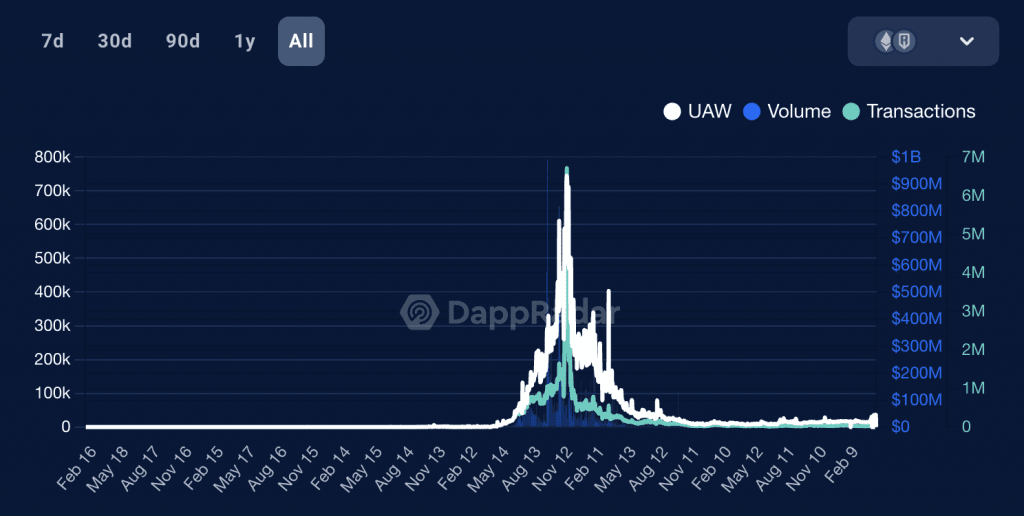
Source: DappRadar - Axie Infinity continues to see a significant drop in active users.
Meanwhile, another game built on the same blockchain (Ronin) has a comparable number of active users as Axie Infinity at its peak, but it hasn’t garnered the same level of attention as the former. That game is Pixels.
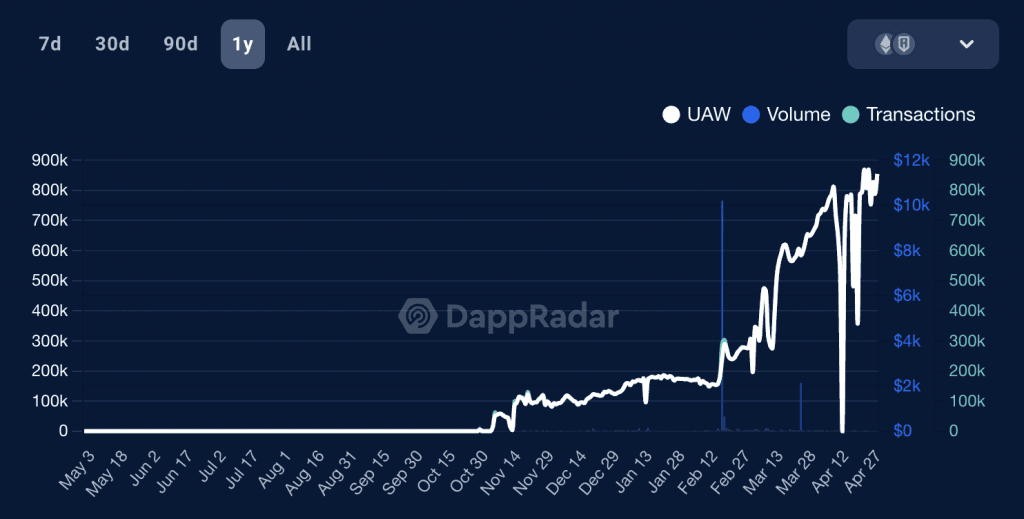
Source: DappRadar - Pixels’ UAW is approaching the levels seen during Axie’s peak.
In its heyday, Axie's native token $AXS had a market cap of over $10 billion. However, over time, the consensus among market participants shifted to supporting gaming infrastructure providers rather than betting on individual games. When you invest in a provider or game studio, you automatically gain exposure to all the games on it, which helps spread the risk. As a result, we've seen a shift in focus from $AXS to other tokens like $IMX or $GALA.
Today, Axie ($AXS) and Pixels ($PIXELS) are the two most popular games on Ronin. The former still has a market cap of $1 billion despite being down 95% from its all-time high, while the latter is trading around $300 million. Both projects currently have a fully diluted market cap of $1.9 billion. However, given the dilution effects of dual-token models like Axie’s $AXS and $SLP, and the massive inflation of token incentives, we advocate betting on Ronin, the actual infrastructure layer that supports both games.
Using $RON as a proxy for betting on Web3 games also allows us to take advantage of the liquidity premium associated with first-layer tokens and availability on major exchanges. $RON is already listed on Binance, Coinbase, and OKX. $RON currently has over 30% of tokens in circulation, with a market cap of $880 million and a fully diluted market cap of $2.7 billion.
Overview
Ronin is an EVM-compatible blockchain designed for gaming, optimized for near-instant transactions, negligible fees, and a frictionless user experience. It was originally created primarily to support Sky Mavis' flagship game Axie Infinity, but its adoption has grown rapidly, and it currently hosts 15 dApps, records over 1 million UAWs per day, 1 million+ transactions, and $5 million+ in daily trading volume.
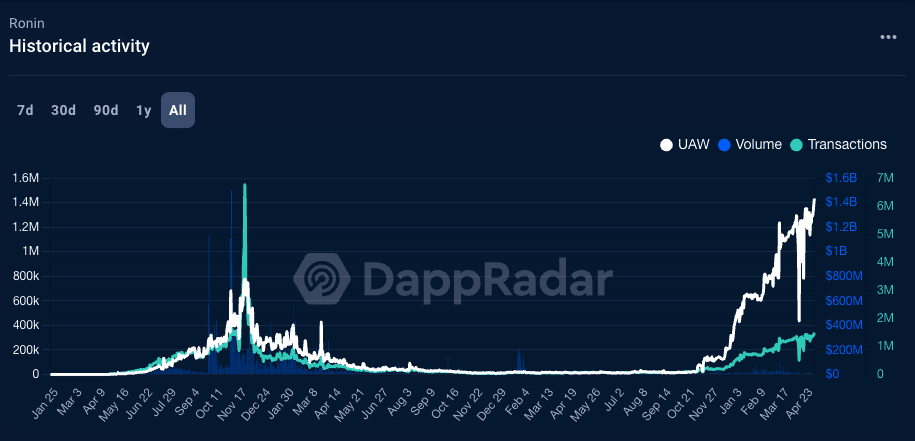
Source: DappRadar - Ronin historical activity
With a transaction volume of over $4 billion, Ronin is on its way to becoming one of the most dominant gaming chains on the market, as well as a major marketplace and distribution channel for games deployed on it.
Backing Ronin is the $RON token, which is issued through a pool on its native Katana DEX. There is no private sale, and the initial supply is distributed through an incentivized liquidity program. Issuance is reduced quarterly, with a total issuance capped at 1 billion, reached 108 months after launch.
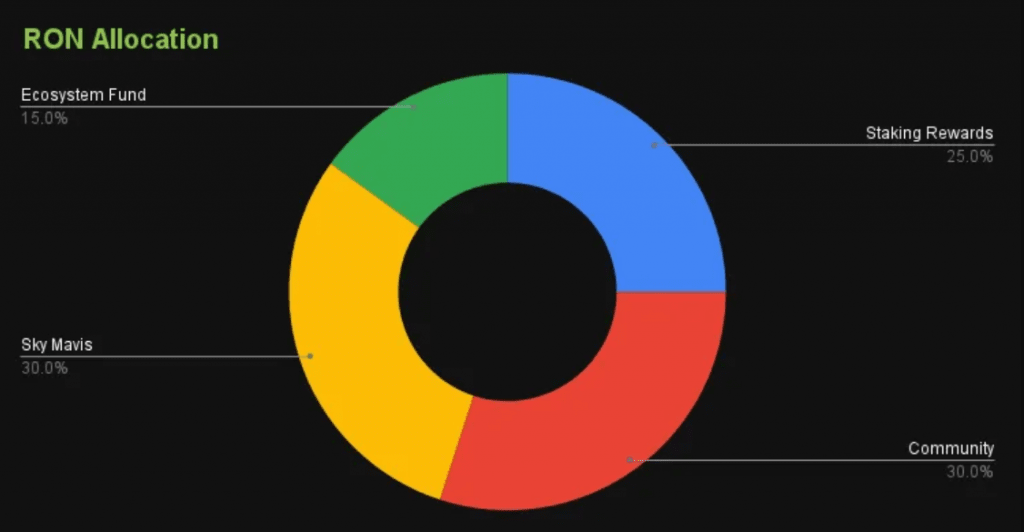
Source: Coingecko - $RON Token Distribution
As the native token of the chain, $RON is used to pay transaction fees, participate in governance, and ensure the security of the chain by earning income from inflation emissions by staking tokens.
Despite a complicated launch and suffering one of the largest attacks in crypto history, resulting in $650 million in losses, Ronin quickly recovered in 2023, attracting many world-renowned game studios such as Foonie Magus, Directive Games, Bali Games, Tribes Studio, and Bowled.io
Industry Outlook and Competition Landscape
The Web3 gaming space, currently valued at $23 billion, has seen a recent surge in activity and interest. Among its projects, Ronin has successfully proven to be an effective primary distribution channel for crypto games, as evidenced by the recent success of Pixels Online following its migration from Polygon.
Currently, Ronin has a market cap of $880 million, ranking eighth in its category, while Immutable leads with $2.9 billion. However, beyond valuation, Ronin stands out on several key metrics.
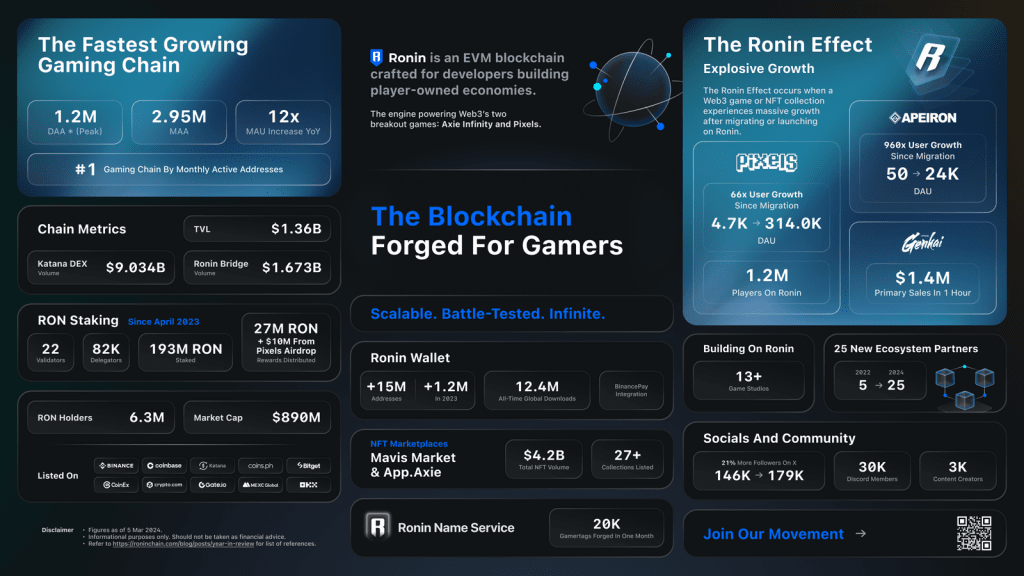
Source: Ronin Blog - Fastest Growing Gaming Blockchain as of March 5, 2024
While transaction volumes are still well below 2021 levels, Ronin is now the second most used blockchain, having experienced significant growth over the past six months. Additionally, there are 3.37 million unique active users in the past 30 days.
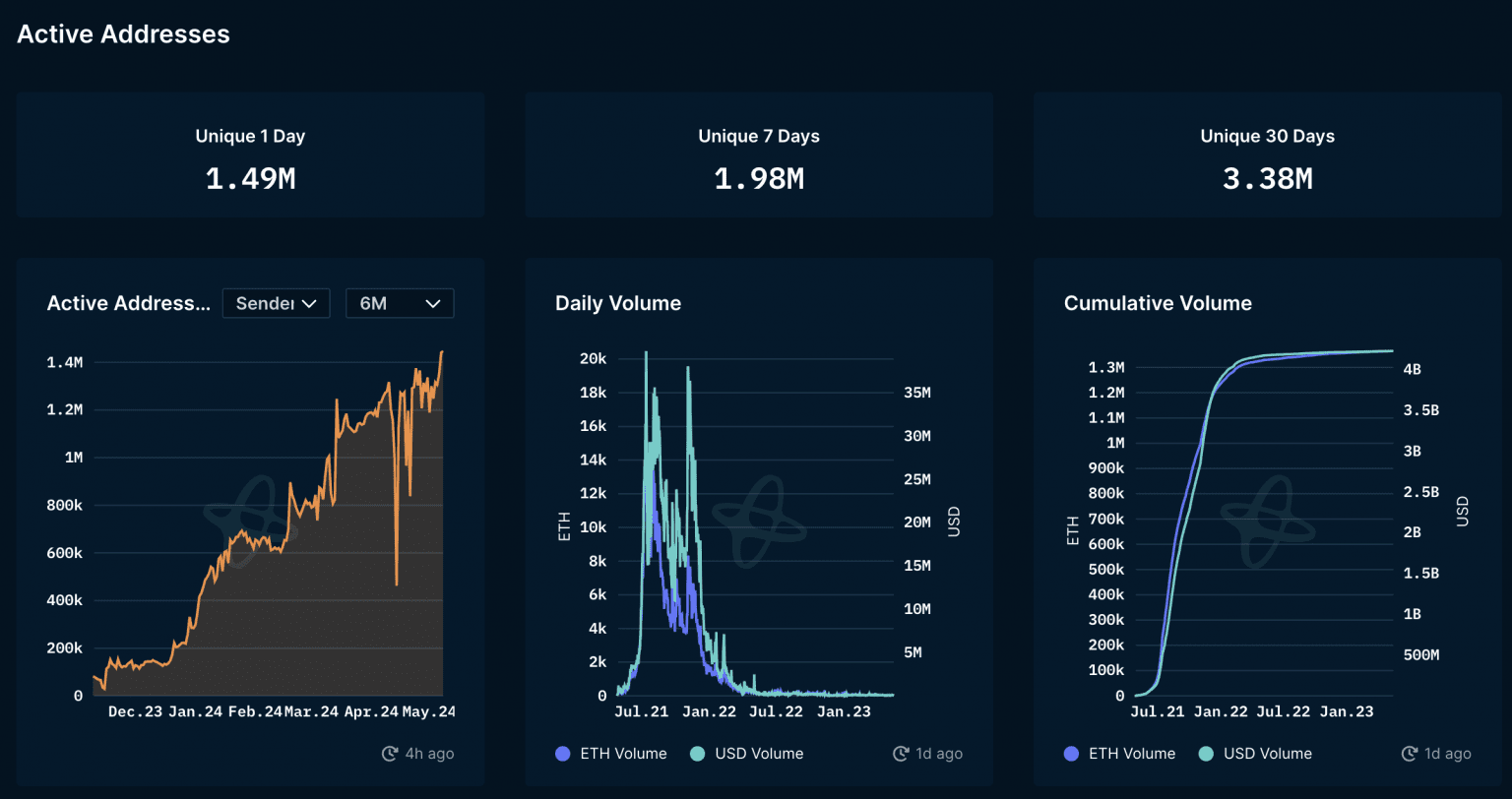
Source: Nansen - Ronin active addresses as of May 7, 2024
Ronin has more than 1.4 million active users, an increase of approximately 1,790% since November 2023. As of May 9, Ronin has approximately 18.9 million total addresses, with an average daily transaction volume of 1.28 million transactions over the past 30 days and a TVL of $183 million (cross-chain TVL of $1.06 billion).
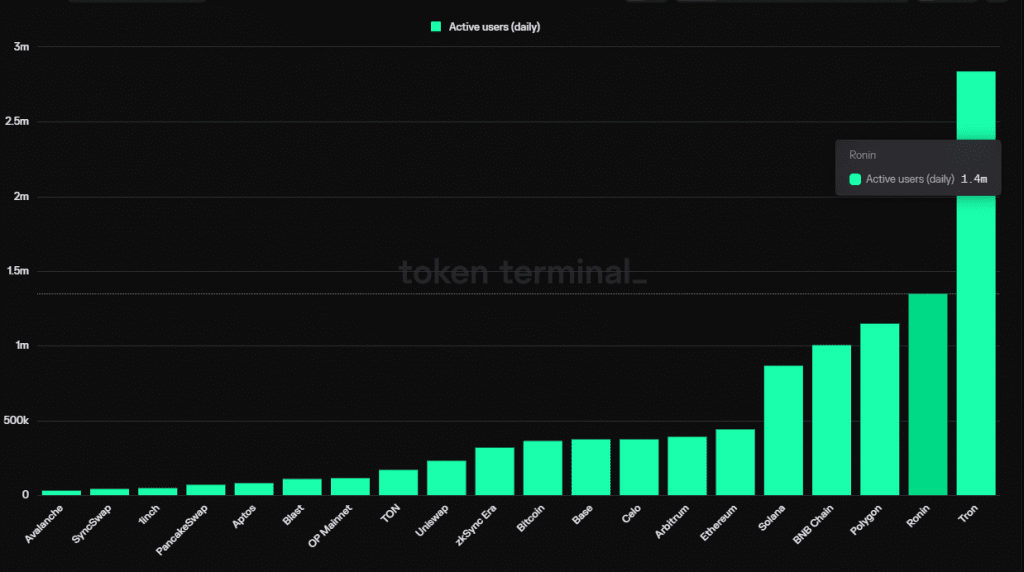
Source: TokenTerminal - Ronin ranks second in terms of daily active users (DAUs), second only to Tron, which is mainly dominated by $USDT transfers.
By 2024, Ronin reached its previous all-time high (ATH) of $4.23, but has since retreated by about 40% to a current price of $2.8. Given the expansion of the gaming industry and Ronin’s strong performance indicators, if the bull run continues, Ronin has the potential to surpass its ATH and enter a new price discovery phase.
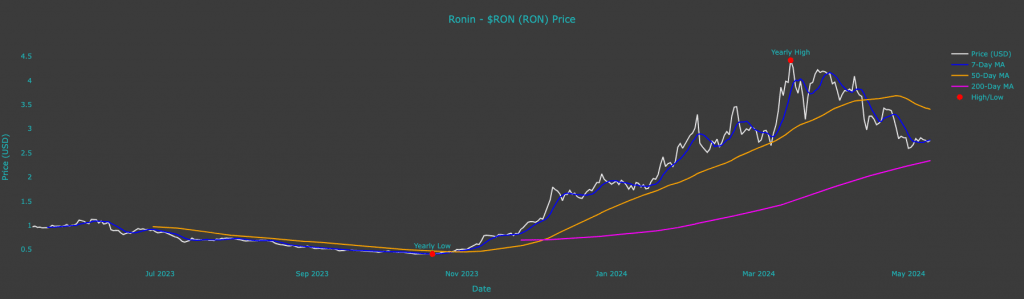
Source: CoinGecko
argument
Investing in $RON gives you exposure to the broader Web3 gaming market, helping to diversify the risk that comes with over-investing in a specific game. Even in Web2, games often face user stickiness and retention issues. Therefore, Ronin serves as a "mining tool and shovel" option in the crypto gaming space. This allows us to capture the upside of multiple games that decide to launch on the platform. Ultimately, most of these games will experience ups and downs, some of them will ride on the wave of short-term hype, and only a few will be able to stay in the long run.
Ronin’s versatility is not limited to hosting some of the most popular games in Web3, such as Axie Infinity and Pixel. Its ambition is to become the platform of choice for the most used games in the future. This has not gone unnoticed so far, as well-known games like Apeiron and Wild Forest, as well as NFT communities like Cyberkongz, have recently started to turn all their efforts to growing their communities on Ronin. Another differentiating factor is the support for DeFi primitives, as shown by Katana DEX, Metalend or Mavis Market (NFT Marketplace).
Active wallets are a key metric when analyzing an ecosystem, and Ronin performs well in this regard. This helps measure player interest and can serve as a leading indicator of future network activity. An increase in the number of users generally means more transactions and shows usage of applications built on the base chain, which drives demand for the native token. Additionally, growth in the number of active users can also increase investor confidence, making it more likely that the network effect will be stronger in the future. In short, this is the key to achieving a virtuous cycle, where more active users can lead to more developers building on the chain, further attracting new users and driving exponential growth in demand for the native token.
Now that $RON has enabled staking, and we already have a precedent for $PIXEL, if you plan to hold $RON as a spot position, you might as well stake it to reduce dilution and increase your chances of receiving airdrops from ecosystem projects.
Different Voices
The main risk of investing in $RON comes from the broader uncertainty in the Web3 gaming space. While a large amount of capital has been allocated to game studios to build Web3 games, we cannot underestimate the complexity of this challenge and the time required for the development process.
While $RON benefits from not relying on the success of a single game, like Axie, it is ultimately an EVM-compatible chain, which can be quite inflexible and limited compared to other high-throughput chains like Solana or Sui. Nonetheless, as long as the majority of logic is executed off-chain, the EVM already has strong network effects and has proven its resilience over time.
At the same time, while betting on an ecosystem that covers a broad range of games can help us hedge downside risk, it also limits the possibility of gaining upside potential through rapid price movements of individual games. For example, if a game like Pixels grows in prominence, $RON may underperform relative to the $PIXEL token.
in conclusion
In conclusion, while Web3 games generally have longer development timelines than DeFi protocols, if you really believe in this market, it is crucial to stay invested. While we continue to wait for AAA games to enter the market, we think betting on a growing ecosystem that has the potential to become a leader seems to be the smartest choice.
Show
We have never had a commercial relationship with Ronin or SkyMavis and this report was not paid or commissioned.
Members of our team, including those directly involved in the analysis above, may hold positions in the tokens discussed.
This content is for educational purposes only and does not constitute financial or investment advice. You should do your own research and only invest what you can afford to lose. We are a research platform, not an investment or financial advisor.
References
Ronin Docs
Ron's zkEVM
Ron's Blog
Ronin Substack/ Newsletter
Ronin Twitter
Ronin Litepaper
Ronin Coingecko
Sky Mavis Funding Details
Ronin DappRadar
Pixels DappRadar
Axie Infinity DappRadar
Ronin Bridge Hack CoinDesk Article
CoinDesk Jihoz Interview
Ronin Network is highly sought after, what is its potential? (2024/02/25)
Top Gaming Tokens by Market Capitalization
Ronin Chain Blog
Pixel 3M Lifetime wallets
Ronin stats (2024/04/30)
Ronin Active Addresses and Volumes
Breaking: RON listed on Coinbase
Ronin Stats (2024/05/07)
Gaming Token Analytics
Ronin Token Terminal
Jihoz $RON Coinase Listing Thread
Jihoz Ronin Chain Growth Tweet
Jason Choi Ronin Thread
0xNathan Pixels Growth Tweet
What is Ronin Network? All About the Gaming Blockchain (2023-nov)
DappRadar Ronin Background Article
DappRadar: Blockchain Game Rankings
$RON Coinmarketcap
Ron's TVL DefiLlama
Footprint Analytics Chain Stats
Source of this article: Revelointel