

Cryptography has made incredible progress over the past few years, and the blockchain protocol industry is now extremely competitive. With advances in speed, scale, and power consumption, the promise of Web3 and the growth of a blockchain-based internet is beginning to redefine what’s possible with technology.
Blockchain technology was first introduced as a financial tool for creating and managing cryptocurrencies with the advent of Bitcoin, and after the launch of Ethereum, it quickly evolved into programmable currencies and smart contracts.
Now, blockchains are designed to fight centralization of all databases, storage, and computing to support innovative new dapps and services.
As the industry matures from a primary focus on financial products to the revolutionary decentralized technology stack of Web3, some key metrics can be used to compare and evaluate Layer-1 competitors: transaction throughput, finality, transaction costs, energy efficiency, and on-chain storage costs.
This article reviews these metrics for leading protocols from public datasets and real-time dashboards to provide a clear comparison of the level at which these chains are currently operating.
Transaction throughput
In order for blockchain networks to attract users, they must be able to deliver an experience that meets the expectations of today’s web users, and do so in a scalable manner, which means providing fast website and application screen loading (read operations) as well as reasonably fast data writing.
Most blockchains perform well on read operations, but Layer-1 protocols may have difficulty scaling their data writes to the point where they can accommodate millions of users and still provide a good user experience.
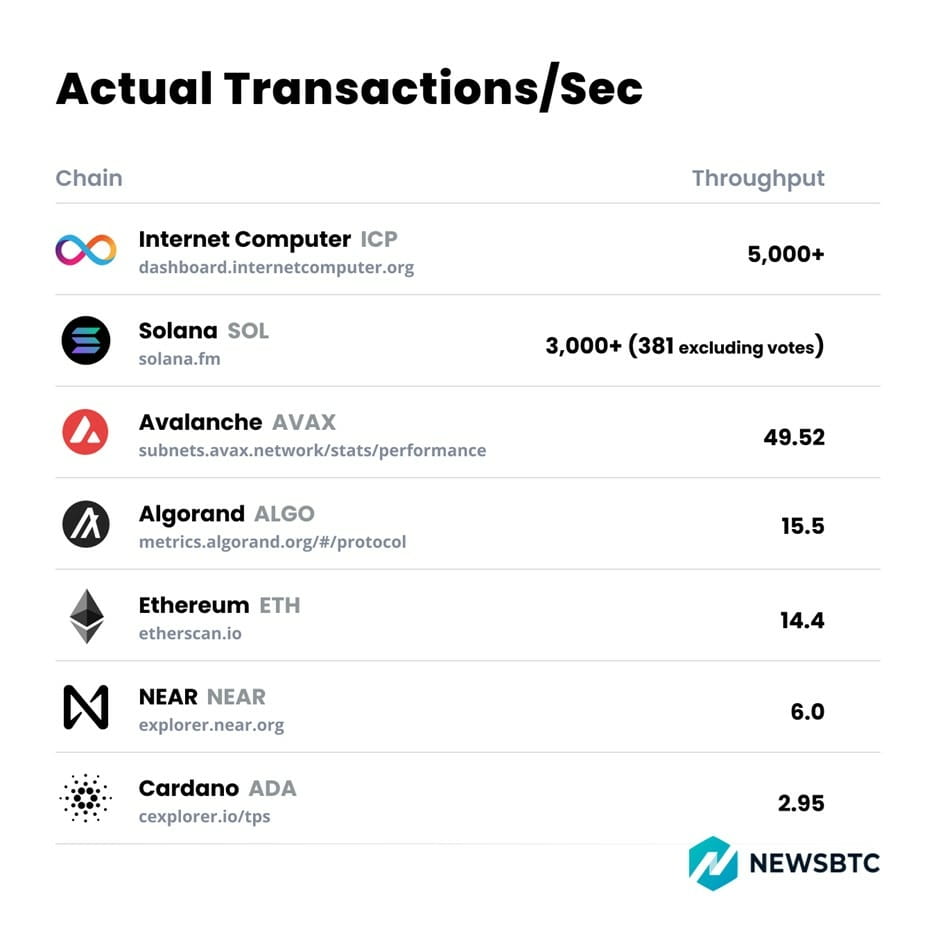 Throughput is a measure of network scalability — the ability of a blockchain to write data and update its state for millions and billions of network users and Internet of Things (IoT) devices. To provide a satisfactory user experience for mainstream internet users, blockchains need to be able to process thousands of transactions per second.
Only Solana and the Internet Computer have demonstrated actual transaction speeds that achieve this feat, and despite the majority of Solana’s transactions being voting transactions for validators, which do not exist on other chains, the SolanaFM explorer shows Solana’s real TPS to be around 381.
Other chains either do not generate the traffic required to demonstrate high throughput or are technically unable to achieve high throughput.
Finality
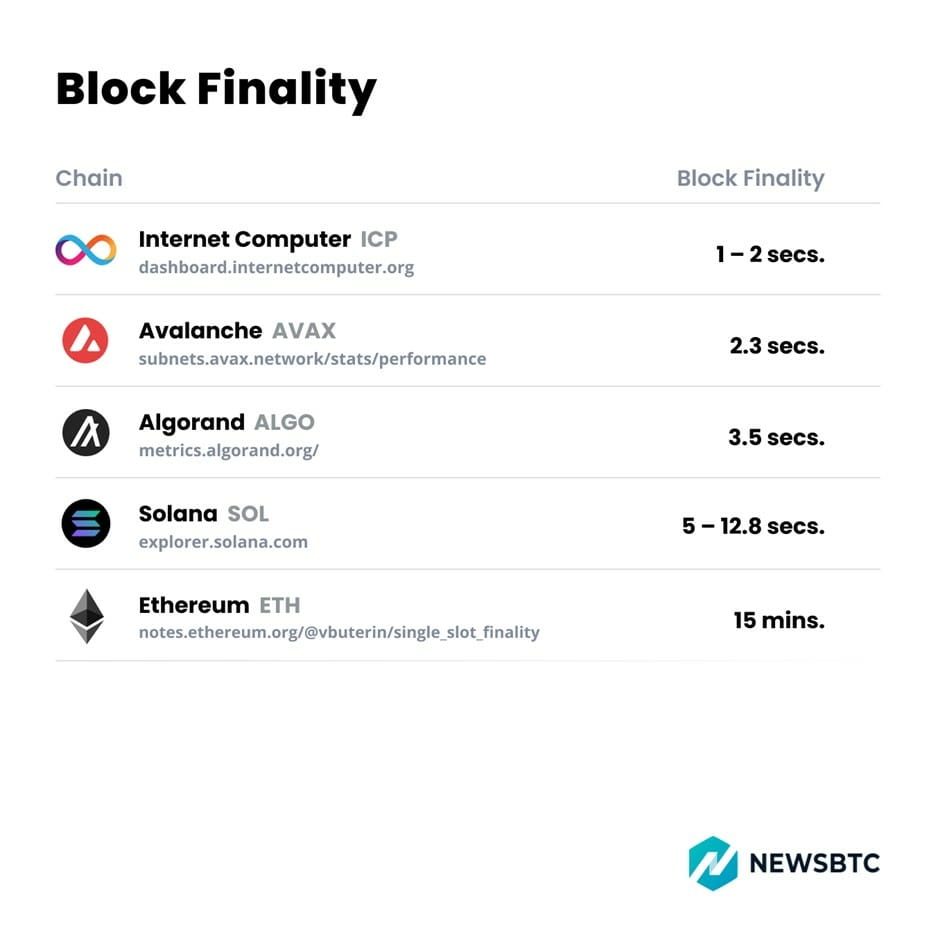
Finality refers to the average amount of time that passes between the proposal of a new valid block containing transactions and the time when that block is finalized and its contents are guaranteed not to be revoked or modified. (For some blockchains, such as Bitcoin, the moment of finalization can only be determined probabilistically.) This metric also affects user experience, as users are less likely to use applications that take more than a few seconds to complete operations.
 transaction cost
Blockchain originated as a financial product that could offer much lower transaction costs than traditional finance and execute transactions faster, and high transaction costs have shaped the way we use the internet and monetize content.
Because of these costs, content creators and applications often prefer larger transactional value models, such as subscriptions or bulk purchases of content.
Transaction costs are typically related in some way to the value of the network token to which they are associated, so the values below are current as of the time of writing this article during the week of November 14, 2022.
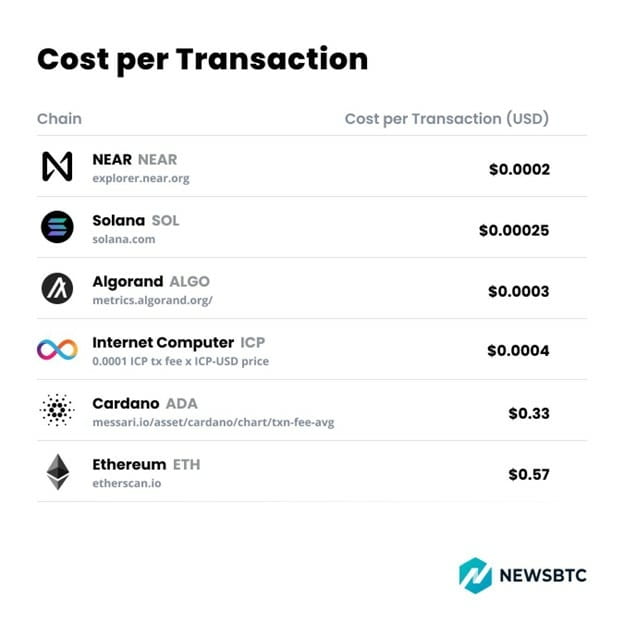 Cheaper transaction costs could support websites and applications developing new revenue models, such as microtransactions like tipping. For these types of models to emerge, the transaction costs of a blockchain must be a small fraction of the expected average transaction value.
energy efficiency
As industries around the world strive to become more sustainable in the face of climate change, energy efficiency has become a major area of focus in the crypto space, and it can also be seen as a measure of how well a blockchain can perform and how well it can scale.
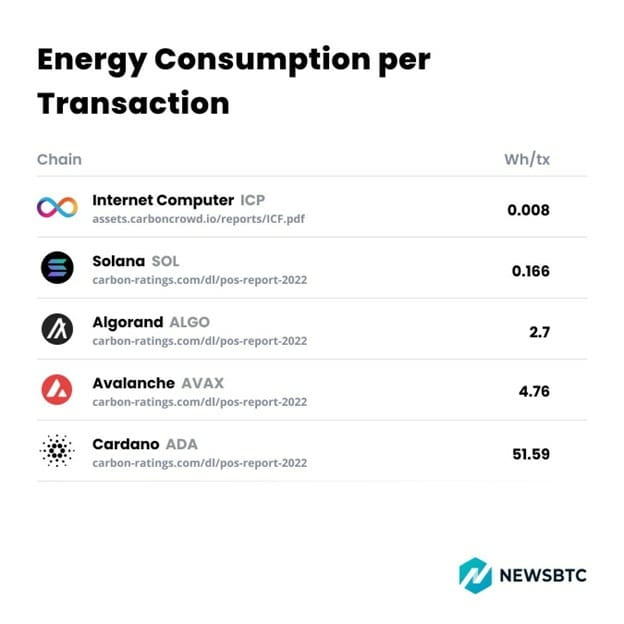 Improving the efficiency of blockchain will not only reduce the carbon footprint of the technology stack, but also reduce the energy costs associated with the protocol. More energy-efficient networks and the applications built on them will have an advantage in an increasingly competitive market.
On-chain storage costs
On-chain storage has been an ongoing challenge for blockchains, which often struggle to scale to meet the needs of consumer-facing applications that require large amounts of data hosting, forcing many developers to rely on Web2 intermediaries for storage and front-end hosting, compromising security, resiliency, and decentralization.
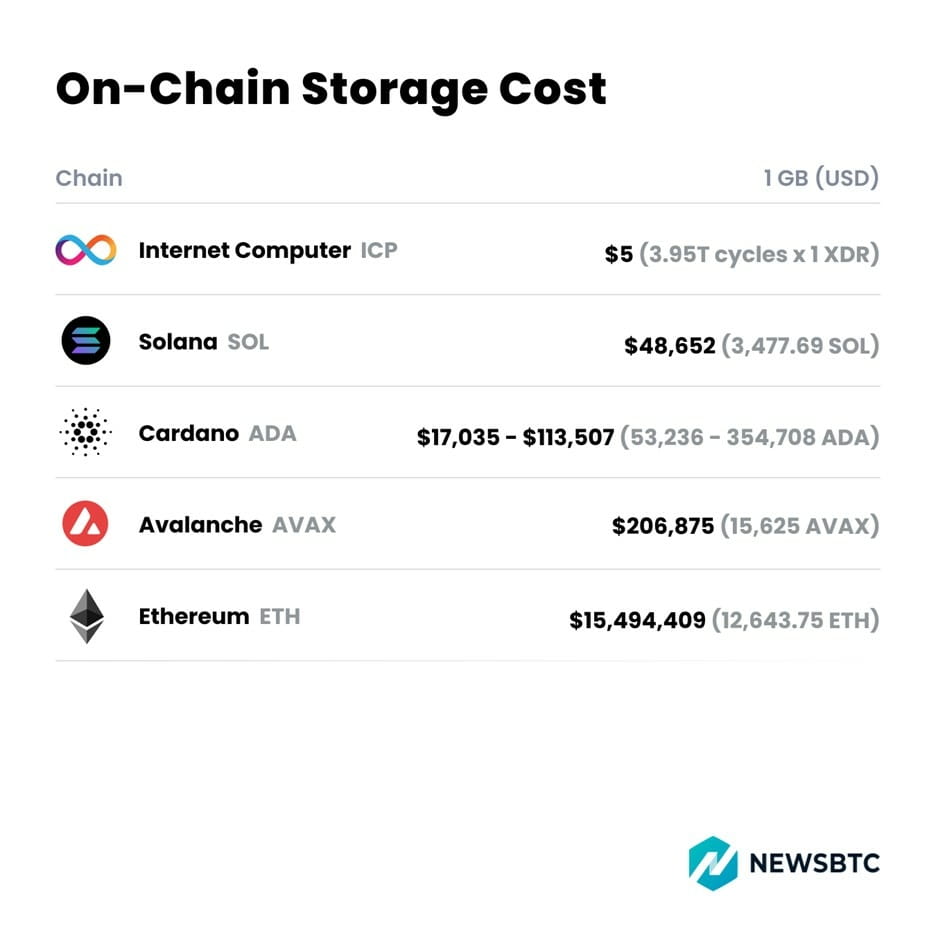 Among the best performing L1s, the Internet Computer was found to have the lowest and most stable on-chain data storage costs, with “Gas” taking the form of “Cycles”, with 1 trillion Cycles pegged to 1 XDR (equivalent to $1.31 at the time of writing).
Developers convert ICP to Cycles to pay for data usage, and 1 GB per month requires 329 billion Cycles, which is equivalent to $0.423 - equivalent to $5.07 per GB per year.
The cost of storing data on L1 protocols typically fluctuates with the value of their associated network token, with fees rising with the value of the token and vice versa.
At the time of writing, Solana’s annual rental rate is 0.00000348 SOL per byte, which works out to 3,477.69 SOL per GB per year, which at SOL’s current price of $13.99, equates to a rate of $48,652.
Cardano currently has no way to store non-financial data such as media files and store all transactions permanently. For simplicity, we skip the computational costs associated with processing transactions.
At a price of $0.32 at the time of writing, the cost of storing 1GB of transactions depends on the size of each transaction, with 2 million transactions of 500 bytes each generating 354,708 ADA ($113,506.56) and 62,500 transactions of 16 KB each equaling 53,236.08 ADA ($17,035.54) representing the lowest per-byte fee.
Avalanche’s gas price is about 25 NanoAVAX, and 32 bytes cost about 0.0005 AVAX.
For simplicity, we skip the gas costs of smart contract code execution and allocated storage and only consider the minimum cost of the SSTORE operation, which makes the cost of storing 1GB of data approximately 15,625 AVAX, which is $13.24 AVAX at the time of writing, for a total of $206,875.
Ethereum’s congestion and high costs have motivated a push for on-chain efficiency, which still sets the bar for fees. For simplicity, we skip the gas costs of smart contract code execution and allocated storage and only consider the minimum cost of the SSTORE operation.
The network consumes 20K gas units to perform an SSTORE operation on 32 bytes of data, which translates to 625B gas units for 1 GB of data, and at the time of writing this article, the average gas cost is 20.23 Gwei, or 12.64375T Gwei, or 12,643.75 ETH.
At the time of writing, the price of ETH is $1,225.46, which is equivalent to $15,494,409.
in conclusion
As the blockchain industry evolves into the next-generation technology stack capable of reopening the consumer internet, only a few platforms have the technical specifications necessary to deliver the user experience that most internet users expect.
A top-performing Layer-1 network will enable the development of previously impossible applications and services, including revolutionary capabilities in areas such as security, microtransactions, and decentralized ownership of data and applications.
Source: NewsBTC
Translation: Catherine
IC content you care about
Technology Progress | Project Information | Global Activities
 Collect and follow IC Binance Channel
Answer your questions at any time