

Two years ago, Bitcoin dominated the cryptocurrency market, gobbling up 70% of its market value. But as crypto assets swelled to more than $2 trillion, the industry has fragmented.
Today, Bitcoin’s share is below 40%, and new crypto networks are emerging every day. One way to sift through the clutter and understand where the industry is headed is to follow the software developers who build and maintain crypto networks.
“Developers tend to be very rational, and if there’s something they can use that has real utility, developers have the ability to seek that thing out,” said Avichal Garg, managing partner at Electric Capital, a crypto-focused venture capital firm.
He believes that the number of developers working on crypto networks “is a leading indicator of where value will be created and accumulated over the next 10 years.”
Garg co-authored a report with Electric Capital partner Maria Shen that revealed which cryptocurrency platforms attracted the most developers in 2021.
They used data from GitHub, the go-to online repository for developers to store their code, to estimate the number of engineers working on each platform, but their data underestimates the total number of developers because it doesn’t capture the many engineers who write code privately or work at companies like Coinbase.
Their research shows that there are 18,000 active developers (including full-time and part-time contributors) working on cryptocurrency platforms, up from about 10,000 a year ago, a surge that Garg sees as validation of the industry’s growth and longevity.
Kinjal Shah, an investor at Blockchain Capital, agreed, saying: “When people vote with their feet and their time, it’s a strong signal that they are building something for the long term.”
Electric Capital's study analyzed nearly 500,000 sets of code and 160 million code updates. It compared growth in December 2020 and December 2021. For the list below, developers were counted as full-time if they made at least 10 software updates in a month.
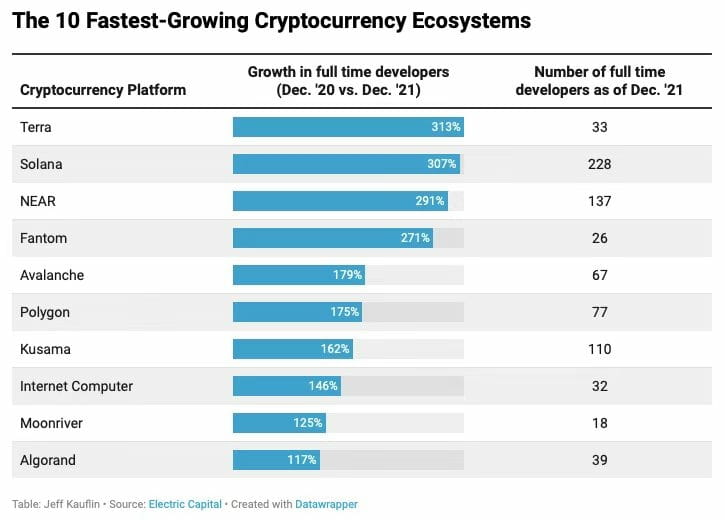
The fastest-growing platforms are all competitors to Ethereum, the second-largest crypto network that launched in 2015 and has 1,300 full-time developers creating applications on it. Ethereum acts as a decentralized computer on which applications can be built, and it is maintained by more than 5,000 "nodes," or computers that help verify transactions.
One downside to such widespread distribution is that Ethereum can only process about 15 transactions per second (the Nasdaq stock market averages about 20,000 transactions per second), and individual transaction fees can sometimes exceed $100.
All of these fast-growing crypto networks take different approaches than Ethereum to decentralization and “consensus,” the algorithmic process of validating transactions. They settle transactions faster, with lower fees, and most are not as widely decentralized as Ethereum.
South Korea-based Terra was founded by 30-year-old entrepreneur Do Kwon and launched four years ago. Its UST “stablecoin” — a cryptocurrency pegged to the value of the U.S. dollar — has grown rapidly to a market capitalization of $10 billion, making it one of the top five stablecoins in the world, according to crypto data site Messari.
Over the past year, San Francisco-based Solana has surprised many in the crypto industry by attracting hundreds of developers and vocal support from cryptocurrency billionaire Sam Bankman-Fried.
Various applications built on Solana, from cryptocurrency trading exchanges and lending products to music apps, have become extremely popular. Solana’s SOL token rose from $1.85 in January 2021 to $170 by the end of the year, with a market capitalization of $53 billion.
Near is a Bay Area-based protocol founded in 2017 by Alexander Skidanov and Illia Polosukhin, two engineers who previously worked on the well-regarded MemSQL distributed database system and Google’s TensorFlow machine learning platform.
Both Solana and Near are built in Rust, a popular programming language that is more widely used than Solidity, which Ethereum is based on. Solana and Near also actively offer grants to software developers if they agree to build applications on their respective systems.
Near announced an $800 million grantmaking program in October, and former Circle CMO Marieke Flament became CEO of the Near Foundation this year.
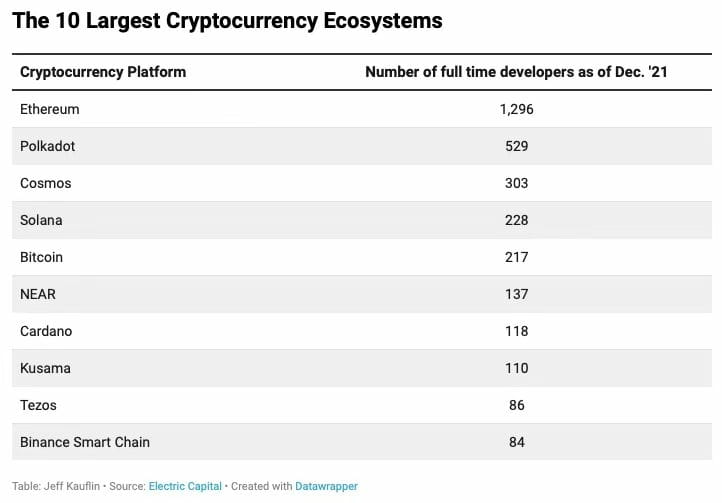
One platform that lost a significant number of developers was EOS, which dropped from around 125 active developers (both full-time and part-time) in December 2020 to 80 a year later.
EOS, which raised $4 billion in an “initial coin offering” in 2018, was later fined $24 million by the U.S. Securities and Exchange Commission for conducting an unregistered securities offering, without admitting or denying wrongdoing.
In addition to being the fastest growing network, Electric Capital’s research shows that Ethereum has the largest number of developers overall.
Ethereum has long maintained its lead, with about a quarter of new crypto developers entering the industry last year choosing to build on Ethereum.

By Jeff Kauflin (Forbes)
Translation: Catherine
IC content you care about
Technology Progress | Project Information | Global Activities
 Collect and follow IC Binance Channel
Answer your questions at any time