

Author:IGNAS
Compiled by: TechFlow
In South Korea, almost no one is unfamiliar with Bitcoin.
In 2017, the country of more than 50 million people completed 20% of all Bitcoin transactions and became the largest market for Ethereum.
South Korean students check the price of Bitcoin during breaks from class, office workers trade while waiting in line for coffee, and the elderly participate in the market from home.
The craze peaked when local bitcoin prices were 40% higher than on U.S. exchanges. Coinmarketcap even removed South Korean prices from cryptocurrency quotes. This phenomenon became known as the “Kimchi premium.”
That kimchi premium disappeared in 2018 when the government cracked down on speculation. First, it mandated the use of real-name bank accounts for cryptocurrency transactions, then banned ICOs altogether that same year. The kimchi premium may be long gone, but the craze continues.
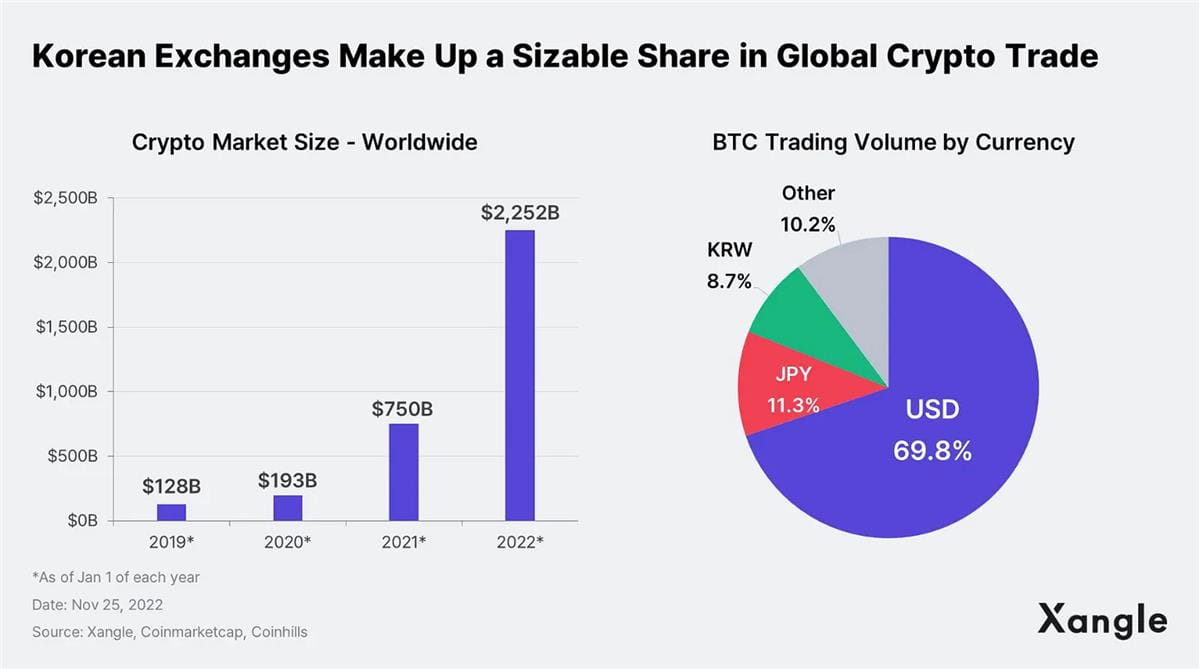
South Korea ranked third in terms of Bitcoin trading volume in 2022, accounting for 8.7% of the market. The United States ranked first with a share of 69.8%, followed by Japan with a share of 11.3%.
One explanation for the boom is South Korea’s rapid adoption of new technologies, but there’s more at play: culture and narrative.
Learn about Korean Culture: Miracle on the Han River
The Korean War of 1950-53 made South Korea one of the poorest countries in the world. By 2023, it was one of the richest.
Rapid economic growth is attributed to family-owned business groups (called chaebols), an emphasis on exports, a hard-working workforce and the Korean mentality of moving quickly and getting things done efficiently.
The "빨리 빨리" (fast) mentality permeates the Korean way of life. Every second counts. Food must be delivered quickly, trains arrive on time, and buildings are built in weeks. Whatever you do, do it quickly and efficiently. Getting rich quickly is no exception.
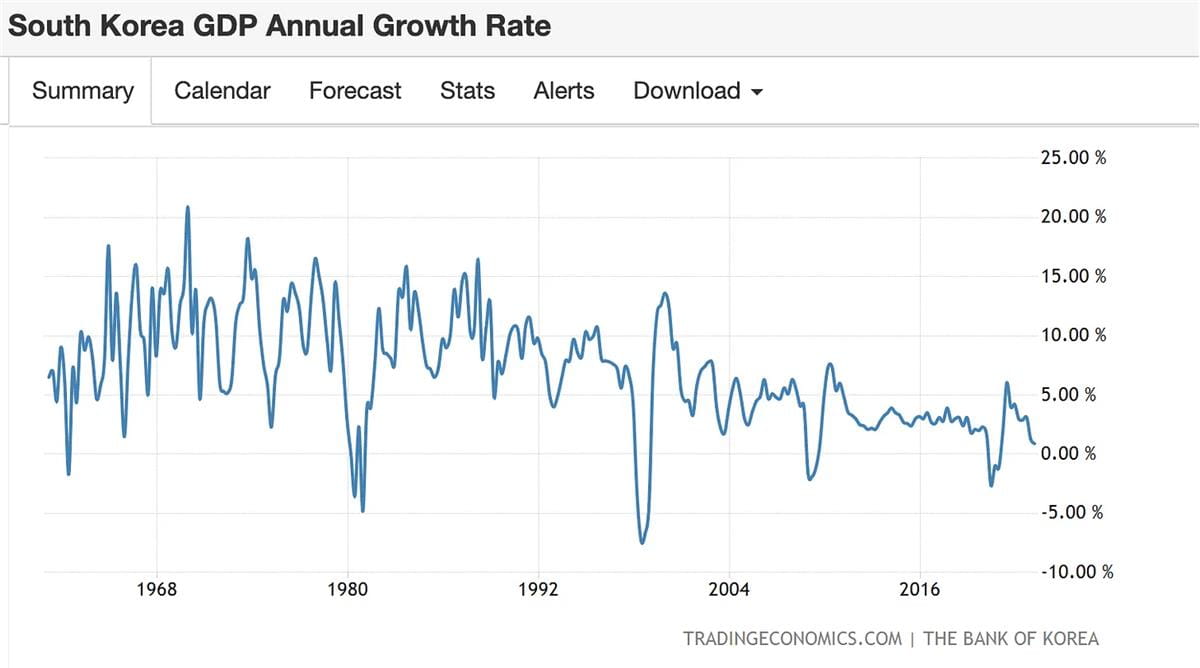
Getting richer, however, has become more difficult. Economic growth has slowed from double-digit growth in the 2000s to about 3% since 2012. So the way to get rich includes investing in stocks or real estate, but the markets are not for everyone.
Real estate and domestic stocks become less attractive when real estate is expensive and interest rates rise due to a lack of high-risk investments. Derivatives trading has strict certification requirements, while the overall technology stock index KOSDAQ has barely grown since 2011.
Alternatives have long been a gamble.
The way to get rich quick - gambling.
The problem is, gambling is not even illegal in South Korea.
Games including lotteries, horse, boat and bicycle racing, and casino gambling are all illegal - even for South Koreans traveling abroad.
The prevalence of gambling addiction in South Korea is two to three times higher than in other major countries, according to the Korea Problem Gambling Center, which was established by the South Korean government in 2012. While it is unclear how these statistics were calculated, the theory that South Koreans are particularly susceptible to gambling addiction is a widely held social theory that has influenced the formulation of relevant laws.
Cryptocurrencies are seen as a way to get rich quick as other investments are restricted.
South Koreans view cryptocurrency exchanges as gambling, trying to make a lot of money in a short period of time.
In the West, the cryptocurrency story of “no longer being confined to banks” or Bitcoin as digital gold dominates. But in South Korea, where trust in the financial and banking sectors is high, these stories have less influence.
Ultimately, the story of Bitcoin as digital gold is not compelling enough because gold cannot surge 100% in price in a single day.
However, altcoins can.
To keep traders engaged and bring the adrenaline rush, some local exchanges have become experts in meeting the demand.
For example, a listing on a major exchange always attracts attention from retail investors, but only in South Korea is delisting from an exchange also an opportunity.
The delisting window requires deposits to stop, so as the inflow of new tokens is restricted, speculators will push up the price to make a final profit before they can no longer be traded. Naturally, delisting notices attract the same or even more attention among speculators than listings.
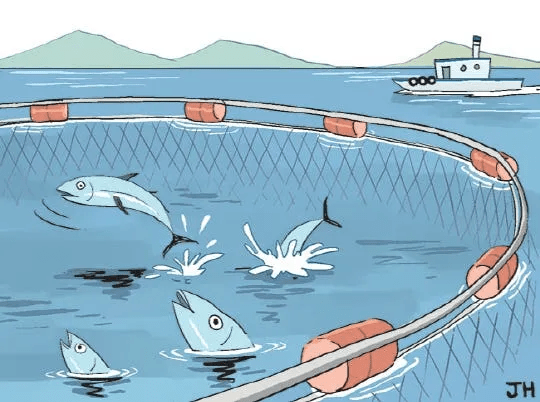
An even more exciting feast is exchange maintenance. When deposits and withdrawals are closed, but trading is not disabled, this situation is called a "가두리" (a closed net used to hold live fish). Similar to fish that cannot escape the net, closed markets do not rely on external prices and cannot be arbitraged, making trading in this environment a real feast for gamblers.
To be fair, this type of internal market trading is also popular in South Korea’s stock market, and cryptocurrencies offer new opportunities to use this technique.
Some exchanges don’t even allow deposits and withdrawals of cryptocurrencies from the beginning, focusing on internal market transactions.
But cryptocurrency regulation is coming...
Since 2021, exchanges must register with the financial regulator.
All exchanges are required to have an ISMS security license and a real-name bank account (only five exchanges have both). The heads of cryptocurrency exchanges who fail to register could face up to five years in prison or a fine of up to 50 million won.
Cryptocurrency regulation has imposed restrictions on cryptocurrency trading, requiring every investor to use a real-name bank account. This means that Koreans must open a real-name account at a bank supported by the exchange.
Koreans are even required to report deposits/withdrawals to their own wallets or other centralized exchanges by registering withdrawal addresses with local CEXs.
The end result of this regulation was the closure of hundreds of cryptocurrency exchanges.
Currently, only five exchanges have real-name bank accounts. One of these exchanges, Gopax, was supposed to be acquired by Binance, but a report published in a South Korean daily newspaper stated that the Financial Services Commission (FSC) is reviewing Binance’s acquisition due to a recent lawsuit filed against Binance by the U.S. Securities and Exchange Commission (SEC).
Why DeFi is not popular in South Korea
Considering all these changes and the ongoing crypto bear market, the narrative of crypto as a gambling alternative should drive Koreans towards DeFi.
But DeFi is not as popular in South Korea as it is in the West, despite efforts by major South Korean blockchain companies.
For example, Klaytn is the largest layer-one blockchain in South Korea with its own DeFi, NFT, and GameFi ecosystem. Klaytn is backed by Kakao, Korea’s Facebook-like app, with 53 million active users. There is even a Klaytn wallet in the Kakao Messaging App.
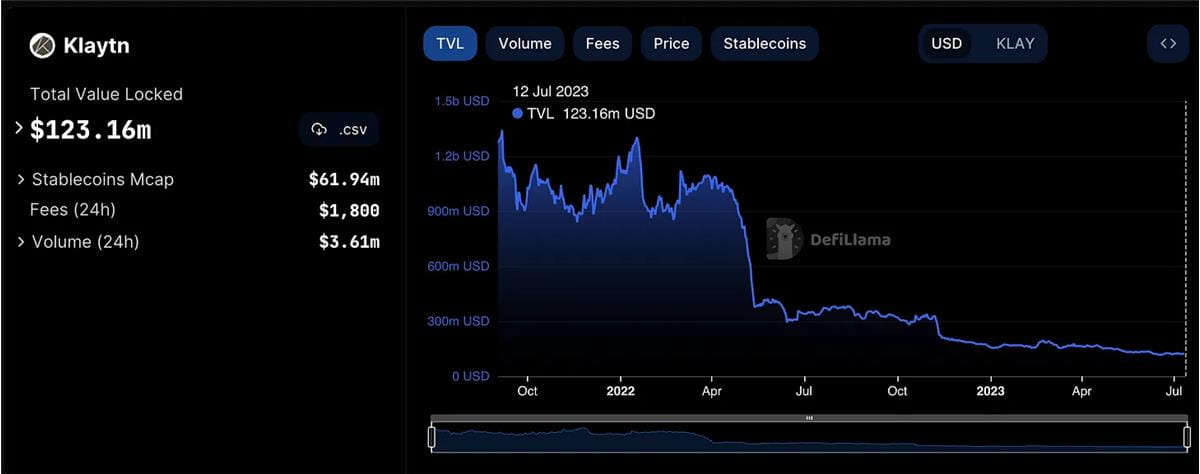
As of this writing, there are 34 DeFi applications on Klaytn (DefiLlama data) with a total locked value (TVL) of $123 million. This number is not bad, but in reality, South Korea has a low DeFi adoption rate.
Based on my personal conversations with Koreans in crypto investing, I noticed that only a few showed interest in DeFi. Even my colleagues working at a crypto exchange didn’t have much love for DeFi, and only a few were familiar with setting up a Metamask wallet.
Their motivations for avoiding DeFi vary, but I currently believe the main reasons are as follows:
In a society where there is a higher level of trust in the financial system, the benefits of self-custody are not enough to attract people, and major centralized exchanges like Upbit and Bithumb already provide enough trust.
Compared to centralized exchanges, DeFi is more difficult to use: wallets, private keys, withdrawals, and deposits are all “annoying,” and the user interface and user experience of DeFi applications themselves are not adapted for the Korean market.
In the pursuit of the goal of getting rich quick (gambling), centralized exchanges provide enough entertainment without the need for gambling on decentralized exchanges.
Lack of Korean content. DeFi terminology is complex and targeted at English speakers.
Single or even double-digit annualized returns are not attractive to speculators who prefer leveraged trading on exchanges (derivatives trading is banned in South Korea).
Since I’m not Korean myself, I asked my friends Doo, COO of StableLab and Growth AVC member of MakerDAO, and Garlam, Managing Partner of Momentum 6 for advice.
Question 1: Why do you think DeFi is not that popular in Korea despite the popularity of cryptocurrencies in Korea?
Doo:
While South Korean users have shown interest in aspects of DeFi such as lending and yield, use of self-custodial options like Ledger and MetaMask is not widespread.
Additionally, most DeFi apps and websites are written in English, which is a significant barrier for Korean users.
This was demonstrated by the recent closure of withdrawals by Haru Invest and Delio, which has prompted many users to choose to use South Korea-friendly centralized finance (CeFi) platforms to experience “DeFi-like” lending and yield.
Accelerate:
I think there are three key factors:
Structure: The traditional banking system has a rigid structure and clear guidelines, which makes the evolving DeFi difficult for some to adopt. For example, some people still have difficulty using Google Chrome for banking because certain anti-hacking, key tracing, and authentication software are only supported on Internet Explorer. This rigid structure causes many to turn to familiar platforms such as centralized exchanges.
Busy: Koreans’ busy work and social schedules limit their ability to keep up with the rapid development of DeFi. Many are either too busy or too complacent to invest the time to understand this field that requires continuous learning, especially if the information is provided in a foreign language and only remains relevant for a short period of time.
Timing: Participation in DeFi often starts with high-risk, high-return projects before moving on to safer blue-chip DeFi. Due to the time zone difference between Korea and the United States, where most project launches and updates occur, many Koreans often miss out. This, combined with the need to constantly monitor English news (not commonly used in Korea), makes their first experience in DeFi poor and hinders their ability to keep up with the pace of developments.
Question 2: What changes need to be made for DeFi to be adopted in South Korea?
Doo:
There are two main (though not mutually exclusive) ways to achieve this. One is to be more "Korea-friendly" by providing Korean-language materials and websites.
Another is to partner with a popular centralized entity. For example, Coinone is one of the few major Korean exchanges that has integrated DeFi yield positions, enabling its users to benefit from these DeFi yields.
This is a step towards gradually guiding users to directly use DeFi in a non-custodial manner.
Accelerate:
It’s very simple. Koreans need to make money from DeFi in Korea. Once they get a taste of it, the craze will begin.
Question 3: What do DeFi protocols and communities need to do to attract Korean users to participate in DeFi?
Doo:
Methods for attracting Korean users vary by DeFi protocol. For some protocols, attracting Korean users may be more challenging than others.
The complexity of the project product usually determines the difficulty of attracting users.
For example, options and insurance are complex products that are difficult for most Korean users to understand. Therefore, such protocols may be more successful in attracting Korean users to trade their tokens rather than use their products.
For simpler DeFi products, marketing and most importantly, acquisition needs to be considered. Marketing can be done in both passive and active ways.
Passive methods include translating websites into Korean and providing Korean guides so that users can easily find and use them. Active methods may include participating in interviews and speaking at events in Korea.
Maintaining a Korean Telegram or Kakaotalk group may also be beneficial. In terms of access, protocols need to partner with Korean centralized financial platforms that can provide DeFi products or Korean-friendly crypto mobile wallet companies.
Mobile wallets are the preferred method of accessing cryptocurrencies in South Korea compared to other regions.
Accelerate:
Localization - Korea is a highly culturally homogenous market. It is difficult for a team to enter the Korean market without a real Korean team operating in Korea.
KOLs and media — They are the preferred medium for people to exchange information. Identify good and bad players in Telegram and Kakao groups and educate the administrators of these groups (or even provide them with promotion budget). This will probably give the highest ROI for expansion.
Preconceptions — As mentioned before, in times of uncertainty, people tend to revert to their default modes. Tokens traded on Korean exchanges allow them to become familiar with their names and historical prices. Once people can gain some sort of benefit from a token, they are more likely to participate in the entire ecosystem.