


Today we are going to talk about a newly launched project. Currently, it has been launched on OK, bybit, kucoin, etc. It is also a cross-L2 chain lending project. The project name is Zerolend. The current market value is 18 million US dollars, and the total FDV is 70 million US dollars. However, its current TVL is 200 million. So let's take a look at the situation of this project today.
Introduction
ZeroLend is the largest lending marketplace on L2 networks, including Linea, zkSync, Manta, Blast, and X Layer, with a focus on Liquidity Rehypothecation Tokens (LRTs) lending, governance, Real World Assets (RWAs) lending, and account abstraction.
Core products and features in the ZeroLend ecosystem:
1. DeFi Lending (already launched): A decentralized, non-custodial liquidity protocol that enables users to participate as liquidity providers and borrowers. ZeroLend also aims to provide lending and borrowing of various assets supported across multiple chains.
2. ZeroLend Governance ($ZERO): A governance system for managing the ZeroLend protocol, driven by the $ZERO token.
3. Liquidity re-collateralization token lending (already launched): Users can deposit LRTs such as EtherFi, Puffer, Renzo and Kelp and borrow in stablecoins/ETH.
4. ZeroLend Protocol Airdrop: Users using the protocol will be eligible to participate in the upcoming chain airdrop.
5. Real World Asset Lending (already launched): Users can deposit RWAs and take out collateralized loans in the form of stablecoins or ETH.
5. Account abstraction (already online): This feature allows gas-free transactions, social login, delegated transactions, etc.
ZeroLend Important Parameters
1. Maximum Loan to Value (LTV)
The maximum LTV indicates the maximum amount a user can borrow based on the collateral. For example, on ZeroLend’s Linea market, the LTV of $WETH is 80%. So ZeroLend is also overcollateralized.
2. Liquidation Threshold
The liquidation threshold is the value at which a user’s loan becomes underfunded and at risk of liquidation. On ZeroLend’s Linea marketplace, the liquidation threshold for $WETH loans is 82.50%. This means that if the value of a user’s $WETH debt reaches 82.50% of the user’s deposited collateral, the protocol can sell the collateral to repay the loan.
3. Liquidation Penalty
If a user's collateral is liquidated, a liquidation penalty will be added to the user's loan amount. If a user borrows on ZeroLend and the user's collateral is liquidated, the user will pay a 5% liquidation penalty.
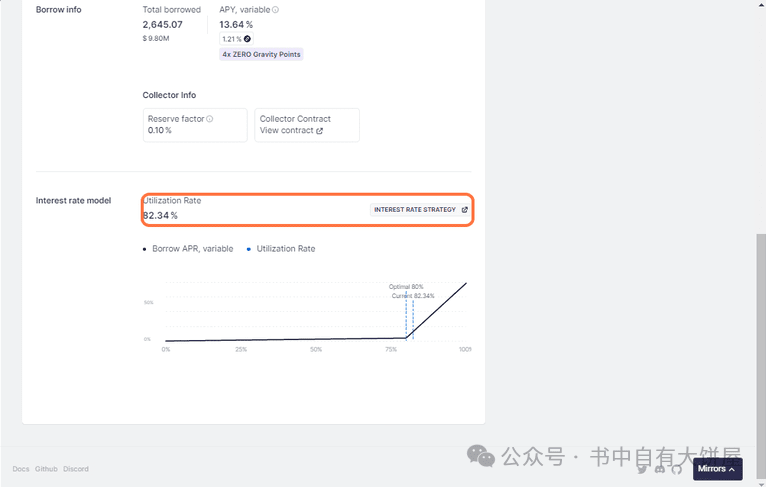
4. Utilization
This is the percentage of total available funds that are currently being lent out. For example, a utilization rate of 82.34% means that of all funds available to lend, 82.34% are currently being lent out by users. This ratio can impact the interest rate on loans. The higher the utilization rate, the higher the interest rate because there is a higher demand for funds relative to the supply.
5. Health Factor
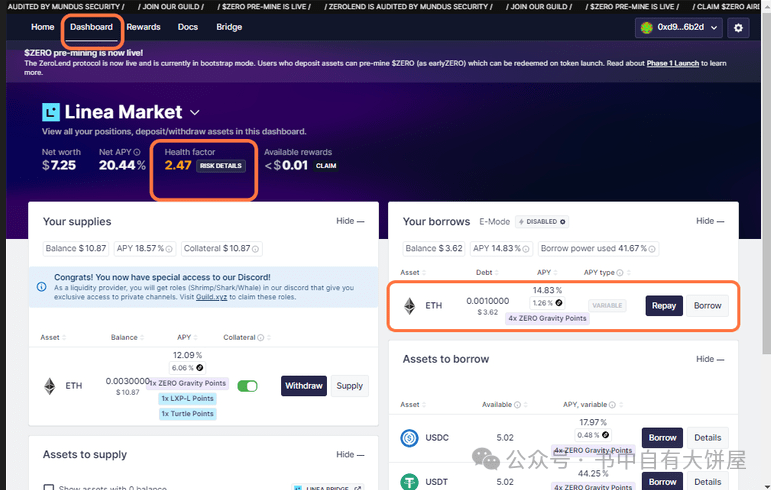
The health factor represents the risk of liquidation. A health factor above 1 means that the user is not at immediate risk of liquidation. If the health factor is below 1, the loan is not sufficient and may be liquidated. Users can view the user's loan health factor under the "Dashboard" in ZeroLend.
Zerolend Features
1. LRT Loans
ZeroLend provides a dedicated ETH LRTs market. Currently there is only one ezeth pool with a pool size of 80 million US dollars.
2. RWA lending
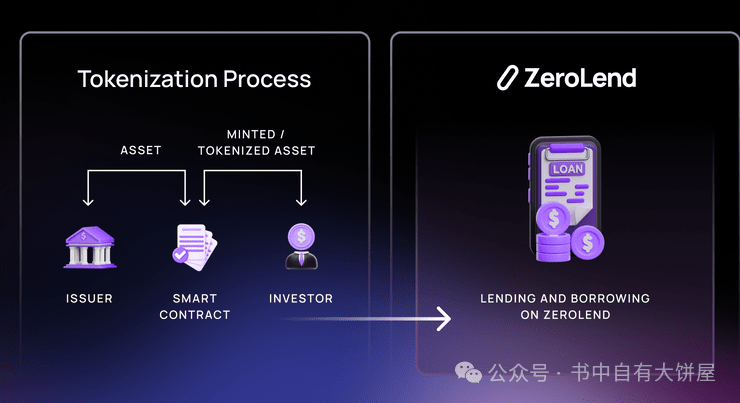
The RWA platform allows users to represent real-world assets, such as stocks, government bonds, real estate, and commodities, as crypto tokens and trade them on the blockchain. $USDT and $USDC can be considered RWAs, representing tokenized and on-chain versions of the US dollar.
According to Boston Consulting Group, the RWA market will grow from $1.5 trillion in 2024 to $16 trillion in 2030.
RWA lending on ZeroLend
RWAs can be used for lending on money markets such as ZeroLend. Currently supports USDC and USDT. The USDC pool is 17 million US dollars, and the USDT pool is approximately 440,000 US dollars.
3. Account Abstraction (AA)
We have talked about the concept of account abstraction before. When we talked about the Biconomy project, we have already popularized the concept of account abstraction. If you don’t know it, you can check out the potential analysis of Biconomy, the leader in the account abstraction track.
ZeroLend integrates several zkSync native AA features in terms of:
- Payment Master (runs on zkSync, not live yet): allows protocols to subsidize or allow users to pay transaction fees with ERC20 tokens instead of using $ETH. Payment Master is a smart contract that controls and pays gas fees for transactions on behalf of wallet owners/users. With Payment Master, developers can grant users the ability to transact with zero gas fees or pay with the application's native ERC-20 token.
- Social Login and other authentication options (not yet live): Allows users to own a wallet that controls their securely isolated device (Face ID, fingerprint scanner, etc.). Social Login provides a user-friendly and self-hosted authentication mechanism for ZeroLend. By allowing users to associate their Web2 identities with their on-chain accounts, we aim to lower the barrier to entry for beginners. This process eliminates the need for users to interact directly with private keys, providing a seamless onboarding experience. With social login, end users can easily authenticate through their preferred accounts, such as email, phone number, or social media accounts. Users can easily create smart contract wallets on ZeroLend. Users no longer need to download specific wallet applications or manage seed phrases with smart contract wallets.
- Delegated Trading (not yet live): Allows users to authorize ZeroLend to perform limited operations on their behalf without losing custody of their assets. In DeFi lending, collateral monitoring is a challenge. Managing collateral and loans on platforms such as Compound requires users to constantly monitor and adjust collateral deposits to prevent losses. If the price of the collateral deposited by the user falls below a certain critical value, it will be liquidated. This process can be burdensome and stressful for users.
ZeroLend abstracts these challenges. With ZeroLend, users will gain an automated and secure collateral management solution using account abstraction and delegated trading.
4. Capital efficiency characteristics
4.1 Efficiency Mode (E-Mode)
E-Mode, or Efficient Mode, enables borrowers to maximize their borrowing power by using related assets in the same category (e.g. stablecoins) as collateral. For example, providing $USDC in E-Mode can achieve enhanced collateral power when borrowing $ONEZ.
In E-Mode, ZeroLend categorizes assets based on the following factors:
Loan-to-Value (LTV): A higher LTV allows borrowers to receive more funds relative to the value of the collateral within the same category. E-Mode allows LTV ratios up to 97%.
Liquidation Threshold: This is the minimum amount of collateral required to avoid liquidation, providing borrowers with greater risk control capabilities.
Liquidation Rewards: In E-Mode, borrowers are rewarded for repaying their loans early, encouraging responsible borrowing behavior.
4.2 Isolation Mode
Quarantine mode is a risk management feature that limits the risk of volatile assets used as collateral. During the platform’s evaluation process, if an asset is determined to be high risk, quarantine mode is activated at the time of listing.
When an asset is listed in "Segregated Mode" on ZeroLend, users can only borrow permitted stablecoins against it. Once an asset is successfully placed in Segregated Mode, borrowing capacity will be limited to a specific debt ceiling. This ceiling is the maximum USD amount that can be borrowed against the corresponding asset as collateral, accurate to two decimal places.
The debt ceiling and limited assets for lending against segregated assets prevent users from over-borrowing, thus protecting against market risks.
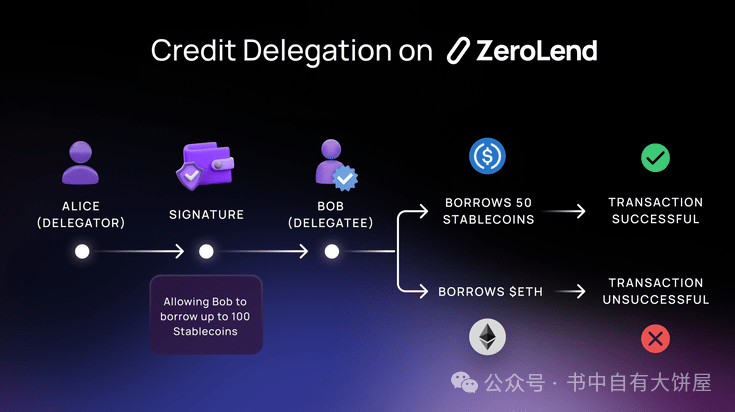
4.3 Credit Entrustment
Credit delegation is a feature that allows depositors to deposit funds into ZeroLend to earn interest while delegating lending rights (credit) to other users. The lending terms are determined by the depositor.
People and borrowers reach agreements on-chain through smart contracts. This feature provides additional returns to depositors and provides borrowers with access to unsecured loans.
4.4. Supply/Borrowing Limit
In the event that one of the underlying collateral collapses faster than the risk team can stop lending or delisting that asset, borrow/supply caps come into play, limiting the bad debt that could occur due to collateral collapse.
Borrow/supply caps are critical to minimizing bad debts when collateral value decreases faster than risk management actions. For example, if a user provides collateral A and its value decreases, the user's collateral may be liquidated. To avoid bankruptcy in this case, the platform adds a borrow cap.
Token Economy
Maximum supply: 100,000,000,000 (100 billion), initial circulating supply: 25,000,000,000 (25 billion), token format: Linea ERC20 bridged via LayerZero. The current exchange rate is $0.00072.
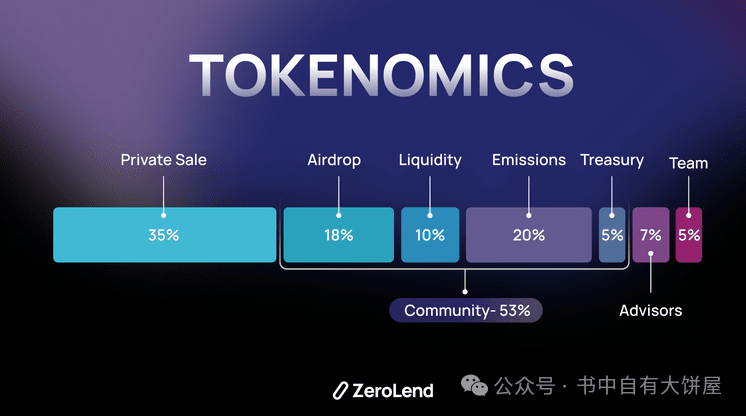
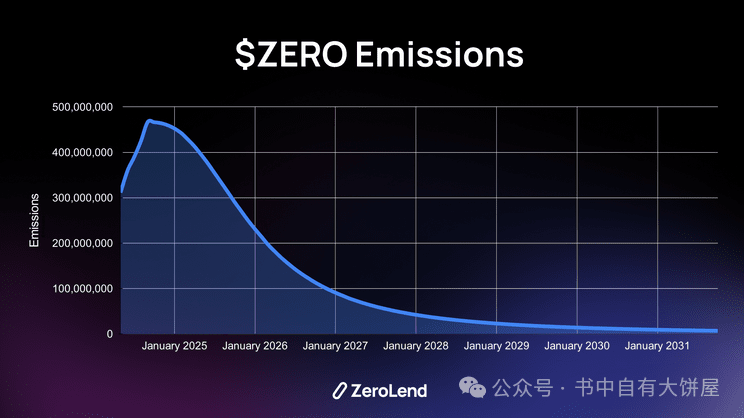
In terms of token distribution, we can see 35% private sales, 18% airdrops, 10% liquidity rewards, 20% emissions, 5% foundation, 7% consultants, and 5% team. This project is the one that I have seen so far where the team gets the least, and gives the most to private sales and airdrops.
The TVL of the project is also in a state of continuous growth, currently at 170 million US dollars.
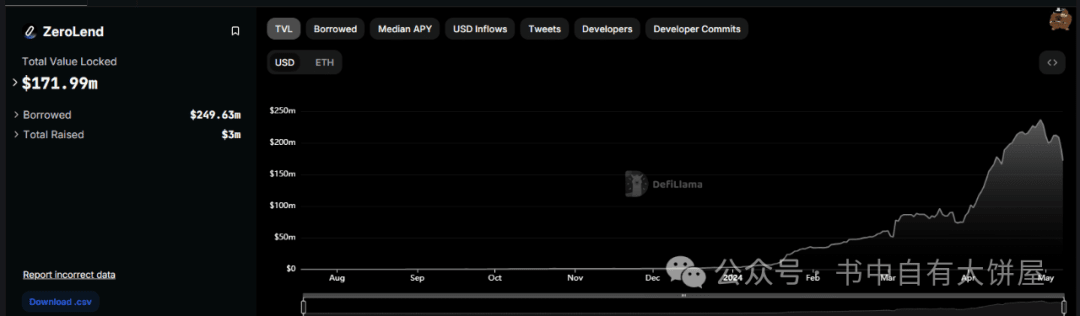
Finally, let's summarize this project. It can be regarded as a new lending platform in the post-L2 era. Compared with the L2 platforms of the OP series, such as RDNT on arb, or sonne on OP, the TVL is much higher. Then look at the top lending platforms such as AAVE, which currently has a TVL of 10 billion, a market value of 1.3 billion, and a FDV of about 1.4 billion. That's about 7 to 1. Compared with AAVE, zero's TVL is 170 million, corresponding to a market value of about 25 million US dollars, so from this point of view, the current market value of the project is a little higher. But its biggest advantage at present is that, first, its current overall market value is low, only tens of millions, and second, its TVL is still growing. Third, the yield of its token pledge is 120%. Of course, it can be clearly seen that the project party is to let you pledge the token, and also gave 20% of the emission, just to promote growth, and the proportion taken by the project party itself is very small, which is considered to be a more conscientious project party. (But now I know from the comments that the project did not issue any airdrops? Deleted the discord? I really cannot join the discord at the moment, and my energy is limited. The data I source is also official documents, so if the project does not follow through on its promises, water can carry a boat but can also capsize it!) As for the token strategy, we will talk about it on the planet.#DEFI2.0
#Layer2