

Author: dappOS
Recently, the Web3 operating protocol dappOS received investment from Binance Labs. The dappOS operating protocol consists of two parts: a unified account based on account abstraction, dappOS Account, and an automatic execution network, dappOS Network. This allows users to use dApp with a low threshold, while reducing the difficulty of multi-chain customer acquisition for dApp. On July 7, dappOS released the V2 product roadmap.
1. Background
In the traditional Internet world, the user-friendly interface and interactive experience provided by "operating system" applications have contributed to the large-scale popularization of computers. However, as the Web3 industry has gradually matured after its first decade of wild growth, the high entry threshold for new users is still a problem that hinders the development of Web3.
2. Brief Introduction of dappOS
dappOS aims to lower the threshold for using Web3 applications. Its solution mainly consists of two parts: one is the dappOS Account based on account abstraction, and the other is the dappOS Network that solves the problem of automated execution of operations.
It is usually difficult for dApp to have excellent liquidity on all chains without giving up users of all chains. dappOS solves this problem very well. After DApp is connected to the front-end SDK, users of other public chains can use it seamlessly without modifying the contract, thus avoiding the dispersion of liquidity on multiple chains. For example, the on-chain protocol only needs to be deployed on BSC, and users of other public chains such as Ethereum can be seamlessly attracted by integrating the front-end SDK of dappOS.
C-end users can manage multi-chain assets through dappOS and use different dApps on different chains with one click, without having to switch back and forth between different networks or manually cross-chain assets and purchase Gas tokens.
3. dappOS V2
After MVP product verification and testing, dappOS will launch its first official version V2. According to the latest v2 roadmap disclosed by dappOS, the main new functions and features of this version include: unified accounts, task-linked order execution, and a new node bidding system. The first batch of projects supported by dappOS V2 include Benqi, Cheems, Curve, DeFi Kingdom, Frax Finance, GMX, KyberSwap, Lido, Perpetual, QuickSwap, StarryNift, SyncSwap, and SynFutures.
dappOS Account: Unified Account
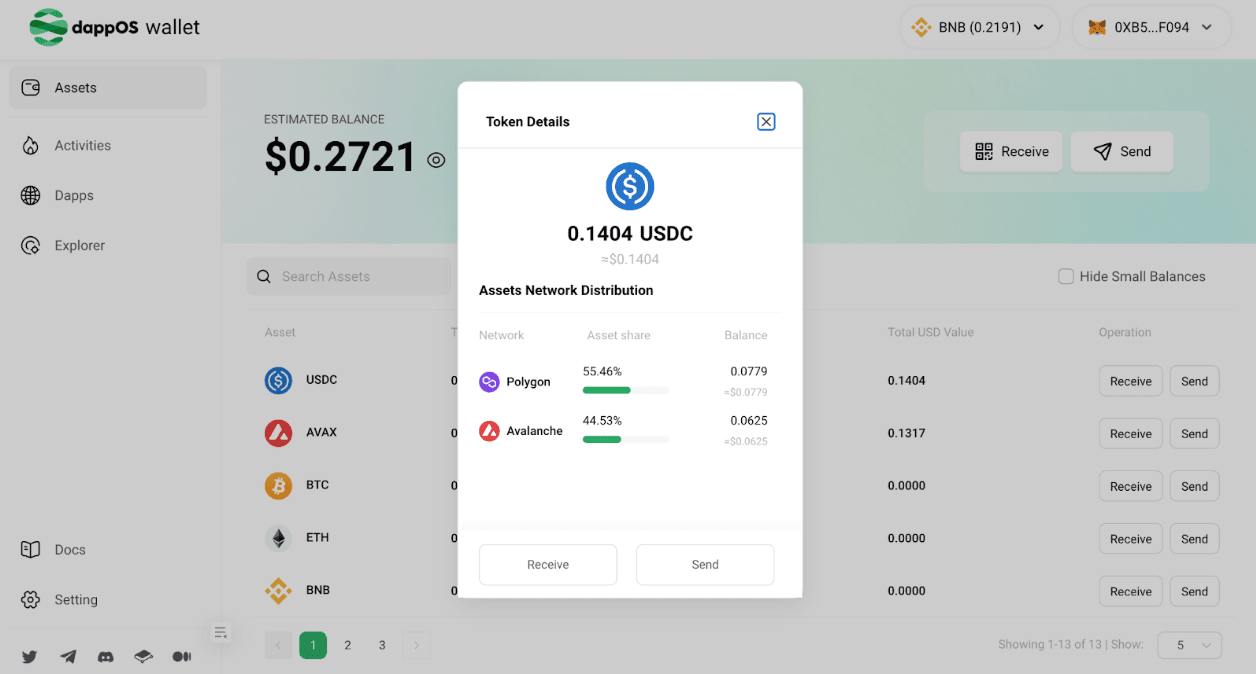
dappOS Account is a unified account built on account abstraction. Under the premise of ensuring decentralization, it can provide traders with trading services similar to CeFi experience. Unlike traditional EOA accounts, account abstraction itself is a smart contract. When using it, users do not use private keys, mnemonics, etc. as the only account management method. Similar to Web2 accounts, they can specify mobile phones, emails, etc. for retrieval. When users lose their mnemonics or private keys, dappOS Account can be reset in a variety of ways.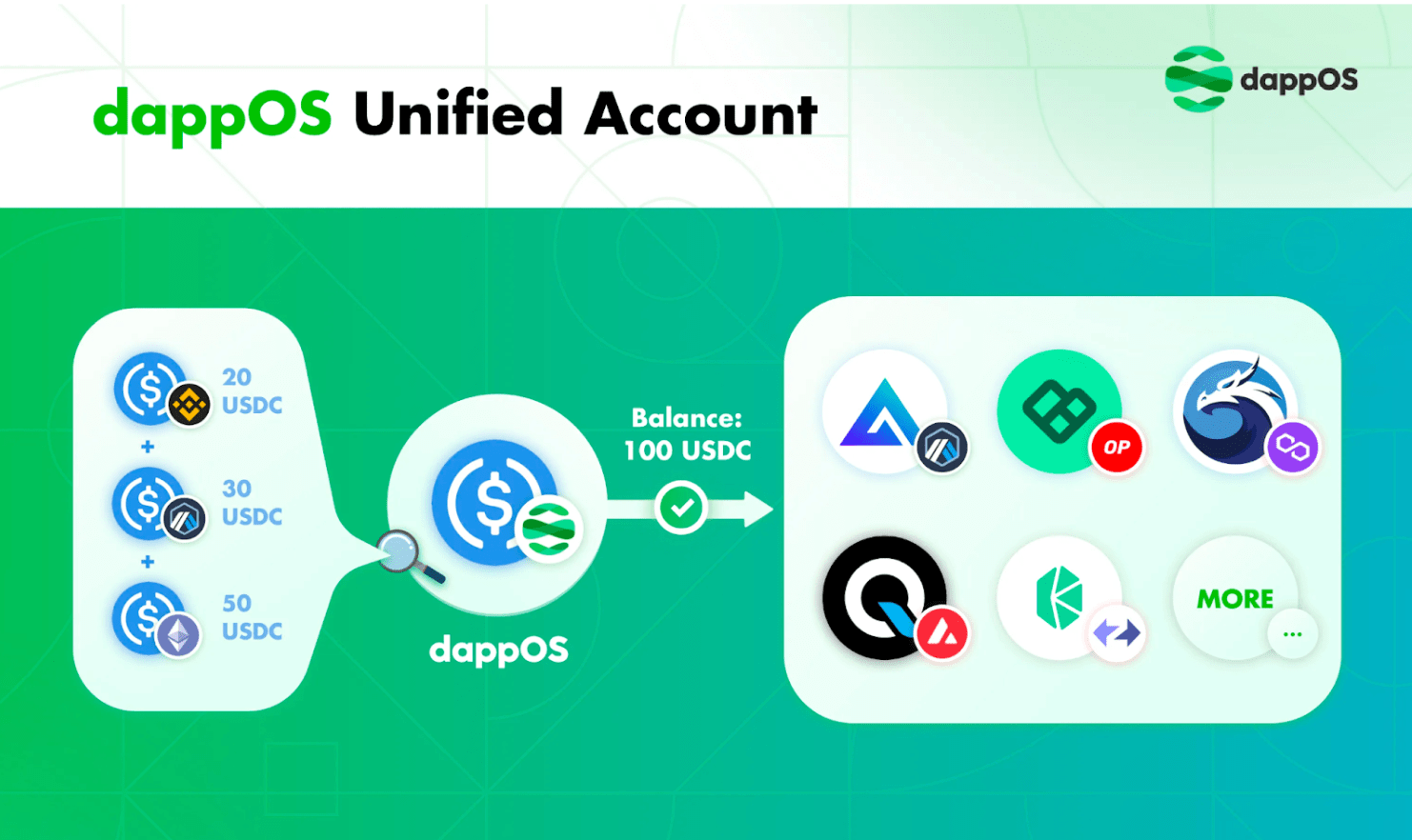
For example, user A holds 20, 30 and 50 USDC on BNB, Arbitrum and Ethereum respectively. The balance of user A in the unified account of dappOS is the total asset of 100 USDC. The user only needs to sign once to confirm the transaction, and then he can use the balance of 100 USDC on GMX of Arbitrum, Perpetual on OP, and Benqi on Polygon. He does not need to consider which specific chain the USDC is on or the gas payment issue. Compared with the complex steps of users completing the purchase of gas tokens, withdrawing coins to the corresponding public chain, using cross-chain bridges, and waiting for the asset cross-chain to succeed, the entire transaction process is shortened from more than 20 minutes to less than 2 minutes.
Under the LSD and LSDFi narratives, various protocols are distributed on various L1 and L2. The dappOS unified account allows users to directly manage the total assets and realize asset universality without the need to perceive the existence of the public chain. They can seamlessly interact with dapps and better benefit from the composability of DeFi.
Task-related order execution
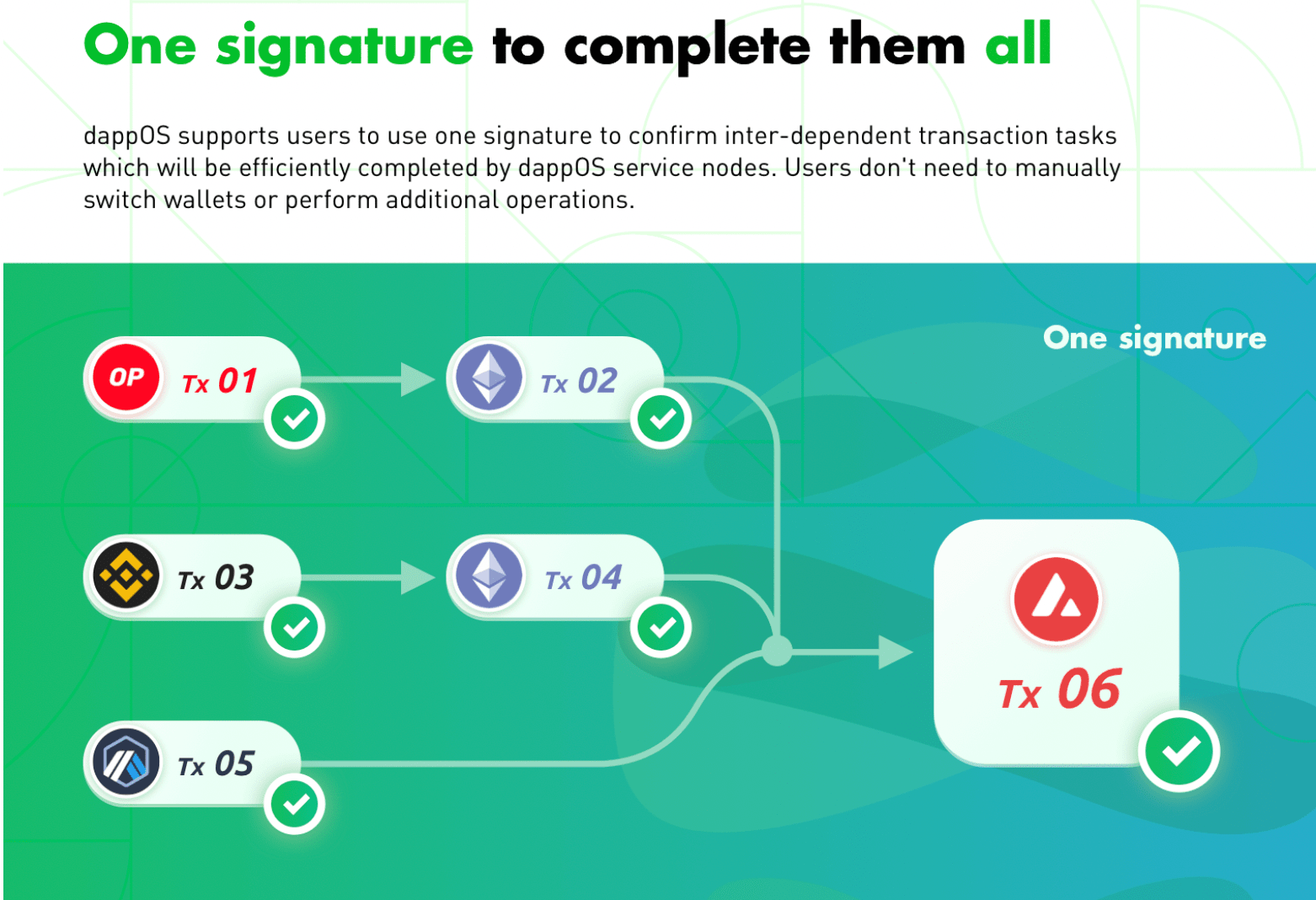
Task-linked order execution is a new feature of dappOS v2. When a user makes a transaction, they only need to sign once to confirm the completion of complex transaction operations involving any chain and in a certain order.
New node bidding system
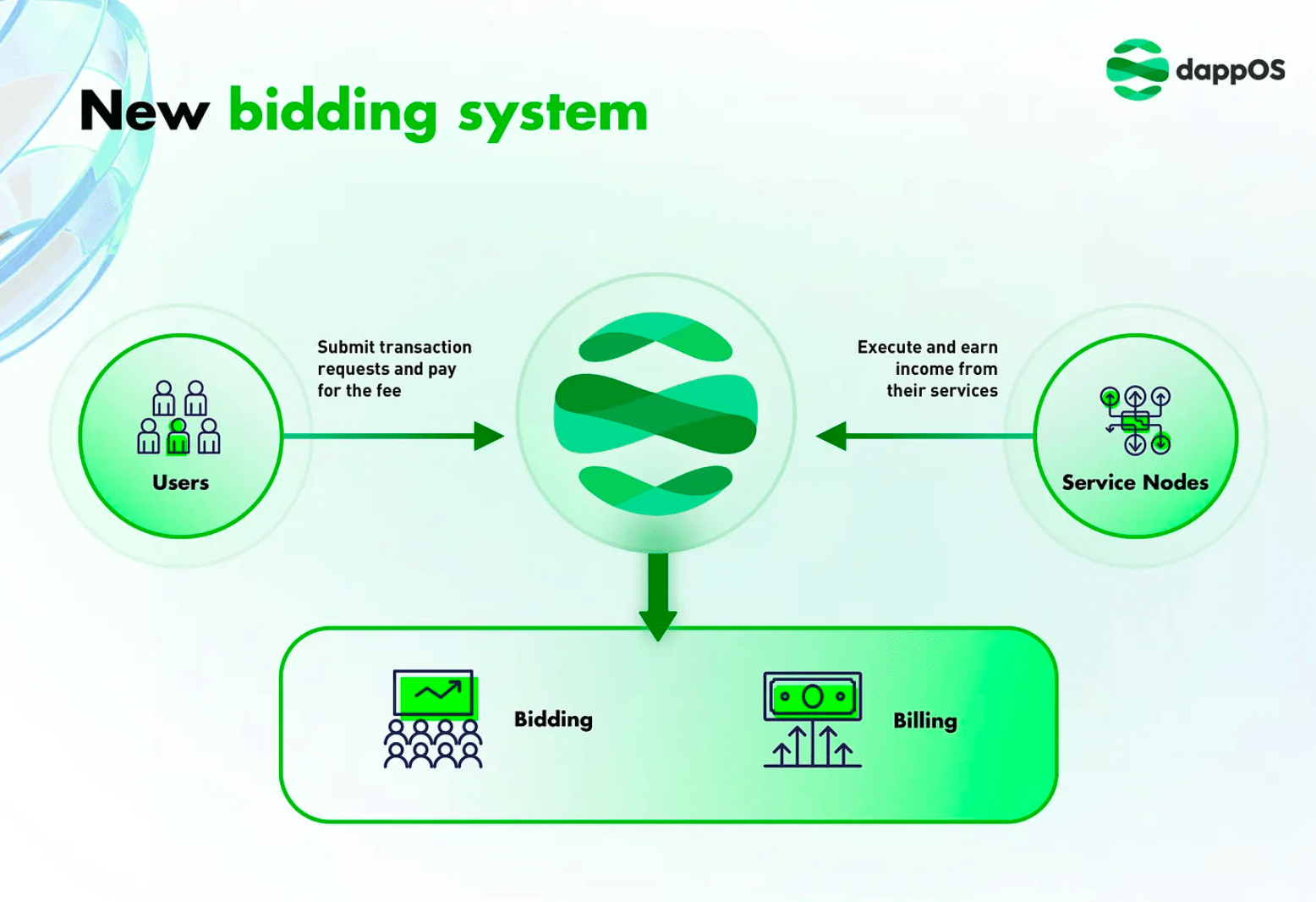
dappOS V2 will also launch a new node bidding system, which allows users to see a list of service nodes in a target transaction and display the fees and time required for all service nodes to complete the transaction. Users can make the best autonomous selection of different service nodes to improve transaction efficiency and reduce transaction costs.
Under the new bidding system, service nodes receive revenue incentives, and service nodes with high service efficiency and low cost have a higher probability of successfully "taking orders" and executing transaction needs for users, which can promote healthy competition among service nodes in the network and promote the self-innovation and optimization of the dappOS Network transaction system. In the latest disclosed dappOS V2 roadmap, the V2 Stage 2 stage will also launch an autonomous access platform for service nodes, providing open source implementations of different specifications.
 4. Investment institutions and project progress
In early December last year, DappOS was selected as the first Web3 operating protocol for the fifth season of the Binance Labs incubation program, and received industry resource support from Binance Labs. In June of this year, dappOS received financing from Binance Labs.
During the MVP product testing phase, dappOS has been integrated by many leading Web3 applications, including dozens of Dapps including GMX, Benqi, Perpetual, Pangolin, Kyber, QuickSwap, etc.
The first official version V2 (Major Version) will be launched in the near future, officially introducing features such as unified account (users do not need to distinguish between chains, but only need to pay attention to the total amount of funds, and the total balance is applicable to any application on any chain), task-linked order execution (one signature can confirm and complete operations involving any chain with sequential dependencies), and launching a billing bidding system.
Summarize
The release of the dappOS v2 roadmap indicates that dappOS will be launched to the market with a complete functional appearance, which is crucial to expanding the Web3 user base from millions to billions. This also enables dappOS to continue to attract the attention of top capital.
From the application side, dappOS breaks the barriers between Web3 products on different chains through the "Web3 operating protocol", which is conducive to reducing the customer acquisition cost of Web3 applications in different ecosystems. Whether it is promoting the further adoption of cryptocurrencies, the evolution of Web3 product forms, or the overall development of the Web3 world in the future, dappOS will be able to play a positive role.