

01. Incentive compatibility in token economics
Decentralized P2P systems based on cryptography were not new in 2009 when Bitcoin was introduced.
You may have heard of the BitTorrent protocol, commonly known as BT download, which is a P2P-based file sharing protocol that is mainly used to distribute large amounts of data to users on the Internet. It uses some form of economic incentives, for example, "seeds" (users who upload complete files) can get faster download speeds, but this early decentralized system launched in 2001 still lacks a complete economic incentive design.
The lack of economic incentives stifled these early P2P systems from prospering over time.
(Coincidentally, in 2019, the developers of the BitTorrent protocol launched BitTorrent Token (BTT), which was later acquired by TRON. They chose to use cryptocurrency to provide economic incentives to improve the performance and interaction of the BitTorrent protocol. For example, users can spend BTT to increase their download speeds, or earn BTT by sharing files.)
When Satoshi Nakamoto created Bitcoin in 2009, he added economic incentives to the P2P system.
From DigiCash to Bit Gold, multiple experiments in creating decentralized digital cash systems have not completely solved the Byzantine Generals Problem. But Satoshi Nakamoto implemented a Proof-of-Work consensus mechanism + economic incentives to solve this seemingly unsolvable problem, that is, how to reach a consensus between nodes. Bitcoin not only provides a means of storing value for people who want to replace the existing financial system; it also uses a combination of cryptocurrency and incentives to provide a new and universal design and development method, which ultimately formed today's powerful and vibrant P2P payment network.
From Satoshi Nakamoto’s “Galileo Era”, cryptoeconomics has evolved to Vitalik’s “Einstein Era”.
A more expressive scripting language enables the implementation of complex transaction types, and a more general decentralized computing platform. After Ethereum switches to Proof-of-Stake (PoS), token holders will become validators of the network and earn more tokens in this way. Controversy aside, this is indeed a "more inclusive token distribution method" compared to Bitcoin's current ASIC mining method.
“Designing a token economic model is actually designing an “incentive-compatible” game mechanism.” -- Hank, BuilderDAO
Incentive compatibility is an important concept in game theory. It was first proposed by economist Roger Myerson in his classic book, The Theory of Cooperative Games. This book was published in 1991 and has become one of the important reference books in the field of game theory. In the book, Myerson elaborated on the concept of incentive compatibility and its importance in game theory.
Its academic definition can be understood as: a mechanism or rule design in which participants act according to their true interests and preferences without resorting to fraud, cheating or dishonesty to pursue better results. This game structure enables individuals to maximize their personal interests while maximizing collective benefits. For example, in the design of Bitcoin, when expected income > input costs, miners will continue to invest in computing power to maintain the network, and users can continue to conduct secure transactions on the Bitcoin ledger - this trust machine now stores more than $40 billion in value and processes more than $600 million in transactions per day.
In Tokenomics, it is an eternal proposition to use token incentives and rules to guide the behavior of multiple participants, achieve better incentive compatibility in design, and expand the scale and upper limit of achievable decentralized structures or economic benefits.
Tokenomics plays a decisive role in the success or failure of cryptocurrency projects. How to design incentives to achieve incentive compatibility plays a decisive role in the success or failure of tokenomics.
This is similar to monetary policy and fiscal policy for a national government.
When the protocol acts as a country, it needs to formulate monetary policy, such as the token issuance rate (inflation rate), and decide under what conditions new tokens are minted. It needs to regulate fiscal policy to regulate taxes and government spending, usually in the form of transaction fees and treasury funds.
It’s complicated. As humans have proven in their economic experiments and governance construction over the past few thousand years, it is extremely difficult to design a model to coordinate human nature and the economy. There are mistakes, wars, and even regressions. Crypto, which is less than 20 years old, also needs to create better models in these trial-and-error iterations (such as the Terra incident) to welcome a long-term successful and resilient ecosystem. And this is obviously a kind of thinking reset that the market needs more in the long crypto winter.
02. Different economic model classifications, goals and designs
When designing an economic model, we need to clarify the object of token design. Public chains, DeFi (decentralized finance), GameFi (gamified finance) and NFT (non-fungible tokens) are different categories of projects in the blockchain field, and they have some differences in designing economic models.
The design of public chain tokens is more like macroeconomics, while others are closer to microeconomics; the former needs to focus on the overall dynamic balance of supply and demand within the entire system and between ecosystems, while the latter focuses on the supply and demand relationship between products and users/markets.
Different types of projects have completely different design goals and core points of their economic models. Specifically:
Public chain economic model:
Different consensus mechanisms determine different economic models of public chains. But the same thing is that the design goal of their economic models is to ensure the stability, security and sustainability of the public chain. Therefore, the core lies in using tokens to incentivize validators, attract enough nodes to participate and maintain the network. This usually involves the issuance of cryptocurrency, incentive mechanisms, and node rewards and governance to maintain the continued stability of the economic system.
DeFi economic model:
Tokenomics originated from the public chain, but has been developed and matured in DeFi projects, which will be analyzed in detail later. The economic model of DeFi projects usually involves lending, liquidity provision, trading, and asset management. The design goal of the economic model is to encourage users to provide liquidity, participate in lending and trading activities, and provide participants with corresponding interest, rewards, and benefits. In the DeFi economic model, the design of the incentive layer is the core, such as how to guide token holders to hold tokens instead of selling them, and how to coordinate the distribution of interests between LP and governance token holders.
GameFi Economic Model:
GameFi is a concept that combines gaming and financial elements, aiming to provide financial rewards and economic incentives for gamers. The economic model of GameFi projects usually includes the issuance, trading, and revenue distribution of virtual assets in the game. Compared with DeFi projects, GameFi's model design is more complex. With transaction pumping as the core of revenue, how to increase users' reinvestment needs becomes the first priority in economic model design, but it also naturally poses design challenges to the playability of game mechanisms. This makes it inevitable that most projects will show Ponzi structures and spiral effects.
NFT Economic Model:
The economic model of an NFT project usually involves the issuance, trading, and rights of NFT holders. The design goal of the economic model is to provide NFT holders with opportunities to create value, trade value, and gain benefits, and to encourage more creators and collectors to participate. This can be further divided into the NFT platform economic model and the project economic model. The former focuses on royalties, while the latter focuses on how to solve economic scalability, such as increasing repeat sales revenue and fundraising in different fields (see Yuga Labs).
Although these projects have their own unique economic model designs, they may also have cross-cutting and overlapping aspects. For example, NFTs can be integrated as collateral in DeFi projects, and DeFi mechanisms can be used for fund management in GameFi projects. In the evolution of economic model design, DeFi projects have developed more abundantly, both at the business layer and at the incentive layer. At the same time, many DeFi models are also widely used in projects such as Gamefi Socialfi, so DeFi's economic model design is undoubtedly an area worthy of in-depth study.
03. DeFi economic model from the perspective of incentive model
If we divide the DeFi economic model according to the business logic of different projects, we can roughly divide it into three main categories: DEX, Lending, and Derivatives. If we divide it according to the characteristics of the incentive layer of the economic model, we can divide it into four models: governance model, staking/cash flow model, voting custody (including ve and ve(3,3) models), and es mining model.
Among them, the governance model and pledge/cash flow model are relatively simple, and the representative projects are Uniswap and SushiSwap. A brief summary is as follows:
Governance model: Tokens only have governance functions for the protocol; for example, UNI represents the governance rights of the protocol. Uniswap DAO is the decision-making body of Uniswap, where UNI holders initiate proposals and vote to decide on decisions that affect the protocol. The main governance content includes managing the UNI community treasury, adjusting the handling fee rate, etc.
Staking/cash flow model: Tokens can bring continuous cash flow; for example, when Sushiswap was launched, it quickly attracted liquidity by distributing its token SUSHI to early LPs, completing a "vampire attack" on Uniswap. In addition to transaction fees, SUSHI tokens also enjoy the right to distribute 0.05% of the protocol revenue.
They have their own advantages and imperfections. UNI’s governance function has been criticized for not being able to bring value realization, nor for not being able to give back to LPs and users who took greater risks in the early stage; and the large-scale issuance of Sushi caused the price of the currency to fall, and part of the liquidity was moved back to Uniswap by LPs from Sushiswap.
In the early days of DeFi projects, these two economic models were relatively common. Later economic models were iterated on this basis. Next, we will focus on analyzing the voting trusteeship and es mining models in combination with Token Value Flow.
This article mainly uses the Value Flow method to study the project, aiming to abstract the value flow of the project, including starting from the real benefits of the protocol, drawing the redistribution path of the benefits in the protocol, the links of incentives, and the flow of tokens. All of this constitutes the core business model of the protocol and is constantly adjusted and optimized through Value Flow. Although Value Flow does not include all Tokenomics, it is a product value flow designed based on Tokenomics. On this basis, combined with factors such as the initial allocation and unlocking of tokens, the Tokenomics of the protocol can be fully presented. In this process, the supply and demand relationship of tokens is adjusted to achieve value capture.
04. Voting Trusteeship
The birth background of vote escrow comes from the dilemma of early DeFi projects. The solution lies in how to motivate users to hold coins, how to coordinate the interests of multiple parties, and contribute to the long-term development of the protocol. After Curve first proposed the ve model, other subsequent protocols have made iterations and innovations in economic models based on Curve, mainly the ve model and the ve(3,3) model.
ve model: The core mechanism of ve is that users obtain veTokens by locking tokens. veToken is a non-transferable and non-circulating governance token. The longer the lock-up period (usually there is a lock-up period cap), the more veTokens can be obtained. According to their veToken weight, users can obtain a corresponding proportion of voting rights. The voting right part is reflected in the ability to determine the liquidity pool for the additional token rewards, which has a substantial impact on the user's personal benefits and enhances the user's motivation to hold coins.
VE(3,3) model: The VE(3,3) model combines Curve's VE model and OlympusDAO's (3,3) game model. (3,3) refers to the game results of investors under different behavior choices. The simplest Olympus model contains 2 investors, who can choose to pledge, bond, and sell. As can be seen from the table below, when both investors choose to pledge, the joint benefits are maximized, reaching (3,3), which is intended to encourage cooperation and staking.
Curve: The first ve model
In the value flow chart of Curve below, we can see that CRV holders cannot share any relevant benefits of the protocol. Only when LP locks up CRV in their hands to obtain veCRV can the value of the protocol be captured, which is reflected in: transaction fees, market making income acceleration, and governance voting rights of the protocol.
Transaction fees: After users stake and lock CRV tokens, they can obtain 0.04% of the transaction fee share of most trading pools on the entire platform based on the amount of staked veCRV. The share ratio is 50% of the total transaction fee (the other 50% goes to liquidity providers), and the share is distributed through 3CRV tokens.
Accelerated market making income: After locking CRV, Curve liquidity providers can use the Boost function to increase the CRV reward income they receive from market making, thereby increasing their overall APR for market making. The CRV required for Boost is determined by the amount of funds in the pool and LP.
Governance voting rights of the protocol: Curve’s governance also needs to be implemented through veCRV. In addition to the parameter modification of the protocol, the scope of governance also includes Curve’s new liquidity pool voting and the weight distribution of CRV’s liquidity incentives among various trading pools, etc.
In addition, holding veCRV also has the possibility of airdropping tokens of other projects supported and cooperated by Curve, such as CVX, a token based on Curve's liquidity and CRV staking management platform Convex, which will airdrop 1% of the total amount to veCRV users.
It can be seen that CRV and veCRV fully capture the value of the overall protocol. Not only can they obtain the protocol's fee share and accelerate market-making income, but their role in governance is also very huge. This has created huge demand and stable buying for CRV.
Curve Value Flow Chart: DODO Research
Since stable asset operators have a strong demand for anchoring and liquidity of their issued assets, it is almost their inevitable choice to list their stable assets on Curve to establish liquidity pools and obtain CRV liquidity mining incentives to maintain sufficient trading depth. The competition for CRV produced daily for liquidity mining incentives is determined by Curve's DAO core module "Gauge Weight Voting". Users can vote with their own veCRV in "Gauge Weight Voting" to determine the distribution ratio of CRV in each liquidity pool for the next week. The higher the distribution ratio of the pool, the easier it is to attract sufficient liquidity.
This war of involution without gunpowder is about the "judgment of listing" and "the right to distribute liquidity incentives". Of course, while obtaining project governance rights through CRV, these projects will also receive stable dividends from the Curve platform as a cash flow income. The game and involution of various projects on Curve have generated a continuous demand for CRV, stabilized the price of CRV under a large number of additional issuances, and supported Curve's market-making APY, attracting liquidity, and achieving a cycle. As a result, the war on CRV has derived a complex vote-buying ecosystem built on veCRV. At present, as long as Curve still occupies a leading position in the exchange of stable assets, this war will not end.
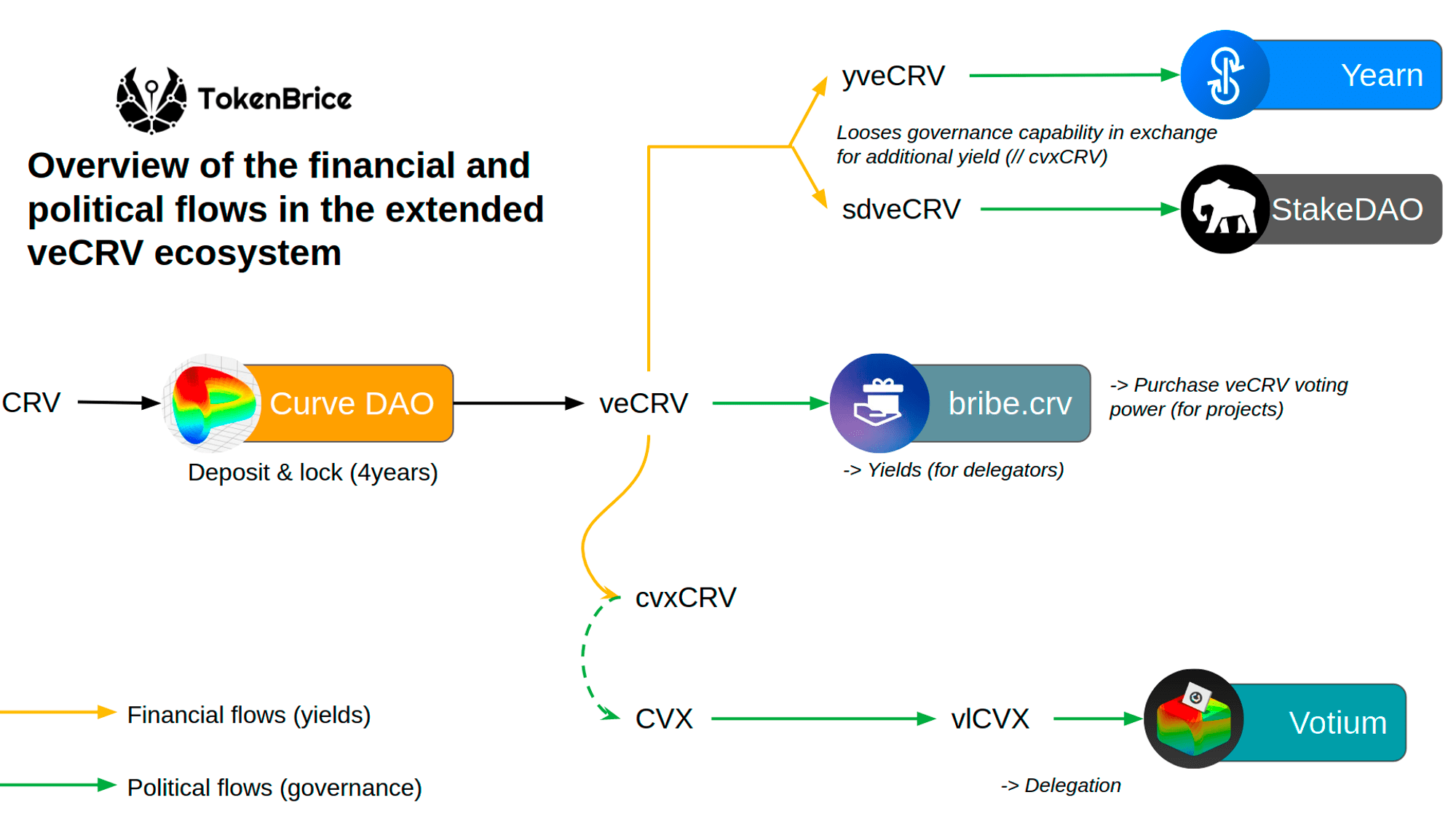
Ecosystem built on veCRV source: https://tokenbrice.xyz/crv-wars/
Let’s briefly summarize the obvious advantages and disadvantages of the veCRV mechanism:
advantage
After the lock-up, liquidity is reduced, selling pressure is reduced, and the price of the currency is stabilized (currently 45% of CRV has been locked for voting, with an average lock-up period of 3.56 years.)
Make the long-term interests of all parties relatively coordinated (veCRV holders also enjoy a share of the handling fee, that is, the interests of the liquidity provider, the trading party, the token holder, and the protocol are coordinated together)
Weighting of time and quantity, better governance possibilities
2. Disadvantages
More than half of Curve’s governance rights are in the hands of Convex (53.65%), so governance rights are quite concentrated.
The liquidity within Curve is not fully utilized (the boost mining rewards and governance voting rights obtained by an address locking CRV are limited to this address and cannot be transferred; it attracts a large amount of liquidity through high subsidies, but this liquidity does not play its high-speed liquidity function and cannot generate external benefits)
The hard lock-up period is not friendly to investors, and 4 years is too long for the crypto industry.
Different innovations for the vetoken mechanism
In a previous article by DODO Research, we analyzed in detail the five innovations of the veToken model in terms of incentive design. Each protocol made different adjustments at the key levels of the mechanism based on its own needs and focus. Specifically, they are:
Design veNFT to improve the liquidity problem of vetoken
How to better distribute tokens to vetoken holders
Encourage the healthy development of liquidity pool trading volume
Layer the revenue structure to give users the opportunity to choose
Take Balancer as an example. In March 2022, Balancer launched version V2, which modified the original economic model. Users can lock the BPT (LP token of the Balancer fund pool) of the 80/20 BAL/WETH pool to obtain veBAL, thereby deeply binding the governance rights and protocol dividend rights of Balancer V2 with veBAL.
Users must lock up two tokens, BAL and WETH, in a ratio of 80:20, instead of just locking up BAL. Locking up LP tokens instead of locking up a single token can increase market liquidity and reduce volatility. Compared to Curve's veCRV, veBAL has a maximum lock-up period of 1 year and a minimum lock-up period of 1 week. This also greatly reduces the lock-up period.
In terms of fee sharing, 50% of the protocol fees received by Balancer will be distributed to veBAL holders in the form of bbaUSD. The remaining Boost, Voting, and governance rights are not much different from Curve.
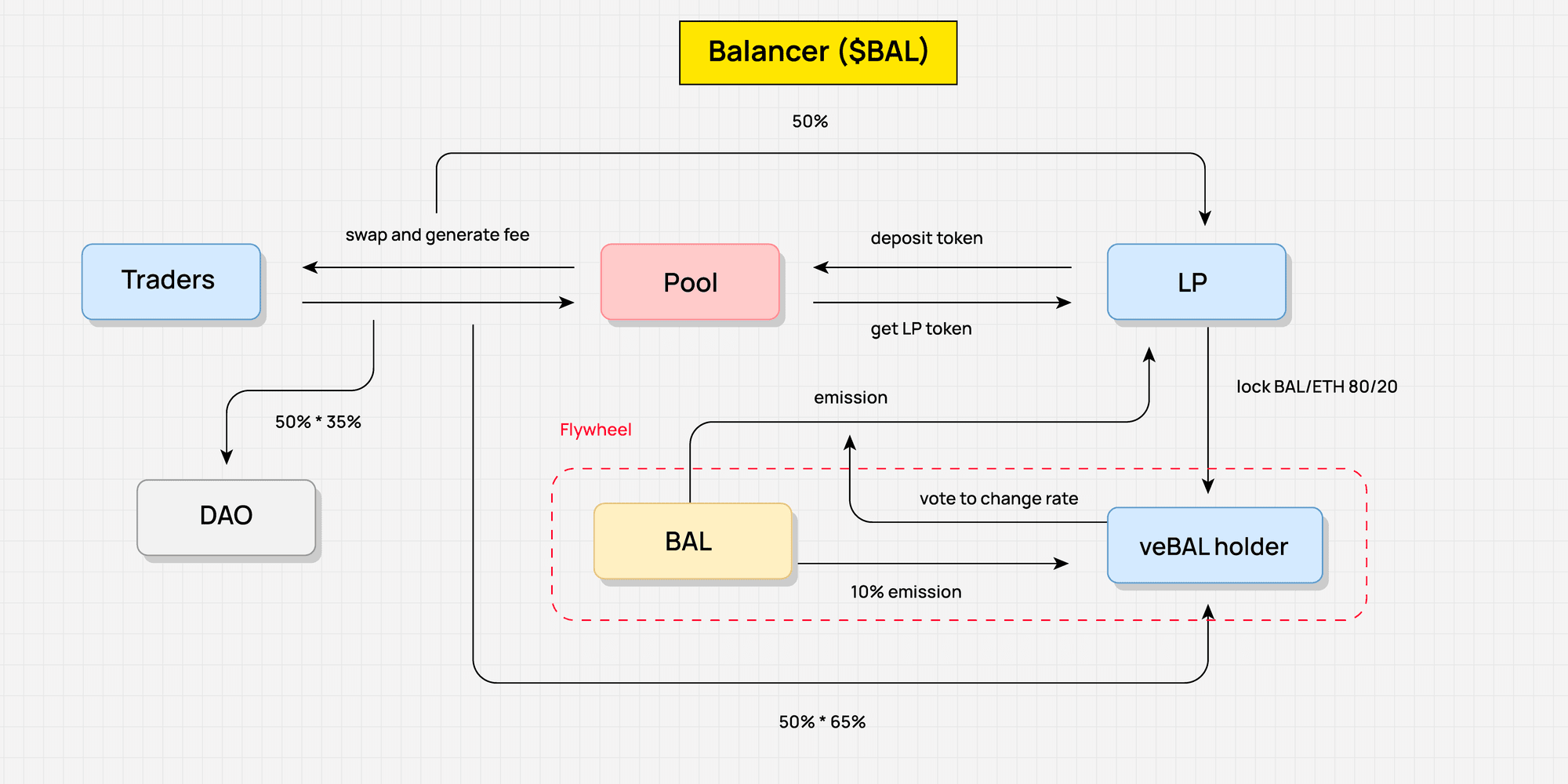
Balancer Value Flow Chart: DODO Research
It is worth mentioning that in response to the problem of "waste of liquidity - unable to increase external benefits for the product" in the vetoken model, Balancer uses the interest-bearing trading pool Boosted Pool mechanism to increase LP income (LP tokens issued by the LP pool are called bb-a-USD, which can be paired with various assets in the AMM pool as paired assets. The issuance of LP tokens achieves asset leverage, thereby increasing LP income). Later, Core Pools was proposed (in order to improve the original Boosted Pools that can only benefit LPs). The official bribed veBAL holders through Bribes to vote for Core Pools, which will cause a large amount of $BAL to shift to Core Pools, increase the income of external interest-bearing assets, and change the income structure of the Balancer protocol itself.
Velodrome: The most representative ve(3,3)
Before we talk about Velodrome, let’s briefly define ve(3,3) again: Curve’s veCRV economic architecture + Olympus’ (3,3) game theory.
As shown in the figure below, there are two main ways to motivate OHM in Olympus: one is the bond mechanism (Bonding), and the other is the staking mechanism (Staking). Olympus officially sells OHM to users in the form of bonds at a price lower than the market price. The official obtains USDC, ETH and other assets paid by users, so that the treasury is supported by valuable assets, and generates OHM to be distributed to OHM pledgers through the Rebase mechanism. Ideally, as long as users choose to pledge for a long time, that is, the so-called (Stake, Stake) - that is, (3,3), the OHM balance in their positions can continue to grow with compound interest, and the pledgers have a positive cycle effect of high APR. However, if the selling pressure of OHM in the secondary market is serious, this flywheel cannot be sustained. This is of course a game of game theory. The ideal state is Nash equilibrium, achieving a win-win situation.
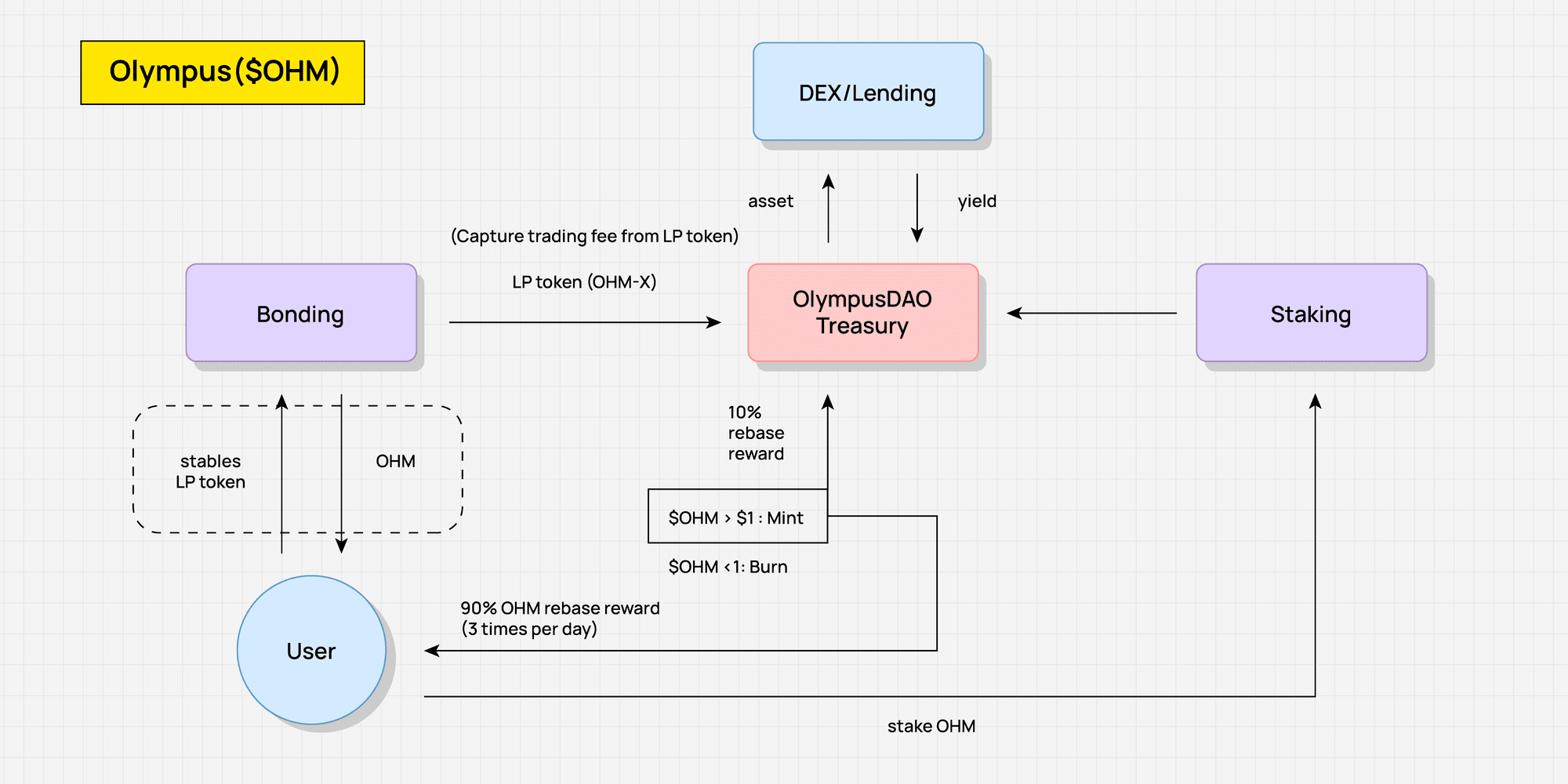
Olympus Value Flow Chart: DODO Research
At the beginning of 2022, Andre Cronje launched Solidly on Fantom, with veNFT and voting rights optimization at its core. veSOLID positions are represented by veNFTs, which seems to liberate liquidity. Even if users transfer NFTs, any NFT holder has the right to vote to determine the distribution of rewards; veSOLID holders will receive a certain base proportional to weekly emissions, which allows them to maintain their voting share even without locking new tokens; at the same time, stakers receive 100% of transaction fees, but can only earn rewards from the pools that have voted, avoiding the situation on Curve where voters vote for pools just to bribe voters.
After AC announced on Twitter that the Solidly token ROCK would be directly airdropped to the top 20 protocols with the largest locked volume on the Fantom protocol, a Vampire Attack between the Fantom on-chain protocols was triggered, and 0xDAO and veDAO came into being, starting the TVL war. A few months later, the veDAO team incubated another project of ve(3,3), Velodrome.
So why has Velodrome Solidly become the standard fork template on layer2 such as Arbitrum or zkSync?
In its original design, Solidly had some key weaknesses, such as high inflation and complete permissionlessness, allowing any pool to earn SOLID rewards, resulting in a large number of air tokens. Rebases or “anti-dilution” also did not add any value to the entire system.
What changes has Velodrome made?
The Pool for issuing incentives for Velo tokens adopts a whitelist mechanism. The whitelist is currently open to applications and does not follow the on-chain governance process (avoiding voting to decide token incentives).
Liquidity bribe rewards for the Pool can only be claimed in the next cycle
(veVELO.totalSupply ÷ VELO.totalsupply)³ × 0.5 × emission - reduces the issuance reward ratio for ve token holders. Under Velo's adjusted model, veVELO users will only receive 1/4 of the total emission in the traditional model. This improvement has actually greatly weakened the (3,3) part of the ve(3,3) mechanism.
Cancelled the LP Boost mechanism
3% of Velo’s emissions will be used as operating expenses
Extended exploration of veNFT mechanisms: including veNFT being tradable even when staking/voting, veNFT being divisible, veNFT lending, etc.;
More reasonable token distribution and issuance rhythm: Velodrome distributed 60% of the initial supply to the community on the first day of the project, tied up with the Optimism team to help with the cold start, and airdropped several protocols with veVELO NFTs with no strings attached, which greatly helped attract initial voting and bribery activities.
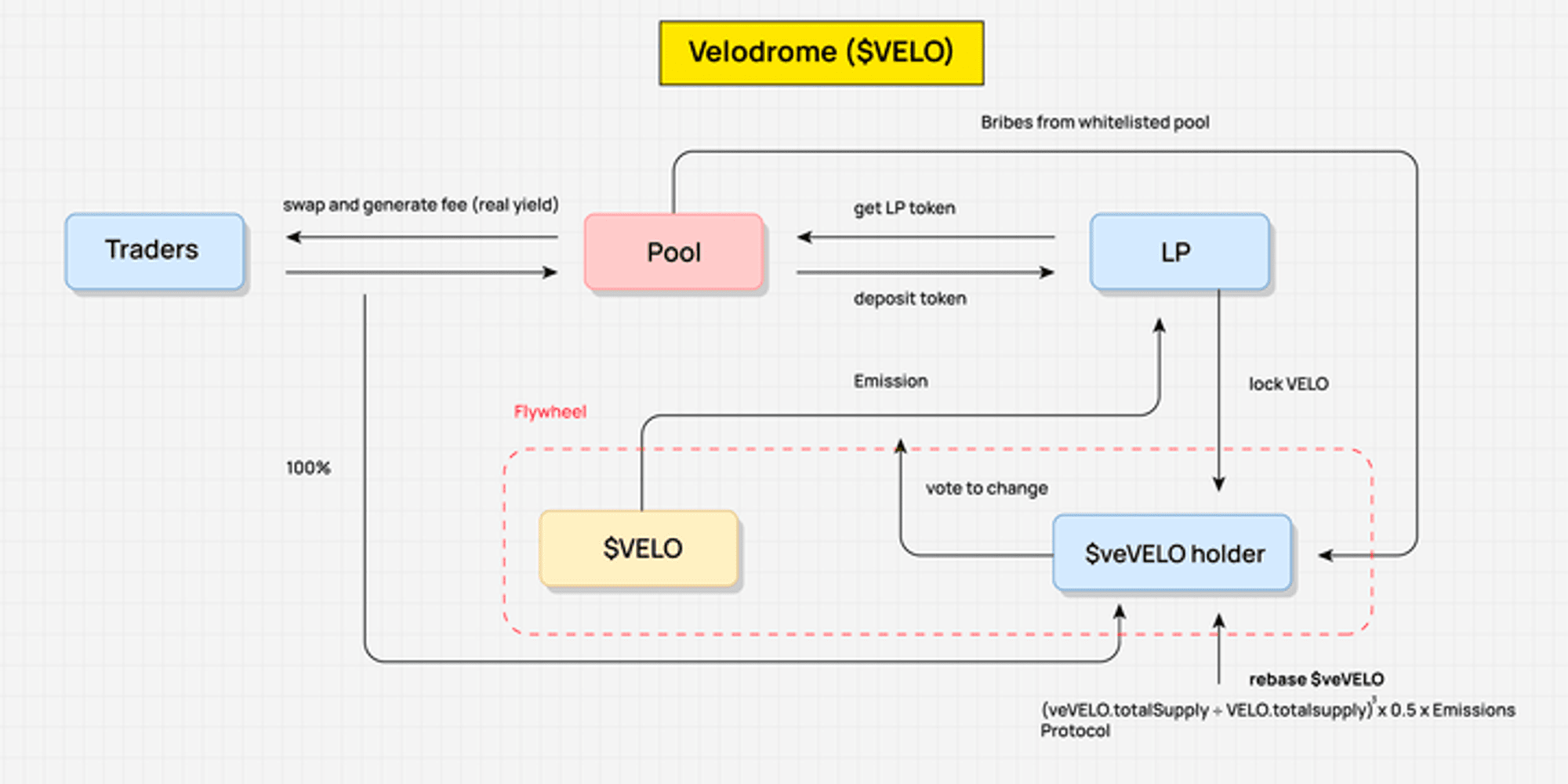
Velodrome Value Flow Chart: DODO Research
After the launch, Velo's pledge rate has been on an upward trend. At its peak, 70%-80% was a very high lock-up ratio (Curve, which also uses the ve model, currently has a pledge rate of 38.8%). Many people question that as the "Tour de OP" plan started in November last year comes to an end, the incentive of 4 million OP rewards will come to an end, and the incentive of lock-up will further decline, forming potential selling pressure. However, the current Velo pledge rate remains at a good level (~70%). The upcoming V2 upgrade is also aimed at encouraging more holders to lock their tokens, which is worth keeping an eye on.
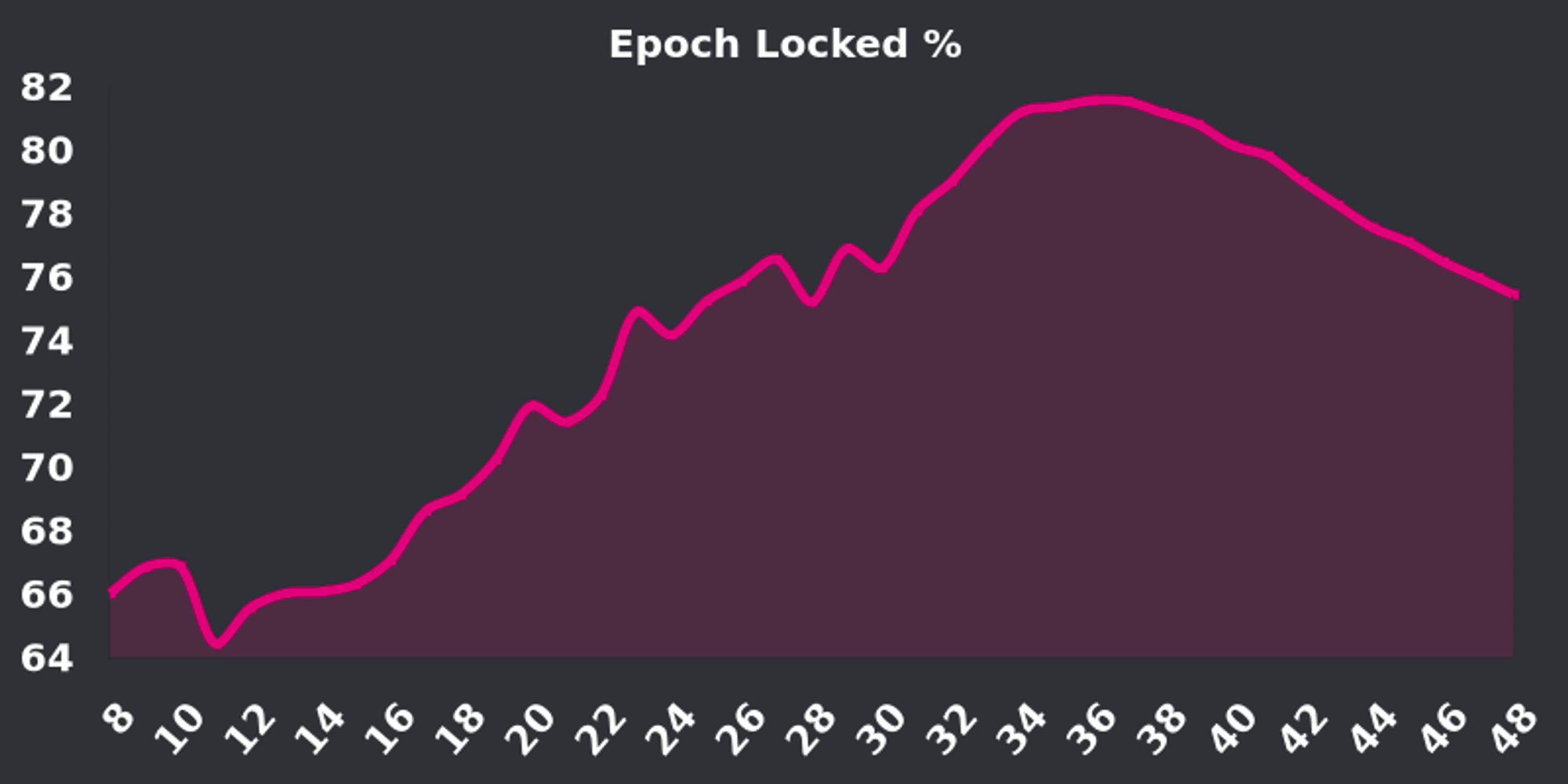
Velo pledge rate curve, image source: Velo official DC, source: mint ventures
05.ES Mining Mode
ES: Gambling with real income to encourage loyal users to participate
The ES mining model is an attractive and challenging new Tokenomics mechanism. Its core idea is to reduce the cost of protocol subsidies by unlocking thresholds and enhance its attractiveness and inclusiveness by incentivizing real user participation.
In the ES model, users can get ES Token rewards by staking or locking positions. Although this reward makes the yield seem higher, in fact, due to the existence of the unlocking threshold, users cannot immediately cash out these earnings, making the actual profit calculation complicated and unpredictable. This increases the challenge of the ES model and its attractiveness.
Compared with the traditional ve model, the ES model has obvious advantages in terms of the cost of protocol subsidies, because its designed unlocking threshold reduces the subsidy cost. This makes the ES model closer to reality in the game of allocating real benefits, and therefore more universal and inclusive, and is likely to attract more users to participate.
The essence of the ES model is that it can incentivize real users to participate. If users leave the system, they will give up the ES Token reward, which means that the protocol does not need to pay additional token incentives. As long as users stay in the system, they can get ES Token rewards, although this part of the reward cannot be quickly converted into cash. This design incentivizes the participation of real users, maintains user activity and loyalty, and does not impose excessive incentives on users. By controlling the spot ratio and unlocking period of staking or lock-up, the project itself can achieve a more interesting and attractive token unlocking curve.
Camelot: Introducing some ES mining incentives
When discussing how Camelot's value flows, the abstract Camelot value flow clearly shows how Camelot's tokenomics works. Here, we do not elaborate on each link in detail, but abstractly show the main value flow parts to better understand its overall framework.
Camelot's core incentive goal is to encourage liquidity providers (LPs) to continue to provide liquidity to ensure that traders can enjoy a smooth trading experience and sufficient liquidity. This design ensures the smoothness of transactions through an incentive mechanism and helps LPs and traders share the generated profits.
The real revenue of the Camelot protocol comes from the transaction fees generated by the interaction between traders and pools. This is the real income of the protocol and the main source of revenue redistribution for the protocol. In this way, Camelot ensures the sustainability of its economic model.
As for the redistribution of revenue, 60% of the handling fee will be distributed to LP, 22.5% will be redistributed to Flywheel, 12.5% will be used to purchase GRAIL and destroy it, and the remaining 5% will be distributed to the team. This redistribution mechanism ensures the fairness of the protocol and also provides motivation for continued operation.
In addition, this profit distribution also encourages and drives the flywheel operation. In order to obtain the redistributed profits, LPs must stake LP tokens, which indirectly incentivizes them to provide liquidity for a longer period of time. In addition to the real income of 22.5% handling fees, Camelot also allocates 20% of GRAIL tokens and xGRAIL (ES tokens) as incentives. This strategy not only incentivizes LPs, but also encourages ordinary users to participate in profit distribution by staking GRAIL, enhancing the activity and attractiveness of the entire protocol.
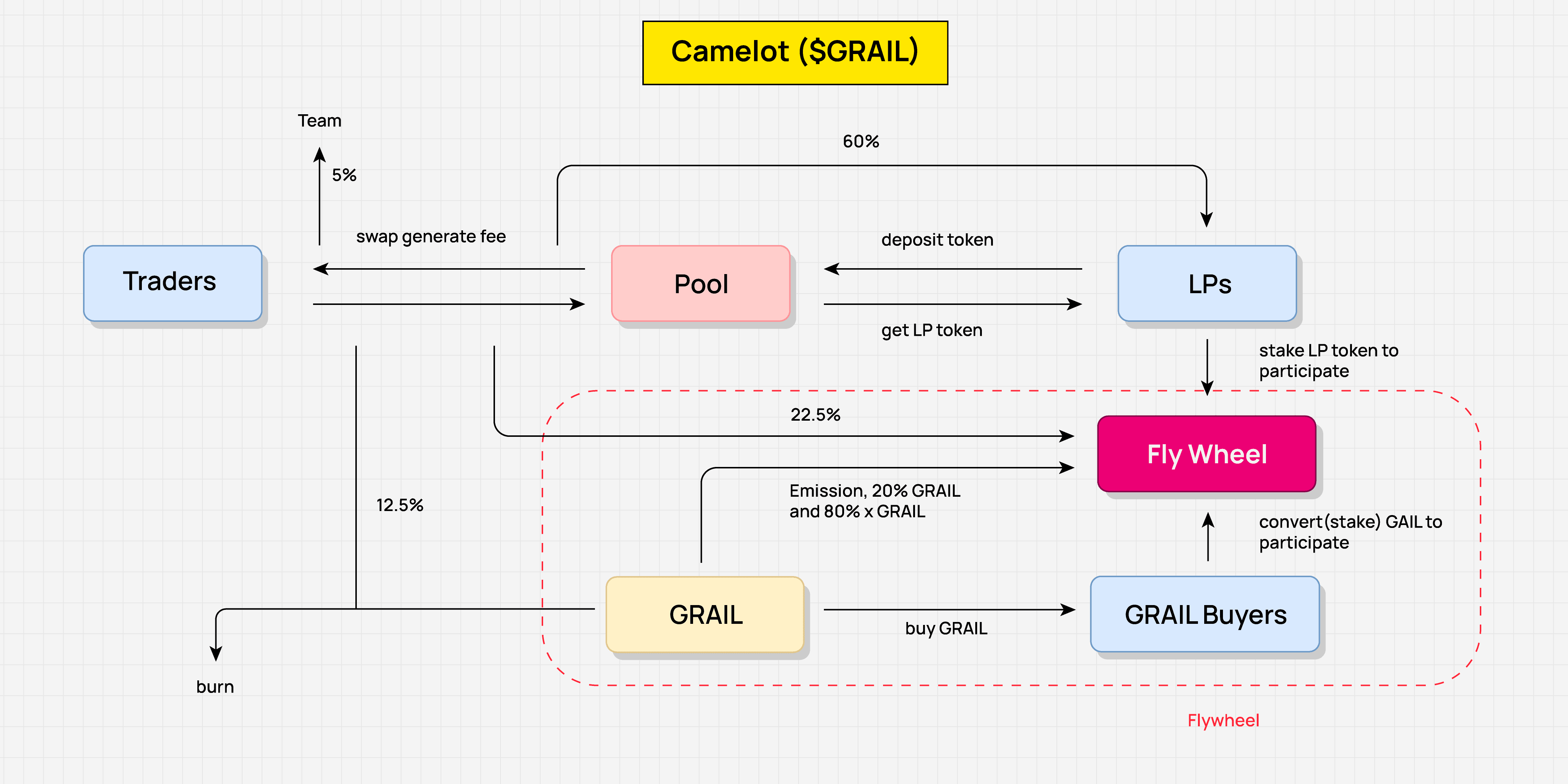
Camelot Value Flow Chart: DODO Research
GMX: Encourage competition for real profit distribution
GMX's tokenomics model is a highly interesting and interactive design, whose core goal is to achieve continuous supply of liquidity and encourage traders to continue trading with liquidity providers (LPs). This design aims to ensure the liquidity and trading volume of the protocol while incentivizing the continuous lock-up of GMX.
The real income of this model comes from the fees generated by traders for exchange and leveraged trading, which is the main source of income for the protocol. In order to ensure fair distribution of income, the income is first used to deduct the referral fee and the keeper's fee. Of the remaining part, 70% will be distributed to GLP holders (actually LP), and the remaining 30% will be redistributed. GMX distributes this part of the income through a game mechanism, which is also the core mechanism of the model.
The core game mechanism of GMX is designed to redistribute 30% of the real income. This ratio is fixed, but GMX holders can use different strategies to influence the proportion of income they can share. For example, users can get esGMX rewards by staking GMX, and the unlocking of esGMX requires GMX spot staking, and a certain unlocking period must be met. In addition, staking GMX will also get Multiplier Points. Although this part of the reward cannot be directly cashed out, it can increase the user's profit share.
In this game mechanism, GMX, esGMX and Multiplier Point all play a weighted role in profit sharing. The only difference is that Multiplier Point cannot be cashed out; esGMX requires the staking of GMX to be gradually unlocked; while GMX can be quickly cashed out, but Multiplier Point will be cleared and the esGMX reward will be given up.
This design enables users to develop strategies based on their needs. For example, for users who pursue long-term returns, they can choose to continue locking to obtain the maximum weight and obtain higher relative returns. If users want to withdraw from the protocol quickly, they can choose to withdraw and cash out all the staked GMX. At this time, the unrealized esGMX rewards will remain in the protocol. The protocol does not need to actually issue subsidies, but distributes the real income during this period to users.
In this way, the token economic model of GMX encourages GLP holders to continue to provide liquidity and fully utilizes the value of real income redistribution. This makes it possible to continuously lock up GMX, further strengthening the stability and attractiveness of its economic model.
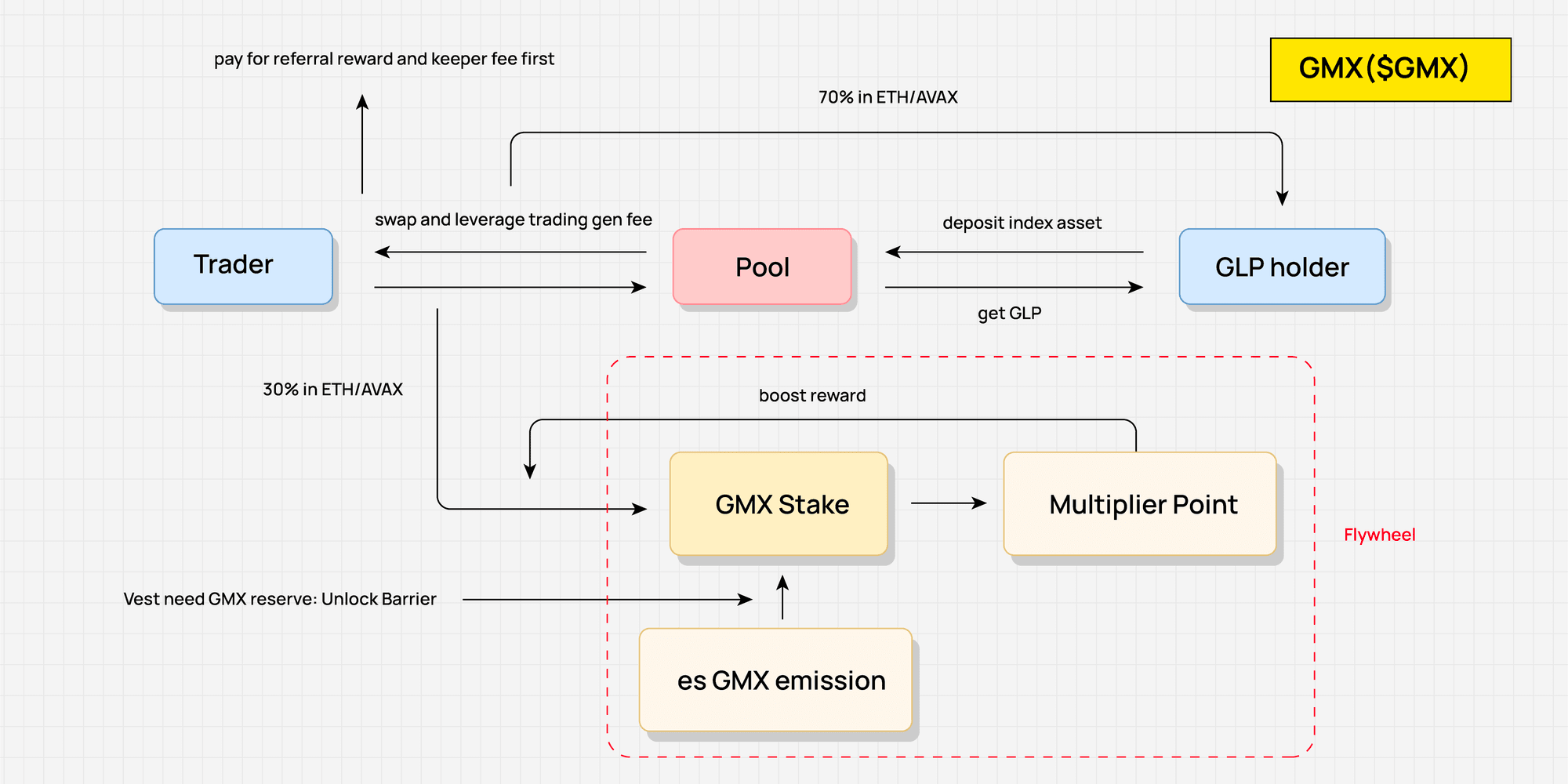
GMX Value Flow Chart: DODO Research
06. The core elements of DeFi economic model design from the perspective of Value Flow
In the design of DeFi economic models, the core elements include basic value, token supply, demand, and utility. These components are relatively discrete and cannot be combined intuitively in some previous analyses. The Value Flow method used in this article is to abstract the value flow within the protocol by studying the project's Tokenomics mechanism, and combine it with product logic to analyze the value flow of the project as a whole, including the flywheel composition, the direction of income distribution, and the incentive links. Combined with the distribution of token chips and the unlocking cycle, etc., you can intuitively understand the Tokenomics of a project.
The following is the Value Flow that was not expanded in detail in the above article due to space limitations:
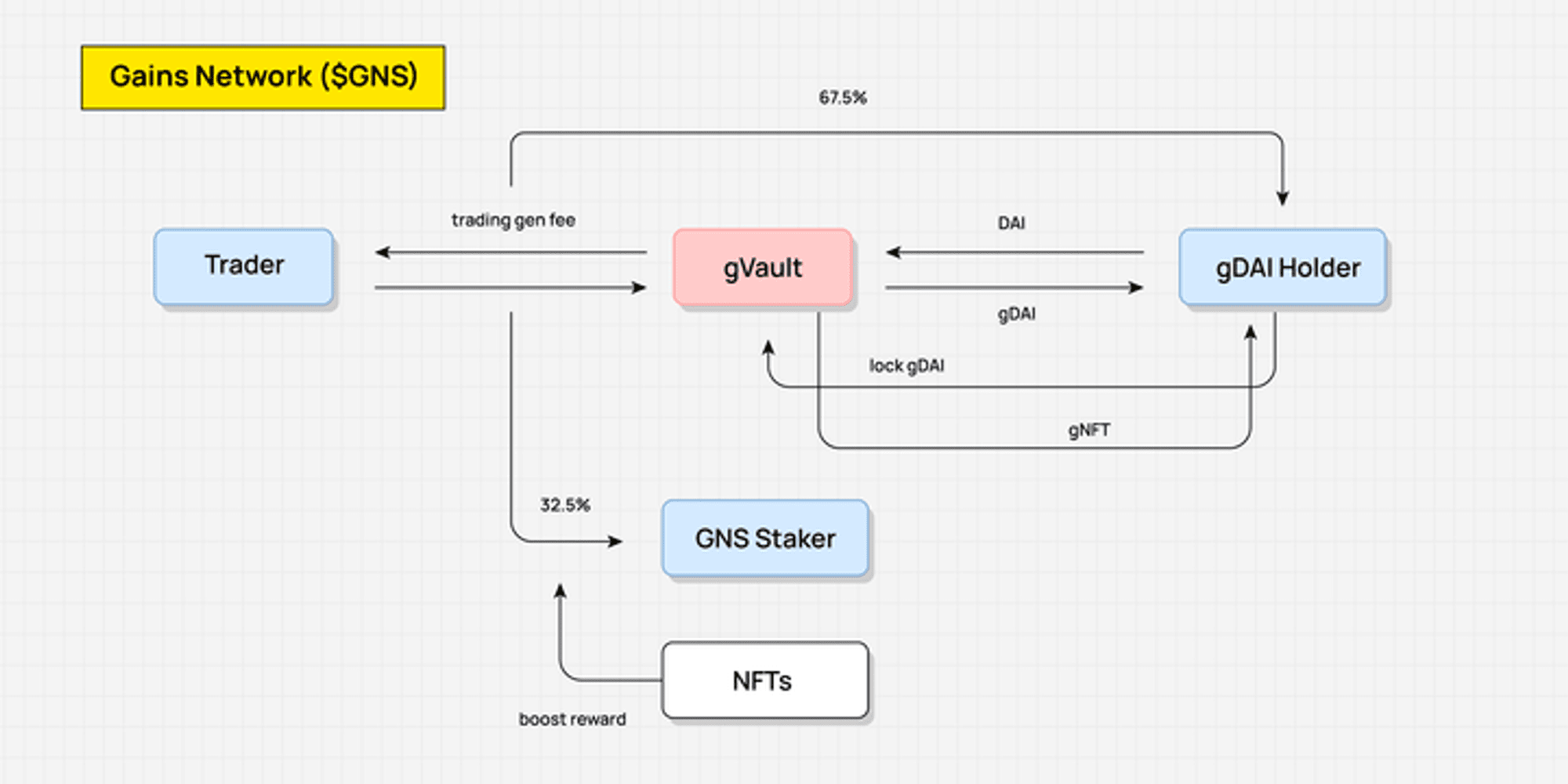
GNS Value Flow (using NFT to implement membership mechanism and redistribute profits) Chart: DODO Research
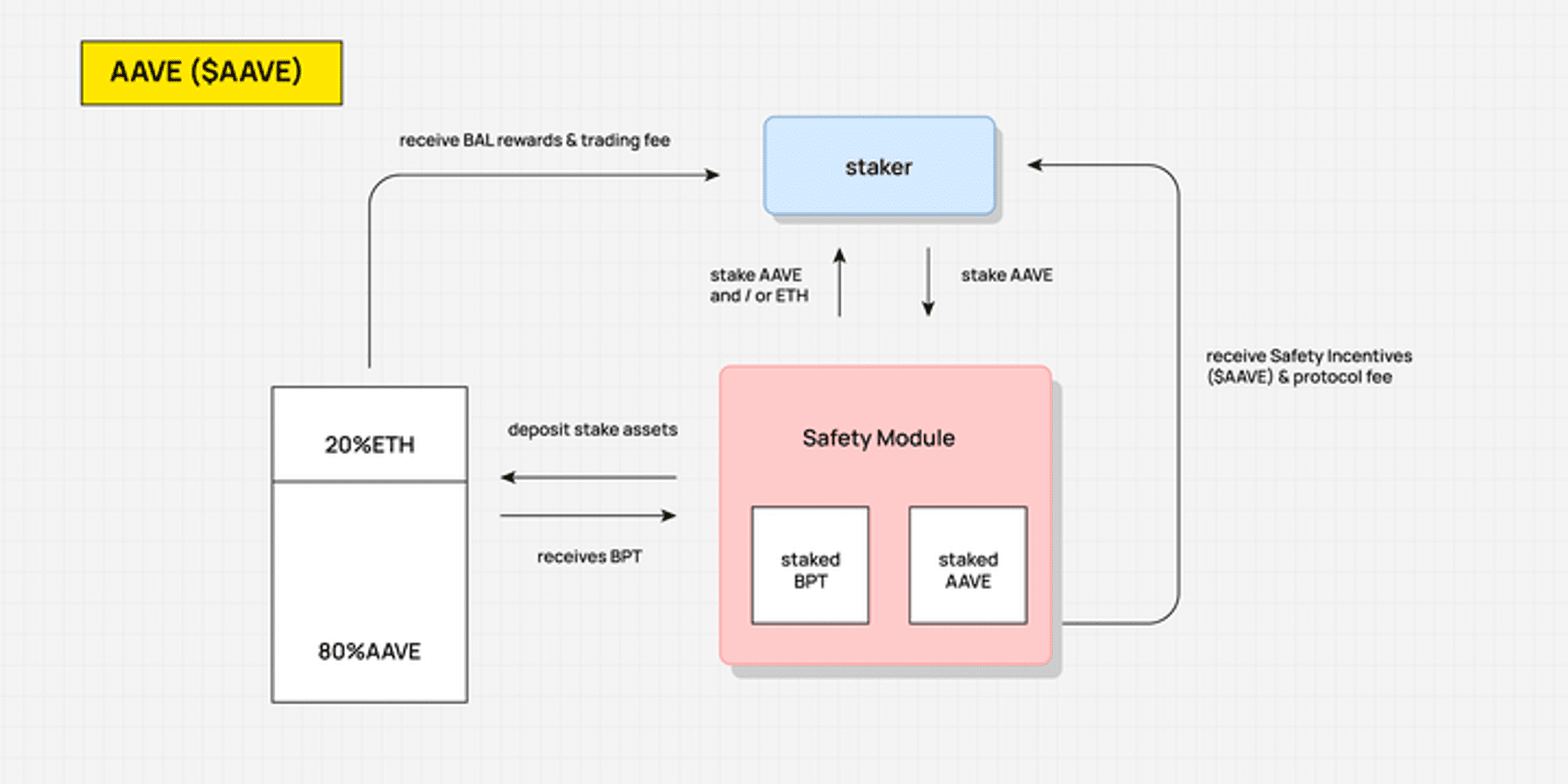
AAVE Value Flow (users stake AAVE to receive part of the protocol revenue) Chart: DODO Research
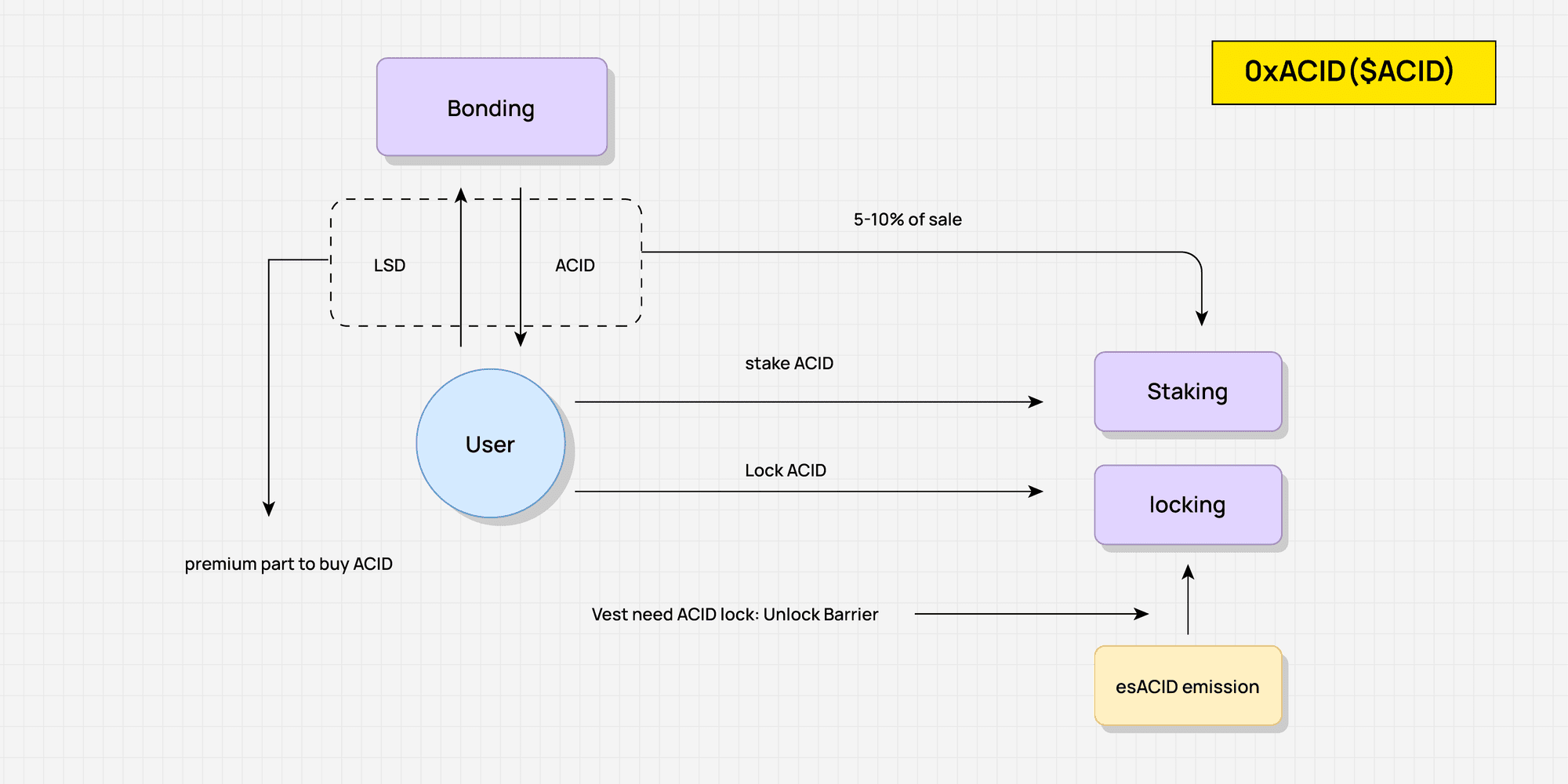
ACID Value Flow (combining the es mechanism and the Olympus DAO mechanism to achieve a flywheel) Chart: DODO Research
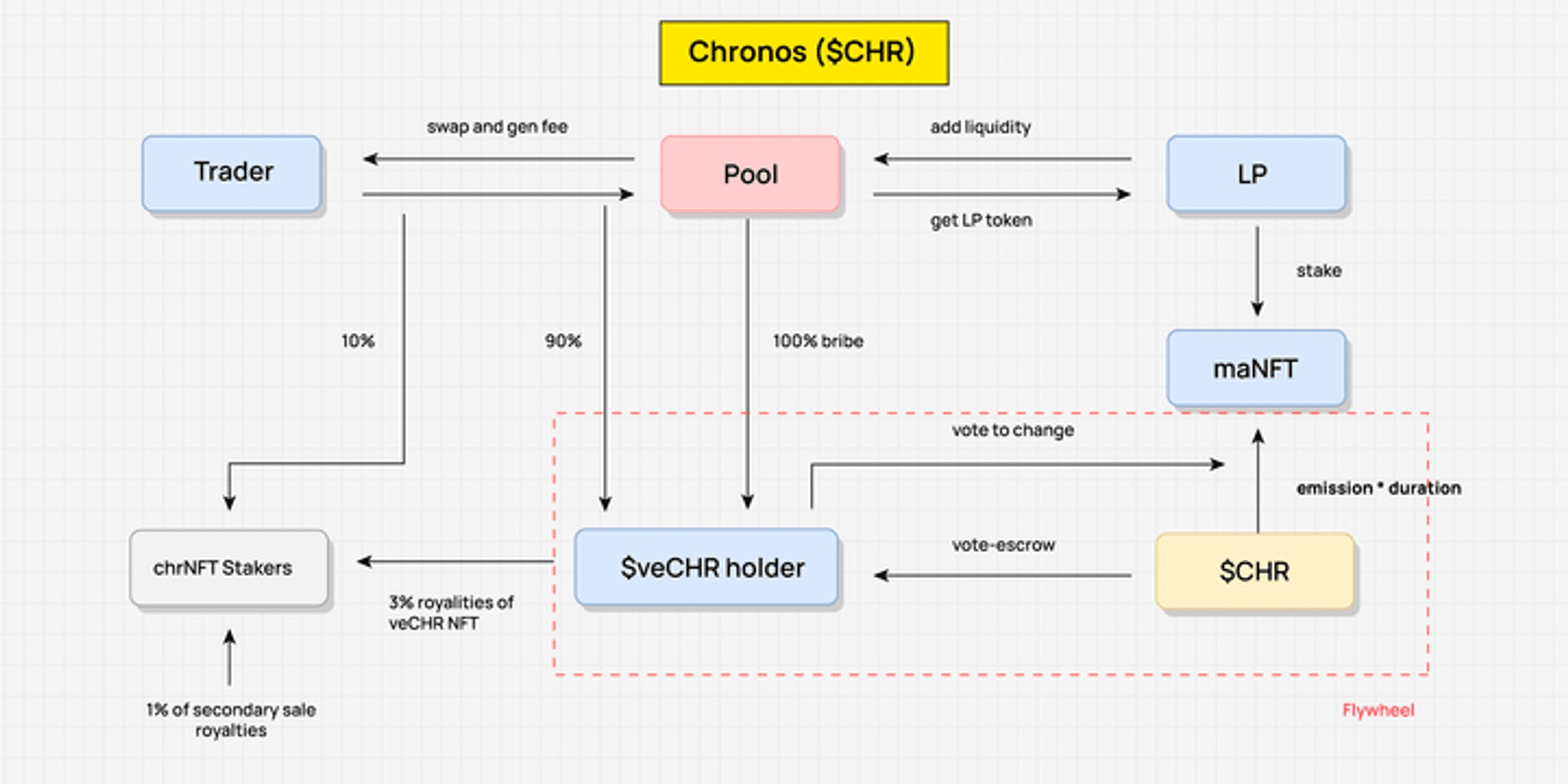
CHR Value Flow (ve(3,3) without rebase mechanism to prevent voting power concentration) Chart: DODO Research
Value Flow Composition
DeFi protocols all generate real returns to a greater or lesser extent, with real money flowing through the protocols and value being generated accordingly.
Value Flow is the flow of value in the abstract protocol itself. First, starting from the real benefits, the redistribution of the real benefits of the protocol is depicted; secondly, the flow and acquisition conditions of token incentives are abstracted, so that the value capture of tokens, the links of incentives and the flow of tokens can be clearly seen. These flows of value constitute the entire business model, and the release of tokens will be redistributed through Value Flow in the continuous operation of the protocol.
Taking Chronos as an example, when abstracting its Value Flow, we need to first abstract the key stakeholders, such as Trader, LP, and veCHR holder. The key stakeholders are the participants in redistribution and the nodes of Value flow. Value flows between these stakeholders and the benefits are redistributed according to the mechanism design.
The key to abstracting Value Flow is to abstract the direction and mechanism of revenue distribution. It does not require specific details of each link, but to merge various small flow branches and abstract and integrate them when necessary to form an overall flow. Taking this figure as an example, the real source of revenue is the handling fee generated by Trader transactions. 90% of this part is allocated to veCHR holders and redistributed through the ve mechanism to achieve incentives for native tokens. After the Value Flow is abstracted, we can clearly see how the value flows within the protocol and how the revenue is distributed over time.
Value Flow is not the whole of Tokenomics, but it is the product value flow itself designed based on Tokenomics. If we add the initial allocation and unlocking of tokens, we can fully present the Tokenomics of a protocol.
Tokenomics Reshapes Value Flow
Why is the early mining, withdrawal and selling economic model becoming less and less common?
In the early days, the design of Tokenomics was relatively crude, and tokens were seen as a means to incentivize users and a tool for short-term profit. However, this incentive method was simple and direct, and lacked an effective redistribution mechanism. Take DEX as an example. When emission and all handling fees are directly allocated to LPs, there is a lack of long-term incentives for LPs. This model is prone to collapse when there is no other source of value for the coin price, because the migration cost of LPs is too low, resulting in one collapsed mining pool after another.
As time goes by, the design of DeFi protocols on Tokenomics has become more and more sophisticated and complex. In order to achieve incentive goals and regulate token supply and demand, various game mechanisms and profit redistribution models have been introduced. Tokenomics is closely coupled with the product logic and profit distribution of the protocol itself. Reshaping the Value Flow through Tokenomics and redistributing real profits have become the main functions of Tokenomics. In this process, the supply and demand of tokens can be regulated, and tokens can achieve value capture.
DeFi Tokenomics Key Mechanism: Gaming and Value Redistribution
In the late DeFi summer, many protocols have improved their economic models. The essence of these is to introduce a game mechanism to redistribute a certain part of the profits, thereby increasing the stickiness of users on the entire chain. Curve redistributed the token reward mechanism, redistributed emission rewards through voting, and even derived vote-buying value and various combinatorial platforms. In addition, another core of the Tokenomics mechanism is to drive the rotation of the entire flywheel and capture more traffic and funds by introducing additional token rewards.
In summary, under such a mechanism, tokens are no longer just a simple medium of value exchange, but also a tool for capturing users and creating value. This process of redistributing profits can not only increase user activity and stickiness, but also stimulate user participation and promote the development of the entire system through token rewards.