


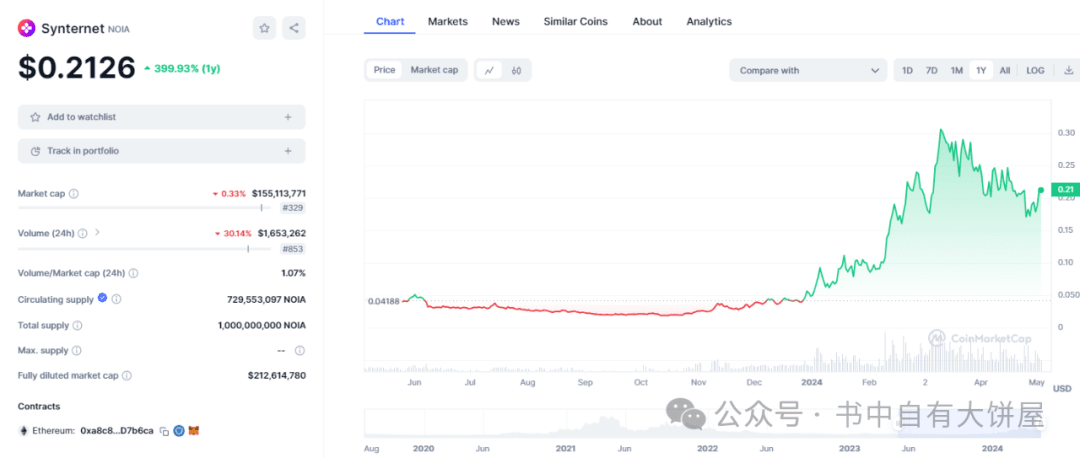
Today we continue to share projects. This project is very similar to the modular data layer of TIA we talked about before, and it also focuses on DA. TIA is mainly a chain and launched its own DA system, and then it started to soar after it went online. The project has been around for about 10 years in the past six months, but the current market value is still relatively low at only 150 million US dollars, and the overall FDV is around 200 million US dollars. Compared with TIA’s market value of 1.8 billion US dollars (FDV 10 billion), there is still a big gap. Let’s take a look at the potential of this project today.
Introduction
Synternet is a blockchain that provides modular, interoperable data infrastructure support for all major chains. At its core is the Data Layer, a protocol that acts as a customizable execution layer between all blockchains. Designed for efficiency, security, and interoperability, the Data Layer provides a fully decentralized data exchange for developers, organizations, and users. By removing reliance on centralized services, Synternet provides fast and seamless access to real-time and historical on-chain data. Synternet’s modular data infrastructure fosters a vibrant ecosystem dedicated to driving the development of the next generation of decentralized applications, while opening up unprecedented opportunities for innovation.
Purpose
The Synternet Data Layer protocol is designed to provide and obtain blockchain data. While anyone can publish various types of data on the data layer, the protocol is specifically built for Web3 data. For the main blockchain data use case, full nodes connected to the respective blockchain networks can sell the data generated by these networks through Synternet. Users interested in building decentralized applications can purchase this data using crypto tokens. The protocol for sharing and using blockchain data in an incentive-driven manner is called the Synternet Data Layer.
Problem (background)
The main problem with current on-chain data access is that the vast majority of dApps that exist today are centralized at their core. The data they use originates from a decentralized world, but is transmitted to these purportedly decentralized applications through centralized databases. However, at the end of the day, these applications rely on a simple and straightforward Web2 solution: an application programming interface (API) created and controlled by a single data provider entity.
solution
The Synternet Data Layer Protocol defines the authentication of entities participating in the protocol, authorizes access to economic actors to perform their roles, and performs accounting of data, enforced through on-chain consensus. The protocol has many desirable properties that make it a key building block for truly decentralized applications:
1. Decentralization. It was created with the single goal of distributing and democratizing access to blockchain data so that anyone can become a data provider and consume data through a decentralized protocol.
2. Availability. Powered by utility tokens, this ensures cheaper on-chain data and quality of service for the solution through staking and incentive-driven.
3. Scalability. By adopting PubSub messaging instead of a centralized API model, we remove the computational burden from the data source and introduce and incentivize a message broker network.
Decentralization
Through the Synternet Data Layer Protocol, anyone can become a provider in the open market for Web3 data. Token holders decide which providers are reliable and therefore worthy of rewards based on the quality of the data they provide as well as their overall performance. The tokenization of the relationship between data providers and consumers thus becomes the most unique feature of the Synternet Data Layer Protocol, with the Synternet token being the fuel for Web3 data.
Availability
A decentralized system will also be able to offer prices below the current industry standard for RPC nodes. Increased demand within the Synternet data layer will drive the price per GB of data down. At the high data price end, the vast majority of the total cost is fixed hardware server costs, while at the low data price end, service costs are expected to account for 30-40% of the total cost. Here, service costs are the cost of transmitting data over the network to the user.
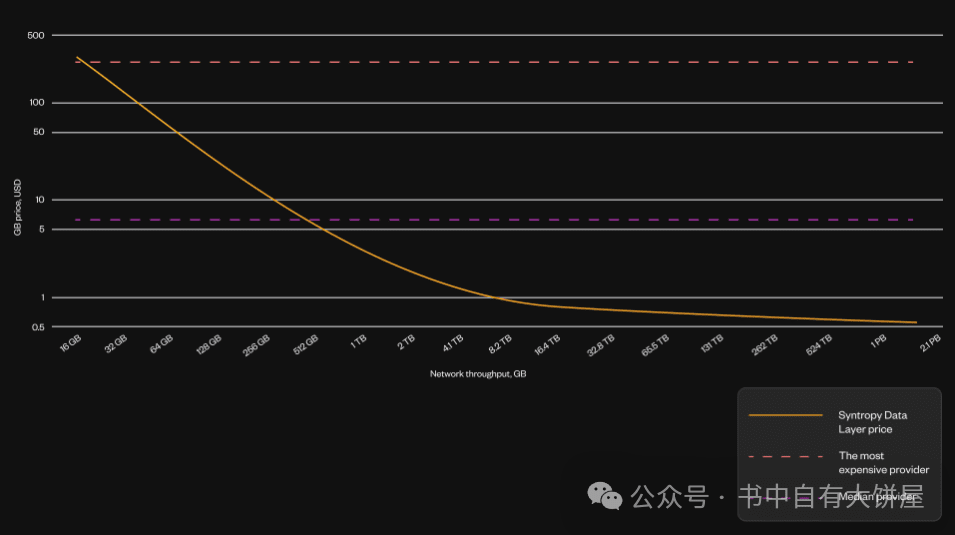
Chart: Expected price per GB of Ethereum data in the Synternet data layer compared to RPC node providers and centralized APIs. Calculations assume profit margins for publishers and proxy nodes are 80% initially, decreasing to 60% as the network matures.
Scalability
By removing the computational burden from the source of data, Synternet is able to achieve economies of scale. In the standard request-response model, each request causes the data source to perform some computation. In the publisher-subscriber model, computation is performed only once at the source, making such a solution more scalable and able to compete on price with existing solutions that provide blockchain data, such as RPC nodes and centralized APIs.
High-level overview of the protocol
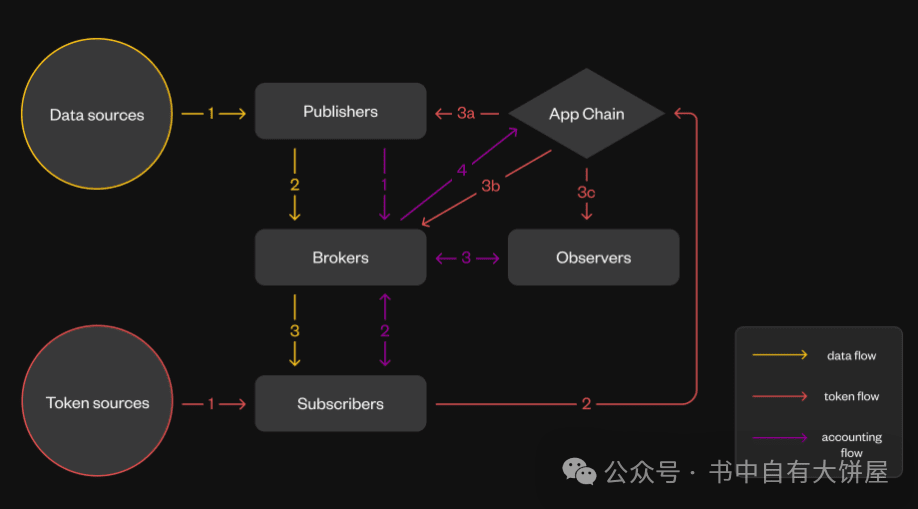
The goal of the system is to enable decentralized data delivery services and their payments. Each service has a specific name, the topic, which allows publishers and subscribers to find each other. Messages are streamed by publishers according to a specific topic. The messages are then delivered to subscribers and/or clients authorized by the subscribers through a network of brokers.
The Synternet data layer protocol consists of three main components:
1. Publish-Subscribe Protocol and its SDK,
2. Application Specific Chains (AppChains) and Utility Tokens,
3. Data layer token economics.
1. Publish-Subscribe Protocol
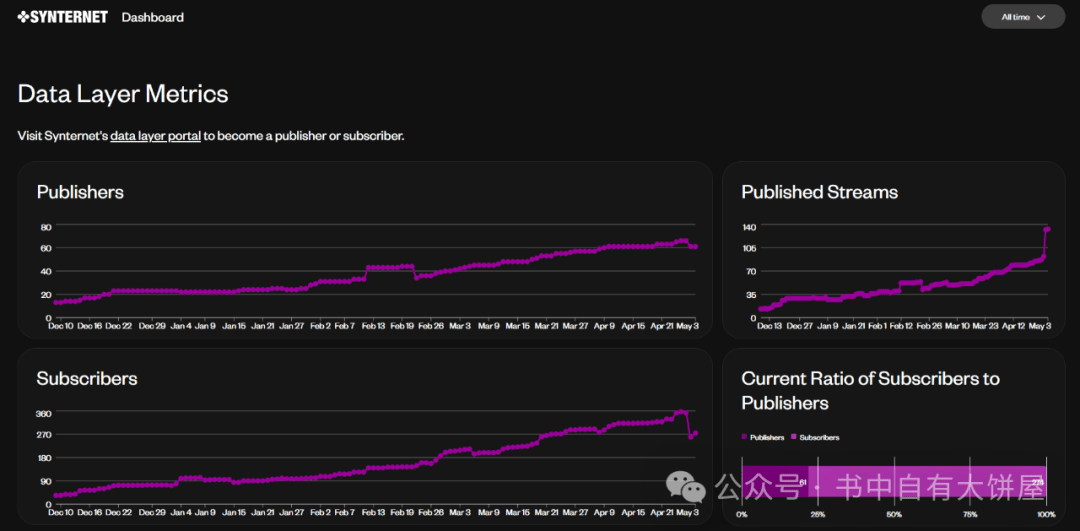
The Publish-Subscribe (PubSub) protocol provides a framework for exchanging messages between publishers and subscribers. The PubSub protocol used in the Synternet data layer is a compatible fork of NATS.
Publishers only need to compute a message once and send it to a message broker (which we simply call a broker). Publishers provide data to the system, the broker distributes the data to subscribers, and subscribers pay for the data.
Each publisher and subscriber requires specialized software integration to participate in the PubSub protocol. The PubSub SDK is provided and managed by the Synternet team and the community to simplify and accelerate the development of publisher and subscriber applications. The SDK supports multiple languages and consists of libraries that make it possible to participate in on-chain protocols and decentralized data delivery networks.
2. Application Specific Chains
The chain is a synchronization layer responsible for reaching agreements between parties and facilitating appropriate accounting and payment infrastructure. A complex collateral and incentive mechanism is implemented to ensure that all parties act in their best interests while protecting the system from malicious behavior.
In summary, blockchain is used in the following ways:
1. Registration: All entities and data flow services are registered on the blockchain.
2. Authentication: All parties participating in the protocol are authenticated by storing the public part of the key on-chain.
3. Authorization: Only subscribers (and their clients) who have expressed an economic interest in receiving the data stream are authorized to consume the data stream.
4. Accounting: All data flows delivered through the Synternet data layer are ultimately accounted for on-chain, which becomes the basis for rewarding issuers, agents, and observers.
5. Payment: Payments for all on-chain services are made in native utility tokens.
6. Incentives and penalties: Many protocol participants must pledge a certain amount of utility tokens (collateral) for the service they provide to ensure optimal performance in providing that service. If some kind of misconduct is detected and proven on-chain, a portion of the collateral will be slashed.
Data Layer Token Economics
The value flowing into the system is brought by subscribers who are directly or indirectly responsible for all rewards within the protocol. Therefore, the data layer token economics is more focused on catering to subscribers rather than other participants in the system.
Publishers can compete with each other on data price, data richness, completeness and efficiency, and overall service quality. All of this competition should drive the median price per GB of data down. Publishers and brokers will both profit as demand for cheap, high-quality data made available through decentralized protocols increases. Brokers won't even compete with each other on price, as they always get a fixed protocol fee, even if a publisher decides to give away their data for free.
In order to protect the system from malicious behavior, additional observer entities are required. Observers are responsible for monitoring and proving the behavior of the agent. In addition to delivering data, the agent is also responsible for accounting data off-chain and constructing proof of delivery, which is subsequently proven by the observer and can then be submitted to the application chain.
Synternet Network Token
Protocol Layer
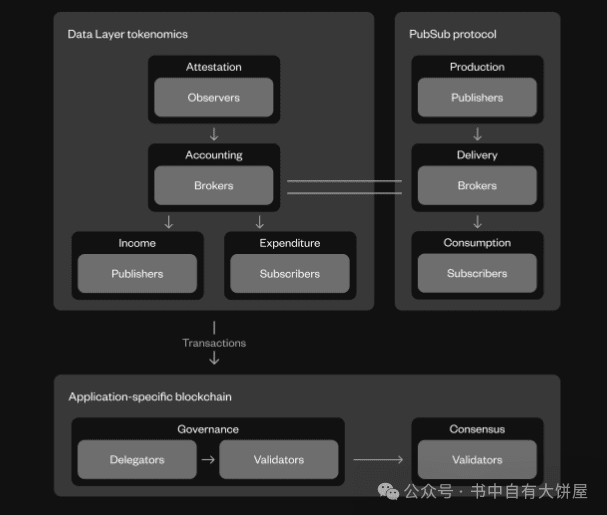
The protocol consists of three main components: Application Chain, Data Layer, and PubSub Protocol. Synternet tokens are an important component of the blockchain and data layer.
Appchains are application-specific chains whose sole purpose is to hold state inside the application. The data layer is the application itself, which enables the supply of Web3 data to meet demand. It is the economic overlay of the PubSub protocol. Finally, the PubSub protocol enables data to be streamed throughout the network.
On the data layer, various economic entities engaged in data production, transmission and consumption conduct state transitions through on-chain transactions. These transactions are sent to the application chain and added to the blockchain after being confirmed by a group of validators running the consensus protocol.
Uses of Synternet Tokens
The main uses of Synternet tokens include:
Provide security for the chain through pledge, delegation and reduction mechanisms.
The data layer is secured through continuous staking, evidence challenge and reduction mechanisms.
Provide governance for the chain through proposals and voting.
Providing payment to the data layer by ensuring at the protocol level that payment will be made if the data is delivered.
As a store of value reflecting ecosystem activity and its value creation
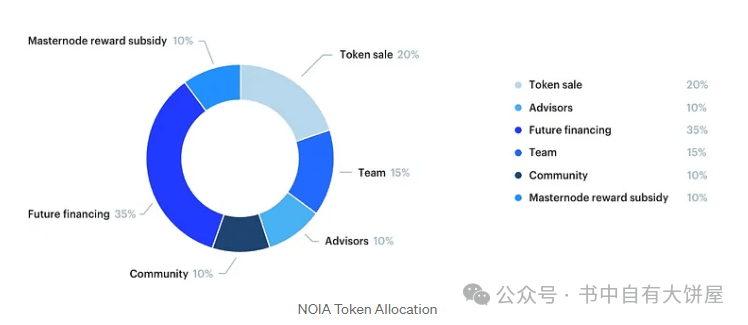
The launch time is 2021-03-30. The total amount of tokens is 1,000,000,000, with 729,553,097 in circulation, a circulation rate of 72.9%, and a current exchange rate of $0.2. The highest exchange rate is $1.1629 (2021-04-21). In terms of token distribution, the finance department will receive 35%, the sales department will receive 20%, the team will receive 15%, the community will receive 10%, the node reward will receive 10%, and the consultant will receive 10%. The ratio of 10% for the team + 35% for the finance department is a bit high.
Finally, let me summarize this project. This project is mainly about the data layer. In fact, whether it is TIA or GRT, although there are some subtle differences, the essence is still similar. This project is the same. I personally think that the data layer does not play such a significant role in the entire blockchain (compared to consensus, execution, etc.), so I personally think that TIA is definitely an overvalued range at present, but this project does have a relatively low market value at present. Compared with GRT's 2.5 billion US dollars, there is still a gap of about 10 times (although it has increased by about 10 times), and compared with TIA's 10 billion FDV, there is still a gap of 50 times.