

Tech and community updates from across the Cartesi ecosystem

science and technology
Research and Design
Do you like to frequently look for the latest information on Discord, or do you find it difficult to find it? Don't worry now, here is a summary of the developments in June:
Cartesi’s documentation has been completely revamped to support documentation for Cartesi Rollups 0.8 and 0.9, as well as updates to the Cartesi Computation (Cartesi’s computation oracle solution) section. To learn more about what’s new in the upgraded documentation portal, see this handy guide from core contributor Nico:
https://medium.com/cartesi/introducing-cartesis-upgraded-docs-portal-b5844d97a0bf
The Node unit is working full steam towards the final milestone of mainnet readiness for Cartesi Rollups and will be working on it in the beta phase.
The Explorer has a new version in its codebase! The Cartesi Rollups Explorer is now ready to render data for DApps on Cartesi Rollups v0.9.0. A detailed breakdown was released:
https://github.com/cartesi/explorer/releases/tag/v3.5.0
A new version of the Emulator SDK is coming soon, with many improvements. Please refer to our Discord channel for more details.
The Compute unit powered by Zippie successfully ran the first zkLinux in ~2000-3000 machine cycles per ZK proof segment. That is, booting Linux inside the Cartesi Machine (a large simulator).
Sunodo's preliminary documentation is online! It still needs more information. Check it out here:
https://docs.sunodo.io/
For the more careful observers among us, you may have noticed a new addition, the Research and Design Conference. Cartesi’s Research and Design Conferences are now available on YouTube, giving everyone access to complex discussions and the latest topics on the cutting edge of Cartesi technology. You can check out the first video here, which dives deep into DEX data structures:
https://youtu.be/RDI-GuaWuWw
If you have questions, you can ask the core developers and researchers directly on Discord.
Ecosystem Updates
Ultrachess is a fully on-chain chess application built using Cartesi Rollups, allowing users to stake real value and not just bet on Elo ratings when playing chess.
Current work in progress:
Verify the robot's bytecode by allowing users to upload a git code repository and compile it within ctsi-machine to verify the robot's source code.
NFT minting means that chess AI can break away from the Cartesi portal and trade in NFT markets (such as Opensea and Blur).
AI Ownership: Chess engines can own other chess engines.
Productive, a software development company focused on web and mobile application development projects, has received funding to provide design, development, update and maintenance services for websites in the Cartesi ecosystem.
Cartesian Explorer front end:
Improved test coverage for the packages/ui workspace
Improved test coverage for apps/rollups workspace
Improved test coverage for apps/staking workspace
Decentralized painting canvas application.
UI design and development completed, awaiting review
Rollups setup and backend development in progress
Aetheras, a blockchain company with experience and deep knowledge of game development, received funding to develop Texas HODL’em Poker and Dazzle, a match-3 strategy game.
Texas HODL'em Poker:
Fixed bugs in the initial playable version
Dazzle:
Implementing interactive tutorials
Implemented and tested the built-in wallet process
Implemented tournament mode leaderboards
Fixing Errors
You can follow them on Twitter and Discord
UXBoost is conducting a comprehensive user research and service flow study on the hacker/developer experience of Cartesi, including awareness, understanding Cartesi technology, hacker experience, and funding application. UXBoost aims to gain insights, identify areas for improvement, and develop strategies to enhance the overall user experience.
A research plan (learning objectives, sample size, target criteria), questions, observation forms, and user journey templates were created to conduct the interviews.
Recruited 6/7 participants from the previous Cartesi hackathon and completed four interviews. More are in progress.
Keep in line with core contributors, collect and analyze unit operation processes, roles, responsibilities, and work experience of each core contributor.
Map out the working relationships of the background research and reflect on the hacker/developer experience to identify areas of improvement.
P.S. If you want to get more and timely updates, you can also learn about the updates of your favorite projects in the Cartesi Discord ecosystem.
https://discord.gg/UqzU93hXCW
Community
Community Grant Program
On the Cartesi Governance Forum, we saw 5 new proposals in June, and it is possible to vote for a tool proposal through your vote.
Share your feedback, either on the governance forum or via Snapshot voting, and that’s where the real magic happens.
Let us witness the flourishing development of the Cartesi ecosystem together!
If you want to shape the Cartesi ecosystem through voting, make sure you are ready for the next vote by staking your CTSI.
community activity
June has been an exciting month for events, we just concluded Cartesi’s first community-driven hackathon in Rio de Janeiro, with students from the prestigious Federal University’s Computer Institute.
Meanwhile, Ukrainian Ambassador Muxailo traveled to Kyiv for the annual Incrypted conference to promote Cartesi to local developers and Web3 enthusiasts. You can check out his recap of the event:
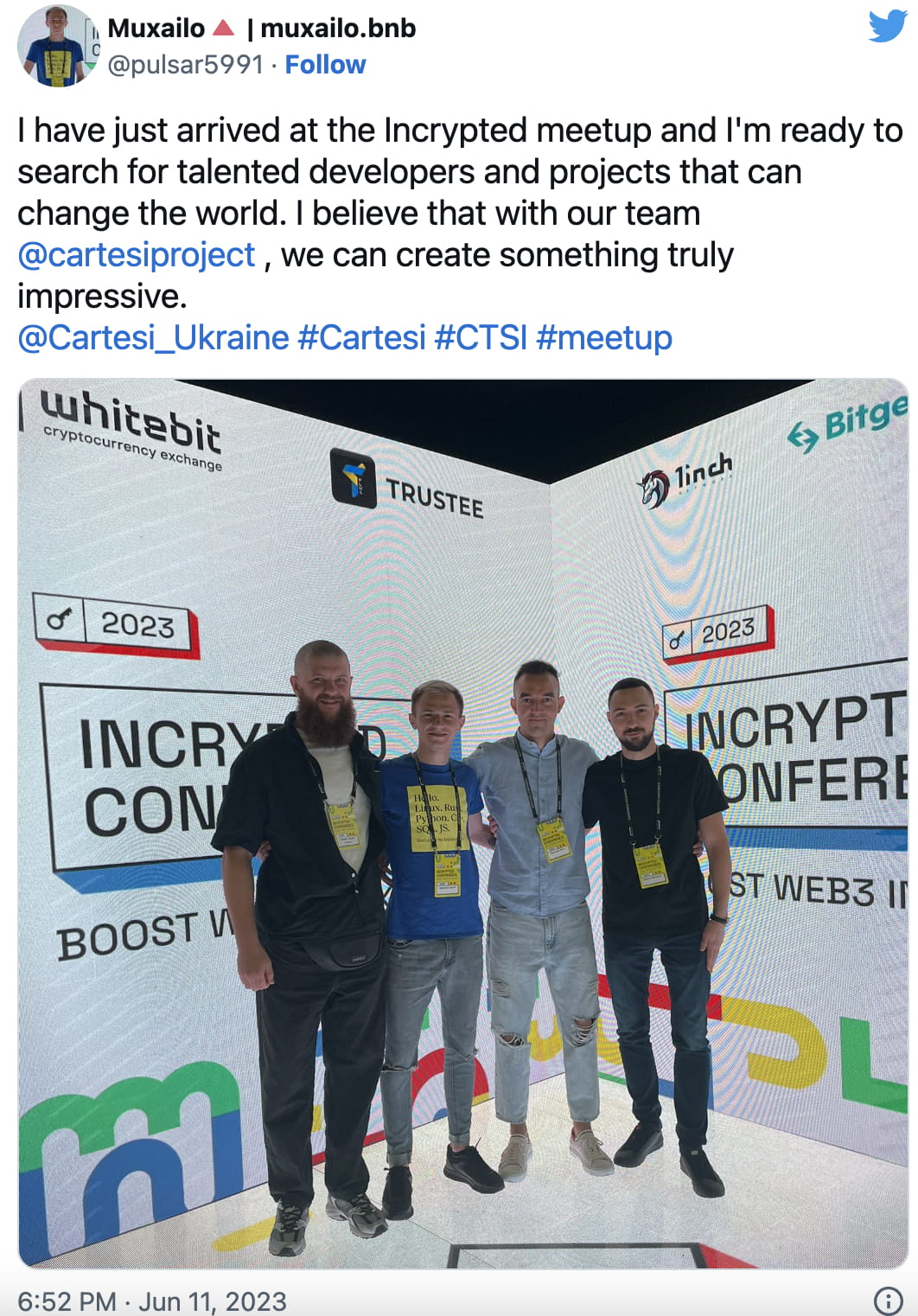
Contributors Carlo and Gabriel were featured in the dOrg community on Discord, where they took the center stage to answer questions about Cartesi technology, computing, and other related topics. If you missed the live conference, don't worry! dOrg will provide a hot podcast replay to get you straight into the heart of the event.
Cartesi's Chinese community has been active, with core contributor Jacky working with @TangDAO to host a Web3 roundtable to introduce Cartesi technology and welcome more enthusiastic individuals to join the Cartesi community. Core developers Stephen and Zehui also joined the discussion, participating in L2 discussions with the BinanceZH community - check out the replay here:

In the fourth Cartesi Game Developer Community Call, we invited Ronan, the developer of Infinity Games, to join us to discuss the abstraction layer of on-chain games. In addition, we also learned about the latest updates in the Dazzle and Ultrachess fields. You can catch up with the details of the event by replaying:
https://youtu.be/nIdO1cEVFA8
Before the month officially ends, we still have the Cartesi Coders Monthly event. It is for all those who love and work for the Cartesi community and want more people to participate!
Additionally, there will be a Demo Day from the Blockchain Game Alliance. Learn about the exciting games being developed by BGA members. Ultrachess and Dazzle will be showcasing Cartesi technology alongside games from Union Avatars and Gala Games.
P.S. Stay informed and don’t miss out on anything important by subscribing to our exciting public events calendar!
feature
Twitter Spaces and Polybase: A real-world use case for ZK and optimistic rollups.
House of Chimera: Cartesi’s unique capabilities as a Layer 2 solution (https://twitter.com/HouseofChimera/status/1674073444344791043).
Women in blockchain technology feature: Cartesi community manager Cynthia. (https://twitter.com/cartesiproject/status/1669265094138793984?s=20)
Of course, there’s more to it than that!
Check out what we’ve been enjoying this month from across the ecosystem and beyond:
A deep dive into the how and why of Cartesi Rollups with Max. (https://twitter.com/Max_Hatesuer/status/1664286205838778369?s=20)
Will Cartesi run a model similar to ChatGPT? Explaining ChainGPT. (https://twitter.com/Max_Hatesuer/status/1672167638821380096?s=20)
Proving a single Cartesi Machine cycle (RV64GC) in ZK using Risc Zero. (https://twitter.com/stskeeps/status/1670763748020088833)
About Cartesi
Cartesi is an application-specific Rollup execution layer with a Linux runtime. Cartesi Rollup can be deployed as a second layer (on top of Ethereum), a third layer (on top of Optimism, Arbitrum, zkEVM, etc.), or a sovereign Rollup. It opens up the design space for more expressive and computationally intensive blockchain applications.
DApps can be deployed on their own customized application-specific Rollup chains;
In Cartesi’s ecosystem, DApps do not compete with each other for scarce block space;
Cartesi provides several times the computing capacity of Ethereum or L2;
Developers can write decentralized logic using their favorite libraries, compilers, and other time-tested open source components;
DApps retain the strong security guarantees and censorship resistance of the underlying blockchain;
Cartesi Rollups opens up the design space for more expressive and computationally intensive blockchain applications;
Cartesi Rollups can be deployed as a second layer (on top of Ethereum), a third layer (on top of Optimism, Arbitrum, zkEVM, etc.), or a sovereign Rollup.