

Original title: "Derivatives DEX newcomer Vertex: daily trading volume market share is about 10%, why is it worth paying attention to? "
Original author: duoduo, LD Capital
The competition in the derivatives DEX field is fierce. The leading ones include GMX, DYDX, and SNX, and the second-tier ones include Gains, MUX, Level, and ApolloX. At the same time, there is a steady stream of new protocols coming online.
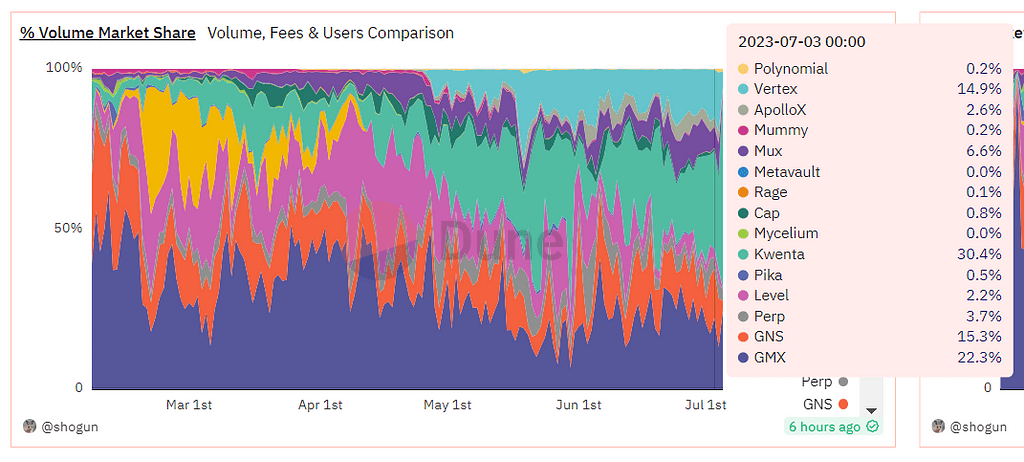
Vertex is a derivatives DEX protocol that has performed well recently. Since its launch at the end of April 2023, its recent daily trading volume has accounted for approximately 10% to 15% of the capital pool model derivatives DEX market, and it received strategic investment from Wintermute in June 2023.
Source: dune
Note: This chart does not include the data of DYDX, and compares the derivatives DEX with a fund pool model.
1. Business Data
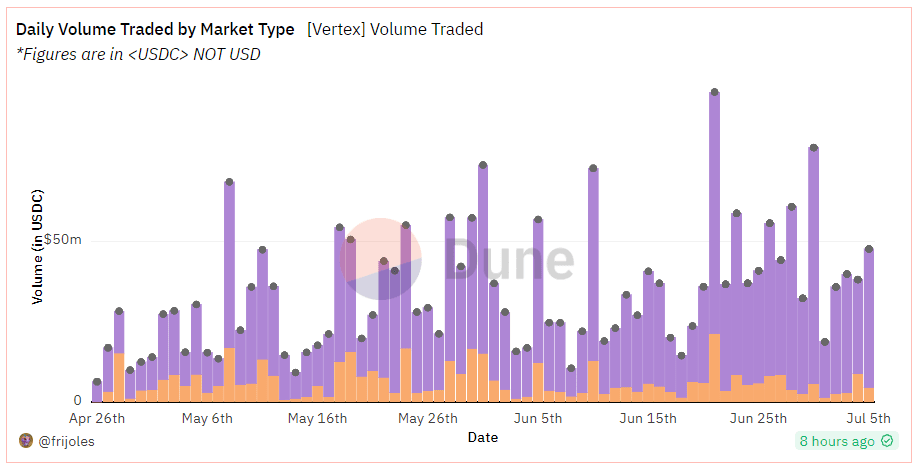
Trading volume: Mainly through trading incentives, a high trading volume has been created, with an average daily trading volume of about US$40 million in the last 7 days. The purple part is derivatives, and the yellow part is spot, with derivatives trading as the main focus.
The daily trading volume is lower than that of the top derivatives DEX (DYDX/GMX/SNX), and the daily trading volume of the second-tier derivatives DEX is comparable. Judging from the trading volume in the past 7 days, Vertex has already ranked among the top ten.
Source: dune
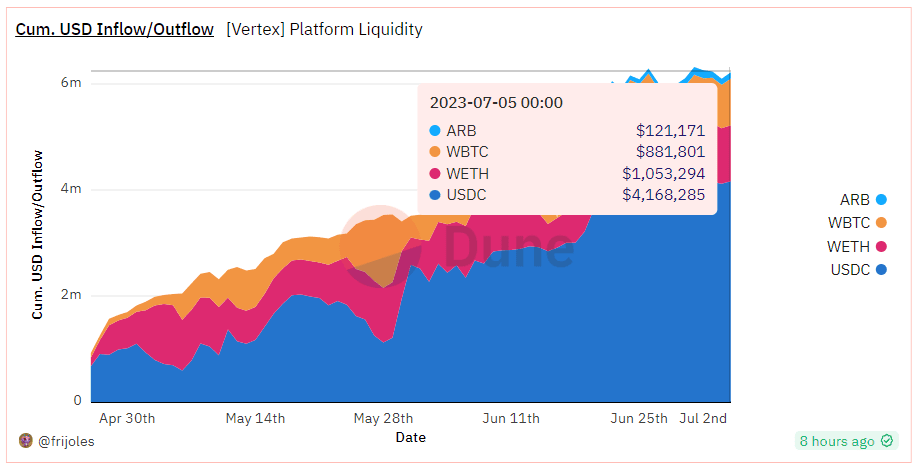
TVL: 6.22 million USD, which is still relatively small in scale and includes four tokens. The specific composition is as follows:
Source: dune
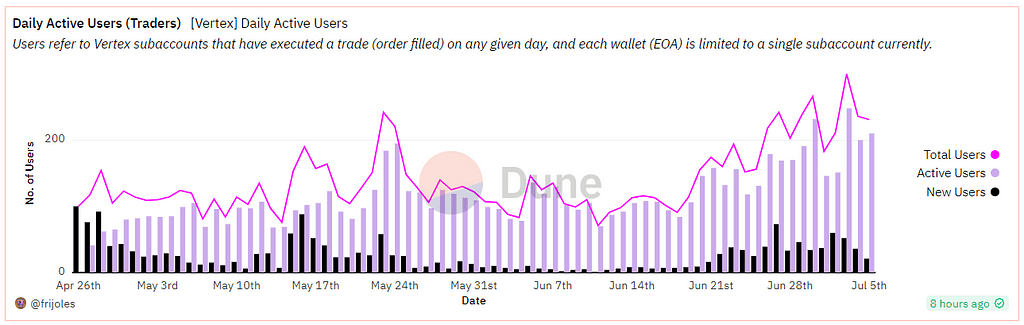
DAU: The cumulative number of users is 1,842, and the number of daily active users in the past 7 days is about 200. In comparison, the number of daily active users of GMX exceeds 1,000, DYDX is around 700, and SNX is about 500.
Source: dune
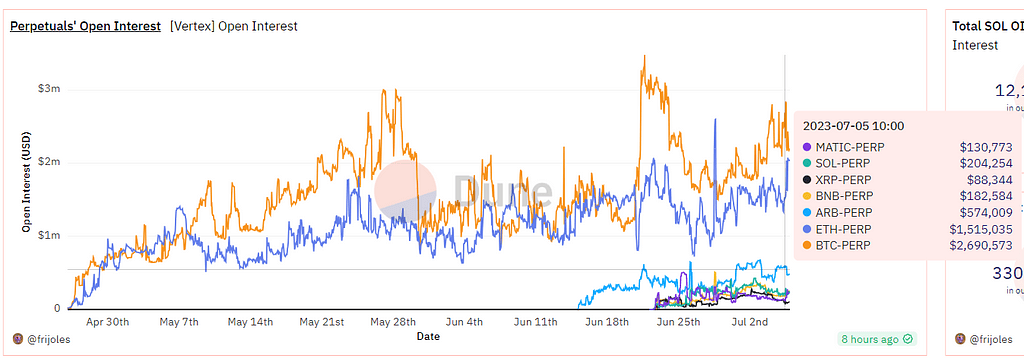
Open Interest: There are 7 trading pairs in total, with BTC and ETH accounting for the majority, and the current holdings are approximately $5.37 million. The holding amount is also relatively low.
DYDX's holding amount is approximately 300 million, GMX's holding amount is approximately between 150 million and 200 million, Gain Network's holding amount is approximately between 30 million and 50 million, and Mux's holding amount is approximately between 20 million and 50 million.
Source: dune
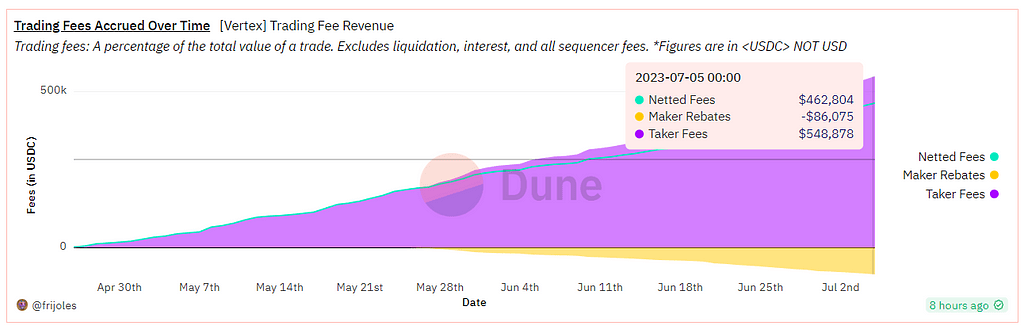
Fee: The accumulated gross income is approximately US$540,000. After deducting the rebate of US$86,000 to the maker, the net income is US$460,000.
Source: dune
2. Team and Investors
Co-founder Darius is primarily responsible for external marketing activities.
Co-founder Alwin Peng previously worked at Jump trading as a blockchain engineer.
Vertex received a strategic investment from Wintermute Ventures in June 2023. Wintermute Ventures is the venture capital arm of cryptocurrency market maker Wintermute. Wintermute provides market making services for many well-known projects such as Arb, OP, and Blur.
Wintermute announced its investment in Vertex, saying: "Vertex is led by a strong team of traders and engineers, has a strong track record in the TradFi and DeFi markets, and is at the forefront of smart contracts and market innovation."
Previously, in April 2022, Vertex received $8.5 million in seed round investment, led by Hack VC and Dexterity Capital, and followed by Collab+Currency, GSR, Jane St., Hudson River Trading, Huobi, JST Capital, Big Brain, Lunatic Capital, etc. Early investors received 8.5% of the tokens, which means that Vertex's seed round valuation is $100 million.
Vertex was originally a project built on Terra. After Terra collapsed, the protocol migrated to Arbitrum.
3. Products
It provides one-stop DeFi services, including spot, contract, and lending markets. It mainly conducts business around the contract market. Most of the transactions are perpetual contract transactions. Spot and lending are more for contract services, so it is classified as a derivative DEX.
Liquidity supply model: hybrid order book-AMM model
The liquidity supply model is the main difference between Vertex and other derivatives DEXs. Vertex believes that the off-chain order book can reduce MEV attacks and increase the speed of transaction execution through FIFO (first-in-first-out) processing. On-chain AMM provides permissionless liquidity support, traders can force transactions, and can ensure the effective conduct of transactions when the order book liquidity is insufficient.
Vertex implements the hybrid order book-AMM model through the following components:
On-chain trading venues (AMMs);
On-chain risk engine for fast liquidation;
Off-chain sequencer for order matching.
Figure: Vertex core component architecture
Source: Vertex
This means that there are two types of liquidity coexisting in the Vertex trading platform, one is the order book liquidity provided by market makers through APIs, and the other is the LP funds provided by smart contracts.
These two types of liquidity are combined through the sorter, and what you see on the front end of the page is a unified liquidity, which is traded according to the best available price. The figure below shows how the sorter uses order book liquidity and LP liquidity to complete transactions.
Source: Vertex
Process analysis:
The ETH-USDC pair is trading at $1,200.
Alice wants to buy 75 ETH on the market and sets the maximum slippage to 1%.
There is an order for 25 ETH worth of it on the order book at $1,200, so one-third of the trades are filled at $1,200.
The next set of order book sell orders (60ETH in total) is at $1210.
However, there are 25 ETH LP positions with prices between $1,200 and $1,210. So, the next third of the trades are bought from LP positions at prices between $1,200 and $1,210.
The final third of the trade was executed at $1210.
Funding efficiency: Universal Cross Margin expands margin range
Vertex wants to improve the efficiency of capital utilization and proposed the concept of "Universal Cross Margin", which mainly expands the scope of margin.
There are two common margin models in derivatives trading. One is the isolated margin model, where a trading pair is an independent isolated margin account. Only the currency of the trading pair can be transferred, held, or borrowed in a specific isolated margin account. Each isolated margin account has an independent risk rate, which is calculated independently based on the assets and liabilities held under the trading pair. The risk of each isolated margin account is isolated, and once a margin call risk occurs, it will not have any impact on other isolated margin accounts.
The other is the Cross Margin model. Generally, a user has only one Cross Margin account, which can trade all supported currencies. The assets in the account are cross-collateralized and shared. The risk rate is calculated based on all assets and liabilities under the Cross Margin account. Once a margin call occurs, all assets under the account will be liquidated.
It can be seen that the capital utilization efficiency of the full-margin model is higher than that of the position-by-position model. Based on this, Vertex proposed the Universal Cross Margin.
All funds (deposits, positions, and investment gains and losses) of users on the platform can be used for margin, including open positions in spot, perpetual contracts, and money markets. For example, users can earn fees by providing liquidity to the spot fund pool, and on the other hand, this LP fund can also be used as margin for contract trading. This improves the efficiency of fund use.
Universal Cross Margin also allows for portfolio margining, where unrealized profits can be used to offset unrealized losses or used as margin on existing positions or to open new positions.
In order to help users better manage the risks of their accounts, Vertex also provides account risk level prompts, so that users can directly see the health of their accounts on the page.
Accounts can be divided into two states: Initial and Maintenance. In the Initial state, they can also be divided into three levels of risk: medium, low, and high, based on the margin-to-liability ratio. The Maintenance state means that the initial margin usage exceeds 100%, and no more positions can be opened. Margin needs to be replenished as soon as possible, otherwise there may be liquidation.
Due to the Universal Cross Margin, liquidation is also a full-margin mode, and positions will be closed in the following order:
The order is cancelled and the order funds are released;
LP assets are unwound and sold;
Assets are liquidated (spot balance / contract position);
Liabilities are liquidated (borrowings).
If during the liquidation process the account's initial health returns to above 0, the liquidation stops.
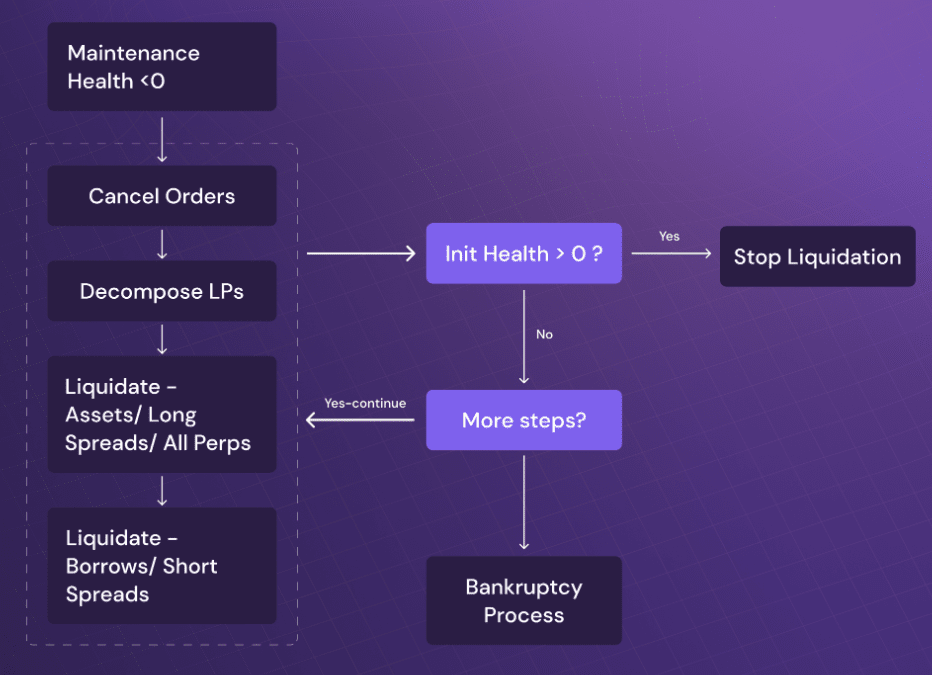
Source: Vertex
Lower transaction fees
Vertex’s transaction fees are relatively low. Whether it is spot or contract, the maker fee is currently 0, and the taker fee is 0.01%-0.04%.

Source: Vertex
In order to encourage maker transactions, makers whose transaction volume exceeds 0.25% of the total transaction volume within a specific period (28 days, one epoch) can also receive rebates. The rebate ratio is as follows:

Source: Vertex
Compared with several major derivatives DEX markets, GMX has higher transaction fees, with both opening and closing fees of 0.1%; DYDX's transaction fees are 0.02% to 0.05%, and decrease with the increase in trading volume; Kwenta's transaction fees are 0.02% to 0.06%.
Token Economic Model
VRTX is the governance token of Vertex Protocol with a total supply of 1 billion, of which 90.08% of the tokens will be distributed within 5 years.
The token distribution is shown in the figure below. A total of 46% is used for community incentives, of which 9% is used for initial token incentives and 37% is used for continuous incentives; a total of 41% is used for the team, treasury, ecological fund, and future contributors; 8.5% is allocated to early investors; and another 4.5% is used for liquidity. It should be noted that this allocation chart was disclosed to the public in early June 2022 and does not involve the Wintermute investment part. In general, it may be allocated from the treasury to new investors.
Source: Vertex
Vertex tokens will be distributed six months after the mainnet launch, which is expected to be in October 2023. The token release schedule is as follows:
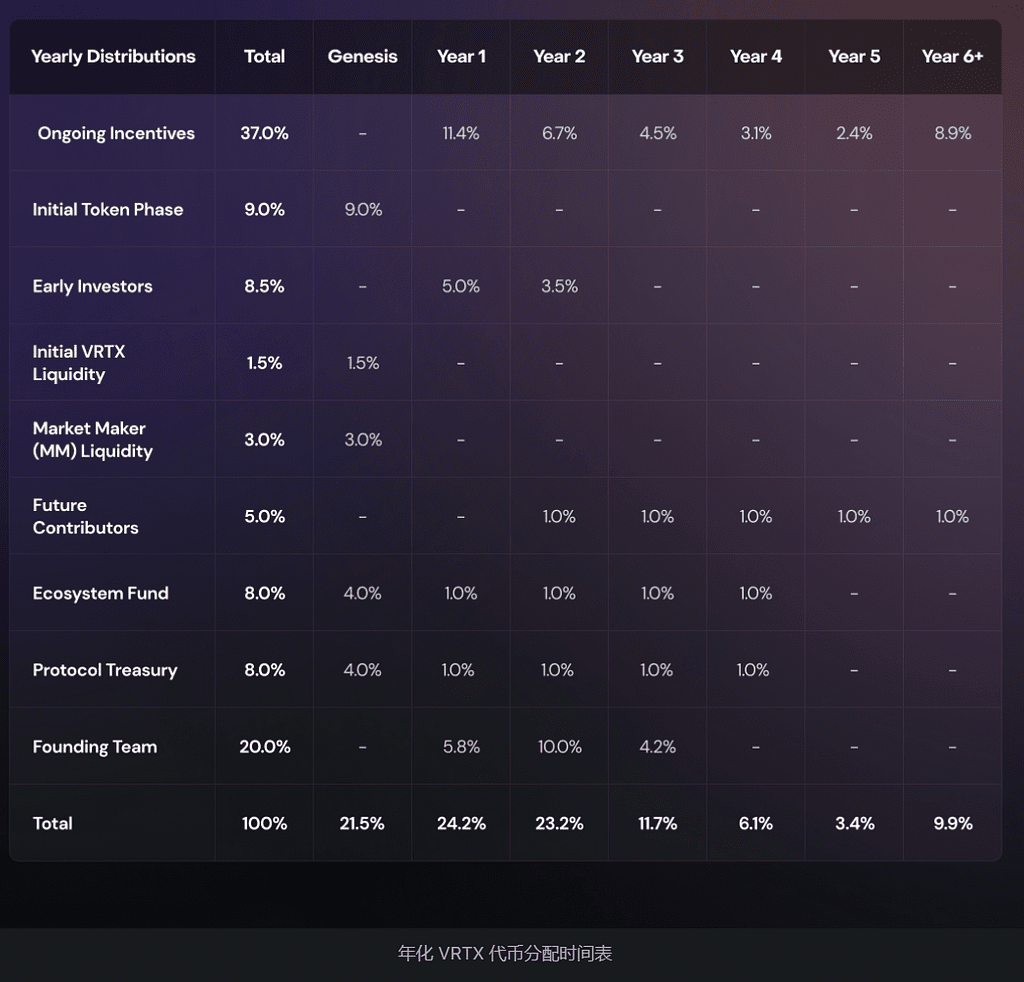
Source: Vertex
Initial token phase Some tokens are used for transaction incentives before coin issuance. Users can track them on the rewards page of the Vertex application. The official website clearly states that the relevant incentives can be collected in October 2023.
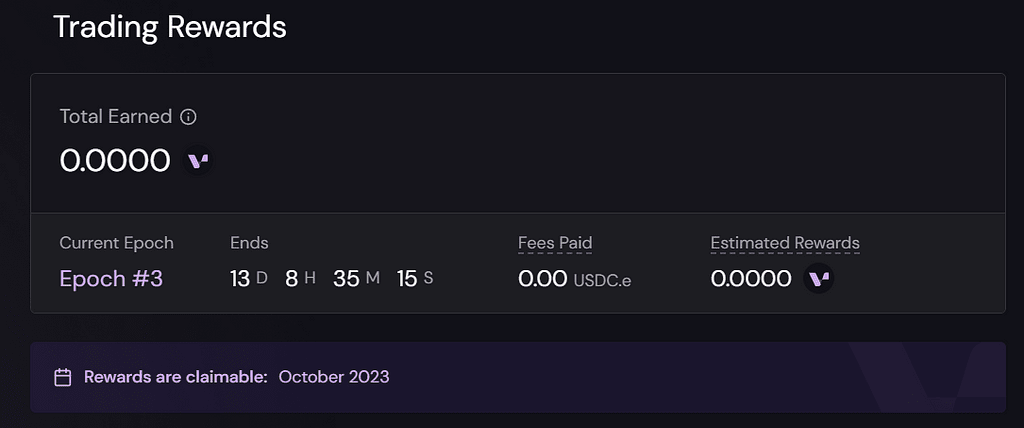
Source: Vertex
There are 6 epochs in the Initial token phase, each epoch is 28 days, and each epoch rewards 15 million tokens. It is currently the 3rd epoch. The proportion of transaction incentive tokens is mainly based on the weight of transaction fees. In addition, different transaction pairs have different rewards, as shown in the following figure:
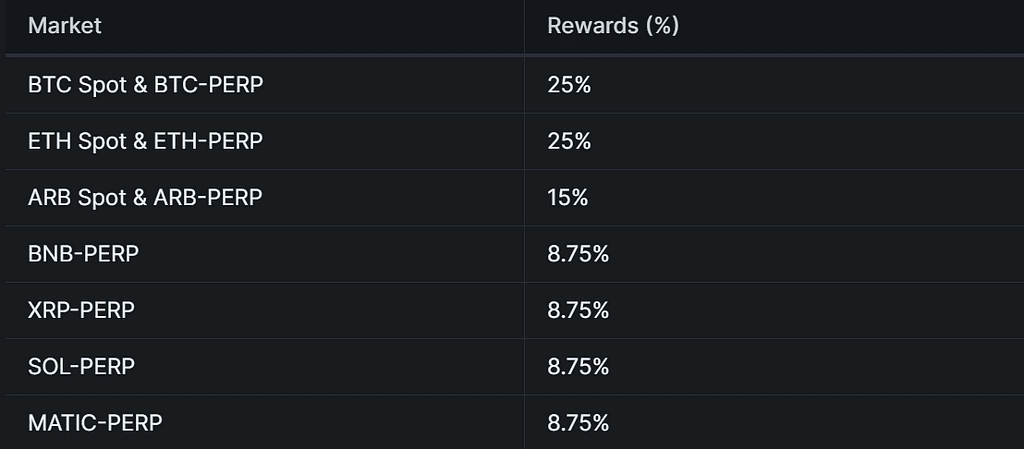
Source: Vertex
Vertex protocol tokens have not yet been issued. Due to the existence of trading incentives, it is impossible to avoid the existence of wash trading. At present, the launch of derivative DEX protocols all rely on trading incentives. For example, Vela has implemented trading incentives in its beta version to stimulate the growth of trading volume. Most protocols still maintain trading incentives after they are launched, such as DYDX, Kwenta, etc. Vertex can be widely adopted at this stage, indicating that funds have a positive view of protocol tokens.
V. Conclusion
The competition in the derivatives DEX market is already fierce. A large number of projects have adopted the model of forking GMX, deploying it on new public chains or the second layer, offering higher APRs in an attempt to attract funds and earn profits. In comparison, Vertex has provided some innovations in mechanisms, and is worthy of attention in order to create better liquidity and higher efficiency in the use of funds.
The risk that needs to be paid attention to is that while its Universal Cross Margin improves the efficiency of fund use, it also increases the risk exposure of users' assets, and traders need to do corresponding risk control.
Original link