

By Footprint Analytics
In Japan's cryptocurrency industry, NFT and Web3 games are two dominant fields. High-quality projects have adopted a series of operational strategies, including building a strong community, localizing project marketing, and winning the trust of users through long-term operations. In recent months, the relaxation of Japanese regulations has attracted more attention to the field of cryptocurrency.
Key Takeaways:
In order to ensure the stability of the investment market and the safety of investors' assets, the Japanese government has formulated strict laws and regulations, which is a challenge for small cryptocurrency projects.
STEPN is an example of a project that successfully entered the Japanese market. The project seized the opportunity, carried out localized marketing, and actively built a community, attracting a lot of attention in the Japanese market.
Globally, Japan is a unique market with huge potential in the financial and investment sectors, with a strong retail foreign exchange industry and a thriving stock trading sector.
Due to the frequent hacking of cryptocurrencies in the early days, the Japanese government has a conservative attitude towards the cryptocurrency industry and has carefully regulated it. Even today, due to the supervision of the Financial Services Agency, the selection of cryptocurrency assets in Japan is relatively limited.
However, Japan approved Bitcoin as a legal form of payment in 2017, creating conditions for the rapid development of the cryptocurrency industry. Although the government was initially skeptical of the industry, recent events have shown that the government has become more supportive of the development of the blockchain industry in Japan as it continues to grow.
In April 2023, the Web 3.0 project team of Japan's ruling party released a white paper proposing recommendations to promote the development of Japan's crypto industry. In June 2023, Japan's "Fund Decision Bill Amendment" was voted through in the upper house, becoming the first country in the world to enact a stablecoin bill.
However, due to some policy restrictions, such as not being able to directly invest in tokens, issuing token projects, etc., the development of DeFi in Japan is still relatively limited. Therefore, NFT and blockchain games are generally considered to be the main players in the Japanese cryptocurrency market.
If you want to learn more about the Japanese cryptocurrency market, you can check out the full report here: Japanese Crypto Market Report: A Study on Industry Trends and Future Outlook.
What are the characteristics of successful blockchain projects in Japan?
Japan's high-quality blockchain projects have adopted a series of operational strategies, including building a strong community, localizing projects, and winning the trust of users through long-term operations.
Strong community
One of the most important characteristics of a successful blockchain project is having a community of project supporters and loyal users. This community can help the project increase visibility, increase participation, and ensure the long-term operation of the project. There are many ways to achieve a prosperous community, such as holding community events, incentivizing users, and increasing the transparency of the project.
Project Localization
The localization of projects is very important for various blockchain projects in the Japanese market. Since Japan has a strong cultural foundation and Japanese language is dominant in daily life, overseas projects need to adapt their products and services to local regulations, translate information into Japanese, and cooperate with local KOLs and media to hold local events. By reaching out to localized audiences, projects can gain more visibility and users.
Long-term operation
A successful blockchain currency project must have the ability to cope with risks and adapt to the market. To develop a viable product and concept, it is necessary to maintain stable operation of the project in the market fluctuations. Japanese people are relatively rigorous and are usually hesitant about new technologies, so the project must gradually build a reputation in the Japanese market and operate for a long time in order to succeed in the market.
In addition to these characteristics, establishing partnerships with local KOLs, VCs, projects, and media in Japan can also help projects expand their influence, build credibility, and drive win-win growth. This is especially important in Japan, where industry giants, especially companies in traditional fields, still dominate the market. Therefore, startups should make full use of their own innovative advantages to establish partnerships with these existing giants, thereby leveraging their strengths to rise.
STEPN Case Study: Development of Overseas Projects in the Japanese Market

STEPN is the first game to implement the "Move to Earn" economic model in the game and has achieved significant success in the Japanese cryptocurrency market.
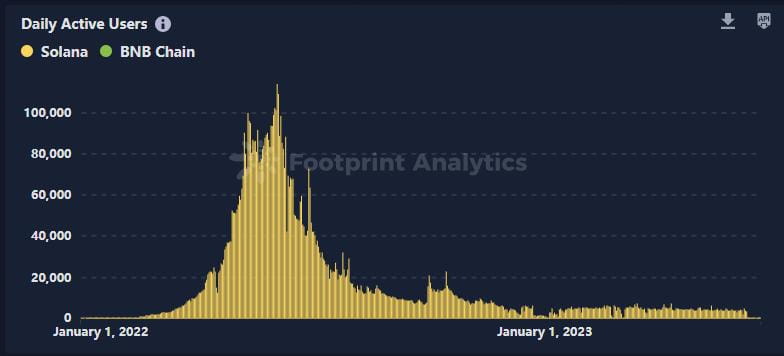 STEPN Daily Active Users
The core game mechanic of STEPN is that in this game, players can buy sneaker NFTs and earn in-game tokens GST by walking, jogging or running outdoors. These tokens can be used to upgrade existing sneakers or create new sneakers. STEPN has achieved great success in Japan thanks to several key factors.
First of all, the timing of entry plays a very critical role. When STEPN was launched around the end of 2021, the macro market conditions were relatively good. After the bull run in November 2021, many people had ample funds on hand. The increase in liquidity triggered a greater willingness of a large number of users to purchase in-game items. Although the project party itself cannot control the market trend, it is still an important determinant of the project's success.
In addition, it is important to note that Japanese players generally have higher spending power than players in other countries. They are often willing to invest a lot of money in NFT items in the game, and some even invest five or six figures in order to maximize the benefits of the game.
Compared to other countries, this level of spending is rarely seen in the gaming space. For example, Axie Infinity is a very popular game in the Philippines, and its main driving force is the scholarship mechanism. Players can rent three Axies for a low price to join a guild, which allows players to enter the game with almost no upfront cost. Therefore, individuals can participate with less initial capital.
STEPN identified Japan as its target market in the early days of the game. Therefore, before players in other parts of the world joined the game economy, Japanese players had already used their strong purchasing power to shape the in-game market circulation mechanism, making its in-game market healthier and more liquid than the global average. Japanese people are generally less involved in global communities, and STEPN successfully adapted to the local Japanese community and triggered a positive cycle, so STEPN is discussed more in the Japanese market than in other major markets in the world.
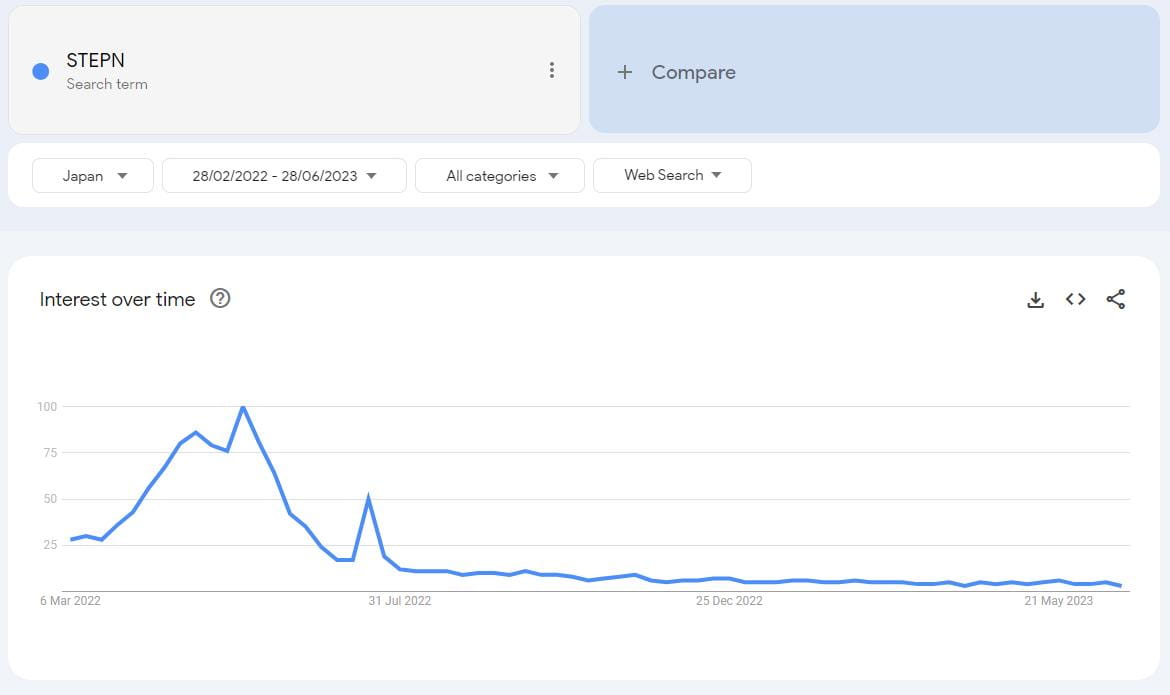 Source: Google Trends
The use of GPS in the game can also be seen as a positive factor. STEPN needs to track GPS accurately to prevent cheating and maintain the integrity of the in-game economy while also injecting bets in real time. Many Japanese use iPhones with accurate GPS systems, which makes it easy for players to start playing and make money.
The Gacha system is a unique feature widely used in Japanese mobile games, where players can exchange game tokens for random in-game items. The Gacha system has been an important factor driving the growth of games in Web2 mobile games. STEPN successfully integrated this concept into the game, enhancing the engagement and interest of gamers.
At the height of the game’s popularity, STEPN players could earn around $3,000 a day just by walking. The game’s user-friendliness and generous rewards sparked a viral frenzy that even broke the circle.
Other projects can learn strategies from successful cases like STEPN. However, it is important to note that macro market conditions and other external factors also have a great impact on the success of projects operating in the Japanese market.
Opportunities and Challenges of Japan's Cryptocurrency Industry
Japan has a strong and well-established traditional financial system, which provides a solid foundation for the development of its blockchain and Web3 industries.
When it comes to Japan's cryptocurrency market, compliance has always been an important topic. In order to ensure the stability of the investment market and the safety of investors' assets, Japan has strict laws and regulations in the blockchain field. However, while these regulations protect the industry, they also pose challenges to some startup cryptocurrency projects. The entry and development of these projects are hindered by compliance costs and high tax burdens. In addition, the lengthy approval process for token listings has also led people to believe that the market lacks vitality and leads to a loss of confidence in this field.
Japan has long been known for its stability and prudence in financial affairs. This attitude may limit innovation and market flexibility, but it also protects traders from significant risks. Innovation is key to the success of cryptocurrencies, so a lack of innovation may be a major reason why Japan's cryptocurrency industry lags behind other countries.
The good news is that in April 2023, the Web 3.0 project team of Japan's ruling party released a white paper proposing suggestions for promoting the development of Japan's crypto industry. In June 2023, Japan's "Fund Decision Bill Amendment" was voted through in the upper house, making Japan the first country in the world to enact a stablecoin bill.
Japanese institutional investors are showing increasing interest in cryptocurrencies and have a clearer understanding of the potential of this industry. The growing market interest could greatly promote the development of the entire cryptocurrency industry, bringing more liquidity, stability and credibility to the market, thereby attracting more interest from retail and institutional investors.
Japan's gaming market and its strong IP resources have proven their great potential. Japan's unique cultural characteristics combined with a strong financial system will make it a global leader in the Web3 industry with great potential. By giving full play to its advantages and promoting innovation and growth, Japan has the opportunity to lead the future of the global Web3 industry.