


Today we are going to talk about a project with great potential, Convex. We should have mentioned it before when we talked about Curve. This project is quite magical. Why do we say that?
Convex was launched on May 17, 2021. It is a DeFi protocol built on Curve. It aims to provide higher returns to liquidity providers (LPs) and CRV stakers. Now, basically, he has the final say on the value of CRV. Do you think it’s fun? Because it accounts for more than half of CRV’s share. According to data on defiwars, Convex accounts for more than 50% of VeCRV, while the second-place Yearn only has 10%.
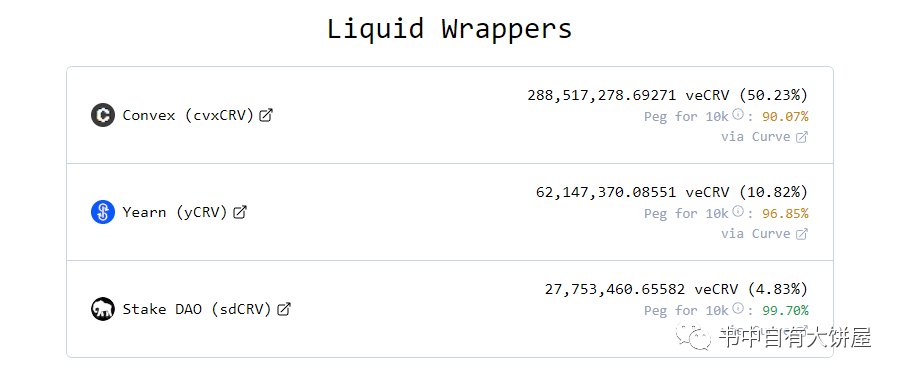
We have mentioned before that the governance power of Curve's tokens is very strong, that is, staking Curve on Curve can get VeCurve. After you lock it, you get governance rights (determine the allocation of different funds in the pool), 50% of the protocol transaction fee (0.02% of each transaction in the non-volatile pool), and you can increase the liquidity pool to get CRV rewards (up to 2.5 times). The more VeCurve you hold, the greater your power. So now Convex has more than 50% of VeCurve. Think about it, it occupies more than 50% of the voting rights, so does it have the final say?
Then let's talk about why Convex appears. As mentioned above, in the usage rules customized by Curve, users want to share high mining income and community governance fees, but users hate the irreversibility of CRV lock-up. Liquidity and yield are in conflict here. If people want to get higher yields, they must sacrifice current liquidity, because Curve.fi will provide accelerated returns for users who lock CRV, but this locked process is irreversible, CRV will be converted to veCRV, and veCRV cannot be traded. But this problem is really solved by Convex.
Convex provides CRV holders with a way to convert their CRV into another tokenized form of veCRV, namely cvxCRV. Users can take cvxCRV to decentralized exchanges to continue trading. This solves VeCurve's liquidity problem, but if you switch to cvxCRV, it is equivalent to losing your voting rights, because you are trading with Convex and you give your voting rights to Convex.
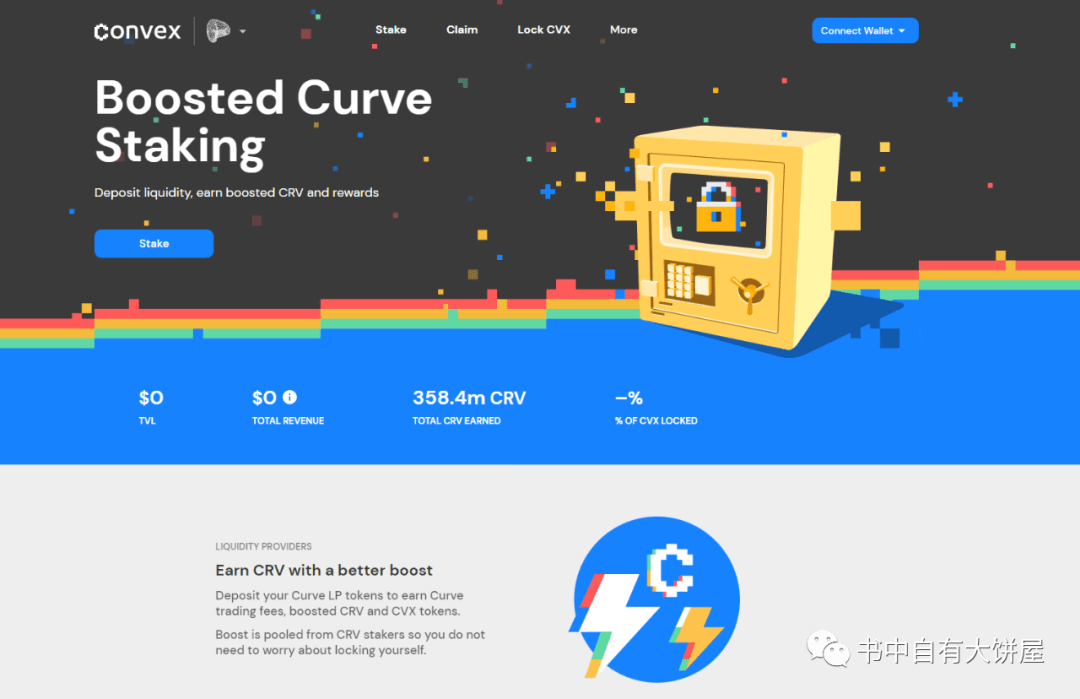
Agreement Highlights
1. Convex allows Curve.fi liquidity providers to earn transaction fees and receive accelerated CRV returns without having to lock up CRV themselves.
Liquidity providers can obtain increased CRV returns and liquidity mining rewards with minimal effort.
2. Convex has no withdrawal fees and has the lowest performance fee (also known as management fee) compared to other platforms.
Convex will charge LPs a 16% fee, while Yearn charges LPs a 2% management fee and 20% of the proceeds.
3.CRV stakers and liquidity providers also receive liquidity mining rewards in the form of CVX.
Product Usage
See the video for details.
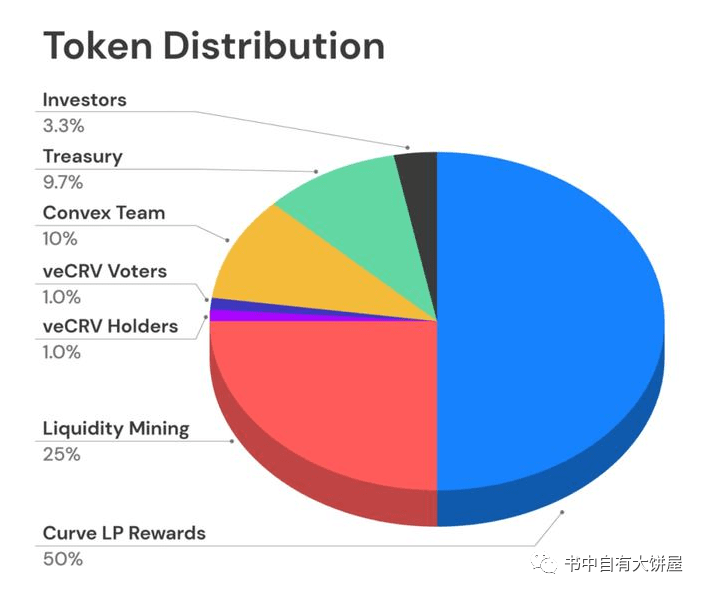
Token allocation:
At present, the market value of CVX is about 380 million, while the market value of Curve is 698 million. As we said before, CVX occupies more than 50% of VeCRV, and now its market value is only half of Curve. This is not a coincidence. As we said before, Curve is currently one of the top 2 DEFI projects. As long as Curve's market value can go up, the same is true for CVX, just like it is leaning on a big tree.
The total amount of CVX is 100 million, which has been fully released. The team has only kept 10%, and most of the rest has been given to LP rewards and liquidity mining rewards. This is relatively good, because the project itself has very little, and there is no foundation, management fees, etc.
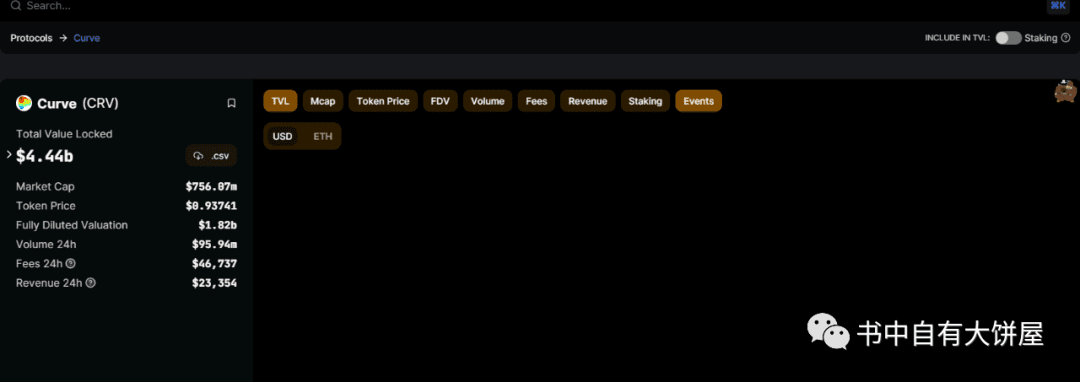
Let’s look at another data, which is TVL. Currently, CVX’s TVL is 3.3 billion US dollars. At its peak in 22 years, it reached a TVL of about 20 billion US dollars.
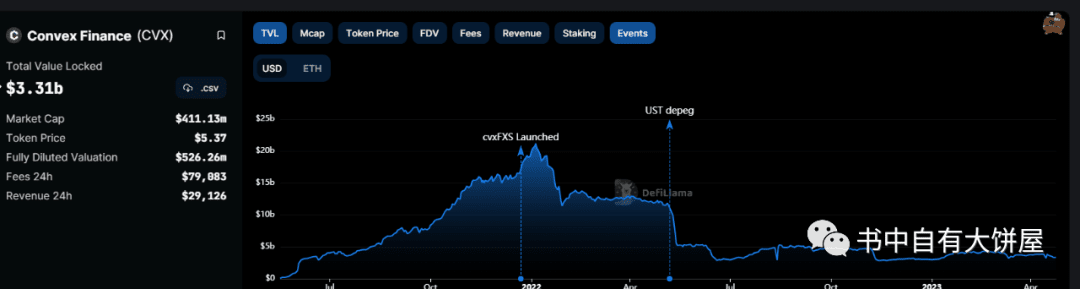
In comparison, Curve’s TVL is only 4.4 billion US dollars. In fact, the gap is not that big. From this perspective, Cvx is currently underestimated.
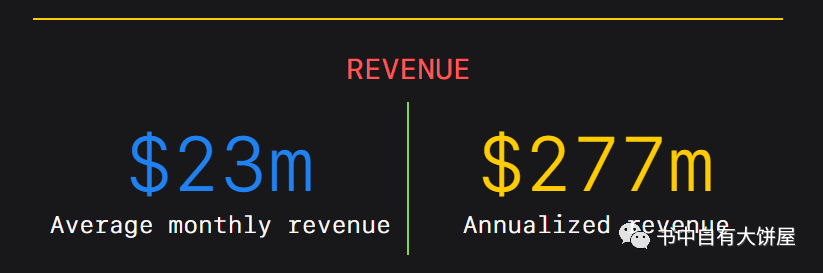
Let's look at another data. The first is the total income of its official website, and the second is the annual income. It was launched in May 21. In less than two years, the total income is 400 million US dollars, and the average annual income is also 200 million US dollars. Of course, this is to calculate all the staking income. Most of the income is to be given to the pledger, and we said above that he charges LP 16% of the income. According to this calculation, his annual income is also 32 million US dollars. Right, and his current market value is only 300 million US dollars, so it is still good at this point.

Then let's look at its current financing situation. I have found a financing record that in May 2022, Convex announced the completion of a $26 million Series A financing, led by A16Z. Generally speaking, a round of A financing will only sell a maximum of 10% of the shares, so in terms of financing scale, its current valuation is consistent with its coin price.
Next, let’s talk about some interesting phenomena. Since the emergence of Curve, there has been the Curve War, which then triggered a chain reaction and led to the CVX war. Does it feel like the "nesting doll" situation has been happening on Curve? Let’s talk about it below.
Convex War
The projects participating in Curve War seem to revolve around Convex rather than Curve itself. Why is that?
The reason is simple, because a large part of CRV's voting rights are controlled by Convex. In fact, Convex controls a very large part of CRV, and thus controls its voting rights and revenue rights. But other protocols are not very concerned about revenue rights, but only about voting rights.
This is equivalent to the general manager handing over most of his power to the secretary. So the briber essentially wants to bribe the general manager, but most of the power has actually been transferred to the secretary, so the target of the bribe becomes the secretary. Before the power was handed over to this secretary, there were actually many secretaries vying for the general manager's power, and finally one won. Convex is the secretary who won. As for the specific reasons why Convex won, this article will not go into too much detail.
In order to get higher liquidity, different protocols need to compete for voting rights on Curve to attract others to provide TVL, because it is cheaper than providing it by themselves.
The way to fight for voting rights has shifted from directly purchasing CRV to "bribing" CRV holders to only buy voting rights, because this is also more cost-effective
Since a large part of CRV is already controlled by Convex, the main battlefield of the "war" is on Convex.
Since Curve War has evolved into Convex War, it means that the "Curve voting rights" owned by Convex have been transferred to Convex's own token: CVX. As a result, users who have staked CVX on Convex can vote on the Convex platform to decide how much the liquidity pool on the Curve platform will reward, thereby affecting the liquidity of different pools on the Curve platform.
However, there are problems with voting: a user does not actually know which pool to vote in, nor does he know which pool has the highest return, or the process of voting + receiving voting rewards is too complicated. In order to solve such problems and help users maximize their voting benefits, new so-called "voting aggregators" have emerged.
Redacted Cartel
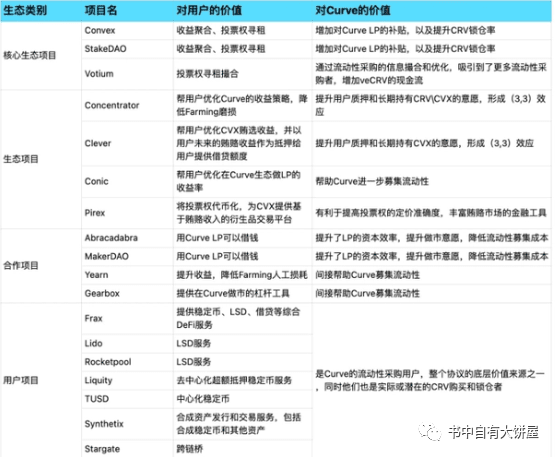
I will talk about this later. Okay, let me give you an introduction first. Friends who are interested can prepare for it first, and then we will talk about it later.