
The Metaverse is a platform for carrying virtual activities with credible asset value and identity authentication, which realizes the replication of the underlying logic of the real world. Its essence is a platform for carrying all virtual activities. Users can engage in social, entertainment, creation, display, education, trading and other activities, which will have a subtle impact and change on the production and lifestyle of users. The Metaverse has the following key points: 1. It has credible asset value; 2. It can be authenticated; 3. It is a replica of all production and lifestyles in the physical world in the virtual world.
First acquaintance with the Metaverse:
Virtual environment, virtual avatar, virtual reality.
The Metaverse is defined as “a collective virtual shared space created by the fusion of virtually augmented physical reality and physically persistent virtual space, including the sum of all virtual worlds, augmented reality, and the Internet.”
Metaverse consists of two parts: "meta" and "universe". Therefore, it is not difficult to understand that Metaverse can actually be seen as an extension of our current existence, and is often used to describe the concept of future iterations of the Internet.
This is another virtual world parallel to our physical world - a world we can freely access and interact in through the Internet and compatible hardware devices. In this digital world, anything we can imagine can exist. In this shared virtual space, people can be seen as a digital avatar, and the virtual world will continue to grow and evolve based on the decisions and actions within the society.
The Metaverse is a bridge between the real and the virtual, which can expand our vision, sound and touch, integrate digital objects into the physical world, and allow us to enter a fully immersive 3D environment at any time. This series of technologies is collectively called eXtended Reality, or XR. Industry insider Eric Elliott once predicted that Metaverse will one day bring huge economic benefits, and even develop to 10 times the current global economic value.
The Importance of the Metaverse
Although not as fantastical as depicted in science fiction and film and television works, the metaverse has the potential to become a new computing platform and content media, generating trillions of dollars in value. The metaverse is expected to become the gateway to most digital experiences, a key component of physical experiences, and even provide job opportunities in the virtual realm.
Today, there is no “owner” of the Internet, but almost all leading Internet companies are among the top 10 most valuable public companies in the world. If the Metaverse can become a key player in the Internet system, the value and benefits will be self-evident.
In fact, the Metaverse can indeed serve as a "successor" to the functions of the network - with greater coverage, longer time spent, more commercial activities - and the economic advantages are likely to be greater. In any case, the opportunities generated by the Metaverse should be similar to those generated by other networks - new companies, products and services will emerge one after another, including payment processing, identity verification, recruitment, advertising delivery, content creation, security, etc. This also means that many existing or traditional businesses have the potential to be replaced by the Metaverse.
More broadly, the Metaverse will change how modern resources are allocated and monetized. Over the centuries, advanced economies have evolved as labor and housing markets have declined.
Under the model of the Metaverse, potential laborers living outside the "first-tier developed urban areas" will participate in the "high-value" economy through virtual labor. As a new thing with great vitality, the Metaverse continuously creates new job opportunities. For example:
Fashion designer, interested in designing personalized clothing in the metaverse;
Asset advisors: NFT is gaining momentum in the future, and Metaverse advisory managers will also be favored;
Lawyer, in the future in the metaverse, not only will technology and communications undergo revolutionary changes, but transaction methods and creative forms will also change with each passing day. This calls on people to establish laws and regulations applicable to the metaverse.
Tour guides, the metaverse is a boundless world with endless possibilities. Cross-metaverse travel is likely to become a new form of tourism. Metaverse tour guides need to be familiar with art history, games, immersive navigation and culture, so as to provide professional services to visitors.
As more consumer spending shifts toward virtual goods, services, and experiences, where we live, the infrastructure we build, and the people who perform tasks will change further.
Main features of the Metaverse:
There are three key aspects of the Metaverse: presence, interoperability, and standardization.
(1) Presence: Presence refers to the feeling of being in a virtual space, with other people’s avatars. Through VR technologies such as head-mounted displays, people can improve the quality of online interactions.
(2) Interoperability: Interoperability means that people can seamlessly shuttle between virtual spaces and own various virtual assets, such as virtual avatars and digital items. People create an avatar and use it in hundreds of different virtual worlds. In addition, you can also use your own virtual avatar in a conference call. At the same time, the emergence of NFTs has promoted the transfer of digital goods in the virtual world.
(3) Standardization: Standardization is what makes platforms and services across the Metaverse interoperable. Just like all mass media technologies—from the printing press to text messaging—developing technical standards is essential if something is to be widely adopted.
In addition, according to Baszucki, the metaverse will also have eight different features, namely: identity, friends, immersion, low latency, login from anywhere, economic system and civilization.
The Metaverse also has the following four main characteristics, which are also the reasons why the Metaverse can be recognized and become popular among the general public.
(1) Highly social: The Metaverse can transcend spatial limitations and share the “physical” environment with people all over the world. This will profoundly change the way we communicate and interact with each other. The world provided by the Metaverse is a breathing, living parallel reality that can continuously and in real time provide services to all residents of the world. It has huge scalability, enabling hundreds of millions of virtual characters to coexist simultaneously around the world.
(2) Persistence: The Metaverse never pauses or stops, but persists indefinitely. In this world, people can evolve over years or decades without worrying about losing their characters and achievements. The Metaverse is not limited by hardware, from computers to consoles to mobile phones, and everyone can interact in the Metaverse using different types of devices.
(3) Interoperability: The Metaverse uses open source code and encryption protocols to provide unprecedented interoperability of data, digital items/assets, and content in every experience. From an incentive perspective, Fortnite skins can be used to decorate guns and given to friends through social media. The Metaverse can make the digital world a shopping mall, where each store can use its own currency and is equipped with a proprietary universal ID card.
(4) Economic benefits: As digital species, we will witness our further transformation in the Metaverse. In the future, the Metaverse is likely to be regarded as a legitimate workplace and investment tool, and will provide rich content and become a vibrant emerging community. The Metaverse will provide users with services to create, invest, own, rent, sell or buy, just like in the real world.
The driving force and prosperity foundation of the Metaverse:
The driving force behind the Metaverse — Web 3.0
The Internet connects people, and over the past 30 years, Internet technology has evolved, and so has the way we all interact with the Internet. Many things have changed over the course of the Internet’s evolution, and we can divide it into 3 eras:
Web 1.0
Web 1.0 was the product of the early days of the Internet. Web 1.0 fostered interest in e-commerce — which eventually led to the Internet boom. It was the first wave of Internet browsers and online messaging platforms. In short, Web 1.0 was a one-way process from the network to the user.
Web 2.0
Web 2.0 was created between 1999 and 2004 - the early days after Web 1.0. Web 2.0 leapt the world from simple static desktop web pages to interactive experiences, user-generated content, and market economies, bringing about Nasdaq giants such as Uber, Facebook, and Twitter. Web 2.0 was a user-to-user process, using the Internet as a communication channel for people to communicate with each other, with social features, like blogs.
Web 2.0 has created trillions of dollars in value, but we — as consumers — have given up many of our rights and freedoms to a few giant companies that provide the services.
Web 3.0
As contradictions continue to emerge, Web 3.0, also known as Web 3, an era of open, trustless, and permissionless networks has emerged. Web 3 understands and can meet user needs, understands user habits, automatically screens resources, intelligently matches, and gives users answers. Web 3 is a process from user to network and then to user, and artificial intelligence is the best example.
Web 3 has the following characteristics:
Open - Based on open standards, it remains open, accessible and fully transparent to the developer community.
Trustless — Participants can interact freely without having to trust a third party for verification.
No authorization required - any user has the right to participate, even authoritative institutions such as governments.
Bitcoin, Ethereum, and other blockchain protocols are the driving force behind Web3 — the vision of an open financial system that anyone can participate in building, without the constraints of traditional financial institutions.
The foundation that drives the Metaverse to thrive
Standards already exist for the basic elements of the Web: protocols like TCP/IP for sharing data packets, file formats like MP3/GIF, etc. NFTs enable for the first time a decentralized universal digital representation and ownership layer that can transparently manage scarcity, uniqueness, and authenticity.
For the Metaverse economy to thrive, shared, widely accepted standards and protocols must first emerge that can facilitate the issuance and flow of virtual goods.
The above figure shows five elements that will drive the prosperity of the Metaverse, namely culture, media, infrastructure, standards & protocols, and content. Although encryption has not yet been recognized by "mainstream" participants, it is very likely to become the basis for promoting the prosperity of the above five Metaverse fields.
From the perspective of early-stage investment, comprehensive aspects such as large-scale infrastructure construction and the development of next-generation media are often led by leading institutions with strong economic and research capabilities, and are relatively saturated. In contrast, the application of NFT in the virtual world is very attractive to investors.
In the NFT and crypto space, it is of utmost importance to solve the following problems: digital scarcity and uniqueness, digital property rights, large-scale coordination across virtual environments, and systems that protect user privacy. The solutions to these problems cannot benefit a few at the expense of many. Without a strong economic backing, the entire concept of the metaverse quickly falls apart.
In the cryptoeconomic incentive system, many tools have emerged to attract user interest, such as rewarding early adopters for ownership and empowering users with governance through rewards. For the first time in the crypto community, we are seeing the rise of community-owned protocols, networks, and games that have cultivated a large number of loyal fans while avoiding third-party platform operators with opaque operations.
Beyond that, it goes without saying that encryption and NFTs bring digital ownership and verifiability, completely subverting the fields of art, games, etc., and also adding an important link to the development of the metaverse.
The prospects of the Metaverse and its four major tracks:
The Metaverse at a Glance
Will the Metaverse change the way we act, socialize, work, and live? What are the business applications of the Metaverse, and who will benefit from it?
What we are talking about now are mainly some potential business applications. Players in every field have business opportunities associated with the Metaverse, from consumer-driven industries such as retail, to manufacturing, construction, and even other industries. Imagine that buying items can be instant. When you see a product, you don’t need to open an app or even touch your smartphone. Products can be purchased from anywhere through the virtual world, and prices can be compared. This increase in connectivity means that goods will be more accessible, and companies will be able to sell their goods globally regardless of the store’s geographical location.
The influence, exposure, immediacy and interactivity of brands and celebrities will be greatly increased, and the opportunities for collaboration will be greater. Consumers will be able to interact directly with brands. User engagement will be higher, and if applied properly, it may have a positive business impact.
The Metaverse will further emphasize digital goods and property, such as non-fungible tokens (NFTs), and there will be a larger market for all types of tradable items. For games, players can expect more interactive experiences and game worlds. Items or skins purchased in one game can be used in another game and can also be traded. Social experiences will also change, and virtual cinemas will bring private viewing experiences with friends. As the way we meet, work and socialize changes, many different industries will have new ways to make money, especially media, social media, technology and retail. Intellectual property will also become an important consideration.
Ultimately, consumers will benefit most from the Metaverse as information, products, entertainment, and social experiences are enhanced. Hardware technology companies and software development companies will dominate the technology market. The demand for hardware and software to power the Metaverse will increase dramatically. Businesses will have the opportunity to create their own place in the Metaverse. Brands and celebrities will have more opportunities to reach a larger audience. Provide consumers with richer and more targeted marketing experiences.
Of course, due to the uncertainty of laws and regulations in the Metaverse, there will also be a demand for legal advice. There is a huge demand for advice in areas such as data protection, privacy and advertising regulations, and the intellectual property assets of commercial enterprises need to be protected in the fusion of the virtual and real worlds. While ensuring that the laws of the real world can be effectively translated into the virtual world, this surge in demand will continue to bring more challenges to lawyers and legislators in the coming years. Under the fire of the "Metaverse" concept, all companies related to VR/AR hardware devices, 5G, cloud computing, blockchain, and even those who make virtual portraits and social games have labeled themselves as "Metaverse". But in fact, these are not the Metaverse, they are just a part of the Metaverse or a track; these technologies can only form the Metaverse when they develop to a certain level and are well integrated.
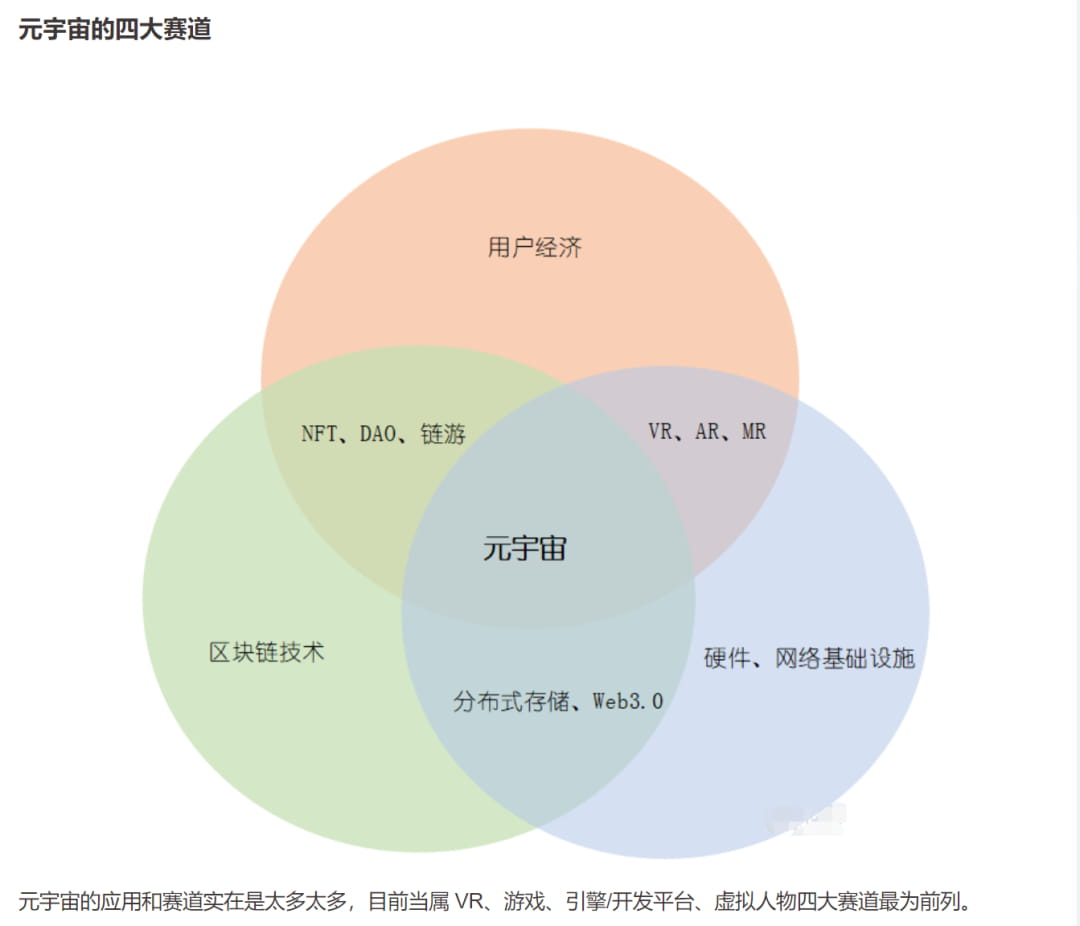
1. VR/AR and other hardware equipment
The metaverse, in a narrow sense, is “a traversable, visually immersive, synchronous multi-user heterogeneous virtual world”.
Highly immersive interactive modes represented by VR will most likely become the entrance to the virtual world of the metaverse. From feature phones to smartphones, and then from smartphones to VR, the display and interactive revolution in hardware will greatly promote the reconstruction of content formats.
Hardware devices such as VR will provide important infrastructure for the most important experience layer of the metaverse, and we cannot imagine a metaverse without AR.
2. Games
Although the Metaverse is very broad in a broad sense, the current exploration of the Metaverse combined with NFT is mainly in the gaming field, which is also a relatively more suitable development path verified by the current market.
The reason why games have become the hottest field in the Metaverse is that, on the one hand, most of the early Metaverse product experiences were centered around the gaming industry, which has accumulated a certain user base; and influenced by similar content such as "Ready Player One", many people's primary concepts when mentioning the Metaverse are similar to games.
On the other hand, Metaverse games have a lot of value extensions. Unlike traditional online games, users are basically just consumers and players (unless they are professional studios). However, all users of Metaverse and related games can be both consumers and creators. They can own the ownership of items in the virtual world by purchasing them, or they can guide users to pay attention to their works by issuing their own NFTs. This game also breaks the centralization and opacity of traditional game companies, allowing players to participate in multiple identities; driven by various factors, it will bring a huge market with exponential growth.
3. 3D rendering and other technologies
The prosperity of the Metaverse is inseparable from realism, which means that traditional design and development cannot break through the traditional boundaries of screens and keyboards; instead, it requires a deeper level of "3D development".
The Metaverse encompasses many technologies, such as: geospatial mapping, mapping and interpreting the internal and external spatial world; 3D rendering technology, which can efficiently simulate complex 3D environments with accurate physical properties using physics engines + AI technology; and of course, high-tech technologies such as voice and gesture recognition, and biometrics.
As for the Metaverse, NVIDIA has a clear roadmap: the first stage is to make it realistic. Use CG technology and real-time ray tracing rendering technology to make digital people look like real people. The second stage is to drive digital virtual people through elements. The third stage is to achieve interaction between the real and virtual worlds, including communication and interaction between digital people and real people, and between digital people.
Of course, NVIDIA is definitely not the only company that is targeting modeling technology to enter the metaverse. With the continuous iteration of modeling technology, just like the progress of engineering construction technology in our reality, it will support us to build the metaverse faster and at a higher level.
If the above technologies cannot reach a certain level, even if the hardware equipment meets the standards, the user experience will not be very good. After all, the sense of reality is too important for the metaverse.
4. Virtual Humans
Virtual humans are the most basic dimension of the metaverse and have diversified application scenarios/commercialization paths.
Japan has created many virtual character IPs, such as Hatsune Miku, which has gained a large number of fans with purchasing power and has achieved good revenue through peripheral products, virtual character concerts, etc., allowing people to see a different business model. But even so, this kind of virtual person is not a virtual person as the Metaverse says, or it cannot meet the requirements of the Metaverse.
If you want to create a real metaverse, you have to make all the elements in it look real, including NPCs. If you can make virtual people have the ability to give real-time feedback to the player's behavior, you can achieve endless possibilities and the most realistic user experience. In this way, the virtual characters in the metaverse can jump out of the set mode of the game NPC and become a virtual person smarter than Siri, without a fixed mode, and can make different reactions based on the player's feedback, forming a truly completely free and fully immersive metaverse.
There are three major development trends for virtual humans: 1. High fidelity, in terms of visual expression, high-fidelity virtual humans are created that are 1:1 restoration of real people in terms of appearance, expression and movement; 2. Intelligence, using technologies such as speech recognition, natural language processing, and speech synthesis to give virtual humans intelligence and emotional expression; 3. Toolization, developing lighter and more convenient tools so that artists and ordinary users can quickly produce high-quality art assets.
Challenges of Metaverse Development:
intellectual property
As we all know, the Internet world has disrupted the existing model of intellectual property utilization and posed challenges to owners and users of protected content in terms of licensing, monetization and enforcement, especially when it comes to UGC content.
To some extent, the metaverse will subvert the original property rights issues, and some new problems will arise, such as whether information landscapes and virtual creations are eligible for legal protection and ownership; whether content built on the bottom layer of third-party information belongs to user works, etc.
copyright
Taking copyright as an example, the Metaverse brings some potential benefits to copyright holders. For example, developers can use their first-mover advantage in a particular aspect of the Metaverse to obtain royalties for copyrighted software from other copycats.
However, the Metaverse also presents certain risks for copyright holders. For example, policing piracy of copyrighted works in the Metaverse may be a challenge, and copyright holders may have difficulty proving infringement. In addition, content creators face unique risks. For example, if they rely on existing licenses for underlying works to create digital content for the Metaverse, they must ensure that these existing licenses cover the use of copyrighted works within the Metaverse.
Best practices for owners and users of copyrighted works are to:
- Review agreements for distribution of third-party content to obtain appropriate permissions for copyrighted works
- Ensure that agreements with clients prevent the accidental dissemination of copyrighted works
- Timely registration of metadata assets and software copyrights
- Appropriately mark copyrighted works
- Implement technical measures to prevent the unauthorized distribution of works
trademark
Another example is a trademark. A trademark is a word, phrase, slogan, design, or logo that is an indicator of the source of goods or services. Trademark law protects unauthorized third parties from using a trademark to convince consumers that the trademark owner is the source of goods or services, or endorses or sponsors those goods or services. Trademarks are also an important feature of virtual worlds and are prevalent in the Metaverse. As people and companies continue to create in virtual and augmented reality worlds, this brings both opportunities and risks. Using the Metaverse for brand trademark promotion allows brands to reach a larger audience, but they must be aware of the potential liabilities associated with it.
Legal Concept
The Metaverse will bring about changes to traditional legal concepts. By eliminating the physicality of the real world, the Metaverse will move our human society away from several long-held legal concepts, including the concept of ownership. Because the meaning of "owning" in the virtual world is completely different from the real world, then, what a person owns or may own in the Metaverse is likely to be a question that only concerns a few people.
This relationship stems from a very simple position. The Internet is made up of code and content, however, no one has any ownership over the code and content except the people who write the code and create the content. Do you think you own a piece of software, a piece of music, an audiobook, a game character, a game asset, a virtual car? In the best case, you have obtained a license to use these items; in the worst case, you may have violated someone else's rights.
Yet, paradoxically, people have never bought and sold more on the Internet than now; study after study shows that ownership is still far more valuable than permission. This “endowment effect” explains why marketers and advertisers are so reluctant to use terms like “limited license” or “permission.”
What is the endowment effect?
In psychology and behavioral economics, the endowment effect is the finding that people are more likely to retain and value an item they own than they would if they acquired the same item if they no longer own it. This is often illustrated in two ways. In a valuation paradigm, the maximum amount people are willing to pay to acquire an item is often lower than the minimum amount they would be willing to accept if they owned the item, even if there is no reason to hold on to it or even if the item was acquired only minutes ago.
The endowment effect is also realized in experiments in psychology, marketing, and organizational behavior when people who are randomly assigned to receive an item (“owners”) value the item more positively than people who are randomly assigned to receive the right to do something with the item (“controllers”), which is precisely the great paradox that the Metaverse needs to face.
"Owning" is the mainstream of the world, and the metaverse will find it difficult to change this situation. However, NFT has arrived.
Business Models in the Metaverse
1. Virtual Land
For most people, one of the biggest attractions of the Metaverse is the opportunity to own digital land in a virtual world, with the holder having the freedom to decide how the land develops.
There are many ways for individual players to profit from this new type of property. Just like traditional real estate, the revenue streams for Metaverse Land include trading, development, and leasing.
Small strategies to earn income from Metaverse Land:
Trading: One of the easiest ways to make money from virtual land is to trade it, selling it for less than the purchase price. It should be noted that trading usually requires a large initial investment, sometimes a long wait, and most importantly, a good eye for discovering potential plots.
Development: Developing land requires the necessary skills, or the ability to pay for it, to find an agent to do the work. Land can be developed to allow other Metaverse citizens to gain experience, or $$$$$$$$$$$$ to be the location of an event. Developed land can be sold or used as a revenue stream to extract revenue regularly. Casinos, galleries, games, advertising space, etc. are all examples of virtual world land development.
For development services, MetaZone offers a wide range of easy-to-deploy pre-built models in Decentraland. Voxel Architects offers excellent architectural services in Cryptovoxels.
Leasing: Currently, there is not much demand for leasing. However, if the virtual world becomes more popular and land prices rise significantly, land leasing will become an increasingly important part of the ecosystem. Leasing can be long-term and short-term services, or one-time leasing services can be provided for specific activities.
2. Tokens
Some projects in the Metaverse will issue non-fungible tokens. Similar to other cryptocurrencies and digital assets, these are interchangeable assets created on the blockchain and publicly traded on centralized or decentralized exchanges. These tokens have a variety of uses, but are mostly used for transactions within the virtual world and to reward users.
For those who are not interested and do not have the time to build and develop Metaverse land, these crypto tokens should not be missed. Users can find out the potential Metaverse, buy the tokens they like, and wait for the appreciation.
3. Infrastructure
Another way to invest in the Metaverse is to create something that others want to use. In an industry that is just starting out, there are many ways to provide infrastructure. This can be either mining blockchain infrastructure public chains or custom programs and applications that are compatible with other Metaverse projects.
This approach has the greatest potential for gaining revenue, but it is also the most difficult to achieve, requiring more time, experience, skills, and luck. For example, Metaverse Billboards is an example of providing infrastructure, which provides more than 130 ad slots for the entire Metaverse.
What new industry opportunities will the Metaverse bring about?
The current Internet is a two-dimensional space, while the Metaverse is a three-dimensional space. Reality and virtuality are integrated in the Metaverse. At present, our digital presence in the physical world is still relatively rudimentary. Even if we have a LinkedIn or TikTok account, we do not actually exist in these platforms.
The Metaverse has penetrated into our lives in various ways, but now the Metaverse is no longer limited to the game field where players can socialize. It can also create real life experiences for people - such as listening to concerts, gathering with friends, holding meetings, recharging to purchase game props, etc.
In the Metaverse, young people can play games online with friends and work with colleagues. The COVID-19 pandemic has attracted a lot of attention to the concept of the Metaverse. Closures, curfews, and remote work have led more and more people to explore the online virtual world, not only for entertainment, but also to explore business opportunities.
How the Metaverse Empowers Enterprises
The Metaverse empowers enterprise development mainly through the following three ways:
New Spaces: Allowing Customers to Interact with Businesses and Their Products
New currencies: entering the market on a large scale
New media: enabling new workplace collaboration
New Space: Customer & Business Relationships
Creating new spaces for companies to sell their services is the main business front of the Metaverse. Sotheby's is probably the most eye-catching case. Sotheby's is an online trading market where users can browse and buy NFT artworks. Roblox and Fortnite, two popular online games, are transforming from pure game products to extended real worlds. Roblox co-founder Dave Baszucki said that Roblox can become a new frontier for business transactions. The online market is the most practical benefit that the Metaverse brings to the business development of enterprises. However, it is also difficult to promote the online market immediately. The expansion of corporate business is inseparable from a solid customer base. Technology companies should track user psychology, understand their understanding of the concept of the Metaverse, and build their own business chain in the Metaverse. This is an effective roadmap to the future.
New Currency
Most of the Metaverse runs on blockchain technology, which enables businesses to sell their services on a completely new platform. The digital world is increasingly becoming the backbone of the global market, and the Metaverse is more inclusive of the crypto world.
Let’s take Sotheby’s as an example. In addition to the Metaverse platform mentioned above, Sotheby’s has also opened an NFT gallery on Decentraland, a decentralized metaverse. In other words, Sotheby’s decisions are not made from the top down, but by the users of Decentraland. The creation of this decentralized experience is inseparable from Decentraland’s MANA. Metaverse Decentraland is a powerful proof that new currencies can lead to the development of new businesses. The total transaction volume mediated by MANA has exceeded $900,000. In Decentraland, users can decide how to use MANA: whether to use it to purchase NFTs and virtual properties, or to use MANA to play in the virtual world.
The above examples also show how to build a bridge between the real business operating environment and the Metaverse. If companies like Gucci and Sotheby's can successfully transplant their business models into the Metaverse, other companies should also think about how to emulate them. As digitalization becomes more and more accepted by the mainstream, the trend of business Metaverse will inevitably continue to grow.
Collaborative Office
In addition to bringing profits, the Metaverse can also foster new office models. Readers must have noticed that during the COVID-19 pandemic, most work was done remotely through Zoom software. Today's online collaboration software does bring convenience, but there are still some limitations in the usage scenarios. In the Metaverse, people can create digital conference rooms to simulate real meeting scenes, while retaining the convenience of remote work, thereby optimizing the work experience.
Facebook and Zoom are at the forefront of bringing collaborative work to the Metaverse. Recently, the two companies jointly released new tools to create a more realistic hybrid work experience. Horizon Workrooms is a virtual office environment jointly developed by Facebook and Zoom that can be run on Facebook's Oculus VR helmet. Zoom introduced its conferencing and whiteboard features into Horizon Workrooms, so that users can share screens, write and draw on shared whiteboards, and communicate using stereo sound to make the conversation scene more realistic.
The Metaverse and the Future of Business — 8 Business Models
As shown in the examples of various enterprises above, the Metaverse has already transferred part of people's lifestyles to a virtual universal platform. In the future, by continuously empowering enterprises and creating business opportunities, the Metaverse will be more fully integrated with the material world in both vertical and horizontal dimensions. The eight business models mentioned below are multi-faceted predictions of this integration.
Digital Assets
The growing variety of digital assets has broadened sales channels. Today, thanks to the introduction of NFTs, traders can buy and sell collectibles and other virtual items, such as the well-known CryptoKitties, CryptoPunk and BAYC. In addition, entertainment derivatives are about to join the ranks of NFTs. Korean entertainment company HYBE Labels has partnered with blockchain trading platform Dunamu to form a joint venture focusing on NFTs. SM Corporation will also enter the NFT business and is expected to issue NFTs based on major platforms such as Solana.
The abundance of digital assets has also led to the prosperity of industries related to NFT art, such as NFT art galleries and voxel stores. Galleries are currently the most common business model in the metaverse, perhaps because NFTs are closely related to artworks. Liu Jiaying's Pure Gold Gallery, Song Ting's Panda Gallery, BCA gallery, and dogesoundclub created by the Korean community are all famous crypto voxel galleries. These artists or groups brought galleries into the metaverse, making it the earliest and most popular business model in the metaverse.
The materials that make up the metaverse are very different from the physical world. Structures like CryptoVoxels, which encompass all buildings and wearable devices, are made entirely of voxels, values on a 3D grid. Voxels are essential to CryptoVoxels, from home decoration to the display of personal items. This has spawned many voxel stores, such as Vox Walk.
architecture
Some landlords own a lot of plots, but have limited time and energy to build them. Others prefer to hire more professional teams to build brand HQs. Both of these demands have given rise to third-party construction services in the Metaverse, and MetaEstate and Voxel Architects are such service providers. The four most visited buildings in Origin City on the Cryptovoxels platform, spaceage, stoneage, glassage, and Welcome, are all from Voxel Architects. MetaEstate has also built many exquisite venues such as MetaChi HQ, Creation Fashion Hall, and Haolinju Hotel.
Real estate leasing
Just like the real estate industry in the real world, leasing and buying and selling also exist in the Metaverse. According to statistics from CV Analytics, many landlords own multiple plots of land. Some landlords buy plots of land not for buying and selling, but for long-term investment. Landlords can rent idle land to people who want to build or operate, thus giving rise to a native market.
Immersive Experience
Immersive experiences are created when people focus so much on the designed space that they forget the real environment they are in. At Universal Studios, you may feel that you are experiencing it physically, but you are actually immersed in it mentally. Just by sitting in a chair, you can soar in the air with Harry Potter, jump between skyscrapers with Transformers, and cheer with the Minions. Built on professional architectural design and 3D technology, the Metaverse is the only place to get an immersive experience.
Selling Clothing
The Metaverse will never be able to replace certain aspects of the real world, such as food, clothing, housing and transportation. Clothing e-commerce sales are moving towards 3D, evolving from the original 2D picture introduction to the anchor trying on clothing during the live broadcast. However, watching others wear it is different from wearing it yourself. If there is a 3D scanner, people can wear 3D clothing on their virtual selves.
Online KTV
KTV itself is a way of socializing. In the real world, people who are far away from each other cannot get together in KTV, but the Metaverse can break this limitation. You can sing in the Metaverse KTV with friends anywhere in the world in your spare time.
data service
Everything depends on data, and the Metaverse is no exception. Project owners want to know the traffic data of landowners, buyers want to know the information of land for sale, sellers want to estimate prices based on market dynamics, and visitors want to know where is worth visiting. All of these are inseparable from the support of data. In the future Metaverse, professional data analysis may become an important business model.
Game advertising placement
Gaming is the most profitable sector in the Metaverse. Marketers and distributors can fully exploit this medium and place ads on popular gaming platforms to attract users. Gaming is also the largest game in the Metaverse (larger than the film and television business combined), so I predict that gaming advertising will become more and more popular.
Developing business ideas that work in the Metaverse
If you intend for your business to interact with the Metaverse, make sure your design fully addresses the motivations and needs of your users. The days of attracting customers simply by defining the values of your product are long gone.
It is difficult for users to concentrate in digital space, and in the metaverse, their concentration is more easily distracted. This requires you to provide high-quality products or services so that users can find no reason not to use them. The most important thing is to ensure that users can feel engaged and empowered when they use your product or service for the first time. Products or services also need to be continuously optimized to increase user stickiness and extend the life cycle.
Even if you can retain old users, you still have a long way to go. Next, you need to design new strategies to make old users willing to promote your brand inside and outside the Metaverse. Your top users can not only share their experience with general users within the Metaverse, but also attract people outside the Metaverse to join (and expand the influence of your brand).
It’s not easy to empower your business with the Metaverse. Understanding how the Metaverse works, tracking the dynamics of business giants, and figuring out how the Metaverse empowers your business are just the most basic and necessary requirements. In addition, you need to understand the psychological motivations of your users, master behavioral science, understand human biases, and cultivate heuristic thinking. It’s essential to have empathy and the ability to “get into your users’ shoes.” Only with these can you resonate with your users, like the best examples in the Metaverse field.
Planning your career in the Metaverse
As a new and vital thing, the Metaverse is constantly creating new job opportunities. You can explore career opportunities in the following directions.
Fashion Designer
Dressing up your avatar is not an unfamiliar concept. Today, major fashion brands such as Gucci, Oscar de la Renta, and Casablanca have set their sights on the Metaverse, striving to set fashion trends in the virtual world. As the Metaverse audience grows, the demand for Metaverse fashion designers will also increase. People need dedicated designers to create and decorate avatars to match their personalities. IMVU is an online Metaverse and a social network that held its first fashion show this year. IMVU's virtual store has a total of 50 million items of clothing. During the COVID-19 pandemic, IMVU's growth was as high as 44%, with approximately 7 million monthly active users. In a Metaverse like IMVU, the job of a fashion designer is to guide customers to purchase clothing in the form of NFTs and provide outfit suggestions.
Actor/Producer/Writer
Bollywood is setting out to build a film industry metaverse called Bollyverse. As a parallel world of Bollywood, Bollyverse brings together resources from production companies, major brands, film and television celebrities, music labels, game studios, and animation companies. In Bollyverse, ordinary people can also create stories and legendary characters using Legend NFT and Hero NFT as carriers. NFT holders will receive a 2.5% revenue share and have exclusive use rights to new products.
Asset Advisor
You can think of asset advisors in the Metaverse as financial advisors in the real world. As NFTs gain momentum, Metaverse advisory managers will also be in high demand. People need asset advisors to help them buy assets and provide investment advice. In addition, asset advisors are also responsible for grasping market trends and helping clients adjust investment strategies in a timely manner.
lawyer
In the Metaverse, not only technology and communications have undergone revolutionary changes, but also transaction methods and creative forms are changing with each passing day, which calls for the establishment of laws and regulations applicable to the Metaverse. Earlier this year, the well-known law firm Reed Smith released a white paper titled "Guide to the Metaverse", expressing curiosity and concern about the order of the Metaverse. The main responsibility of Metaverse lawyers is to set standards for various transactions that occur in the Metaverse.
Tourist guide
The metaverse is a boundless world with endless possibilities. Cross-metaverse travel is likely to become a new form of tourism, just like the characters in "Avengers" jumping from one planet to another. In this way, people will need metaverse tour guides to lead themselves to explore different virtual spaces. Metaverse tour guides need to be familiar with knowledge in the fields of art history, games, immersive navigation and culture, so as to provide professional services to visitors.
How the Metaverse Works
Highly virtualized
In a highly interactive virtual world like the Metaverse, land, buildings, and even personal avatars can be traded. The medium of exchange is usually digital assets. People can explore a variety of places in the Metaverse, make friends, build virtual properties, buy goods and services, and attend virtual events.
Feel and touch
Since the beginning of recorded history, humans have been developing various technologies to deceive the senses to communicate and interact, thereby gaining pleasure. Whether it is television, speakers, or the more recently developed interactive games, VR or AR, this purpose has been achieved well. As an advanced technology, the metaverse has the ability to "cheat" human senses (such as smell and touch).
Wide range of scenarios
The Metaverse is not just a game concept, but a platform that encompasses entertainment, social interaction, learning, work, shopping, drama, exhibitions, investment, and financial management. In other words, almost all types of businesses can unleash their potential in the Metaverse.
Examples of Metaverse Empowering Enterprises
Tim Sweeney, CEO of Epic Games, commented, “The Metaverse will become more extensive and more powerful than anything else. If a core company completely controls the Metaverse, the power of this company will be greater than any government and become a god on earth.”
Tim Sweeney is not the only entrepreneur to realize the enormous power of the Metaverse. Tech giants such as Apple, Facebook, Google, and Microsoft are determined to embrace the Metaverse before their competitors. The Metaverse has the potential to shape society, politics, and culture, opening up new markets, innovating social networks, promoting device upgrades, fostering new consumer behavior patterns, and driving new patents.
Metaverse empowers the gaming industry
Big companies are at the forefront of creating the metaverse. Microsoft bought Mojang, the developer of the game Minecraft, for $2.5 billion in 2014. Roblox, the builder of the game universe, is currently worth more than $30 billion.
Metaverse Empowers the Internet
In July this year, Zuckerberg mentioned the word "Metaverse" 16 times in Facebook's earnings conference. Zuckerberg said that Facebook should be known as the "Metaverse Company". Facebook has invested a lot of money in the development of VR and AR technology, and has developed smart products including Oculus VR helmets, AR glasses and tactile wristbands. Facebook said that in the next two years, the company will use new XR projects and research funds to invest in Metaverse projects around the world to ensure that the research and development of Metaverse technology is "inclusive and empowering". Facebook plans to work with experts in four fields, including data privacy and security, to improve the user experience of Metaverse users and create a sense of comfort. In addition, Facebook is also exploring access technology for all users and hopes to engage in "healthy competition" in the emerging industry of Metaverse.
Metaverse empowers manufacturing
German luxury car manufacturer BMW has partnered with Nvidia to use Nvidia's Omniverse platform to build virtual factories to digitally replicate its physical assets, systems and processes. In October 2021, Hyundai Motor will launch "Hyundai Mobility Adventure" in Roblox's Metaverse space, a Hyundai Motor advanced product and future mobility solution, and invite users to participate in the public beta. "Hyundai Mobility Adventure" is a shared virtual space where users use their own digital avatars to interact with other users and experience Hyundai Motor's products.
CN, heading towards the metaverse
The leading domestic Internet companies have obviously seen the benefits of the Metaverse. ByteDance, Tencent and other companies are gearing up to create a Chinese version of the Metaverse. In 2019, Tencent and Roblox reached a strategic partnership to cultivate a new generation of creators in China. At present, China's Metaverse construction has formed a competitive situation. ByteDance has increased its investment in Roblox's competitor Reworld by about 100 million yuan (about 15.3 million US dollars) to optimize its own Metaverse platform to compete with its increasingly powerful rival Tencent.
It is not difficult to see that the Metaverse wave is gaining momentum both at home and abroad. What will the future hold? Let us look forward to it together.
This article is taken from the Internet, and it seems to be a very detailed introduction. I will just borrow some flowers to offer to you! Last year, many gold chain games were under the banner of the Metaverse, and many games were also called 4399 Metaverse, which means that 4399-type games are bound to tokens and transformed into the Metaverse concept. There are also many such types on the market now, which can directly enter the game through the wallet port to achieve the effect of decentralization, the so-called web3.0. Many Metaverse games are essentially inseparable from passing the parcel and Ponzi schemes. These are basically short-lived and will end up in a mess. I won’t give examples of many such projects in the circle. For example, I spent 500,000 yuan to buy a saw for cutting wood...