

Original author: rektdiomedes Original translation: Jaleel, BlockBeats
On June 15, Federal Reserve Chairman Jerome Powell gave a speech: "Today, we decided to keep our policy interest rate unchanged and continue to reduce our securities holdings." At the same time, Powell also said that further interest rate hikes this year would be appropriate to reduce inflation to 2%.
After nearly a year and a half of rate hikes, the Fed has finally paused. We are in a really fascinating macro environment right now, and I have some crazy ideas about macroeconomics and crypto…
1. Economic performance is much better than expected
I can’t think of any macro commentator 18 months ago who thought the Fed could raise rates this high without completely blowing things up, but paradoxically the economy appears to be booming (at least so far).
2. The huge impact of the increasing fiscal spending of the US government
I think the ultimate lesson from this rate hike cycle may be the Fed’s increasing inability to overcome the impact of the U.S. government’s massive and growing fiscal spending.
TheHappyHawaiian (@ThHappyHawaiian) believes that 2023 is the year when the US deficit explodes. In the first 5 months of 2023, the deficit reached a staggering $743 billion, an increase of 1416% from 2022, and was $49B as of May. Revenue: $1,969B vs. $2,323B (-15.3%); Expenditure: $2,712B vs. $2,371B (+14.4%). In short, revenue is down and expenditure is up.

Image source: @ThHappyHawaiian
Also as Kuppy (@hkuppy) and Luke Gromen (@LukeGromen) have pointed out, the Fed paying 5% on Treasuries ends up being stimulative in its own way, because all the excess money the government drunkenly spends still goes into the economy, just in a different way compared to zirp and QE.
In fact, the rest of this decade looks like just an increasingly creative dance between the Fed and the Treasury on how to monetize our rising budget deficits/sovereign debt. As Captain Rational @noahseidman argues: If the Fed does not fund Treasury recapitalization, Congress will eventually be forced to direct the Treasury to simply print money rather than borrow based on Treasury market conditions and balance sheet pressures (revenues vs. capital expenditures).
Three: We are in a new era of structurally low unemployment
One lesson this hiking cycle also seems to teach is that we are in a new period of structurally low unemployment, largely due to demographics (all the baby boomers retiring + the sharp decline in birth rates over the past 40 years in the US and globally)… Today is the longest stretch of unemployment < 4% since the streak ended in 1970.

Image source: @LizAnnSonders
Obviously, the official unemployment rate is a somewhat tortured data point, but there is no doubt that labor demand is growing due to demographic and social factors, and wages are (rightfully) rising for the first time in 40 years.
Four: Risks from vacant properties are brewing
Vacancy rates for commercial real estate (particularly offices) look absolutely dire, not only because of the obviously high interest rates resulting from the equity destruction process, which has resulted in higher cap rates, but also because of the shift to remote work. According to data from The Kobeissi Letter @KobeissiLetter, office vacancy rates by city are as follows:

Currently, 17% of all office space in the U.S. is vacant. Meanwhile, more than $1.5 trillion in commercial real estate debt is set to mature by 2025. Much of that debt is held by regional banks, and vacant properties are struggling to pay down their debt. It’s a crisis in the making.
5. Remote work is here to stay
It's becoming increasingly clear that cubicle offices are completely out of fashion today. More importantly, there has been a broad cultural shift in perceptions, from a "remote preference" to a visceral hatred of office work. Working from home is becoming a huge political issue, with many viewing working in an office as a freedom taken away. It's an issue people feel very passionately about, akin to religion/politics. The movement is much stronger than many realize, especially with younger generations.
It’s hard to overstate the significance of this transition to remote. For more than 150 years, during the Industrial Age and the Office Age, America has been defined by a massive economic migration to cities, and this arguably represents a 180-degree shift in the other direction.
VI: Impact of the Debt Ceiling Resolution/TGA Supplement
I think the big question in the short term will be what impact the debt ceiling resolution/TGA replenishment etc will have on liquidity conditions and risk assets.

The consensus is undoubtedly bearish, but I think the following thread from Conks (@concodanomic) offers a more nuanced view of the issue:The liquidity-fueled rally has driven the S&P 500 up 12% so far this year. But now, the next big “liquidity drain” is about to begin. The latest political drama ended with a suspension of the debt ceiling until 2025, allowing monetary leaders to start the printing presses again. Over the rest of 2023, the U.S. Treasury is now poised to issue a net of about $1 trillion in notes to the most systemically important markets…
If history repeats itself, officials aim to fill the U.S. government’s bank account, the Treasury General Account (TGA) within the Federal Reserve System, with about $600 billion by September. The TGA holds the master key to every commercial bank’s Fed account and will slowly accumulate reserves. Consensus focuses on two effects of a “TGA top-up”: market instability from the massive issuance of government debt and a subsequent loss of liquidity from bank deposits and reserves. However, both outcomes are not as dire as they seem.
First, it was thought that such a large issuance of Treasury bills in a short period of time would be difficult for the market to absorb, pushing up spreads and causing turmoil. But as history shows, the bond market does not have much trouble absorbing large issuances, even within a month. As for demand, with yields reaching their highest returns in decades and the transition from an unsecured (LIBOR) to a "secured" (SOFR) monetary standard in full swing, the world is eager to gobble up the United States' growing debt load. Financial giants are hungrier than ever.
We also know in advance that major market participants are willing to consume large amounts of sovereign debt, referring to the Fed's latest survey of its primary dealers, the specific entities authorized by the Fed to make markets in US Treasuries. Expected supply is in line with demand. Instead, what affects liquidity is not whether market participants can absorb trillions of dollars in new Treasury issuance, but who buys most of the Treasury that has been issued. The real concern is the subsequent loss of liquidity from the banking system.
The most optimistic scenario for liquidity is if most Treasuries are purchased with cash stored primarily by money market funds (MMFs) and some banks in the Fed's RRP (reverse repo) facility. This is where most of the excess cash ends up, after accounting for regulation and risk vs. reward...
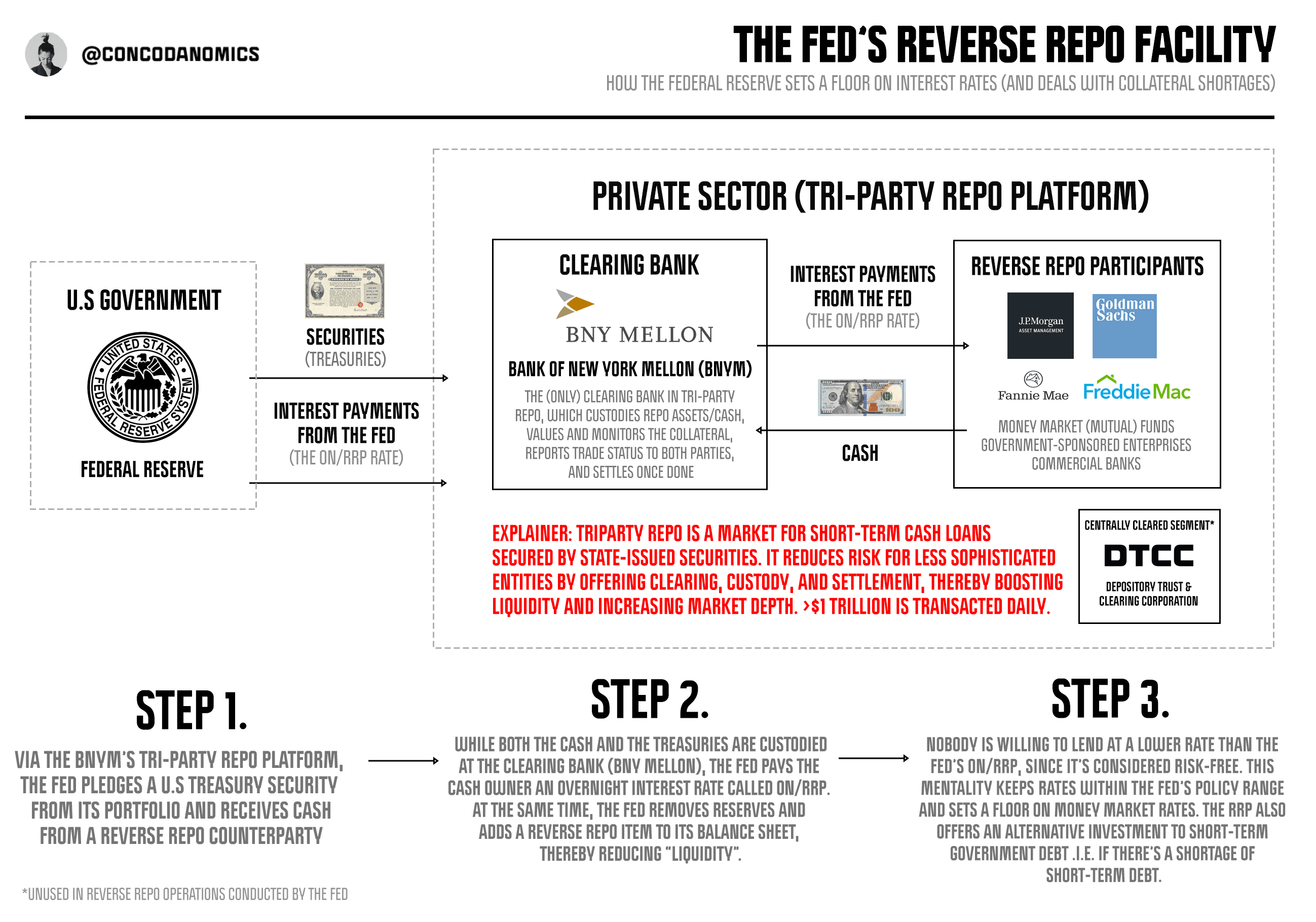
The Fed’s recent silence has added icing on the cake for the risk asset rally. What’s more, the market may have gotten ahead of the “blackout period” that currently limits the ability of FOMC staff to speak publicly or take questions. The temporary pause has reached maximum effectiveness.
7. Energy supply situation remains unresolved, price is a big variable
Likewise, energy prices still seem to be a big variable to watch in the medium term, as they are the factor that could start to drive inflation back up. Lyn Alden (@LynAldenContact), founder of Lyn Alden Investment Strategy, believes: If you look at commodity capital spending, sovereign bond bubbles, global frictions, rising populism, and an inability to cut spending, then you might think this is cyclical deflation (temporary demand destruction) in a long-term structural inflation trend. Inflation is currently on a downward trend (deflation), and I expect many categories of inflation to continue, but remember that energy supply conditions remain largely unresolved and are likely to be the driver of the next inflation cycle.
8. On-chain DeFi and Bitcoin are still developing rapidly
Crypto has been absolutely decimated over the past year and a half. However, on-chain DeFi and Bitcoin are still growing rapidly, and anyone who uses Tradfi and on-chain Rails seriously will realize that on-chain Crypto is 100x more efficient.
9. Crypto still needs a lot of innovation
That being said, it seems like it’s still early days for cryptocurrencies, and a lot of innovation is still needed — especially in terms of privacy and user experience, such as to enable normal things like payroll, AR/AP, etc. to be fully on-chain.
10: The arc of economic history will bend toward cryptocurrencies
Most of the risk to crypto for the rest of the year seems idiosyncratic (regulation, Binance, Tether, etc. type stuff). All liquidity and capital has already left the space, so it’s hard to see any macro contagion affecting it too direly.

But in the long run, as generational cycles progress, I don’t see why the arc of economic history wouldn’t bend toward crypto, because even its critics acknowledge that it attracts a lot of intellectual capital, and I don’t know of any other successful young people who aren’t bullish on it.
Summarize
Despite the Fed’s apparent success in raising rates and tamping inflation, it may look futile when it narrows the range in the coming years. The US still has the same massive debt:GDP ratio and unfunded baby boomer entitlement issues, and the past 18 months may well end up like the famous “Weimar Germany Gold” chart, with a dramatic fall:
