


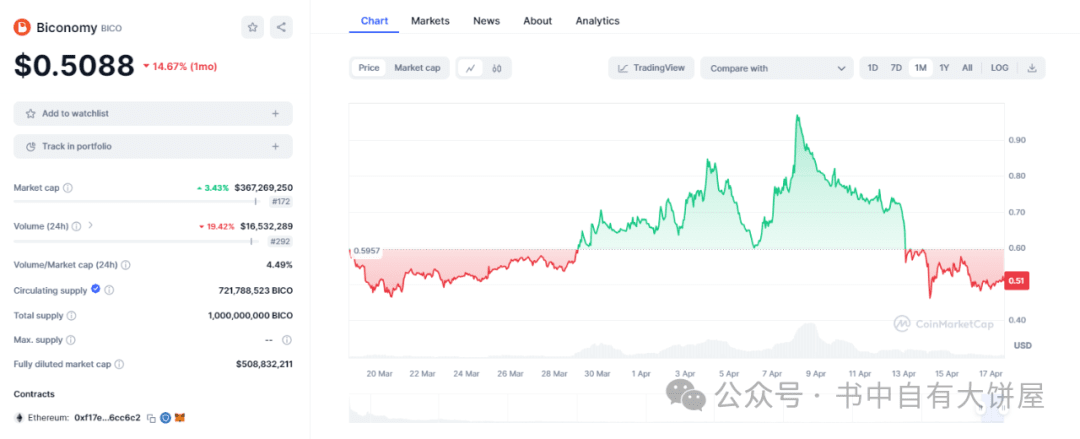
Today we continue to talk about a project proposed by our member group, called Biconomy, which currently has a market value of 360 million US dollars and ranks 170+. This project is also an old project, and its performance in the past year is actually very average, but we still have to talk about it because this project involves an important concept called account abstraction, which is also one of the important improvement proposals of Ethereum, namely EIP4337.
1. Basic Concepts
1.1 Introduction to Ethereum Account
An Ethereum account is an entity with an Ether (ETH) balance that can send transactions on Ethereum. Accounts can be controlled by users or deployed as smart contracts. This is also the account concept proposed by Ethereum based on Bitcoin. The specific principle can be found in the Ethereum white paper.
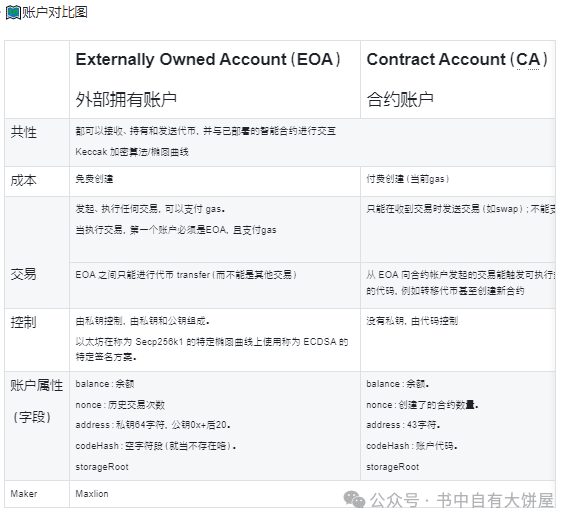
1.2EOA and SCA
There are currently two types of accounts on Ethereum: the first address is an externally owned account (EOA), usually called a wallet account, which consists of a private key and a public key. The commonly used Metamask wallet is designed based on EOA, which requires itself to authorize and pay gas for each transaction. The other is a smart contract account. Various DApps deployed on Ethereum are run in the form of smart contracts.
1.3 Account issues, account abstraction and contract wallet
However, there are many problems with this account (address) design. These limitations include:
• Losing my private key means my account is lost forever
• Risk of losing assets to malicious actors through phishing, hacking, social engineering, etc.
• Gas fees can only be paid with native tokens
• Manually approve each transaction (each action needs to be re-signed), authorization of smart contracts is difficult to manage, etc.
Account abstraction allows EOA (understood as metamask) and Contract Account (understood as dapp) to do things that only the other party can do, or allow EOA to realize CA functions, or vice versa.
In short, account abstraction is account unification.
A wallet that implements Account Abstract (AA) is called a smart contract wallet. Currently, it can implement various functions such as signature verification methods other than ECDSA, multi-signature management, social recovery (account recovery), account freezing, aggregate signature, transaction restrictions, privacy protection, gas optimization, gas payment, foreign currency gas, application aggregation, automatic income, etc. In the long run, it will help lower the entry threshold of Web3 and make on-chain behavior more programmable.
2. Bico Overview
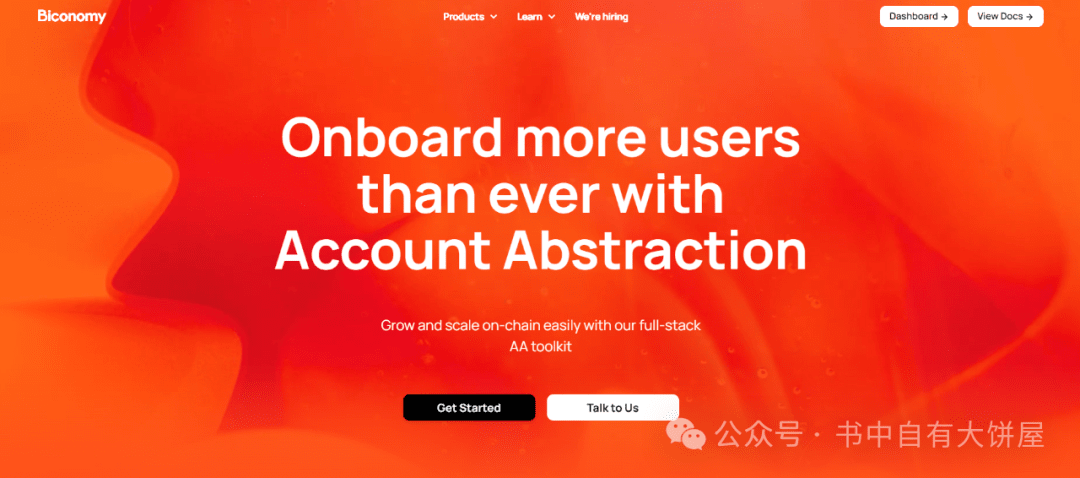
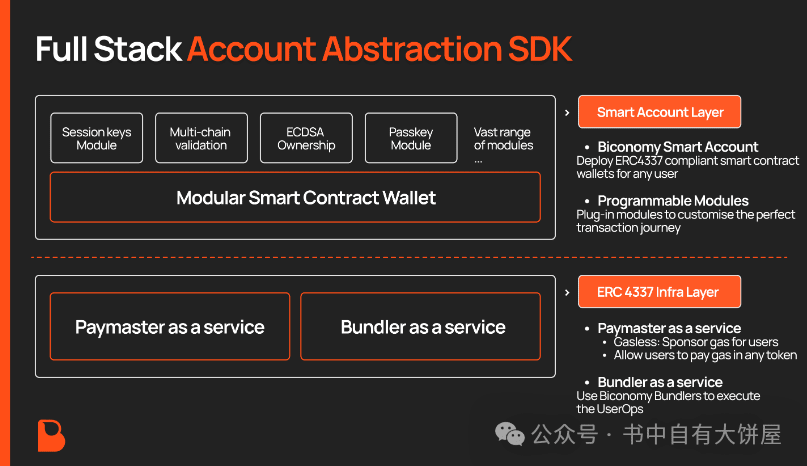
Biconomy SDK is an account abstraction toolkit that provides the simplest user experience for users' dApps, wallets or application chains. The project has built a full-stack solution based on ERC 4337. The main products include the powerful functions of smart account platform, payment supervisor and bundler.
2.1 Smart Account Platform
Biconomy’s modular Smart Accounts are an ERC 4337 compliant solution that works with any payment processor and bundler service. Biconomy Smart Accounts are signer agnostic, meaning any authorization package can be used as long as a signer is passed to the SDK during Smart Account creation. Explore different ways to create a Smart Account here.
2.2 Modularity
The modular architecture enables developers to easily and securely plug in programmable modules to extend the functionality of Smart Accounts. These modules leverage the power of account abstraction to allow for custom authentication schemes and execution environments. Developers are able to build additional modules while leveraging existing modules such as session keys, multi-chain authentication, pass keys, and more.
3. Biconomy Features
With Biconomy, users can easily get a multi-chain experience as their wallets can connect to any dApp, access funds on different blockchains or Layer 2/Rollup, while enjoying low gas transaction services.
The main features provided by Biconomy include:
1. Gas-free transactions
2. Instant cross-chain transfer
3. Flexible choice of gas fee payment
4. Transaction success guarantee
5. Simple and real-time onboarding to expansion solutions
6. Automatically connect to any Layer 2 and EVM compatible chain
7. Real-time and low-cost cross-chain contract calls
IV. Investment Institutions
Biconomy's current total financing amount is US$10.5 million. In 2021, Biconomy completed US$9 million in financing. DACM and Mechanism Capital led this round, and Coinbase Ventures, Huobi Ventures, Bain Capital, NFX, Ledgerprime, Huobi Innovation Labs, Primitive Ventures, Aave founder Stani Kulechov, FalconX co-founder Prabhakar Reddy, Flashbots one of the founders Stephane Gosselin, Uncommon Core's Hasu and others participated in the investment.
5. Project Team
Ahmed Al-Balaghi (CEO) is the founder and host of the Encrypted podcast, co-founder of Biconomy, and community partner of Dubai Fintech Connector. He graduated from Queen Mary University of London with a degree in Economics and Mathematics, and then studied Mandarin for two years at Fudan University. Also the co-founder of the Fudan Blockchain Association, Ahmed Al-Balaghi has worked in the blockchain industry for more than two years, accumulating deep industry expertise and regularly giving lectures and seminars. His main research and investments involve blockchain infrastructure and protocol layers, security tokens, digital identity, cryptoeconomics, and trading platforms. He worked at blockchain company Viewfin and led business expansion in the Middle East.
6. Token Economy
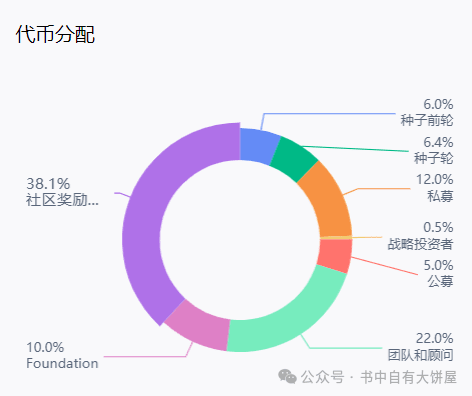
The project token was launched on 2021-12-01. The total supply of tokens is 1,000,000,000. The current circulation is 721,788,523, and the circulation rate is 72%. The current price is 0.5 US dollars. The peak price was $22.0062 (2021-12-02). In terms of token distribution, we can see that the community rewards are 38%, the team and consultants are 22%, and the foundation is 10%. The others are relatively low. However, the team + foundation has 32%, which is still relatively high.
To sum up, this project actually started in 2019, and it has been in operation for many years. It is also regarded as the leader in account abstraction. It currently has 4.5 million users and accounts for 50% of the market share in account abstraction transactions. However, this field is still relatively vertical, and the user experience is not very large, but it is still a very valuable project innovation. If you only innovate from the wallet side, you still can't compare with the old wallet projects. For example, Little Fox can do it itself, and it has a huge user base. So they chose to make SDKs, so that they can assist others with tools, but the tool track is small, and secondly, the progress is too slow. Then the project's coin price performed very poorly. It has only doubled from the bottom, while other good projects may have run more than ten times. Then for the token strategy, let's talk about Planet. #热门话题 #大盘走势 #账户抽象