


By Daniel Li, CoinVoice
The SEC's lawsuit against Binance is the biggest event in the crypto industry in the past month. Affected by this incident, the prices of most crypto assets have been halved in the past few weeks. The crypto market, which has just entered a small spring, has once again fallen into the shadow of a bear market. This incident also caused crypto users to lose trust in centralized exchanges (CEX), which further strengthened the necessity of developing decentralized exchanges (DEX). As a Layer1 public chain built with Cosmos SDK, Sei Network aims to become the preferred chain for DEX in DeFi, NFT and GameFi. Sei's built-in order book infrastructure, extremely fast execution speed, deep liquidity and fully decentralized matching services provide DEX with a more secure, transparent, efficient and reliable network, and also bring new innovation and development opportunities to the crypto market.
Sei is built for transactions and aims to be the fastest layer 1 public chain
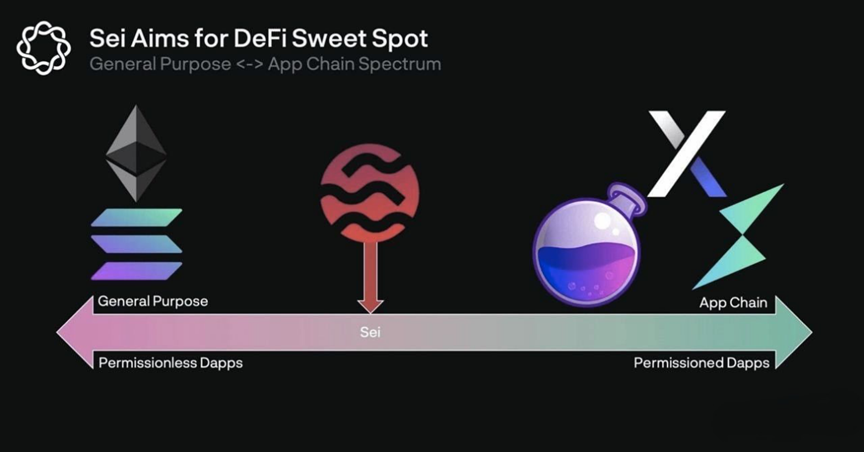
Traditional layer 1 public chains can be roughly divided into two categories, one is general public chains, such as Ethereum, Solana, etc., and the other is application-specific chains, such as dYdX, Osmosis, etc. These public chains have their unique advantages and characteristics in technical implementation, but have certain limitations in transaction scalability.
As a new Layer 1 public chain, Sei is different from other public chains in that it does not choose between general chains and application-specific chains. Instead, Sei finds a middle ground between the two and becomes a public chain built specifically for trading. Compared to general public chains, Sei is optimized at every level of the technology stack to provide the best trading infrastructure. Compared to application-specific chains, Sei is a relatively general public chain that can support a variety of trading applications rather than targeting just one specific application. This makes Sei a more flexible and customizable trading infrastructure that can meet the needs of different types of trading applications.
As a public chain focused on transactions, Sei aims to solve the scalability issues currently faced by on-chain exchanges and become the fastest Layer 1 public chain. To this end, Sei has implemented a number of important improvements to its underlying network architecture, including the Twin Turbo consensus mechanism to achieve industry-leading performance levels. Sei's technical success largely comes from the Twin Turbo consensus, which helps Sei achieve a finalization time floor of 300 milliseconds, 10 times faster than Solana. In addition, Sei has also implemented an order matching module with a composable architecture, which means that dApps on Sei have synchronous composability. Through Sei's many bridge partners, the IBC, EVM, and SVM ecosystems will all have asynchronous composability, which allows seamless connection and interoperability between different blockchain ecosystems, and developers can have more flexibility to choose the technology stack that suits their needs.
Sei also increases throughput by 5-10 times through market-based parallelization technology and supports order batching, which simplifies the process of updating multiple orders across different exchanges. These are innovative features implemented by Sei in optimizing the performance of trading applications. In addition, Sei's liquidity center and its underlying technology are also very beneficial for various dApp operations. Sei's liquidity management system can help DeFi, GameFi, and NFT applications provide users with a deeper liquidity system and cost-effective trading process while leveraging the agility and efficiency of the Sei blockchain.
Transactions are the most basic application scenarios and use cases of blockchain technology, and are also an important force driving the development of blockchain and Web3. By creating a dedicated transaction public chain, Sei provides a compelling product for developers who want to build applications on the general layer 1. The emergence of Sei fills the gap in the current transaction-exclusive public chain, bringing new opportunities and challenges to the development of blockchain technology and Web3, and also provides more possibilities for the circulation and trading of digital assets.
Sei's technological advantages are subverting the traditional DEX network environment
With the rapid development of Web3, exchanges as a centralized place for asset trading have become increasingly important. Currently, exchanges are mainly divided into centralized exchanges and decentralized exchanges. In the past, centralized exchanges have always dominated. However, as the leading centralized exchange Binance was sued by regulators, higher regulatory pressure on centralized exchanges will drive the market to decentralized exchanges. This requires DEX to expand and adapt to the huge wave of adoption.
Given that DEX has unique requirements for speed, throughput, reliability, and front-running, it is necessary to build specialized infrastructure to solve these problems. Sei was born for this purpose, providing a solution to the DEX scalability problem and enabling exchange applications to scale effectively while maintaining decentralization and capital efficiency. Sei's technical advantages mainly include the following aspects:
Order matching engine
Sei is a Layer 1 public chain based on the Cosmos ecosystem. Like Ethereum, Sei also allows users to transfer assets and deploy smart contracts. However, the feature of Sei is that it also creates an order placement and matching engine at the chain level. This order matching engine is one of the core functions of Sei because it allows anyone who wants to build an exchange to easily use this engine to create an order book-based exchange. This means that builders can omit the step of building an order book from scratch, making it more efficient in terms of technology and cost.
In addition, Sei's order matching engine provides a limit order design space similar to conventional centralized exchanges such as Binance and Coinbase. It creates a set of orders at different prices and allows the asset value to be updated based on the executed orders. The benefit of using an order book exchange is that it can provide higher liquidity and a better price discovery mechanism. Although it is technically more challenging to launch an order book-based exchange and provide liquidity for it than on an AMM DEX, Sei aims to provide a cost-effective system for developers and users of decentralized applications built on the network. In this way, they can build order book-based exchanges more efficiently without losing security and reliability.
Parallel Order Execution
Sei’s parallel order execution is a major improvement. It is able to process orders within the same market sequentially and simultaneously process orders from different markets. This approach significantly improves Sei’s throughput while ensuring deterministic behavior among validators. In traditional blockchains, order processing occurs sequentially, meaning that each order must be processed in the exact order in which it is received, regardless of the asset or market it interacts with. Sei’s approach is different in that it allows orders from independent markets to be processed simultaneously, which results in Sei achieving faster block times, lower latency, and higher throughput at all load levels. This marginal improvement is especially noticeable under high loads.
According to Sei internal testing data, in the case of 10,000 orders/blocks and 20 different contracts (markets), parallelism can reduce the block time from 1.33 seconds to 0.81 seconds and the delay from 371 milliseconds to 48 milliseconds. , the throughput increased from 7500 orders/second to 12200 orders/second. As the load increases, the degree of marginal optimization becomes more significant.
Twin-Turbo consensus mechanism
Sei's Twin-Turbo consensus mechanism optimizes and upgrades Cosmos' ABCI, making each step of the consensus programmable. This consensus mechanism consists of two parts: one is smart block propagation, and the other is optimistic block processing.
Smart block propagation aims to increase block processing speed and efficiency. On Sei Network, block proposers can send compressed block proposals that contain only transaction hashes rather than detailed block content. During the block broadcast phase, if a validator has all transactions in the proposal in its local mempool, it will reconstruct the entire block from its mempool without waiting for all block parts to arrive. This process significantly reduces the overall time validators wait to receive blocks. If a transaction does not exist in a validator's mempool, the validator can simply revert to waiting for uncompressed detailed proposals to arrive. Testing according to Sei shows that in more than 99.9% of cases, each validator already has the transaction in its local mempool due to the network’s gossip mechanism. Therefore, this smart block propagation method can greatly speed up Sei’s throughput while still ensuring the validity of transactions.
Optimistic block processing is a blockchain verification method that enables a faster and more efficient verification process. Unlike traditional non-optimistic blockchains, optimistic block processing skips the pre-voting and pre-committing steps, allowing validators to directly call the block finalization function, thereby speeding up block verification and voting. On Sei Network, validators can also optimistically process the first block proposal they receive at any height by starting a parallel processing process and writing the state candidate to the cache. This greatly reduces the waiting time caused by delays in block production, thereby improving Sei's throughput.
Through the Twin-Turbo consensus mechanism, Sei shortens the block confirmation time from 6 seconds of the Cosmos chain to 500 milliseconds, achieving the fastest final block confirmation time in the entire network and reaching a throughput of 20,000 transactions per second. This efficient consensus mechanism also makes Sei an efficient, scalable and programmable blockchain system, providing faster and more efficient services for DEX.
In addition to the three major improvements mentioned above, Sei has also added other features in the base layer. These include:
1. Single Block Order Execution: In Sei, orders are allowed to be placed and executed in a single block, whereas in Serum, multiple blocks are required to complete.
2. Order bundling: Market makers can update prices in multiple markets in a single transaction, thereby improving efficiency.
3. Frequent batch auctions: Market orders can be aggregated at the end of a block and liquidated at a single price. This approach is designed to try and minimize front-running.
4. Native Price Oracle: Native price oracles are integrated into Sei’s base layer, ensuring reliable price information from on-chain markets.
The introduction of these features can further improve the efficiency and scalability of Sei, making it a more comprehensive blockchain network and providing better services for DEX.
Sei Network Ecosystem Development
Ecological layout has always been the focus of Sei's development, especially after entering 2023. In January and April, Sei received two ecological investment funds. Among them, the $20 million crypto ecological fund of the crypto trading platform MEXC and the $50 million crypto ecological fund of Foresight Ventures and the cryptocurrency exchange Bitget, plus the $50 million investment received in September last year from Multicoin Capital, Delphi Digital, Hypersphere and many other investment institutions and market makers. As of now, the total size of Sei's ecological fund has soared to $120 million.
These ecological investment funds provide Sei with more resources and support, which will help Sei further expand its influence and market share in the blockchain field. The participation of many institutions also reflects that all parties are generally optimistic about the prospects of the exclusive transaction public chain created by Sei.
Although Sei's mainnet has not yet been launched, its ecosystem has attracted many well-known projects to join. So far, more than 150 teams have gathered on Sei Network to develop projects on it, covering infrastructure, DEX, MEV, cross-chain, NFT, mortgage lending and other fields. In terms of ecological projects, according to the latest financing report, there are already 120 cooperative projects in the Sei Network ecosystem. There are currently about 70 cooperative projects disclosed on the official website, with the focus on decentralized exchanges, infrastructure, wallets and cross-chain bridges. The addition of these cooperative projects has injected new vitality and momentum into the construction and development of the Sei ecosystem, while also providing users with more choices and services.
Decentralized Exchange (DEX):
Sushiswap: A DEX based on automated market making, a decentralized perpetual futures exchange launched on Sei Network in January 2023.
Satori: An on-chain evolving product protocol built on Polkadot, providing an on-chain evolving product protocol on Sei Network.
infrastructure:
White Whale: A cross-chain liquidity protocol that provides tools for efficient markets through arbitrage, flash loans, and cross-chain liquidity pools. It will conduct an airdrop event on Sei Network to reward and incentivize Sei’s validators and token holders.
Kado: Supports basic settings and supports Sei users to transfer rules and digital assets using their non-custodial wallets.
wallet:
Keplr: A cross-blockchain ecosystem wallet that supports Sei Network’s tokens and applications.
Cosmoscan: A validator node operator and wallet provider that provides a block explorer for the Sei Network.
Cross-chain bridge:
Gravity Bridge: A cross-chain bridge that supports the transmission of assets and messages between Cosmos and Ethereum, providing an open access machine for DeFi projects in the Sei Network ecosystem.
Axelar: Being able to provide various services including multi-chain liquidity pools to enable cross-chain liquidity into Cosmos will make it easier for Sei to obtain liquidity outside of Cosmos.
Summarize
Sei Network is known as the decentralized Nasdaq, aiming to build a blockchain focused on DeFi infrastructure. To achieve this goal, Sei has introduced a number of technical applications to improve the trading experience, including modular order matching, Twin-Turbo consensus, and various base layer functions such as parallel order execution and local price oracles. By synergizing these protocols, systems, and algorithms, Sei provides the best infrastructure for trading applications and exchanges. In the fast-paced world of trading and innovative technology, speed, scalability, and affordability are critical factors. As a high-performance, general-purpose Layer1 public chain, Sei has become the preferred solution for traders, developers, and gaming communities alike.