


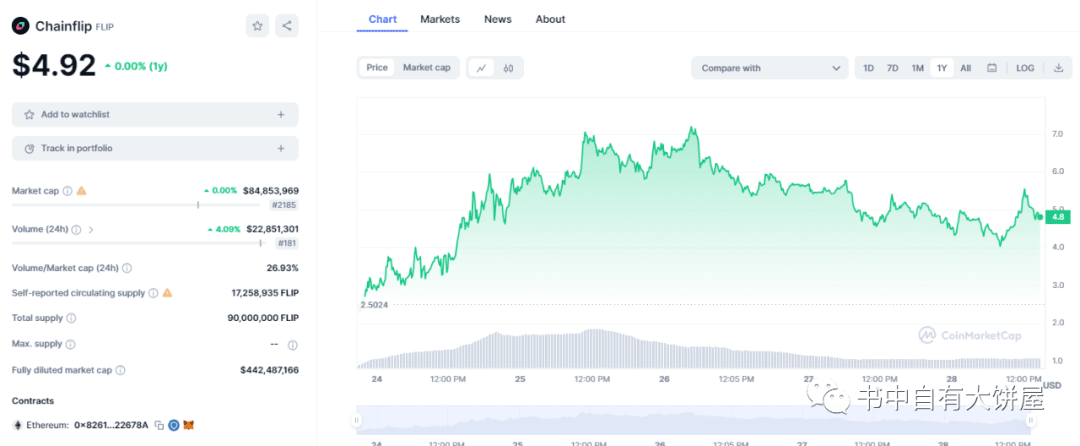
Today we are going to talk about a project recommended by a member of the Planet group. This project has just been launched on the mainnet, and has also been launched on some mainstream exchanges (gate, coinlist, bybit, etc.). After the launch, it has also risen sharply, from 1 US dollar to a maximum of 7 US dollars. It is chainflip, and its current market value has reached 80 million US dollars. It is also a cross-chain AMM. We know that the current mainstream DEXs are either based on ETH, BSC or the second-layer network, and there is no cross-chain for BTC. Therefore, if you want to add BTC to DEX, the current method is to use a cross-chain bridge to transfer BTC to the Ethereum chain through the bridge, such as WBTC, and the previously introduced TBTC, etc. So, is there any way to directly take BTC and trade it? This DEX does this, let’s take a look today.
introduce
Chainflip is a native cross-chain AMM designed to provide users with unparalleled pricing, speed, and access to the industry’s most traded assets. When it comes to swaps, existing cross-chain bridges and infrastructure lack the speed and efficiency of centralized exchanges, while having much higher gas costs. Centralized exchanges have been at the heart of the industry since its inception, despite being founded on the principles of decentralization and the elimination of middlemen.
Thanks to Chainflip's unique architecture, native BTC-ETH on-chain swaps (with exchange speeds that could replace the dominance of centralized exchanges) are possible. To achieve this, Chainflip's unique architecture combines an advanced threshold signature scheme, a completely permissionless validator auction system, a next-generation AMM design (JIT AMM), and universal support that works for any blockchain. Its unique deposit channel system makes it unmatched in terms of gas costs, and its native cross-chain messaging support makes it instantly combinable with thousands of protocols.
Chainflip can be viewed as a cross-chain liquidity network consisting of two distinct architectural layers:
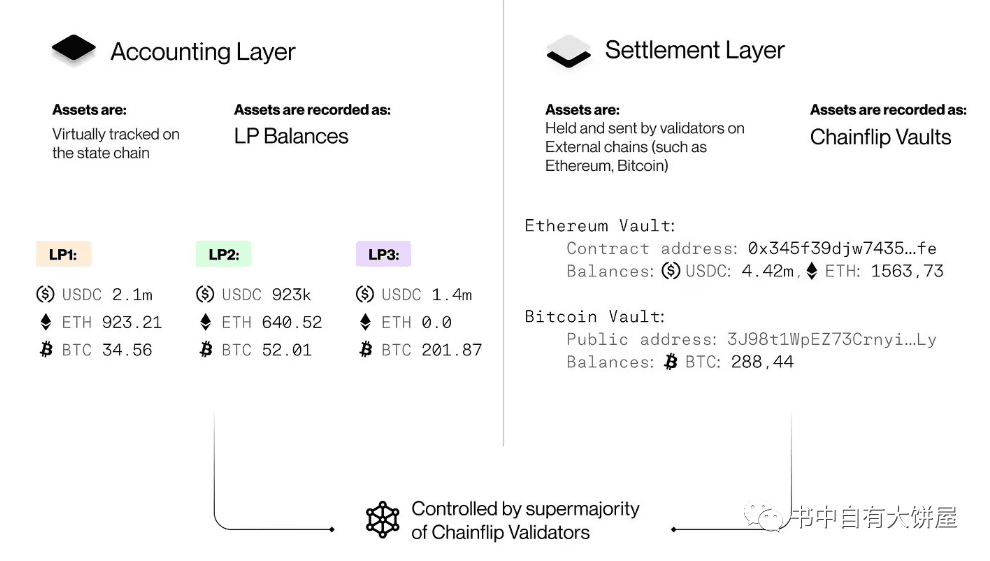
1. Validator layer: Validators play a vital role in the entire network as they control Chainflip Vaults on multiple blockchains, forming a decentralized settlement layer.
Vaults are Chainflip protocol’s native assets and liquidity pools on each supported chain. They are a fundamental building block of the protocol, enabling native assets to be exchanged.
Validators’ responsibilities also include maintaining and updating the statechain. In fact, all protocol events are executed or triggered by the statechain, including validator auctions, slashing, JIT AMM swaps, issuance, and governance.
2. Accounting layer (state chain): An application chain built using Substrate to track balances and process events.
These two layers combined make Chainflip a fully decentralized universal cross-chain exchange protocol.
Project Advantages
Chainflip also connects chains by deploying wallets on each chain. Unlike the centralized database of CEX, in Chainflips, the state chain is used to record protocol events (you can see that it is a relay chain).
To ensure the security of each wallet, each supported blockchain has a vault operated by a validator, so the validator network constitutes the key infrastructure of Chainflip, and the number of validators released by Chainflip will be 150.
150 major validators and scalable signature algorithms
Truly decentralized cross-chain networks require large validator sets to achieve security and censorship resistance. Chainflip requires up to 150 validators per vault. This approach outperforms comparable cross-chain systems in terms of shared economic security. Additionally, Chainflip uses Schnorr signatures, enabling these 150 validators to support large numbers of assets and multiple parallel signatures without incurring excessive hardware costs.
In this system, the honesty of validators is crucial. Validators must lock up a large number of $FLIP tokens as collateral, and the keys held by validators cannot be used to transfer protocol funds. If validators behave maliciously or fail to perform their duties effectively, their stake will be at risk.
How to effectively incentivize and punish validators is a difficult problem for the system. Chainflip also stated that the penalty rules are about to undergo major updates to ensure the long-term stable operation of the system.
The number of tokens provided to validators as rewards does not depend on the staked amount, the actual benefits received by validators will be determined by competition in the auction market. In order to obtain the right to verify transactions and earn rewards, validators need to continuously bid using their $FLIP tokens.
For every transaction that goes through the Chainflip system, users are charged a small fee (in the form of USDC) which is used to purchase $FLIP tokens in the built-in USD/FLIP pool. Purchased $FLIP is automatically burned, removing it from the supply.
The Gas generated by the state chain will also be automatically burned, and these fees will be incurred when interacting with the state chain, including liquidity provider updates, deposit channel requests, validator external fees, etc.
What are the benefits of using state chains?
No reliance on external operation chains
Application specific parameters can be automated and optimized via the Chainflip SDK
Scalability: e.g., transaction batching to save gas
Security: Validators are required to post native Chainflip tokens ($FLIP) as collateral, which can be slashed in the event of malicious behavior.
Governance: Token holders can participate in and the governance committee handles protocol upgrades and parameter adjustments, thus achieving a high degree of flexibility and decentralization.
The Importance of Vaults
We have already mentioned the importance of vaults in the entire system. They hold assets for transactions on different blockchains, while transactions and accounting are performed on the state chain.
As part of the accounting layer, we learned about the Chainflip Just In Time (JIT) Automated Market Maker (AMM).
How does JIT AMM work?
Unlike Uniswap, JIT AMM’s funds are not stored on-chain using wrapped assets (such as WBTC). Instead, they are virtually traded on the state chain (i.e., off-chain transactions) in the form of account balances and settled using native assets in the vault.
As part of its technology stack, Chainflip utilizes: multi-party computation, threshold signature scheme.
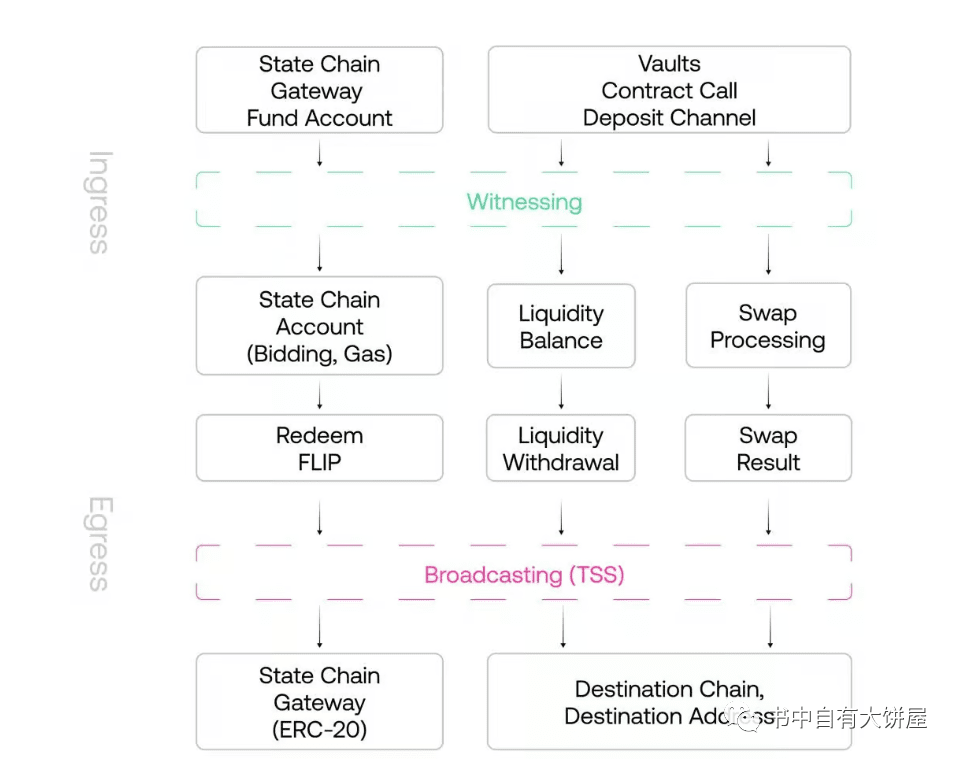
Core features of JIT AMM:
Faster range order updates: Market makers can actively respond to incoming trade flow.
Batch Swaps: Swaps are grouped together and executed at regular intervals, significantly reducing slippage.
No front-running: No MEV, as front-running will not be profitable. Chainflip encourages liquidity providers to front-run each other for the benefit of users.
At the same time, some limitations of the design chosen for Chainflip AMM need to be mentioned: in particular, with regard to ensuring the finality of transaction batches.
Additionally, since range orders are updated frequently, it is difficult for the protocol to determine final pricing including slippage.
Last but not least, rebalancing the asset pool takes longer than with traditional AMMs, and due to additional delays in confirming deposits and processing withdrawals, market makers need to wait longer than with ordinary AMMs to rebalance their deposits.
cooperate
Chainflip has also collaborated with Squid’s cross-chain router, which currently supports the following capabilities:
Native BTC – Best on-chain pricing on the largest crypto spot market
Native ETH - the most widely traded non-stable asset in DeFi
Native DOT – Unparalleled on-chain trading facilities for creating new markets
ERC20 FLIP -- requires deployment of a network fee purchase-destruction strategy
About the Team
Chainflip is a team of more than 25 experienced professionals from Australia and Europe. The team’s experience covers software and web development, software engineering, DevOps, blockchain (smart contracts, Dapps), research and communications, and legal. The company has offices in Berlin, Budapest, and Melbourne. Here is an introduction to the main members of the team.
Simon Harman
Simon Harman, founder and CEO of Chainflip Labs, is an advocate for data privacy and co-authored the white papers for Loki (later renamed Oxen) and Session App (with over 1 million installations on Google Playstore). He graduated from RMIT University with a bachelor's degree in music in September 2017 and worked as an Events Facilitator at the Blockchain Centre 6 months after graduation. Chainflip Labs is not Harman's first crypto project. He previously founded and continued to serve as a board member of Oxen before starting to focus on Chainflip Labs in 2020, which now has about 25 employees. He is currently the CEO of both OXEN and Chainflip Labs.
Tom Nash
CTO Tom Nash is also the co-founder and CTO of Flex Dapps. Previously, Tom worked briefly as a blockchain consultant for TypeHuman and a blockchain developer for WeTrustPlatform. Tom graduated from Lancaster University with a bachelor's degree in computer software engineering.
Alastair Holmes
Alastair Holmes works as a Protocol Research Engineer at Chainflip. He has experience in software development using C++, CMake, Python, DirectX, Vulkan, VBA, and Rust. He holds a Masters degree in Computer Science from Cambridge University.
Investment institutions
Chainflip Labs raised $6 million in its first round of financing, and recently the project reached a $10 million private equity investment deal with three veteran crypto venture capital firms, Framework Ventures, Blockchain Capital, and Pantera Capital. The total financing amount is currently $16 million.
Token Economic Model
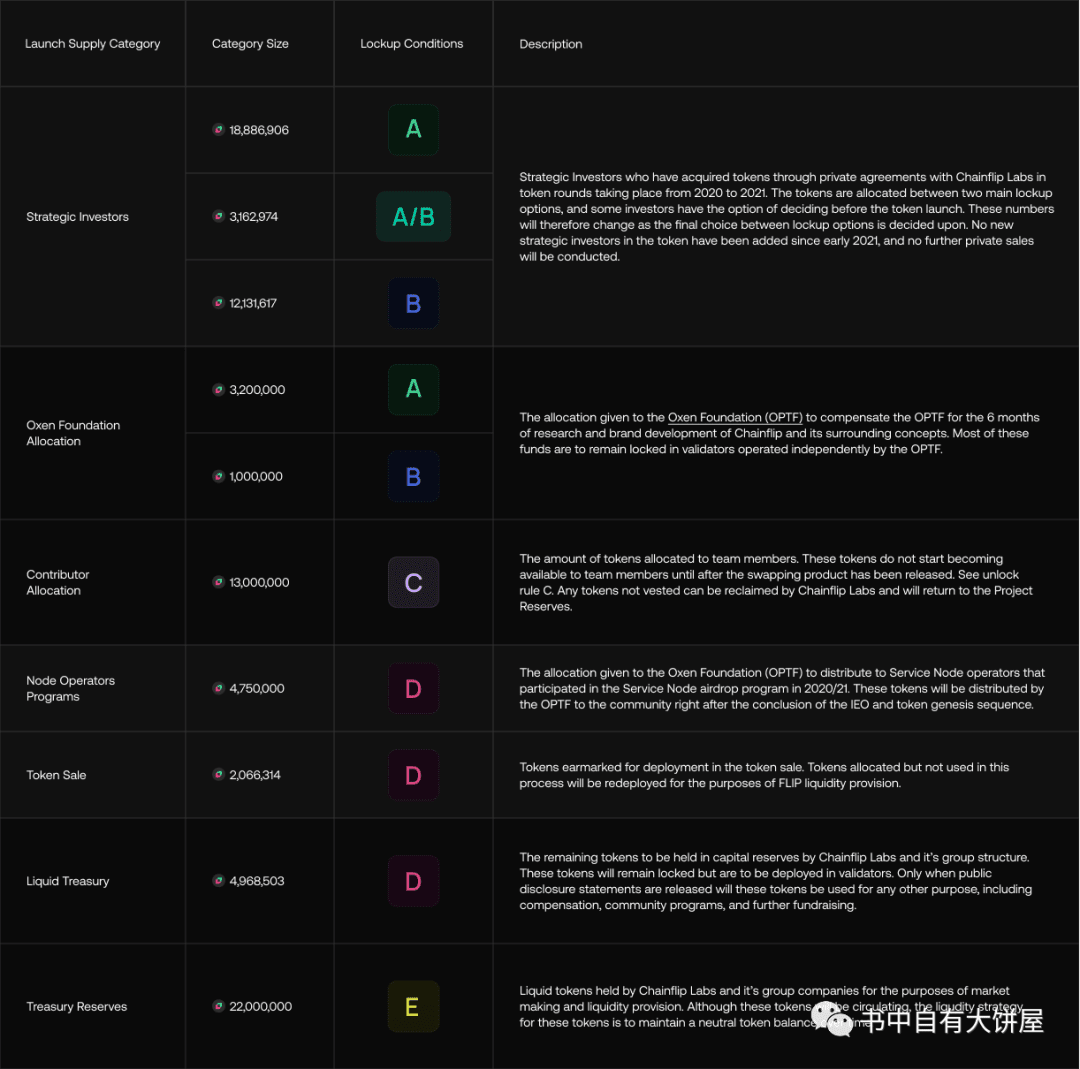
Chainflip Labs announced the token economic model and will airdrop to the community. FLIP is Chainflip Labs' ERC-20 native token, which is expected to be launched in the second quarter of 2023. The initial supply of the token is 90 million, with an annual inflation rate of 8%. The current circulation is 17,258,935, which is still a relatively low circulation rate.
(1) 4.75 million FLIPs will be airdropped to the community and distributed to service node operators who participated in the Service Node airdrop program in 2020 and 2021;
(2) 6.9 million FLIPs for token sales;
(3) 13 million FLIPs are allocated to contributors;
(4) Approximately 34 million FLIPs are allocated to strategic investors;
(5) 4.2 million FLIPs are allocated to the Oxen Foundation;
(6) 4,968,503 FLIPs as liquidity;
(7) 22 million FLIPs as reserve funds.
Current competitors
CrossSwap: CrossSwap is a platform focusing on cross-chain transactions, supporting multiple blockchains, including Ethereum, BSC, Heco, etc.
ThorSwap: ThorSwap is a cross-chain DEX platform that supports tokens on blockchains such as Ethereum, BSC, Heco, and Polygon. The current market value is $5,000. 35% has been unlocked.
Anyswap: Anyswap is a decentralized cross-chain trading platform that supports multiple blockchains, including Ethereum, BSC, Heco, Fantom, etc. 47 million US dollars, currently unlocked 18%.
Finally, let me summarize this project. At present, this project is still innovative in cross-chain AMM, especially its JIT-AMM. Then anyone who plays in the currency circle should have the demand for cross-chain, because many big guys have hoarded a lot of Bitcoin, but there is no liquidity, so they can release liquidity through cross-chain. This is a certain demand, but there are certain solutions at present, such as wbtc, so this cross-chain AMM actually still has a certain market, but the market space will not be very large. From the perspective of several competitors, the market value is relatively low, tens of millions of US dollars, and there is still a certain gap with the mainstream exchanges. If compared with the current second-rate DEX, such as dodo, the current market value of dodo is 70 million. Then compared horizontally with other cross-chain AMM market values, it is also relatively high, so this project is actually in a slightly higher range. As for how much the bull market can be allocated, you can actually look at the market value of DODO in the last bull market, which is about 800 million, so it is estimated that the peak of the bull market will be at most this much, plus the release, so at present, there is a maximum of 8-10 times of space.