


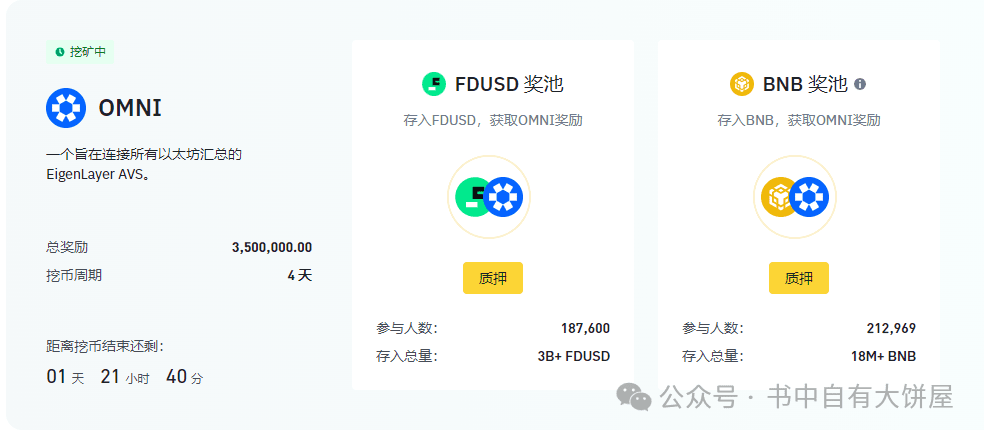
Today we continue to talk about Binance’s 52nd launchpool project - Omni Network (OMNI), a layer 1 blockchain that aims to integrate Ethereum’s rollup ecosystem into a unified system. The mining will last for 4 days, with a maximum token supply of 100,000,000 OMNI. Initial circulation: 10,391,492 OMNI (10.39% of the maximum token supply). Total mining: 3,500,000 OMNI (3.5% of the maximum token supply). BNB can mine 2,975,000 OMNI (85%), and FDUSD can mine 525,000 OMNI (15%).
1. Introduction
Omni Network is a locally secure, externally verified interoperability network based on Ethereum's interoperability layer. It integrates Ethereum's second-layer Rollup and provides developers with the ability to build DApps across multiple second-layer ecosystems. Omni Network has support based on Ethereum security, sub-second message verification, backward compatibility, and an execution environment for building cross-layer DApps.
2. Background
Currently, various types of Rollups on Ethereum have weakened the network effect of Ethereum, and the liquidity of dapps across rollups has decreased. For developers, it is very troublesome for them to independently manage programs between different rollups.
What is needed is a native interoperability protocol specifically designed to realign Ethereum with its original vision of being an operating system for distributed applications.
Central to Omni’s mission is enabling seamless interoperability between different blockchain networks, with a particular focus on rolling technology. This capability is critical to creating a coherent and efficient blockchain ecosystem in which assets, information, and applications can flow freely between chains.
3. Omni’s key innovations
3.1 Security
Interoperability protocols have historically been a challenge in terms of security. First generation protocols relied on only a set of trusted participants to validate and relay the network. But these entities are vulnerable to attacks or collusion.
The second generation protocol uses an improved credit model. The protocol can use cryptoeconomic security to introduce a new dimension of security for the external validator set, but it still relies on the security of the native assets, which is currently an unstable solution.
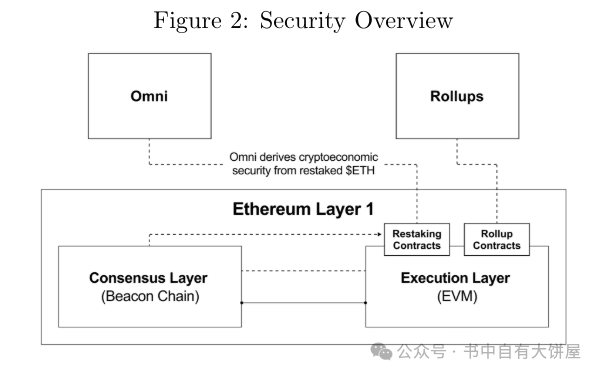
Now using EigenLayer, Omni introduces a fundamentally new security model for interoperability protocols. Omni uses re-staking ETH to secure its validator set, allowing the protocol’s security to be aligned with Ethereum L1’s security budget. Ethereum’s current security budget exceeds $100 billion, an order of magnitude larger than any other PoS network. By leveraging the security of re-staking ETH (a high-liquidity/low-volatility asset) Omni achieves significantly higher stability than its predecessors. Additionally, by deriving security from Ethereum, Omni aligns its security foundation with the Rollups it connects to, promoting a security model that grows in tandem with the Ethereum modular ecosystem.
Omni is setting the standard for EigenLayer’s Active Validation Service (AVS). Omni became the first protocol to insure a Liquid Re-collateralization (LRT) provider when it agreed to lease $600M worth of re-collateralized $ETH from EtherFi. Omni’s team has secured agreements with multiple other LRT providers, pushing its day one security budget to over $1B. This will allow Omni to provide industry-leading security without requiring protocols to incur prohibitive costs to launch a network. As the only Active Validation Service (AVS) running on testnet, besides EigenDA, Omni is positioned as the most production-ready AVS on the market.
3.2 Sub-second Verification
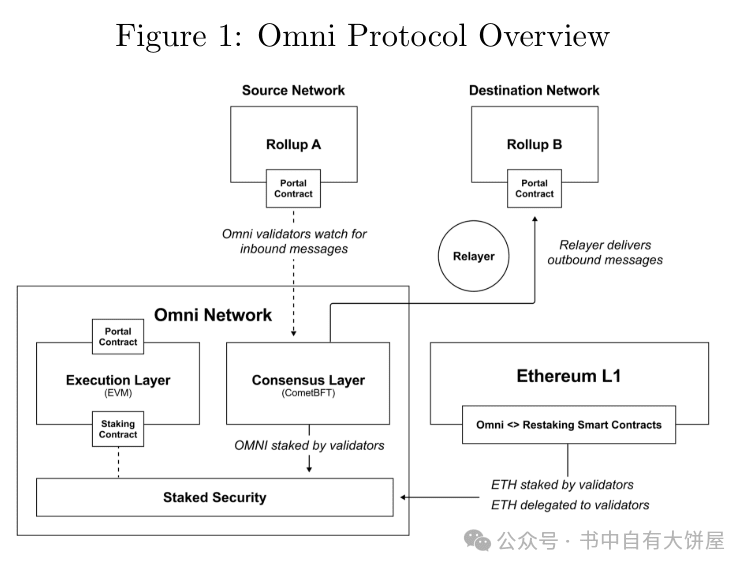
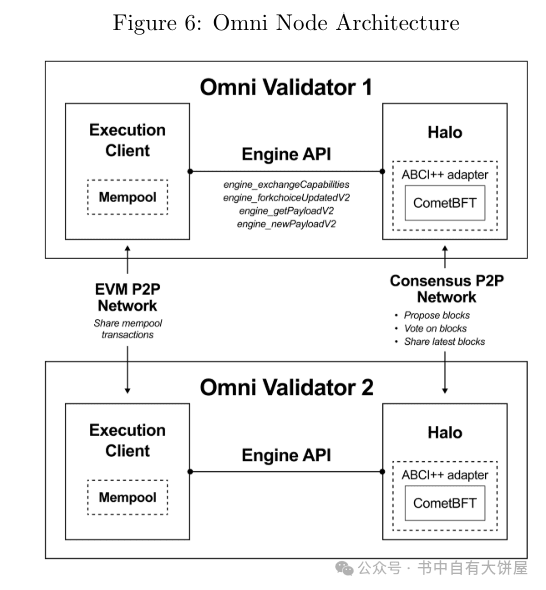
Omni brings this experience to Ethereum Rollups through a novel protocol architecture that enables sub-second cross-Rollups message validation. After processing 7.5 million transactions from 550,000 wallets on a previous testnet, Omni Labs completely overhauled the network’s architecture. At the heart of this design is Octane, a new open source framework that combines the EVM with CometBFT consensus. Using the Ethereum Engine API and ABCI++, Octane creates a clean separation between the execution and consensus environments of an Omni node, isolating performance-hindering components of the existing EVM<CometBFT framework.
3.3 Native Global Applications (NGAs)
In addition to providing cross-Rollups message authentication, Omni also provides a dedicated execution environment, Omni EVM, that allows developers to manage all of their Rollups application deployments from a single location. Using the Omni EVM as an orchestration layer, developers can deploy Native Global Applications (NGAs). NGAs are a new class of applications that dynamically propagate their contracts and interfaces to any Rollups, giving them access to all of Ethereum’s liquidity and users by default. Using NGAs, developers can leverage the scalability of Ethereum Rollups without the burden of managing distributed state between multiple Rollups environments.
4. Dual-chain architecture
Consensus layer + execution layer
Omni introduces an innovative blockchain architecture designed to improve performance and scalability without compromising security. At its core, Omni's architecture is divided into two main layers: the consensus layer and the execution layer. This dual-chain structure enables Omni to efficiently process transactions across multiple networks and manage global state.
4.1 Consensus Layer
At the core of the Omni network is the consensus layer driven by the CometBFT consensus engine. This layer is where validators work together to determine the state of the network, ensuring that every transaction is valid and finalizing the global state of all connected networks within seconds. Its main benefits include:
-Instant transaction finality: With CometBFT, once a transaction is included in a block, it is considered final, eliminating the need for additional confirmations.
- Delegated Proof of Stake (DPoS): This mechanism allows users to delegate their re-invested ETH directly to validators, enhancing the security of the network.
- Proven robustness: CometBFT is battle-tested across multiple blockchain networks and trusted to secure billions of dollars.
4.2 Execution Layer
In addition to the consensus layer, there is also the execution layer, or Omni EVM, which mimics the functionality of the Ethereum L1 execution layer. This is where user transactions are processed, and the following features stand out:
- Scalable transaction processing: Omni EVM processes transactions in its memory pool, achieving high throughput without overloading the network.
- Compatibility with Ethereum Clients: Omni leverages existing Ethereum execution clients (e.g. Geth, Besu, Erigon), ensuring stability and the latest features.
-Dynamic fee mechanism: Supporting EIP-1559, Omni EVM allows dynamic transaction fees and partial fee burning to optimize network usage costs.
- Unified consensus and execution
Omni's dual-chain architecture enables integrated consensus, allowing validators to run Omni EVM and cross-network message consensus simultaneously. This innovative design, supported by tools such as ABCI++ and Engine API, makes Omni's sub-second finality possible. Validators effectively confirm the state of the external rolling virtual machine, ensuring seamless state transitions and unified state management.
By separating consensus operations from transaction execution, Omni effectively scales the activity of its network and connected rolling chains. This architecture not only mitigates the risk of network congestion, but also enhances the security and reliability of cross-network transactions.
5. Financing
In February 2022, Omni Network (formerly known as Rift Finance) announced the completion of US$18 million in financing, with Pantera Capital, Two Sigma Ventures, Jump Crypto, Hashed, The Spartan Group and others participating in the investment.
6. OMNI Token Economics
The total number of OMNI tokens is 100 million, and the circulating supply after listing is approximately 10,391,492 tokens (approximately 10.39% of the total token supply), of which the Binance Launchpool quota is 3.5 million tokens, accounting for 3.50% of the total token supply.
Omni Network’s previous two private token sales raised $18.1 million, totaling 20.1% of the total tokens sold. The tokens were sold at $0.18 and $1.5 respectively.
OMNI tokens are distributed as Binance Launchpool 3.50%, Ecosystem Fund 29.5%, Team 25.25%, Private Investors 20.06%, Community Fund 12.67%, Public Offering Allocation 5.77%, and Advisors 3.25%.
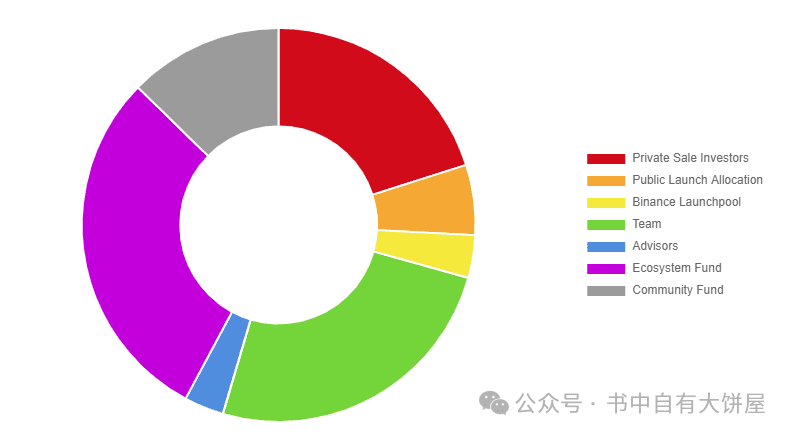
The team and private investors will release tokens in April 2025, and the rest, except for the public offering and Binance Launchpool, will be released in a step-by-step manner.
7. Coin Price Estimation
According to the previous launchpool estimates, the return is about 1%-2% each time. This time the pool has 18 million bnb, so the price should be around 35-70 US dollars. Then the total FDV is about 3.5 billion to 7 billion US dollars, which is still relatively high.
So what should be its reasonable price? In fact, there are project comparisons. We can do a horizontal comparison. This can be regarded as a whole cross-chain interoperability for a dedicated user L2. If we compare it with AXL, another cross-chain interoperability protocol that has just been launched, it currently has 1.4 billion FDV, and Wormhole currently has about 6 billion FDV. However, W is a trump card project, although W has reached a maximum of 1.6 when it was launched. But your project is definitely not at the same level as W, and you can only compare it with AXL at most.
Finally, in summary, this project is a unified project specifically for L2, and is more inclined towards developers or project parties. There should indeed be demand for the project, and the innovation is not too big, nor is it a big project. It can only be said to be average, but there is only a test network at present, and no official version has been launched. In short, mining is definitely possible, but it is not recommended to buy it at the second level. You can choose some good white horse targets.