

ICP price manipulation
After more than 5 years of research and development by a large team of the Swiss non-profit organization Dfinity Foundation, the Internet Computer Blockchain was spun off as part of the public Internet during the network's "genesis" event on May 10, 2021. This allowed existing balances of its native ICP governance token to be transferred on its ledger, and independent cryptocurrency exchanges around the world began creating spot markets for ICP, allowing exchange users to buy and sell ICP.
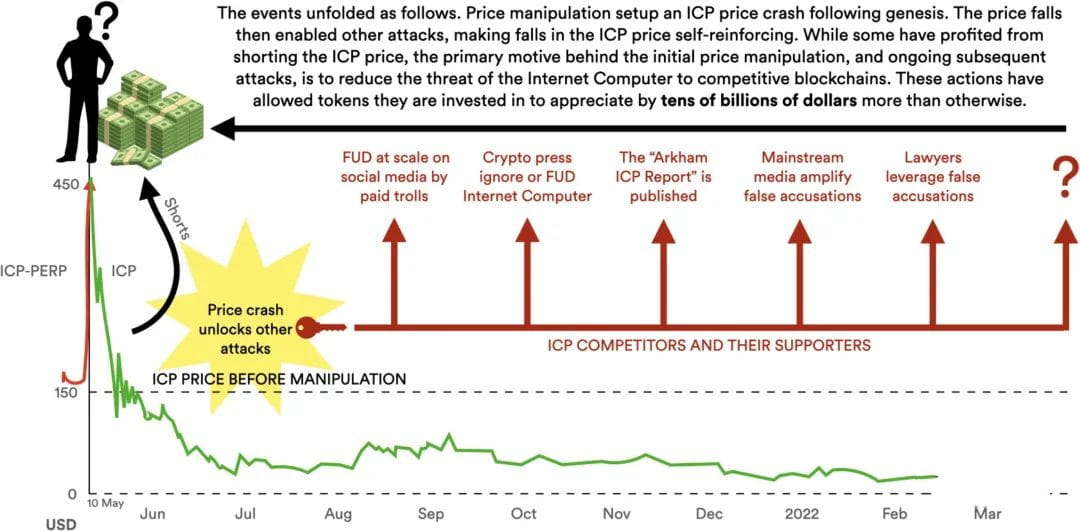
Initially and in the hours that followed, ICP’s price remained above $450/token, giving the network an unarguably high fully diluted valuation of $230 billion. Then the price started to fall. Ultimately, this led to a series of attacks on the Internet computer ecosystem, driving ICP prices well below their natural levels and causing huge harm to ICP holders, people who purchased ICP, and online community building.
Spot markets typically determine the price of an asset through a price discovery process. However, it seems that the initial prices in these markets were not set through a normal price discovery process at genesis. Just four days before genesis, the FTX crypto exchange launched the “perpetual futures” financial instrument ICP-PERP.
We analyzed the trading methods of ICP-PERP before and after the Internet Computer Genesis incident and found suspicious activities, indicating that it was used to manipulate the ICP price in the spot market, causing it to rise sharply. The manipulation occurs within a few hours before and after genesis. As soon as the price manipulation ceased, ICP's price began to fall back toward its natural market level.
The rapidly falling price significantly damaged the reputation of the Internet Computing ecosystem and led to attacks on the project by many other parties claiming that the price drop was caused by inappropriate behavior by people within the project (our investigation indicates that these attacks were caused by investment executed on competing blockchains or by parties holding short positions on ICP). These attacks intensified the decline in ICP prices, causing ICP prices to fall well below their natural price. Within hours of genesis, the market value of the Internet computer network exceeded $230 billion, but over the next six weeks, that number fell by more than $200 billion.
In the absence of clarity about possible price manipulation attacks, suspicion may fall on innocent parties. For example, there is Sam Bankman-Fried, a major supporter of the Solana blockchain ecosystem. It can be said that Solana’s market capitalization benefited by billions of dollars from the events that occurred. At the same time, he is the owner of the FTX exchange, which introduced ICP-PERP before genesis, apparently making the attack possible. He is also the owner of Alameda Research, a massive portfolio of crypto hedge funds and market makers that is perfectly capable of carrying out such an attack. We hope to make it clear that Sam Bankman-Fried had no involvement (other than creating the ICP-PERP tool on FTX 4 days before genesis).
Currently, Sam Bankman-Fried and FTX have records of every ICP-PERP transaction that occurred during the alleged price manipulation period, as well as corresponding user account information. We need them to share this information so we can identify the perpetrators. This will enable ICP holders to seek compensation and help prevent further attacks from occurring, harming thousands of ICP holders.
Reasons for price manipulation
The disruption that manipulation of ICP prices would cause to the Internet computing ecosystem is obvious to a major cryptocurrency player. We believe that ICP prices are controlled in order to destroy the Internet computer ecosystem. We do not believe the purpose of this is to allow insiders to sell at a higher price, as this would inevitably make the insiders poorer. We do not believe the purpose of this is to allow cryptocurrency traders to short ICP. In our opinion, this is to protect the status quo of blockchain.
It's easy to understand the threat that Internet-connected computers pose to the status quo. Genesis had been developed for several years by a large team at the Dfinity Foundation, including renowned engineers, computer science researchers, and cryptographers, and its technical capabilities were (and still are) highly unusual. For example, it claims to support unlimited on-chain scaling on a single blockchain, smart contracts can handle HTTP requests and create interactive network experiences, and the efficiency is orders of magnitude better than any other blockchain, smart contracts can run in parallel, and intelligent Contracts can create transactions on other blockchains, on-chain/in-protocol governance via a DAO that can update its network nodes, networks consisting of dedicated node machines (rather than cloud software instances), and more.
It can be said that the disruption of the Internet computer blockchain has allowed some other blockchains to benefit during the 2021 bull market. If the media and blockchain community do not focus on the decline in ICP prices, but instead focus on the capabilities of Internet computers and the growing community, the status quo of blockchain is likely to be disrupted soon. We believe that large individual backers competing for tokens in the blockchain may have reaped billions of dollars in additional capital gains as a result of the disruption of the internet's computer ecosystem. We believe this is ultimately the reason for manipulation.
How ICP-PERP is weaponized
Four days before the genesis of the Internet computer, FTX exchange launched ICP-PERP, a synthetic financial version of ICP consisting of perpetual futures instruments (essentially a contract for difference). Initially, the price of ICP-PERP was only $114.40, allowing traders to bet on the price of the real ICP after genesis. This price increases slowly and naturally until the day of genesis. At 10 a.m. Pacific time on May 10, eight hours before the birth of the Internet computer, its price had risen to $176.89. Suffice it to say, everything looked normal up to that point.
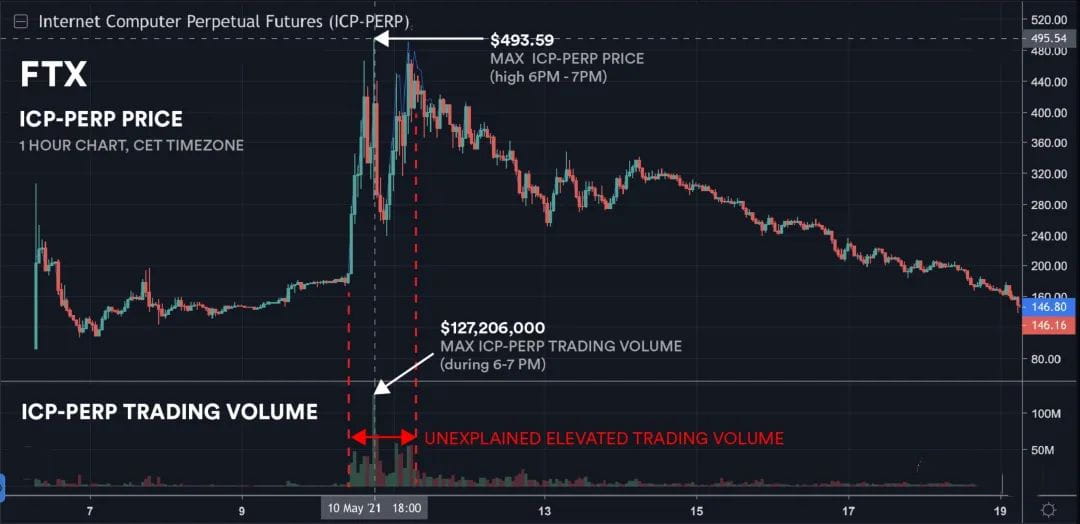
Then at 11 a.m., the trading volume of ICP-PERP (that is, the number of ICP-PERP buys and sells on the FTX exchange) suddenly surged, increasing by 30-40 times compared with the previous few days. In the seven hours from 11am to 6pm, when the real ICP token was listed on other exchanges, the total trading volume of ICP-PERP reached an incredible $241.36 million. On average, more than $34.48 million worth of ICP-PERP is bought and sold on FTX every hour. In the 7 hours before genesis, the prices of ICP-PERP reached $275.67, $344.21, $329.09, $388.16, $466.22, $432.89, and $358.34 respectively.
In order to increase the price of an asset traded in the market, manipulators will often use a number of different techniques to create the illusion of demand, or to increase existing demand. Sometimes they engage in "wash trading," meaning they seek to sell assets while they are both buyers and sellers, thereby increasing trading volume and apparent liquidity. They often use puppets to create the illusion that multiple parties are involved in the sale. Market manipulators can also drive up prices by purchasing assets in large quantities for a limited period of time, again to provide the illusion of demand and thus create more demand.
The key signal that these techniques are being used is a sudden rise in trading volume. This makes ICP-PERP’s trading volume very suspicious. We can clearly see in the chart below that the trading volume of ICP-PERP suddenly surged after 11 a.m., and the price entered a nearly vertical upward phase, and maintained a strong upward momentum after genesis until the peak price was firmly established. . Since then, trading volume has declined sharply, causing the price to remain in a prolonged self-reinforcing downward trend (volume is shown in the chart below the price chart). This data comes from the FTX exchange itself.
At 6pm PT on May 10, cryptocurrency exchanges such as Coinbase and Binance launched spot markets, allowing the public to buy and sell real ICP tokens.
It is important to understand how and why the true prices of ICP-PERP and ICP tokens reflect and track each other. If the price of ICP-PERP is higher than the price of ICP, then financial traders can immediately arbitrage the difference through special hedging transactions, thus pushing the price of the ICP token higher. Therefore, the prices of ICP-PERP and ICP are related to each other. If the price of ICP-PERP is higher than that of ICP and there is strong support, then the price of ICP will inevitably be raised to meet its requirements.
From 6pm to 7pm Pacific time, immediately after network genesis, ICP-PERP’s transaction volume went into overdrive. During this hour, ICP-PERP’s trading volume reached $127,206,000, which is more than 250 times higher than in previous days. Its price reached an all-time high of $494.29. ICP-PERP now directly affects the price of the spot market where ICP is traded in real time. By setting the initial ICP price at such a high level and then maintaining it for a significant period of time, they convinced the public that the opening price range was reasonable.
Before ICP was transferable and appeared on the spot market, the public was unaware that the price of ICP had been affected by ICP-PERP on FTX. After 5 a.m. on May 11, the last high of ICP-PERP trading volume was US$55.914 million, at which time the price of ICP in the spot market reached US$476.75.
At around 7 a.m. Pacific time, ICP-PERP’s trading volume suddenly returned to normal, and the ICP price began to fall.
Bitcoin crash adds to price fall
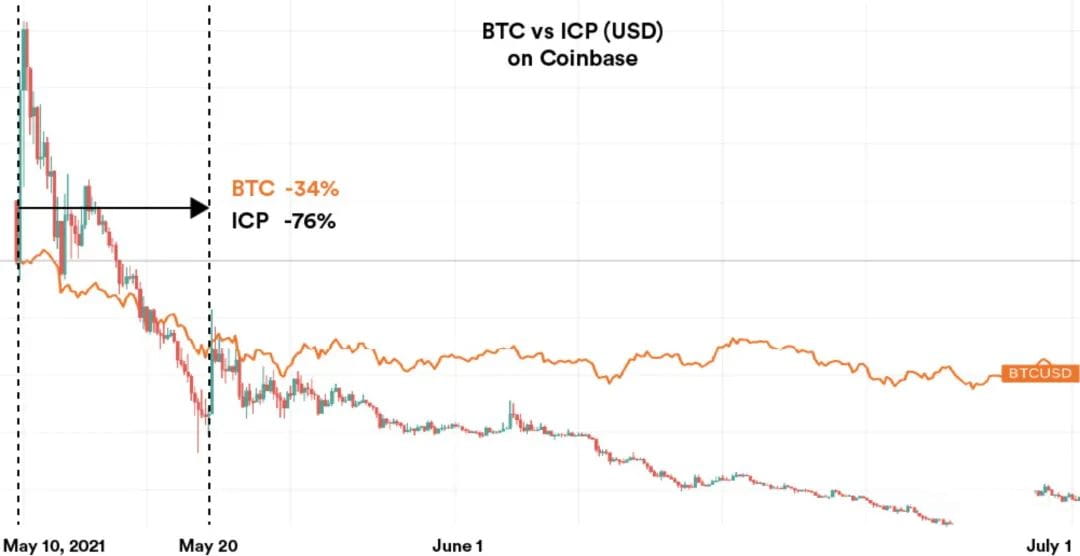
The increase or decrease in the value of most blockchain tokens is highly correlated with changes in the value of Bitcoin. In the 10 days after genesis, the price of Bitcoin dropped significantly, down 34%. This has created a downward pull on the prices of most coins and as can be seen from their price charts, this will also affect the price of ICP. However, this effect is amplified since the initial price of ICP was apparently pushed up 3x through price manipulation so that it would have fallen anyway.
Therefore, the timing is lucky for attackers and unlucky for ICP holders, as Bitcoin causes the value of ICP that people buy in the spot market to fall faster than at other times, thereby increasing their pain. In the 10 days after genesis, ICP’s price fell by 76%. This helped the attackers set off a perfect storm of attacks that ultimately made the price drop self-sustaining.
Aggression triggered by price drops
The crypto industry has long been plagued by “pump and dump” schemes. As a result, participants in the cryptocurrency industry have become accustomed to interpreting large price increases ➡ price collapses of tokens as market demand generated by insiders initially pumping up the price and then selling en masse to them through a kind of “rug pull” or exit scam.
It would be extremely harmful if this interpretation of the project became widespread, as it would mean that the project was actually a scam to defraud token buyers of their funds, and the technology involved in it may not matter to anyone purchasing the token. people may be deceived. The attacker who manipulated the ICP price at genesis, driving it up three times, is supposed to be a major blockchain player, fully aware that when the price starts to fall, this belief will inevitably spread to computers on the Internet, and these How beliefs will trigger other attacks.
The blockchain industry contains many competing tribes incentivized by tokens. People in these tribes use social media to alternately promote networks in which they have invested and attack competing networks that threaten their investments. And much of this propaganda and attack horde is directed and inspired by the organizations behind blockchain.
When the “tribes” began taking action against Internet computers, those who had lost money on ICP trading joined in, believing that ICP prices fell because of a “rug pull” by insiders, sparking a frenzy on social media.
hidden conflicts of interest
The traditional financial system has evolved over hundreds of years. Stock and commodity markets have been subject to significant manipulation and fraud in the past. For these reasons, layer after layer of legal protections were created over time to allow free markets to function properly and to provide participants with a level of protection from those who would steal their money or Injuries to those who cause them unfair loss. The purpose of many regulations is to ensure that certain roles in a free market environment are performed by different parties operating independently, without the possibility of collusion. To understand the importance of this, and what goes wrong in the centralized markets of the cryptocurrency ecosystem, we can imagine a traditional stock financial market that lacks these protections.
First, we will imagine a financial entrepreneur who owns a technology hedge fund that uses clever strategies and automated systems to outperform amateur investors by actively trading technology stocks such as IBM and Microsoft. Entrepreneurs made so much money that they started working as "market makers" to provide liquidity to the stock market (market makers add depth to the market and ensure that participants can buy and sell reasonable amounts of assets close to the current market price , making them key to market operations). Now, potential conflicts of interest could arise if an expanding hedge fund arm requires market makers to disrupt the markets they are shorting while simultaneously boosting the markets they are long.
Now imagine further that the combined hedge funds and market makers made a lot of money together, and they also decided to launch a new financial exchange for tech stocks that later became larger than Nasdaq, and they were all together office. Now, the potential conflicts of interest will be huge: Hedge funds and market makers may now demand confidential market information from exchanges, including what stop-loss orders other traders in the market have placed, what their leverage is, etc. information. In the absence of regulation, the potential for market corruption and unfair profits will be great.
Now imagine further that the combination of technology hedge funds, market makers, and financial exchanges made this entrepreneur so much money that he decided to back a specific technology platform whose stocks would be traded on the same market on transaction. Imagine a market as fervent as the dot-com boom or cryptocurrencies, where many participants are so poorly informed that financial wizardry and marketing will be far more important to market value than the underlying technology involved.
Imagine an entrepreneur amassing a large stake in a technology platform by making huge investments in the company that developed it and in the ecosystem of other businesses built using the platform. Imagine his capital and control of the market causing the platform's stock value to skyrocket, providing returns that can be reinvested in the ecosystem, attracting new investors looking to invest in the next Alphabet company during a virtuous market cycle .
At this stage, the already wealthy and powerful financial entrepreneur is expected to earn hundreds of billions of dollars. But imagine a problem. Another platform has been developed for many years by a non-profit foundation that runs a huge research and development program and is technologically advanced and far ahead of the curve. There are concerns that the launch of the new platform will undermine the key selling points of the entrepreneur platform, which hopes to claim to be the fastest, most scalable and efficient, while it will be vastly outclassed and lack game-changing New abilities. The entrepreneur and those who invested with him could lose the wealth they hoped to gain.
There's clearly a legitimate concern that entrepreneurs' partially vertically integrated financial operations might decide to cause trouble for the new platform's stock -- in a way that temporarily removes the competitive threat and provides time to absorb billions in additional capital. , convince more people to build on his platform, and generally improve his standing. Who knows what entrepreneurs will do, but this is precisely why in markets involving securities and traditional commodities, regulation is designed to prevent such conflicts of interest from occurring, and cryptocurrencies also require these protections.
Sam Bankman-Fried and company
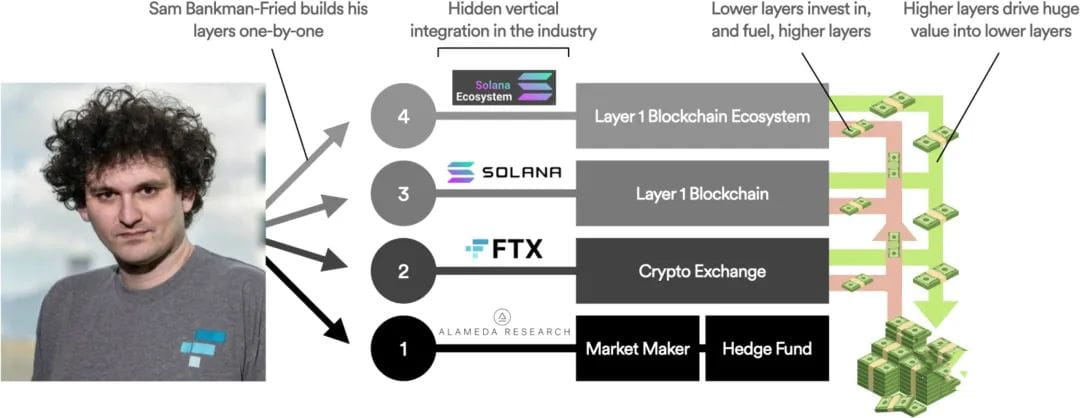
Arguably, potential conflicts of interest could arise within Sam Bankman-Fried's empire, which he has built layer upon layer, creating a vertically integrated financial ecosystem.
First, Sam founded Alameda Research, which became the largest hedge fund in the cryptocurrency space, and then transitioned into the role of a market maker, providing liquidity to the cryptocurrency market. Capitalizing on the massive profits generated by Alameda Research's secretive and controversial trading operations, which made billions trading primarily for retail investors, Sam subsequently launched the FTX crypto exchange, which used its jurisdiction to launch numerous The unusual product, which grew rapidly and generated huge additional profits, gave him immense power over the cryptocurrency market.
Sam Bankman-Fried has quietly established himself in the Solana blockchain and ecosystem, becoming what many consider the largest investor. He then began using his image to widely promote Solana without properly disclosing his role in the project. Recently, Sam Bankman-Fried, Alameda Research, and FTX were joined by Jump Trading Crypto, another large cryptocurrency market maker and hedge fund. Jump voluntarily took on $320 million in losses to protect Solana’s DeFi ecosystem after the “wormhole” bridge was hacked, reflecting the ability to control and manipulate the world of cryptocurrency finance. There are growing connections between the market’s large players and the projects in which their tokens are traded.
Sam Bankman-Fried's efforts have attracted institutional investors who believe his financial power will determine the future of "Web3 technology." The Solana Foundation has begun awarding grants of up to $10 million to crypto projects built using its blockchain. At its peak on November 6, 2021, the Solana network’s SOL token had a fully diluted market capitalization of $132 billion.
The potential conflict of interest necessitates that Sam Bankman Fried and FTX clearly demonstrate their impartiality by sharing ICP-PERP transaction logs (such as with us through NDAs and law enforcement in the United States and Switzerland).
Sam Bankman Fried has repeatedly claimed that he will one day give away 99% of the vast fortune he has made in cryptocurrency, creating a halo effect that often deflects criticism. But most of that money ended up coming from transactions with retail investors, and he was not Robin Hood—Robin Hood took money from the rich, not the poor, and gave it away immediately.
If Sam really cared so much about kindness, he could start simply by sharing the transaction logs in his possession to help solve the enduring mystery of how ICP-ERP was manipulated.
disturbing accusations
Dealing with Sam Bankman Fried is not an easy task. He has billions in cash, vast influence and the ability to fight back against his accusers in a variety of ways. Conflicts with celebrities who are widely praised by the media can also lead to attacks from others. The widespread adoration coverage of Sam Bankman Fried can be daunting.
Now, Sam has pledged to donate at least $1 billion to Democratic causes in the United States to keep them in power in the next election, a commitment that will win him many high-level friends.
But the charges against Sam have emerged. In recent months, Sam Bankman-Fried and Alameda Research have been accused of widespread manipulation of crypto markets, using techniques and systems that are extremely illegal in regulated markets, and by combining market attacks on their tokens with FUD activity. Attacked a blockchain project that appeared to compete with Solana (this has particularly strong resonance given the ICP-PERP attack and subsequent events).
The accusations date back several years. For example, in September 2019, Alameda Research allegedly launched two attacks on the global cryptocurrency market using the Binance exchange, but were blocked by its anti-price manipulation system. The charges allege that they sold a large amount of Bitcoin futures on the Binance market to suddenly and significantly lower the global Bitcoin price, with the purpose of triggering Bitcoin stop-loss orders, margin calls, and causing serial liquidations on other exchanges.
Alameda Research was allegedly set to make huge profits, which posed a great threat to retail investors who triggered stop-loss orders and liquidated positions. A related court case was later filed, which ended with a voluntary dismissal status, which typically indicates that the defendant paid the plaintiff to withdraw (i.e., resolve via an out-of-court agreement).
This investigation primarily involves an attack on Internet computers and ICP holders, which was launched using ICP-ERP on FTX, and in this regard we are seeking the assistance of Sam Bankman-Fried and FTX to identify the culprits. Overall, however, we do feel that more questions should be asked and more information requested about what is acceptable practice in today’s crypto-financial market.
Finally, it’s important to note that the financial performance of today’s cryptocurrency market makers, including Alameda Research, is highly anomalous compared to traditional regulated markets. Rumor has it that they are sitting on billions of dollars in cash profits made over the past two years. In a regulated traditional market, their revenue should be a fraction of that. Ultimately, this is the liquidity extracted from the crypto financial system, a large portion of which comes from retail investors.
Watch Anatoly Yakovenko sneer at ICP
Leaders of major blockchains that have benefited from attacks on Internet computers often deliberately avoid mentioning the network because they want to help amplify the attack by conveying that the project is now irrelevant. However, Anatoly Yakovenko, Solana’s CEO and chief scientist, and his co-founders spoke about the network near the end of an interview, a month after its genesis.
When the interviewee asked to "FUD another project," Anatoly chose "Internet Computer," and couldn't help but laugh and say, "I know I'm a little 'dunked on' Dfinity, right..." and "I feel like saying It’s bad to say bad things about other people” – although his previous words have been edited from the video. Whether Anatoly knows what happened to ICP-PERP is left to the reader to guess.
Please watch the video on YouTube starting at 1:32:20:
youtube.com/watch?v=e8wsw1htJFY&t=5540s
Threats to Solana
For Sam, it's all about Web3.
Web3 is the next phase of the internet, which will involve widespread tokenization, giving people direct ownership of assets such as media content. Early manifestations of the Web3 trend can be seen in the global craze for NFTs, which tokenize simple digital assets. For many blockchain insiders, the next critical step is to reimagine and completely rebuild systems and services such as social media and gaming using decentralized technology. This will have far-reaching consequences.
In the emerging model, online services such as social media will be placed under the full control of community governance systems called DAOs, which in turn are controlled by those who hold governance tokens (these tokens enable control over proposals and Update voting becomes possible). In the future, governance tokens will be issued as rewards and enable users to become part owners of the services they use.
Governance tokens will be distributed to users to engage them and enlist their support, making them part of the team advocating for the service, and creating a token incentive framework in which some users perform necessary tasks such as content moderation. This new user-centric ownership and control architecture, in which users become part of the team that helps sell and run the service, is enhanced by interesting tokenization schemes that promise to make the service richer and more Virality.
It can be said that the Web 2.0 ecosystem will be gradually reinvented in the form of Web3. This presents one of the biggest opportunities in recent history for tech entrepreneurs as it offers services reimagined in highly compelling new ways, where tokenization helps create powerful network effects that allow them to Over time, go beyond existing centralized Web 2.0 services and create entirely new experiences.
Leading blockchains that play the role of Web3 platforms will become extremely valuable, which is why Sam Bankman-Fried and Solana have put their Web3 capabilities and ambitions at the core of their strategy and pitch to the world. Using a blockchain to support Web3 will require it to be extremely fast and efficient, and scale to massive throughput, which Sam Bankman-Fried often claims is Solana's unique selling point. For example, at Yahoo Finance and Decrypt’s Crypto Goes Mainstream conference in November 2021, Sam Bankman-Fried said:
“Solana is one of the few public blockchains out there that has a really reasonable roadmap that can do millions of transactions per second at a scale of pennies per transaction, which is the scale you need
The Web3 blockchain needs to do much more than maintain simple token balances and run lightweight smart contract calculations. In the future, it will be necessary to fully decentralize online services and run them entirely on the blockchain, so that they can be placed under the full control of the community DAO and its governance token (a DAO can only update the other codes on the same blockchain).
There is no point in building a Web3 service using traditional centralized IT technologies such as cloud services, databases, and web servers because it cannot be placed under the control of a community DAO. Additionally, it can be hacked and compromised, and unlike blockchain, which is unstoppable, the person or organization managing it has complete control - this will extend to any Web3 service built with it, even in the future. The Web3 service will be fully managed by its community.
Sam is very clear that in the future the Web3 blockchain will be needed to host mass-market social media services. For example, in the November 2021 Solana Breakpoint, Sam Bankman Fried said:
I think social media on the blockchain will definitely be very successful. I think it solves a lot of existing pain points that are really coming to the forefront of society right now.
Sam Bankman-Fried made it clear that speed, efficiency, scalability and the ability to host social media on the blockchain are at the core of Solana’s pitch.
But aspirations and reality are different. What is the actual reality and how does it compare to Internet computers? Will he and other Solana insiders see Internet computers as a competitive threat?
The Huge Gap: Perception vs. Reality
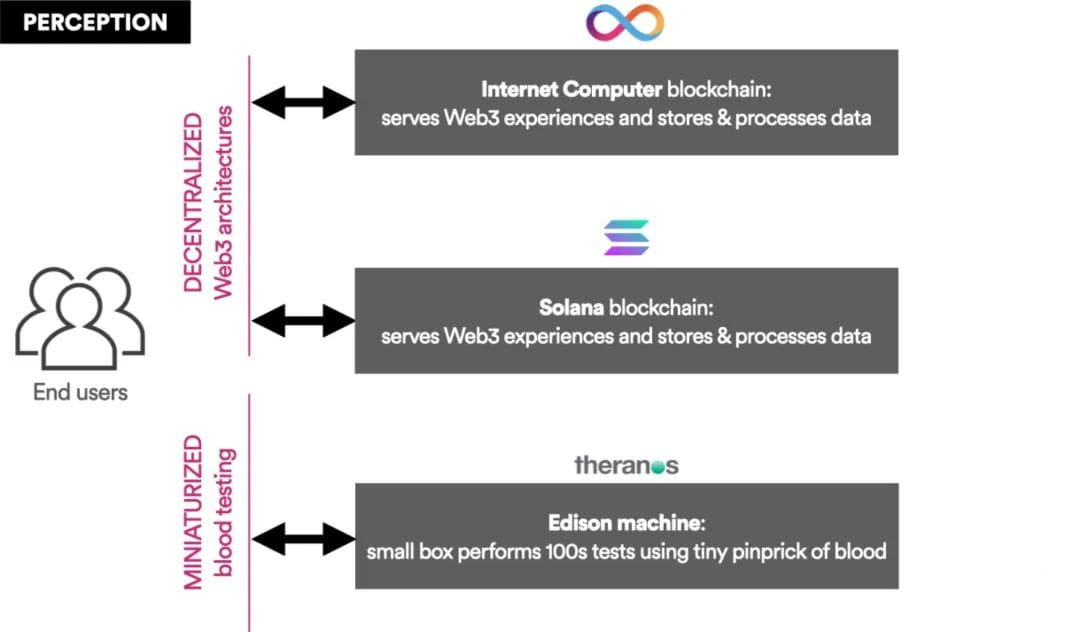
At a high level, the threat Internet computers pose to Solana can be understood with a simple survey: Survey the public interested in blockchain (including journalists and investors) when they hear about Web3 services or applications (i.e., “dapps”). ) how they feel now that they have been "built on Solana". In our experience, everyone we've looked into carefully thinks what this statement means is that the service or application is actually running entirely from the Solana blockchain, an end-to-end Web3 decentralized technology platform:
But this carefully cultivated perception is nothing like reality. Web3 services and applications "built on Solana" are actually based on enterprise cloud services such as Amazon Web services, or unsecured server machines in data centers that are running databases, web servers and other elements of traditional IT, while Solana is only used to maintain tokens and tiny fragments of information:
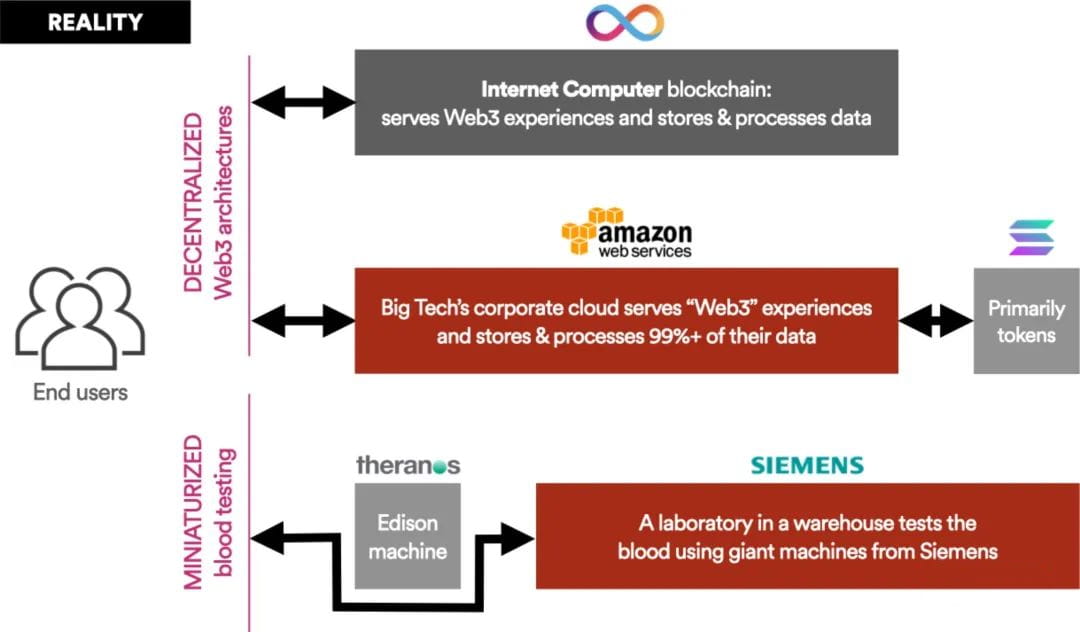
If the chart above surprises you, you're not alone. The blockchain industry operates within a giant reality-bending machine that steers people into projects that benefit hidden cartels of wealthy individuals looking to sell their tokens.
You might think that developers who claim to be "building on Solana" would see problems with this when in practice building with traditional IT, but that's not the case. They accepted the status quo because they didn't know any different, and they were brought straight from Web 2.0 into the Solana ecosystem by Solana's hype, PR and marketing, and flashy parties, which gave them the social proof they needed to keep them Feel like you're doing the right thing. Rather than revisiting alternatives or understanding the nuances of Web3 and blockchain, most people just start building on the web after receiving generous cash grants.
The people behind Solana couldn't help but feel uneasy about this huge discrepancy between perception and reality. As Internet Computer approaches its genesis, they will certainly be concerned that Internet Computer’s ability to host mass-market social media services on-chain will disrupt their rise in the blockchain market capitalization rankings.
Desire vs. Technical Reality
The vast majority of people investing in the Solana blockchain are unaware of the huge technical differences between blockchains. Most people are convinced of the potential of blockchain and Web3 and support Solana due to the success and profile of Sam Bankman-Fried. Many will argue that the technical differences between blockchains are unimportant in Web3 and cite the classic example: how in the 1970s the VHS video format used by JVC defeated the technically superior Betamax format used by Sony Corporation .
Their theory is that the capital and clout of Sam Bankman-Fried and his network could easily defeat a superior technology in the short to medium term, while buying time to bring their own technology up to par.
However, comparing the differences between Internet computers and Solana to the differences in videotape formats is of limited value.
Internet computers have completely different technical capabilities compared to Solana, which can be said to be crucial to realizing the Web3 revolution, as they allow Web3 services to run 100% on-chain under the control of the community DAO. For example, smart contracts hosted on computers on the Internet can handle HTTP requests and provide interactive web experiences directly to users without the need for cloud computing.
Even where technical capabilities are comparable, Solana's numbers are terrible. For example, to store 1GB of data, Solana charges a rental fee of 3,480 SOL/year, which is equivalent to $348,000/year (if 1 SOL token costs $100). By comparison, the annual cost of storing 1GB of data on an Internet computer has stabilized at around $5, and is paid in "cycles."
The developer community of Internet Computing has begun to take advantage of this lower cost to build Web3 social media services that run 100% from the blockchain. This is completely impossible in Solana. The project's founder, Dominic Williams, recently claimed in a video that storing the equivalent of a "mobile phone photo" on its network costs 1.6 cents, but would cost thousands of dollars (in U.S. dollars) on Solana. This directly contradicts one of Solana’s key claims that it is the most efficient and low-cost blockchain.
There is a Web3 messaging service called OpenChat that users can interact with via a web browser, running entirely from the Internet computer blockchain. The service involves smart contracts on computers on the Internet that are fast enough to process instant information and efficient enough to store media information. It can be said that this is an example of what Solana wants to do and needs support.
The service has grown thousands of users, demonstrating that Internet computers are a clear and present danger to Solana and its supporters. Investors may be hoping that Sam Bankman-Fried's billions will halt the development of Internet computers while their R&D departments close the technology gap, but things are not that simple, and key investors should be well aware of this.
Despite all the attacks on Internet computers, it has a large, organically growing community of developers who are said to be building hundreds of Web3 projects. On social media, people often focus on developer growth of Internet Computers vs. Solana. Imagine what it would be like without price manipulation.
Since Solana is already a sure winner in the Web3 competition, there is no doubt that if ICP's price manipulation incident had not occurred, Internet computers would have deeply disrupted its publicity and market position.
Evidence shows Solana is indeed a fake technology
There is a paper about Solana circulating among cryptographers and distributed computing experts. The paper basically states that Solana is falsely promoted as a blockchain that uses cryptography to provide security and validity guarantees, but in fact it is a "federated database" that relies on the operation of Solana Labs. Some claim that Solana's design is highly obfuscated for this reason.
If this argument is correct, it suggests that Internet computers pose an even greater threat to Solana at the time of GENESIS than people thought.
The paper’s backers argue that its CEO, chief scientist, and lead developer Anatoly Yakovenko lacks sufficient understanding of the advanced cryptography, distributed computational mathematics, and other theoretical computer science fields needed to build a truly high-performance blockchain. . Lacking this understanding, Solana built a distributed system more akin to a "federated database" than a blockchain, relying on Solana Labs as a controller to regularly repair and reconfigure the network's state when something goes wrong ( "data"). The paper says they are aware of the problem and decided not to share a formal description of how Solana works in order to prevent anyone from discovering the current situation.
Ironically enough, Solana's high transaction throughput relative to other blockchains (except Internet Computers) will be critical to the success of their 2021 Web3 rollout - but that might just be because the network isn't a real blockchain .
Ongoing network outages. As Solana Labs attempts to act as a trusted intermediary to resolve network state inconsistencies, these outages often last for a long time, such as the 48-hour outage in February 2022 and multiple previous outages. As of this writing, the last time the Solana network was down was on June 1.
Refuse to share protocol mathematics. Open networks and network technologies rely on publicly specified protocols and standards. This is because their safety relies on the mathematics involved, which must be openly open to scrutiny, otherwise experts have no way of verifying whether they are safe. For example, every aspect of the HTTPS protocol and related technologies is shared publicly.
Signs of a severe lack of expertise. In the early days of the Solana project, there were no scientists and cryptographers involved in various aspects of blockchain design such as cryptography, distributed systems, and execution environments (unless they kept this secret, but we have no evidence). Its chief architect, Anatoly Yakovenko, has often stated that he believes cryptography and the orthodox computer science and mathematics upon which blockchain protocols rely are overrated.
Did Anatoly, drawing inferences from his previous work, mistakenly believe that cryptography and blockchain protocol design do not require the formal mathematics typically shared in paper form? We discovered that Dominic Williams, the founder of the Internet Computer Project, had followed a since-deleted post on Reddit in which Anatoly made an assertion that Solana couldn't be true, indicating his foundation in the field. Don't know anything about mathematics.
Solana’s white paper is a hoax, describing a cryptographic scheme called “Proof of History.” Solana’s team is promoting the solution as a revolutionary and creative step to explain its blockchain’s high transaction throughput. This paper looks strange. We discovered an article shared by Victor Shoup on Twitter that provides an in-depth analysis of the historical proof. He is a world-renowned computer scientist working at the Dfinity Foundation, specializing in cryptography and distributed computing. This seems to officially indicate that it is completely false. If Victor is correct (he doesn't seem to be the type to lie, as he has a reputation built over decades to uphold), history proves it to be pure deception.
Summary of Competitive Threats
The above chapters clearly demonstrate that Internet computers could pose a devastating threat to the promotion of Solana. If the content of the Internet Archive's "Way Back Machine" is to be believed, the Internet Computer is a very technical, real-life encryption project that dates back to 2015. In contrast, Solana doesn't even share details about its technology team.
A little digging reveals that the technological advantages of Internet Computer are so superior that it is pursuing a more ambitious vision for blockchain and the Internet as a whole. Despite all the attacks and lack of big money backing, the growth of its developer ecosystem shows that the network has real product/market fit.
Without the market manipulation on May 10, 2021, and the devastating attacks triggered by the price drop that framed Internet Computer as a dishonest project, Internet Computer would almost certainly have deeply disrupted Solana in the 2021 bull run As the core proposition of Web3 in the future. Supporters of the Solana ecosystem benefit greatly from this.
Urgent action must be taken
Price manipulation attacks using ICP-PERP on FTX were almost certainly carried out by cryptocurrency hedge funds or market makers who had both the motivation and the necessary technical capabilities and market capital to do so.
In this case investigation, we provide purely circumstantial evidence that Sam Bankman-Fried benefited from this attack through his position in the Solana ecosystem. We also provide circumstantial evidence that he may have the means to manipulate. Of course, that doesn't mean he carried out the attack.
It is necessary for Sam Bankman-Fried and FTX to clarify themselves by immediately sharing the ICP-PERP trading records in their possession and reveal the price manipulators who triggered the attack. Identifying the culprits will help ensure they do not strike again to cause more damage and will vindicate innocent parties.
(Author: Lao Yupi, typesetting: Catherine)
IC content you care about
Technology Progress | Project Information | Global Events

Collect and follow IC Binance Channel
Stay up to date with the latest information