


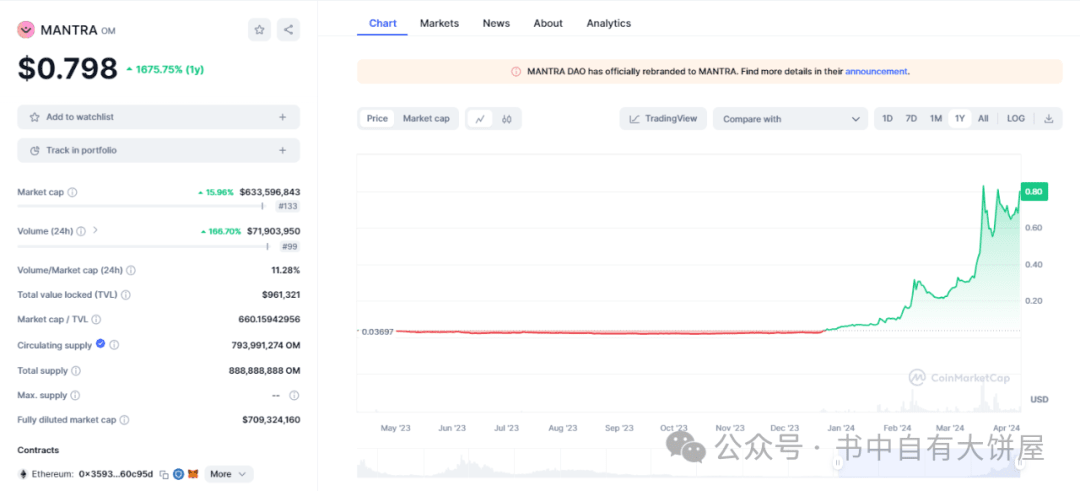
Today MANTRA continues to talk about a project that has also grown rapidly recently and has entered the top 200. It is a defi project, MANTRA. It has risen from 0.02 to 0.8 in half a year, an increase of nearly 40 times. The current market value is 600 million US dollars, and it ranks 133rd, so let’s analyze this project today.
Introduction
MANTRA is a community-managed DeFi platform focused on collateralization, lending, and cross-chain DeFi products. MANTRA has built a suite of DeFi products, including a multi-asset collateral platform, a money market lending protocol, a gaming lottery pool, and a stablecoin minting protocol. The suite is currently built on Ethereum, but cross-chain products for Binance Smart Chain, Polygon, and Polkadot will also be developed in the future.
MANTRA Chain is built on top of the Cosmos SDK, which is also working to build a protocol layer that supports various regulated activities. This includes on-chain identity, permissioned access to products, and connection to the fiat currency/banking world through in/out ports. MANTRA Chain was developed for this specific purpose: to allow Web3 applications to be built on a high-performance, scalable blockchain architecture without permission, but at the same time have a toolkit for building regulated, compliant and licensed applications.
Project Features
Compliance: Applications built on MANTRA Chain will benefit from a compliant environment to build and access regulated digital assets and build a transparent ecosystem.
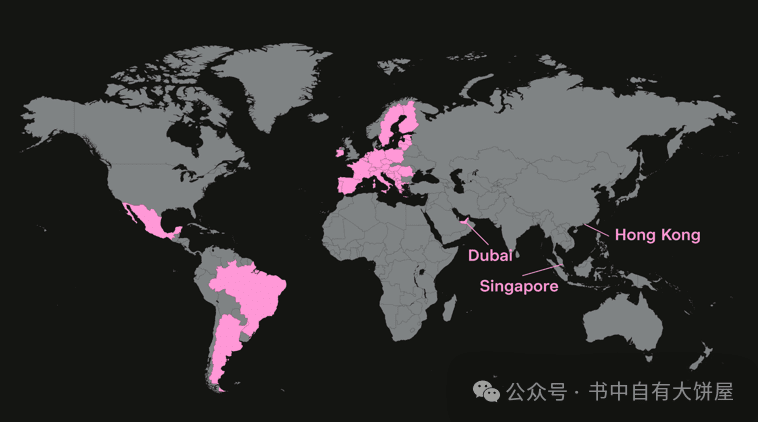
By obtaining the first financial license in the UAE, MANTRA aims to position itself at the forefront of the rapidly growing RWA industry in the Middle East and Asia. MANTRA's 2024 goal is to tokenize a diverse portfolio of assets including real estate, private market funds, private equity, art and treasuries.
Web3 Yield Engine: MANTRA Chain welcomes Web3 builders to develop on the chain and take full advantage of integration with the chain’s sustainable yield engine to attract and reward participants.
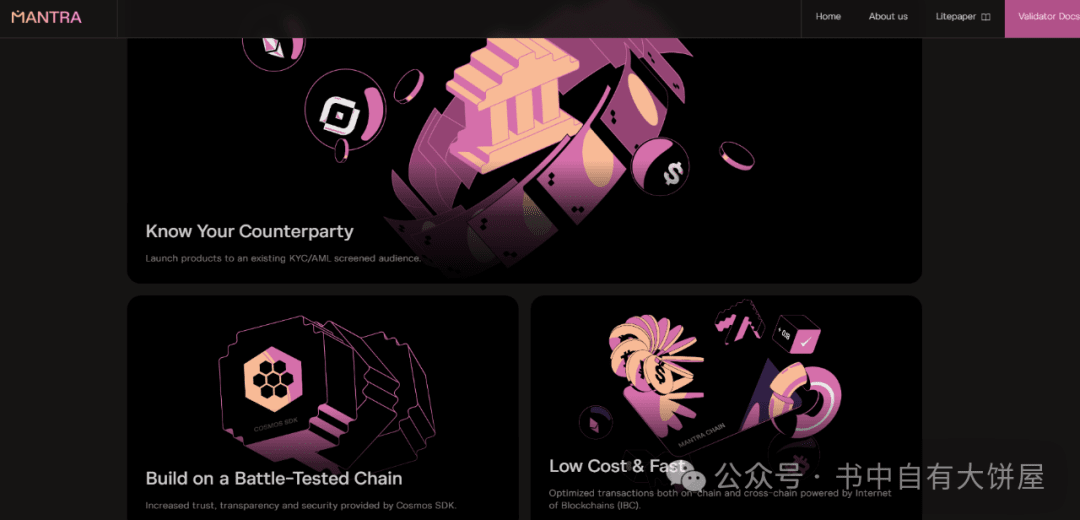
Interoperability: Tendermint is used as the consensus protocol for building the first zone on the Cosmos Hub. The hub can connect to a large number of other zones, such as MANTRA Chain, and communicate through its IBC protocol, a kind of virtual UDP or TCP for blockchains. MANTRA Chain will allow tokens to be securely transferred from one zone to another through the Cosmos Hub, without the need to use exchanges or trusted third parties between zones.
Key features and products:
1. Digitalization of real-world assets: MANTRA assets
2. Decentralized Identity (DID) / Soulbound NFT
3. Legal currency import/export
4.MANTRA Token Service SDK
5. MANTRA Compliance
6. Local DEX
7. Interoperability via Cosmos IBC
8. Revenue Engine
9. Start-up platform: capital formation platform
Characteristics of the chain
1. Main features of MANTRA compliance:
User registration: user identification and verification (KYC/KYB), enterprise verification (KYB), wallet address verification, sanctions/bad media list, AML screening, etc.
Reusable KYC: DID/Soulbound NFT
Ongoing AML checks on user profiles
User Risk Score
Transaction Monitoring: Know Your Transaction (KYT)
Decentralized Identity (DID) on the chain
As part of MANTRA Compliance, MANTRA’s on-chain decentralized identity (DID) system will provide a secure, efficient, and reusable way to verify an individual’s identity to meet regulatory KYC/AML requirements. Once a user’s identity is verified, MANTRA Compliance will issue a Soulbound NFT/ID.
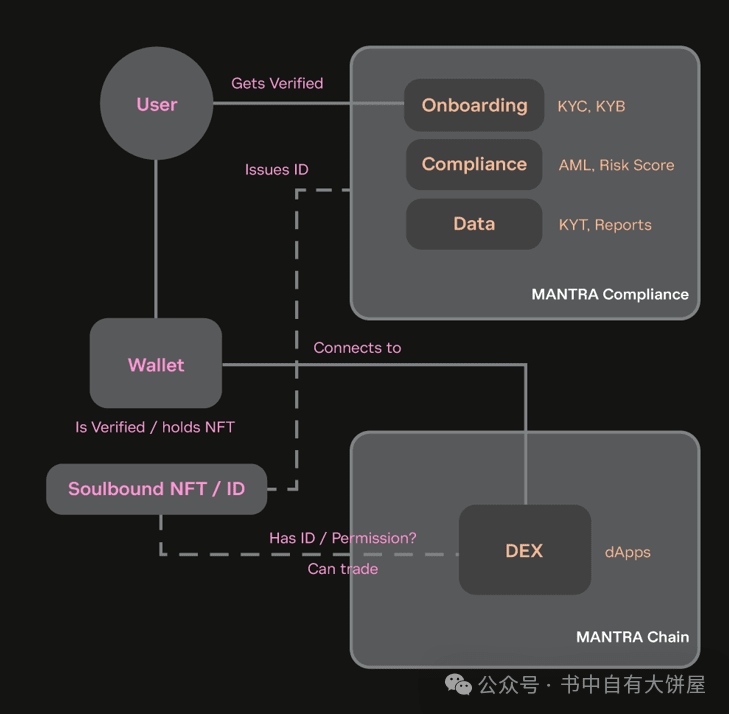
Soulbound NFT/ID is a unique, non-fungible token that is tied to a specific user's identity. The token acts as proof of the user's identity and can be used for various purposes, including KYC verification with third parties. By issuing a Soulbound NFT/ID, the platform can confirm that there are no duplications of a user's personal information and that the user's identity is only stored once. This eliminates the need for users to go through the KYC process multiple times, making the process more convenient and efficient.
Initially, MANTRA Finance and SOMA.finance will be the only DID issuers on the platform, but MANTRA anticipates adding new entities over time. To facilitate this process, MANTRA will conduct due diligence on new entities to ensure that they comply with MANTRA’s guidelines and have a good reputation in the industry.
2.MTS
MANTRA Token Service (“MTS”) is a powerful and flexible SDK (written in Golang + NodeJS) that enables Web3 businesses to create, issue, distribute and manage their own digital assets on the MANTRA network.
One of the key features of MTS is that it allows businesses to create digital assets that comply with various regulatory frameworks, such as those used for legal tender, securities, commodities or other financial instruments. This can make it easier for businesses to create and trade assets regulated in different jurisdictions.
MTS adopts a permission model, which means that only approved entities can create, manage or transfer tokens on the platform. This helps ensure responsible use of the platform and compliance with relevant laws and regulations.
Key Features:
- Create, issue and manage fungible and non-fungible assets.
- Access Control/Permissions Layer: Provides a simple role-based access control mechanism, including the ability to freeze, seize, destroy and transfer tokens.
-Configurable earnings and royalties.
- Predictable and low fees.
3.MANTRA Assets
MANTRA Assets is a simple dApp that utilizes the MANTRA Token Service SDK to allow entities to issue security tokens on MANTRA's network. The idea behind MANTRA Assets is to provide a platform that allows businesses, organizations, and individuals to easily launch security tokens and represent real-world assets such as securities or other financial instruments.
Through MANTRA Assets, entities can define the characteristics of their tokens, including the name, symbol, number of tokens to be issued, and the amount of revenue or royalties. MANTRA Assets also provides a variety of tools to help entities manage their security tokens, including tracking ownership of tokens, granting or revoking permissions, and transferring them to others. MANTRA Assets can automate certain processes, such as distributing dividends to token holders.
4.MANTRA DEX
MANTRA DEX is a DeFi hub that leverages the Cosmos ecosystem to make trading real-world assets simpler and more efficient. The platform aims to provide investors with a fast, secure, and efficient way to trade real-world assets and take advantage of growth opportunities in the TradFi and DeFi sectors.
Token Economy
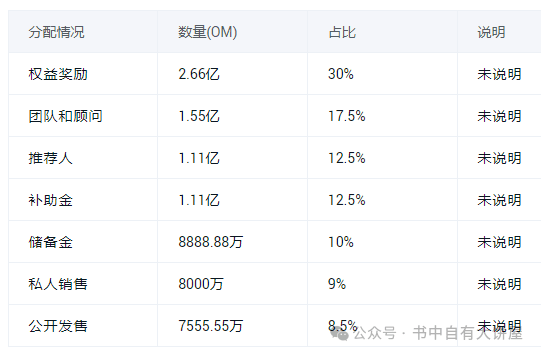
The token was first issued on 2020-08-18. The current total amount of tokens is 888,888,888, with 793,991,274 in circulation and a circulation rate of 89%. The current exchange rate is 0.8 US dollars, and the peak is $0.9439 (2024-03-19). The distribution of tokens is shown in the figure below.
Finally, let me summarize this project. This project can be regarded as a DEFI project that focuses on compliance, but the progress of the project is very slow. The project has been in progress for 4 years, and the chain has not yet produced an AMM. The 4 major products mentioned above have not been seen yet, but the roadmap says that the main network will be released in the second quarter of 24, so this wave of news may have pulled up the price of the currency. Then the project also took advantage of the popularity of RWA, saying that it has obtained a financial license from the UAE, but at least it has not been seen on the official website. But if we look at it from the other side, does DEFI really need this? Except for RWA, which is indeed needed, the others are not that important. At present, what blockchain lacks most is compliance. This has at least helped many countries to demonstrate compliance. If it is well applied on a large scale, it can actually be used in other countries such as our country. As for the strategy of tokens, we will still explain it in the planet. #热门话题 #RWA