


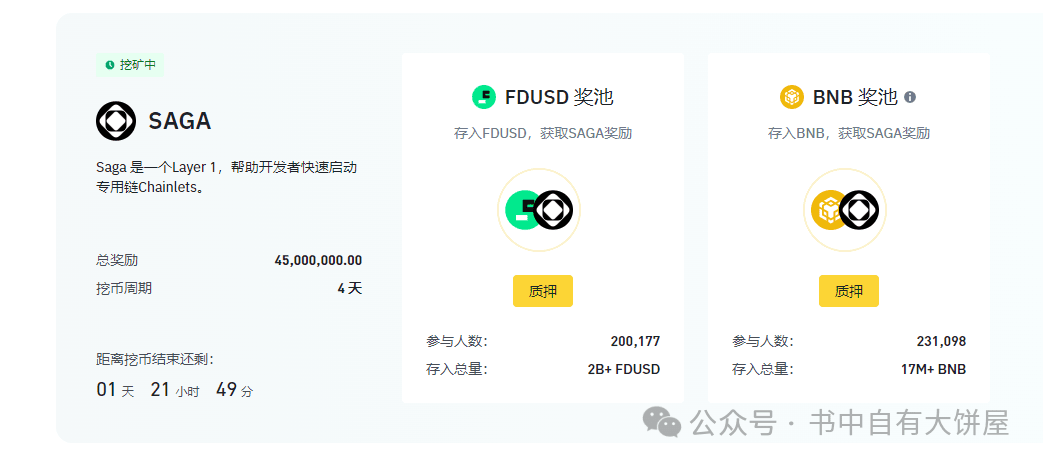
Today I will talk about Binance’s 51st launchpool project SAGA. The total mining time is currently 4 days, with a total reward pool of 45,000,000, including 36,000,000 BNB rewards and 9,000,000 FDUSD rewards. Maximum token supply: 1,000,000,000 SAGA initial circulation: 90,000,000 SAGA (9% of the maximum token supply) Total mining volume: 45,000,000 SAGA (4.5% of the maximum token supply) Then let’s take a look at the basic situation of the project and the currency price forecast.
Introduction
Saga is a Layer 1 that allows developers to develop parallel, interoperable, specialized chains — “Chainlets” — for different virtual machines, providing unlimited scalability for applications.
Saga allows developers to launch Chainlets with the click of a button through shared security, cutting-edge validator orchestration, and an automated CI/CD deployment pipeline that is standardized across any type of blockchain VM.
In less than 2 years, the Saga ecosystem has grown to 350 projects based on its protocol, 80% of which are games. Saga has also established partnerships with Polygon, Avalanche, MarbleX, Com2uS and Celestia to automatically scale its infrastructure using Chainlets.
Project Mission
Saga's mission is to enable the next 1,000 franchises in games and entertainment to be part of the growing Saga Multiverse.
Value Proposition
Mass adoption of blockchain is imminent, and developers need an infinitely scalable, interoperable, and cost-effective underlying infrastructure to support consumer applications.
Saga allows developers to launch dedicated blockspaces on demand that elastically scale based on performance needs, opens fast bridges to other ecosystems, and is priced at commodity prices. Saga provides the E2E infrastructure developers need to build the next generation of applications on the blockchain.
Current Products
The Saga protocol is a fully decentralized proof-of-stake chain. Each Chainlet is a copy of the Saga mainnet with the same validator set and security model.
Each Chainlet has the following functions:
Unlimited horizontal scalability: All Chainlets are parallelized application chain instances, allowing applications to elastically scale to their peak performance and speed.
Costless transactions and low, predictable chain fees: Developers can choose any monetization model they prefer, including their own token (or no token at all), fiat currency, stablecoins, or even another ecosystem’s token. All Chainlet fees are determined by a daily reverse auction between validators, encouraging commodity pricing of blockspace.
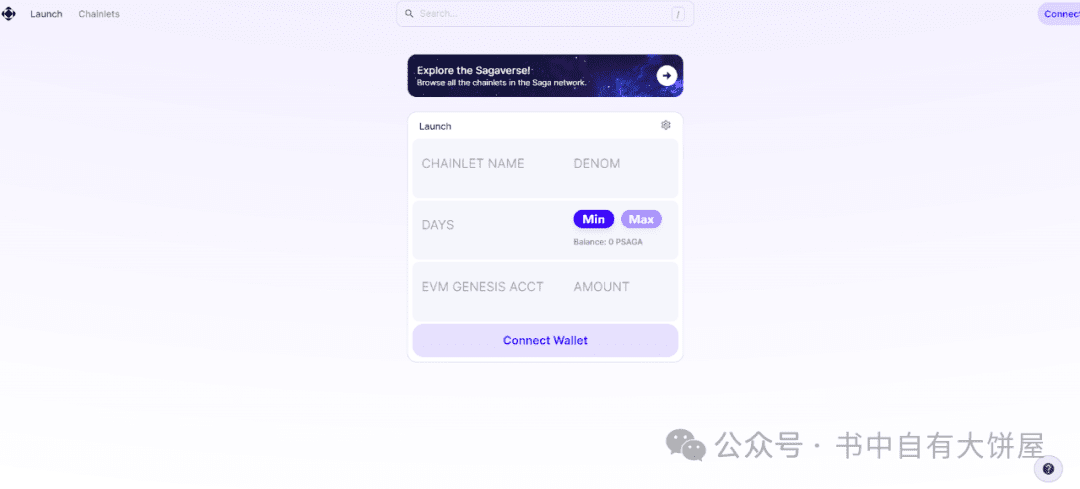
Automation: Developers can build a Chainlet by simply clicking a button in the Saga WebApp.
Interoperability and Fast Bridging: Users can freely and quickly transfer assets between Chainlets and Saga and other ecosystems using automatic interoperability and asynchronous composability. Since each Chainlet provides fast transaction finality, users can also take advantage of fast bridging to other chains.
Fully flexible stack: Developers enjoy their own dedicated chain, allowing for optimal flexibility and customizability of the environment.
Technical Features Saga Mainnet
Similar to most smart contract platforms, developers deploy compiled smart contract binaries to the Saga mainnet. Once initialized, the Saga validator will automatically create a Saga-specific chain, or chain slice, containing the smart contract.
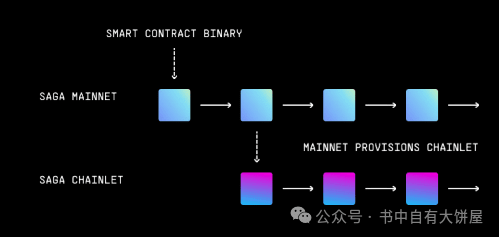
In essence, the Saga chain is a sovereign blockchain with a virtual machine module that runs a single smart contract.
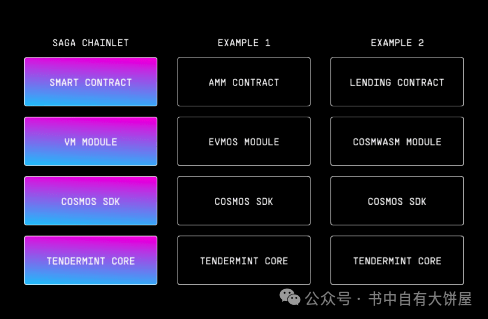
Since each shard only contains the smart contracts that a developer or team wants to deploy on a single chain, developers have a flexible and usable development environment:
- For developers, deploying a chain slice is as easy as deploying a smart contract.
- ChainShard’s block space is not shared with any other applications, so fees are predictable.
- Saga is VM-independent, which means developers can introduce their own VM modules into their chain slices.
- Chainchain components, such as virtual machine modules, SDKs, and Tendermint core, can be upgraded independently of other applications and the Saga mainnet.
- Ultimately, Saga could also support other technology stacks in addition to the Cosmos SDK and Tendermint.
Saga enables developers to manually "shard" various workflows into multiple chain shards to take advantage of horizontal scaling. Deploying Uniswap-like AMM smart contracts into their own application-specific chain shards will already lead to significant scalability improvements. However, once the needs of smart contracts begin to exceed the limitations of current blockchain technology, developers can deploy multiple instances of the same smart contract, targeting specific subsets of activities. In the AMM example, developers can deploy one smart contract instance per asset pair. The chain-slice architecture enables near-infinite scalability, as long as these chain-slices are properly secured.
Safety
One challenge of deploying a specific application chain based on Cosmos is the complexity around securing the chain. Each application chain needs to collect validators, distribute staking tokens, and design a token mechanism that helps to secure the chain. Saga leverages shared security to remove this barrier to entry. Each Saga chain shard is secured by validators on the Saga mainnet using shared security.
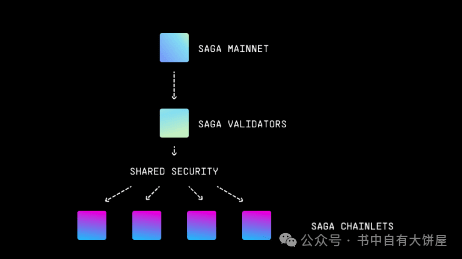
There are many different models for shared security. Saga uses a cross-chain staking model similar to Cosmos Hub version 1, called "optimistic coordination", to ensure the security of each chain.
- Every validator on the Saga mainnet must validate every shard created.
- Validators agree on the creation and maintenance of shards, such as timely deployment, guaranteed computing power, minimum running time, honest consensus participation, and cross-blockchain communication relay.
- An auditor monitors the chain and creates governance cases when validators fail to meet their service obligations.
- Saga Mainnet implements any necessary consequences for validators that violate the service level agreement.
Through optimistic coordination, shards automatically inherit the security of the Saga mainnet. However, in order to simplify the creation of shards as much as possible, Saga requires a set of tools to facilitate the orchestration of shards by validators.
Verify orchestration tools
Deploying smart contracts on Saga and servicing chain slices is intended to be a fully automated process. We can expect to run thousands of independent chain slices simultaneously. This means that Saga validators need to be able to automatically manage thousands of independent binaries and keep up with the resources required to maintain them. To facilitate this process, Saga will develop validator orchestration tools to simplify the process of placement, scheduling, release, installation, and upgrade:
- Automatically generate new binaries and server environments for each chain
- Automatically schedule binary file execution according to the chain slice subscription service level agreement
- Facilitates deployment of new chains on multiple computing resources
- Provide monitoring tools for validators to ensure sufficient resources are provided to new shards
One of the more difficult tasks for validators will be to predict the hardware needed to serve the utilization needs of all chain applications. On the one hand, having too many excess computing resources is wasteful. However, if resources are insufficient, it may lead to a reduction in holdings due to violation of the computer service level agreement. Therefore, Saga's validator orchestration tool will need to help validators predict when new hardware resources will be needed.
team
Rebecca Liao, CEO. She was most recently Co-Founder and COO of Skuchain, working alongside Zaki Manian, one of the original inventors of Cosmos. Prior to the cryptocurrency space, Rebecca was an early employee at Globality, where she served as Director of Business Development and Head of Asia Operations for a global AI supply chain solutions company. She was a Foreign Policy and Technology Policy Advisor to President Joe Biden’s 2020 Presidential Campaign and Hillary Clinton’s 2016 Presidential Campaign.
Jacob McDorman, Chief Technology Officer - Jacob is an entrepreneur, product developer, and researcher.
Jin Kwon, Chief Strategy Officer - Jin has been contributing to the Cosmos ecosystem since 2018, when he joined Tendermint as Head of the CEO Office. Most recently, Jin served as Vice President of Corporate Development as well as Managing Director of Tendermint Ventures.
Bogdan Alexandrescu, VP Engineering - Bogdan is a technologist and industry leader. He is a successful entrepreneur with prior startup experience in technology, fintech, and business consulting. He is a founding partner of Blocktech Ventures, a venture capital firm focused on cutting-edge technologies and blockchain, a member of the Bitcoin Foundation, and an active investor and advisor in the blockchain ecosystem. Prior to joining Saga, he was an engineering leader at Apple Inc, focusing on large-scale distributed computing, machine learning, artificial intelligence, and infrastructure projects.
Financing
Saga has raised $15 million to date. Investors include Placeholder, Maven11, Longhash, Samsung, Com2uS, Polygon, Merit Circle, Figment, and Chorus One.
Tonken Economy & Coin Price Forecast
The total amount of mining this time is 45,000,000 SAGA. According to the previous BNB mining income (1%~2% yield), the currency price this time is about 3-6 US dollars, and the corresponding market value is 3 billion to 6 billion US dollars. This volume is still relatively high for a public chain.
In fact, we have also talked about a sharded public chain ZIL and near before. Near is definitely not comparable to it. So if we compare it with ZIL’s current 600 million US dollars, what is the reasonable valuation of this project? Everyone think about it for themselves.
Finally, let me summarize this project. This project is actually a layer 1 built on cosmos, which can be regarded as a kind of sharding. It just gives one shard chain to one application, which is a bit like a one-bedroom apartment for applications. It is a bit similar to the C chain of Avax (the chain responsible for smart contracts). So you say how innovative it is, it is not very innovative. There are too many public chain projects on the public chain at present. Except for speed, there is no new way to play. If this project has a volume of 5 billion US dollars when it goes online, it can be said that it will not rise in the future. If it can reach about 1-2 billion, it is still a little more reliable. Of course, it depends on its later operation, but it is average overall. #热门话题 #BNB #Launchpool