

Author: SanTi Li & Nashida
1. The harm of inflation:
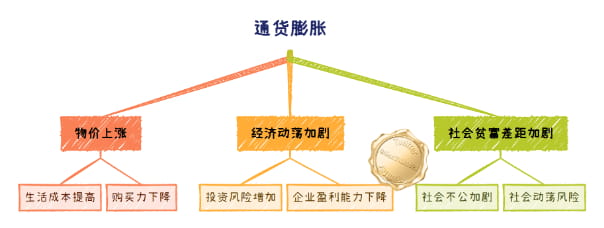
Dangers of inflation:
Rising Prices: Inflation causes prices to rise, which increases the cost of living and reduces people's purchasing power.
Economic instability: Inflation can lead to economic instability, increase investment risks, and may cause a decline in corporate profits.
Widening gap between the rich and the poor in society: Inflation may widen the gap between the rich and the poor in society, leading to social injustice and social unrest.
Second, the harm of deflation:
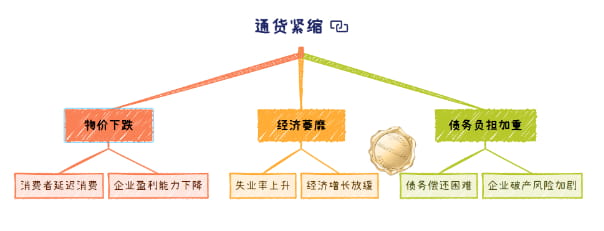
The dangers of deflation:
Falling prices: Deflation causes prices to fall, which may cause consumers to delay spending and companies to lose profits.
Economic contraction: Deflation may cause the economy to shrink, unemployment to rise, and economic growth to slow.
Increased debt burden: Deflation may lead to increased debt burden, difficulty in debt repayment and increased risk of bankruptcy.
If the debt ceiling is continuously raised and new debt is continuously issued, it will intensify and stimulate the inflation crisis. Continuous interest rate hikes will cause interest rates to continue to rise, which will trigger deflation and debt defaults, especially the simultaneous emergence of bank and government debt risks.
3. How to solve the vicious cycle of inflation and debt crisis at the same time?
● Gradually adjust the debt ceiling: Since the debt ceiling set by the United States is not particularly large, there is still room for gradual adjustment. If the debt ceiling is suddenly raised significantly, it may further increase international market concerns about the US fiscal situation, thereby exacerbating inflation concerns. Therefore, the United States may need to gradually and steadily raise the debt ceiling to avoid market panic.
● Debt restructuring: extending the term of debt, reducing the interest rate of debt, paying off old debt with new debt (refinancing, this method can temporarily delay the crisis but cannot solve it), partial debt relief, debt reset, debt-for-equity swap, etc. Although debt restructuring can help reduce debt quickly, it often occurs at a relatively critical time, especially when it involves national debt, which will also involve national credibility and market risks.
Therefore, this method often occurs before and after a crisis, such as: ★ When debt default/excessive debt burden/economic crisis/reform occurs, national income declines, and debt restructuring is used to ease economic pressure and release new space.
● Moderate monetary policy: The central bank can control inflation by adjusting interest rates and money supply. The Fed needs to find a balance between controlling inflation and avoiding an overcooling of the economy. This may mean a moderate rate hike, which increases borrowing costs, thereby reducing money supply and curbing inflation. However, the speed and magnitude of the rate hike need to be carefully controlled at this moment to avoid triggering market panic and debt defaults. The current economic environment is completely different from that in 2022, and it is not an exaggeration to describe it as treading on thin ice.
● Fiscal policy: The United States may need to make some fiscal policy reforms, including the government cutting unnecessary spending, reforming the tax system, increasing taxes, and finding new sources of revenue (it is uncertain whether this includes increasing protection fees for wealthy companies in the gray industry or for certain small and medium-sized countries).
● Promote economic growth: By promoting economic growth, the government can increase tax revenue, thereby helping to reduce the debt burden. This may require a series of policies, including investment in infrastructure, improving education and skills training, and promoting scientific and technological innovation.
● Structural reforms: The government can improve the productivity and competitiveness of the economy by carrying out structural reforms, thereby increasing the economy’s growth potential and helping to resolve debt problems.
● International cooperation: In today’s globalized world, inflation and debt problems often require international cooperation to solve. For example, countries can seek help from international financial institutions such as the International Monetary Fund (IMF) and the World Bank, or stimulate economic growth through international trade and investment. As a major country with a say in the world economy, the United States can cooperate with other countries and international financial institutions to jointly deal with and digest and share the inflation and debt crisis.
● Social security system: The government can protect the most vulnerable groups in society and alleviate the impact of inflation and debt problems on them by establishing and improving social security systems, such as pensions and medical insurance.
● Divert attention: Increase the promotion of the gaming industry, virtual industry, entertainment industry, digital industry and new reservoir industry, which will relatively weaken the harm caused by default risk and inflation risk, and shift thinking to areas of relative spiritual happiness and abundance.
● Shifting the point of conflict: Transforming internal conflicts into international and external conflicts. Although the latter two methods cannot solve the fundamental problem, they can relatively resolve the pressure and negative emotions. Thus lowering the threshold for solving the problem and negative emotions. (Shifting attention and conflict points can only be effective in the short term and cannot solve the long-term fundamental problem, so it can only be used as a temporary tactical means)
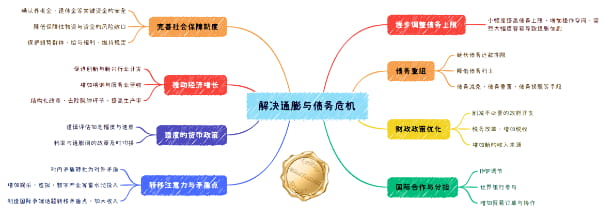
The above solutions need to be adjusted and applied according to the specific economic environment and market response. It can be seen that it is not just the United States, but all countries in the world are facing similar problems, and many of these policies and strategies actually have different effects. However, the current economic environment has reached a stage that requires the test of harmonious integration and reconciliation. Therefore, this is a great test of the wisdom and courage of policymakers, and it requires the overall market confidence and the understanding and support of all the people to complete a difficult task.
4. Summary of usage strategies:
Change: Everything is constantly changing, and we need to adapt to this change, not resist it. In the current economic issues, we need to adapt to market changes and adjust our economic policies and strategies in a timely and rapid manner to adapt to the new economic environment. This change may occur in half a year, a month, a week, or even every other day. We must adapt to changes.
Balance: Yin and Yang balance, everything and strategic strategies have two sides. We need to strive to pursue the direction that is beneficial to us. On the issue of inflation and debt crisis, we need to find a balance point, both to control inflation and to solve the debt problem. Or find the harmony or basis of deflation in the inflation area, and find the relatively stimulating area of inflation in deflation, so as to push the whole from the point to the whole, and gradually achieve equilibrium. This may require us to find a balance between monetary policy and fiscal policy.
Derivation: If a crisis is inevitable, but we cannot be sure what kind it will be, we need to analyze future economic trends and deduce adjustment strategies under different circumstances so that we can prepare in advance and avoid or mitigate the impact of economic problems.
Harmony: Harmony is the foundation of everything. When solving the problems of inflation and debt crisis, we need to seek harmony among all parties, including the government, enterprises, and the public. In this regard, the ancient Zhouyi and Chinese wisdom may benefit us a lot and help us get through this crisis. When the crisis comes, we may be able to temporarily maintain the most important relationship of mutual generation and weaken the mutually restraining links in the less important areas.
5. Trend speculation:
Mode 1:
Raise the debt ceiling, cut spending, find new revenue sources (inspection/taxation/pursuit/seizure/prosecution/new business), etc., and issue new bonds for financing.
If interest rate hikes are temporarily suspended, inflation will rebound. If interest rate hikes continue, the crisis will be unbearable, and debt pressure will continue to increase, making it difficult to maintain.
Some defaults, reputation is damaged, crisis strikes, thunder rolls, debts are restructured, and burdens are reduced.
Restart the economy, multiple stimuli, enter virtual, new expansion period, new era.
Mode 2: Directly release water, enter the era of inflation, and absorb water from new reservoirs (virtual assets, metaverse, VR, AI, etc.)
Since in mode 2 people will only experience inflation directly without any painful contrast, I personally feel that the probability is low, and I tend to speculate on the trend in mode 1.
The speculation here is completely based on my relatively limited and narrow personal views, and does not have any directional recommendations or investment guidance. I hope that everyone can have their own opinions and analyze the shock before the upcoming new era together.