

Your feedback is important
The new Developer Feedback Board has been very well received in the ICP developer community since its recent release, and the DFINITY R&D team has taken the influx of feedback seriously and has already completed 18 smaller requests, including WASM optimizations, compression improvements, and syntax highlighting in VS Code.
Bigger requests, such as increasing WASM limits, introducing an in-network system to manage Cycles, and implementing a systemic solution for the is_controller guard, are at the highest priority list with clear action plans.
The design of the Cycles ledger is already underway, with work already underway to increase the WASM limit from 2MB to 100MB, and Motoko and Rust’s is_controller guards nearing completion.
We want to continue improving the developer experience, so please keep providing feedback on the Developer Feedback Board or on GitHub:
dx.internetcomputer.org
Community Demo
It’s exciting to see new and interesting projects coming out of the ICP ecosystem, and this month Mora, the peer-to-peer Web3 branding tool for super creators, debuted at Global R&D.
Mora consists of many planets created by users, in each of which users can create content, store data, and install payment and subscription models. The data of all planets is completely decentralized, meaning they are on-chain and owned by those who created them.
Create your own planet on Mora:
Also new to the ecosystem is Bioniq Marketplace, an NFT marketplace targeting the Bitcoin community that hosts the Ordinals collection on an internet computer via a Bitcoin wallet that allows users to trade for Bitcoin or ckBTC.
People started logging Ordinals on the Bitcoin network in January of this year and it has gained a lot of traction since then, with the Ordinals dashboard showing nearly $180 million in volume, 350,000 transactions, and nearly 100,000 unique users at the time of this demo.
The Bioniq project aims to capitalize on this hype by making Bitcoin better using the power of the Internet Computer, which makes it a fast, cheap, and easy way to trade BTC NFTs.

Bitcoin Miami
Now that ckBTC is fully launched, it’s time to show it to the world, especially to Bitcoin users who are looking for a fast, cheap and secure way to transact with Bitcoin.
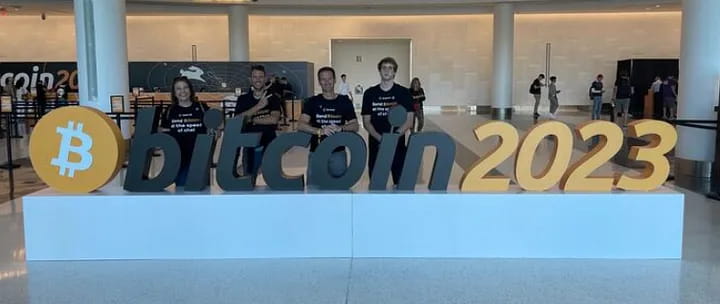
There was no better place to get the word out than at the Bitcoin Miami conference, which this year attracted some 15,000 bitcoin enthusiasts from around the world, and a small ICP team was sent to the event to promote ckBTC by giving away satoshis to those willing to create an OpenChat account.
What did we learn from guerrilla marketing campaigns? Bitcoiners are looking for scalable solutions to use their Bitcoins, and they greatly appreciate decentralization and dapps that run 100% on-chain.
The team collaborated with top crypto influencers like Bitboy and Blockchain Boy and reached a wider audience with the main message that the Internet Computer has the ability to scale Bitcoin.
ckBTC in action
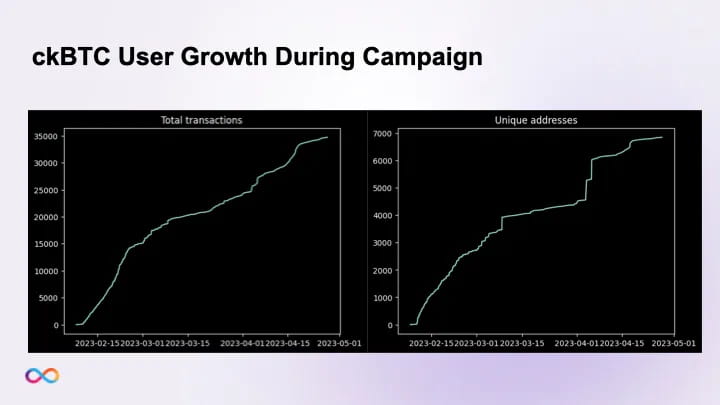
After ckBTC was launched, various projects in the ICP ecosystem put ckBTC into action by introducing interesting promotions, from trading bounties to treasure hunts and writing contests, everyone could get some ckBTC in some way.
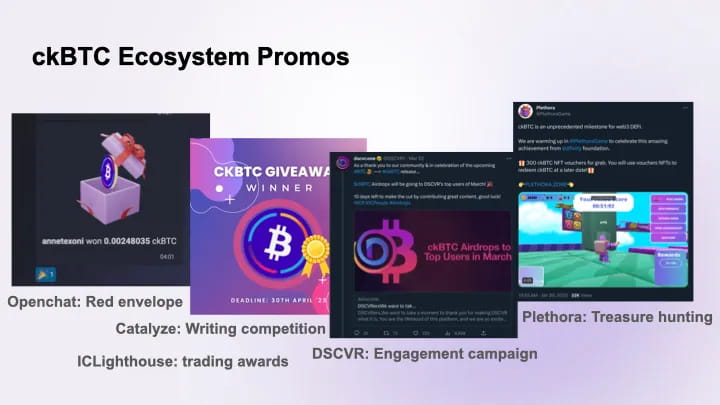
Each event helped the project prioritize feature development and drive user engagement, and overall the events were seen as successful, resulting in steady user growth, 35,000 ckBTC transactions, and airdrops to 5,000 wallets.
Some areas for improvement include projects that work harder to retain users after the promotional period, and better planning of technology releases to avoid undermining marketing efforts and momentum.
More SNS DAOs coming soon!
June is going to be a popular month for SNS releases, and three ecosystem projects are preparing to decentralize their applications before the end of the month. Which DAO would you like to be a part of?
Hot or Not: A web3 TikTok with a cool twist, where users can vote on the trending potential of short videos by rating content by selecting “hot” or “not hot.” The dapp currently has 72,000 users and a healthy roadmap that includes the release of new features such as native mobile apps for Android and iOS, location segregation of content, and GameFi elements.
Read the white paper:
vyatz-hqaaa-aaaam-qauea-cai.ic0.app/menu
Kinic: The world's first web3 search engine is ready for decentralization. This project has an ambitious roadmap that includes building a ZKML-powered search engine, adding more blockchains and decentralized storage networks (i.e. IPFS and Arweave) to the Kinic indexing process, and exploring on-chain large-scale language models for advanced web3 search queries. Kinic currently has 5,000 active users per month.
Read the white paper:
Kinic SNS DAO White Paper
EMC: The first project to bring AI to the Internet Computer, EMC positions itself as an AI-centric layer 2 using containers as ledger, consensus, and economic model. The testnet was recently launched on May 10 this year, with 100 nodes from 20 countries participating. The project has raised $600,000 in pre-sale funds for SNS, held 4 AMAs on Twitter and attracted more than 42,000 listeners. After releasing SNS, the project team has a roadmap to launch ecosystem rewards, a computing power market, and a dapp store centered on AI applications.
Read the white paper:
whitepaper.edgematrix.pro/en/emc-dao
Are you SNS ready?
Successfully handing over your dapp to the SNS DAO is not just a technical process of coding and submitting a proposal to NNS, it is also about credibility and ensuring the community has a clear understanding of what they are funding and supporting.
Being transparent about the token economics of the SNS DAO, providing a roadmap and documentation about the dapp’s technical architecture, and testing technical functionality are all good steps to prepare for the SNS launch.
Refer to the SNS preparation checklist for guidance:
forum.dfinity.org/t/sns-launch-checklist/19855
ETH Integration: Status Update
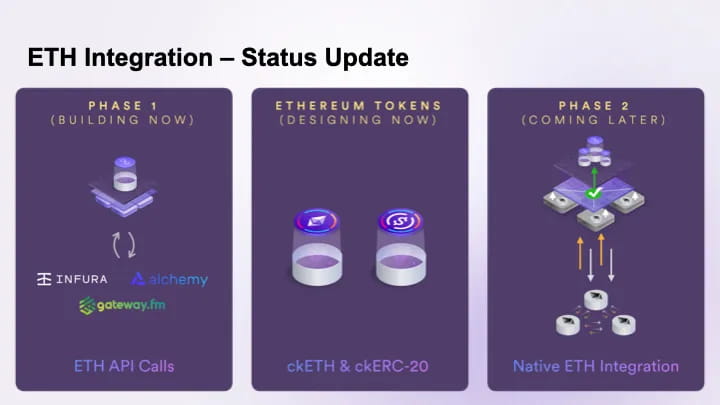
The DFINITY R&D team and ecosystem members are working to enhance Ethereum with Internet Computer features such as unlimited scaling, oracle-free Web2, web services, and low fixed costs. Phase 0 supporting chain key signatures and HTTPS outcalls has been completed.
Phase 1 is now being built to allow Web-2 based API providers to call ETH APIs via HTTPS outcalls, and this phase also includes designing and building ckETH and ckERC-20 tokens to minimize fees, guarantee long-term maintenance, and provide more security for ETH through NNS DAO governance.
Get the open source first stage code:
github.com/internet-computer-protocol/ic-eth-rpc
Finally, Phase 2 will revolve around native ETH integration, which will enable smart contracts on both networks to interact with each other and create opportunities for a wide range of use cases, such as exchanging ERC-20 tokens or trading ETH NFTs on the Internet Computer without the need for wrapped tokens.
About the project:
internetcomputer.org/ethereum-integration
We welcome your feedback
How can we make global R&D better? Give us feedback and let us know what topics you would like to see in upcoming sessions.
Global R&D Meeting Feedback Board:
jyjde-bqaaa-aaaap-abcda-cai.icp0.io
Watch the full video replay at the top of this article and register for the next Global R&D Conference:
internetcomputer.org/live-sessions
IC content you care about
Technology Progress | Project Information | Global Activities

Collect and follow IC Binance Channel
Get the latest news


