


Table of contents
executive Summary
Kinic Vision and Products
Kinic DAO launch and governance
Kinic DAO Treasury and Token Utility
Kinic DAO Token Economics
Startup allocation and mechanism
Rights and Restrictions of Token Holders
one
executive Summary
Kinic is the first and only web3 content search engine that runs on the blockchain.
Kinic is the answer to Google and other search engines that are run by centralized entities, undermine data privacy, favor established players, and ignore the emerging world of web3 content.
Currently, Kinic allows you to search all frontend containers on the Internet Computer blockchain, and Kinic’s roadmap includes adding content hosted on other blockchains and decentralized storage networks.
Kinic’s SEO module will involve unprecedented transparency powered by zero-knowledge machine learning (ZKML) technology, and all users will be able to trust that they are getting the best results determined by the Kinic algorithm and will not receive ad-based content unless that content is clearly transparent.
Kinic's vision will be achieved by decentralizing its governance using an on-chain Decentralized Autonomous Organization (DAO). The DAO will operate using IC's unique Service Nervous System. The Kinic DAO will manage and improve Kinic software services by voting on proposals.
To submit proposals and vote, KINIC token holders must lock (“stake”) their tokens into Neurons. To incentivize KINIC token holders to stake their tokens into Neurons and vote, Neurons receive voting rewards that can be converted into KINIC tokens.
The treasury controlled by Kinic DAO will hold KINIC tokens and ICP tokens. KINIC tokens can be used to pay for Kinic's current and upcoming products and services. When users purchase KINIC tokens from the DAO, Kinic DAO receives ICP as income. The ICP tokens in the DAO treasury can be used to pay fees.
Token economics refers to the initial settings and rules that drive token supply and trading. The total supply of KINIC tokens will be 6 million tokens at launch. Minting tokens will increase the total supply, while burning tokens will reduce the total supply.
KINIC tokens can only be destroyed through proposals, and a reward rate of 2.5% of the total annual supply will be minted to pay voting rewards. KINIC tokens locked in Neurons are not part of the liquid supply.
Kinic DAO will launch with a total supply of 6 million KINIC tokens, 25% will be used for public sale in exchange for ICP tokens, 50% of the tokens will be retained in the DAO’s treasury, 10% will be allocated to the Kinic Development Organization, and 10% will be allocated to seed round funders.
The maximum ICP that can be earned from selling KINIC tokens is 1.5 million ICP, with a minimum of 500,000 ICP. Based on the DAO earning 500,000 to 1.5 million ICP tokens in decentralized sales, 1 KINIC token could be worth between 0.33 and 1 ICP token.
two
Kinic Vision and Products
Summary
Kinic is the first and only web3 content search engine that runs on the blockchain;
Kinic is fully functional and runs entirely on a smart contract container located on the IC blockchain (74iy7-xqaaa-aaaaf-qagra-cai.raw.ic0.app);
Currently, Kinic allows you to search all frontend containers on the Internet Computer blockchain;
Kinic’s proposed roadmap includes adding content hosted on other blockchains and decentralized storage networks, using large language models for advanced web3 search queries;
Kinic’s development will focus on the emerging field of ZKML, where our powerful search model will not only run entirely on-chain, but can also be verified via zero-knowledge proofs.
A new vision for search
Search services have led to the Internet revolution, making nearly all human knowledge available to anyone in many forms of online content.
Google has dominated search for this content for nearly two decades, but because it is run by a centralized company, it has done so by undermining data privacy, favoring established players, and all but ignoring the emerging world of web3 content.
In 2021, the Dfinity Foundation launched the Internet Computer (IC) blockchain, which is a full-stack, decentralized alternative to traditional enterprise cloud servers. Like other public open source blockchains, IC operates on the basis of computational consensus between node computers without any central monopoly.
Likewise, IC is powered by computational units called Cycles (similar to Gas on Ethereum), which are converted from IC’s native utility token, ICP.
However, several unique features make IC arguably the most powerful blockchain in the world, and in many ways the truest embodiment of web3 to date, including:
IC smart contracts not only execute on-chain transactions, but also store content files and other forms of data entirely on-chain (52 GB per smart contract). These smart contracts are called "containers". A major benefit is that web browsers can interact directly with container smart contracts;
The IC blockchain operates at the speed of a standard network and can, in principle, be infinitely scalable by adding more nodes;
Any web browser can be used to view content stored on the IC, including websites and front-end graphics running inside the smart contract container;
Content can be posted anonymously to smart contracts using login credentials, such as IC’s Webauthn-based Internet Identity;
If a smart contract container is locked, the contents can be made immutable (i.e. non-deletable).
Therefore, IC is an end-to-end decentralized computing platform and content network, everything happens, is stored and published on the chain. For more information about IC, please refer to its official website.
Other parts of the Web3 ecosystem include decentralized content storage networks that complement the IC by specializing in long-term storage of infrequently accessed files, including the InterPlanetary File System (IPFS) and Arweave.
Content hosted on web3 requires a new vision for search, and Kinic offers a profound new vision: fully private, user-centric search built on and for web3. The name Kinic comes from the word kin, which means kinship.
Kinic is unlike any other product for the following reasons:
Runs on-chain: Kinic is the only search engine that runs entirely on-chain to benefit from the privacy, security, and immutability properties of blockchain. Unlike privacy-focused search engines such as DuckDuckGo that trust centralized companies to maintain user privacy, Kinic must operate according to the privacy-preserving protocol rules of the Internet Computer Blockchain and its anonymous login method.
Searching for content on web3: Kinic is the only search engine specifically for searching frontend content on web3, as opposed to web2-related content about web3, like Kaito.
Search all of web3: Kinic is the only search engine dedicated to searching all frontends on web3, rather than just focusing on one web3 network, like IPFS Search.
Search frontend: Kinic is the only web3 frontend search engine, in contrast to backend blockchain and NFT data explorers and indexing protocols like The Graph.
How Kinic works
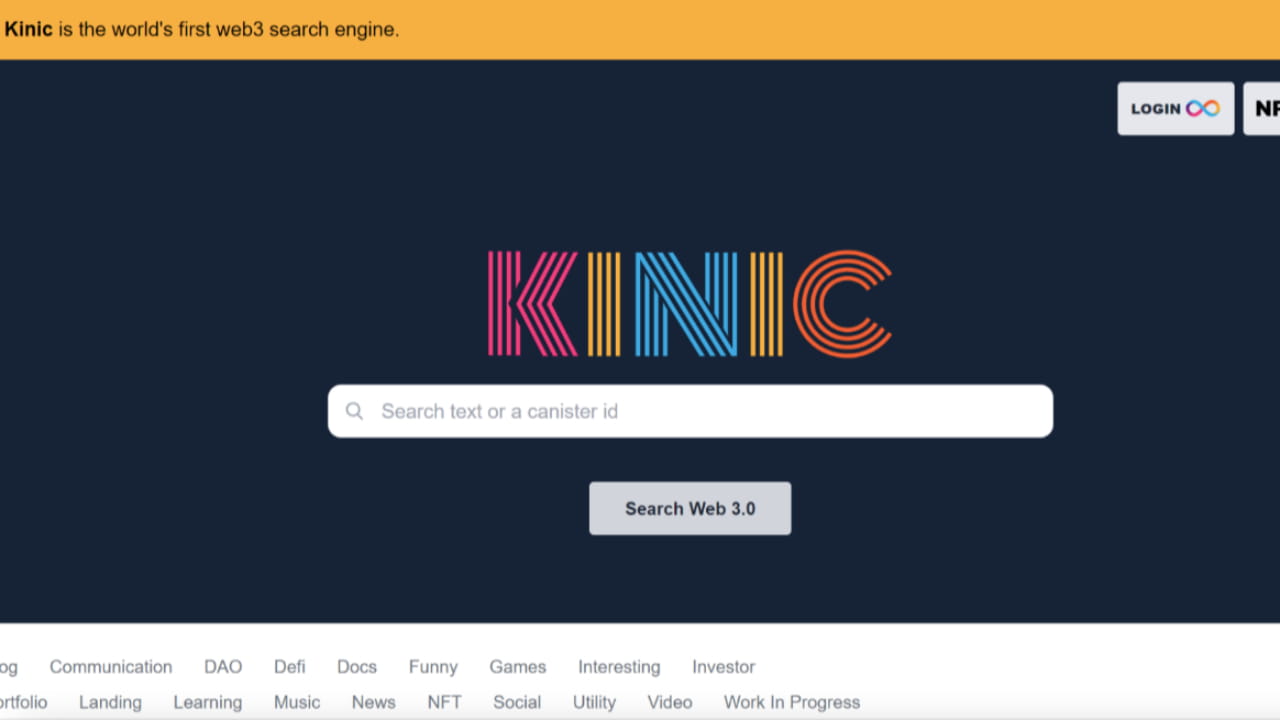
Kinic is a dedicated web3 search engine that runs entirely on the blockchain.
Kinic is fully functional, averaging thousands of unique searches per month, and it is free to use at kinic.io (pointing to this smart contract container: 74iy7-xqaaa-aaaaf-qagra-cai.raw.ic0.app).
Users can search content on IC for free without logging in. Users can also search by category. If users log in, they will be able to see the latest indexed sites. Kinic's login method is anonymous and searches cannot be associated with real-world identities.

Kinic makes frontend content hosted on-chain searchable. Currently, Kinic allows you to search all frontend containers on the Internet Computer blockchain. Other blockchains and decentralized content storage will be added, including IPFS and Aarweave. See the proposed Kinic roadmap below.
When a frontend container (i.e. website) is deployed to IC, it usually takes about 7 days to appear in Kinic search, because we re-index the subnet every 7 days, and websites that are "claimed" by their builders are ranked higher in search results. This is to distinguish claimed sites from preliminary staging sites.
Creators can claim a site through the Kinic Twitter (@kinic_app), claiming a site can also be done by comparing the container owner principal ID to what is provided to us in the DFX command.
Motoko does not have an "info" method call yet, so currently uses DFX for comparison, see here for more details:
forum.dfinity.org/t/getting-a-canisters-controller-on-chain/7531
Kinic’s search categories are taken from the keywords or h1 or h2 of the applications running on the IC, and Kinic also creates a set of common keywords based on all the texts of the applications.
Kinic sets up the indexing process using scripts that anyone can run, the frontend, auctions, and website declare the code is the container, the search database will run on CanDB, and creators can also declare sites so that they have an SEO boost to differentiate between staging and production sites.
Kinic uses IC features found in Rust source code to collect all container IDs on the IC blockchain subnet. By using additional “intelligent code,” Kinic can identify keywords for each application and application type.
We then prioritized “claimed sites” over WIP or staging sites, laying a new foundation for web3 SEO. The front-end application was built with Vue.js, and we A/B tested several variations to find a simple and stylish design.
Kinic Roadmap
The following non-binding roadmap can guide the development of Kinic applications:
API work (data analysis, social app connections, and on-site search APIs available to other web3 projects);
Support advertising sales (dispersed and targeted advertising for categories and search terms);
Automatically highlight new and interesting web3 content;
Add more chains and decentralized storage networks such as IPFS and Arweave to the Kinic indexing process;
Explore on-chain large-scale language models for advanced web3 search queries;
Improve the indexing process to create cross-chain backend and frontend syntax structures;
ZKML will be used to ensure Kinic not only has the best search and API, but also the least trustless.
three
Kinic DAO launch and governance
Summary
Kinic’s vision will be achieved by decentralizing its governance using an on-chain decentralized autonomous organization (DAO);
Kinic DAO will manage and improve Kinic software services by voting on proposals;
To submit proposals and vote, KINIC token holders must lock (“stake”) their tokens into Neurons;
To incentivize KINIC token holders to stake their tokens in Neurons and vote, Neurons receive voting rewards (ultimately redeemable for ICP tokens) every time they vote;
The larger the voting reward, the longer the tokens have been staked (the older they are), and the longer they are locked (the longer the dissolution delay);
Each neuron can only vote once for each proposal;
Neurons can vote on proposals directly or delegate their vote to another voting member.
Launching the DAO
The Internet Computer (IC) provides an on-chain governance system for token holders of decentralized autonomous organizations (DAOs). DAOs on IC exist at the protocol level of the entire blockchain and also at the level of individual applications.
At the protocol level, IC is managed on-chain by a DAO called the Network Nervous System. NNS accepts votes from locked (staked) ICP holders, and staked ICP is called Neuron. At the application level, the Service Nervous System (SNS) DAO is a means of decentralized on-chain governance.
Kinic SNS DAO will be officially launched after the smart contract container controlled by the founding team is transferred to the DAO and fully controlled. The DAO will consist of initial governance, token economics, and technical configurations. Once made public, the initial configuration is permanent until it is released. After launch, the initial configuration parameters can be changed by voting.
The creation of Kinic DAO will proceed as follows:
The Kinic Development Organization will submit a proposal to NNS containing details (parameters) regarding the decentralized sale, such as the initial token allocation, voting rules and rewards, and token economics;
If the proposal is approved by the NNS, the decentralized sale of KINIC tokens will begin;
The ICP raised in the sale will be placed into a smart contract container owned and controlled by Kinic DAO.
The sale will take place at some point in the second quarter of 2023 (April-June), and to participate in the sale during the sale, potential KINIC token purchasers must log into the NNS app (nns.ic0.app), transfer ICP to their NNS account, and then go to the Launchpad section in NNS.
In Launchpad, potential buyers should deposit ICP tokens in the Kinic sale section, and once the sale is completed, buyers will receive the same number of KINIC tokens as the ICP they deposited in the total sale amount.
For example, if the ICP they deposit is 1% of the total ICP deposited during the sale, the buyer will receive 1% of the KINIC tokens sold.
ICP received from the sale will be controlled by the ICP ledger account owned by the Kinic DAO governance container.
Once the decentralized sale is complete, the Kinic DAO is now created and running entirely on-chain, with decentralized governance.
DAO Governance
Once a Kinic DAO is launched, it will be completely controlled by its DAO, and only the DAO will be able to upgrade or otherwise change the smart contract container code and be able to transact with the Treasury.
This means that, for example, only the DAO can choose to disburse funds, change governance rules, or hire third-party developers.
① Take action by voting on proposals
Kinic DAO operates through proposals voted on by holders of KINIC tokens (i.e. KINIC neurons). Each neuron is entitled to one vote for each proposal. Proposals can be submitted by any staked neuron holder and related to any topic.
Non-binding motions can also be proposed to communicate or clarify ideas without requiring the DAO to take any specific action. Examples of non-binding proposals include proposals for roadmap developments or changes.
The following types of proposals can be made to the DAO for approval by the voting neurons:
Container Upgrade Proposals: Upgrades the container of a dapp or the container of the DAO itself. These proposals contain a container ID and a wasm module.
SNS configuration change suggestion: Change the initialization parameters of the DAO (see below).
Token Transfer Proposal: Transfer KINIC, ICP, or other IC native tokens between the DAO and external accounts.
Token Burn Proposal: Destroy KINIC tokens and reduce their total supply.
Custom feature proposal: Enable the DAO’s governance container to perform any operations on the container, such as rolling upgrades, adding new DAOs to sync proposals, and extending Kinic services to run in other containers.
A proposal is adopted when the following conditions are met: the total voting power for "Adopt" votes is greater than the "No" votes within 4 days or after a period of silence, and the "Adopt" votes account for at least 3% of the voting power, or the voting power for "Yes" or "No" votes exceeds 50%.
Neurons that voted within 4 days will still receive voting rewards even if the adoption decision has already been resolved.
② Voting rewards appear in the form of maturity
To incentivize KINIC holders to vote, voters will receive voting rewards every time they cast a vote.
To be eligible for voting rewards, KINIC holders must first stake their tokens and set the dissolution delay of the neuron to at least one month. The dissolution delay is the length of time the neuron is locked, with one year being the maximum dissolution delay.
Staked KINIC tokens (neurons) cannot be traded. To unlock staked KINIC tokens, they must be dissolved. When the dissolution delay is over, KINIC tokens can be transferred and then traded.
The longer the dissolution delay, the larger the voting reward, which helps align voting with the long-term interests of Kinic. A dissolution delay of at least one month is required to be eligible to vote on a proposal.
When a Neuron votes, the Neuron receives a voting reward in the form of maturity. Maturity is a property of the Neuron, not a tradable asset. The more Neurons vote, the more mature their Neuron becomes. Each day, a voting reward (maturity) is received based on all votes in the DAO at the end of that day.
In order to generate income from maturity, KINIC token holders must convert (pay) maturity into new KINIC tokens, a process that consumes (or “burns”) the converted maturity. By default, maturity units are converted to KINIC tokens at a 1:1 ratio.
For example, issuing a neuron with 100 maturity will be converted into 100 KINIC tokens, and these new KINIC tokens will be provided to the main account of the token holder.
As an alternative to converting maturity into KINIC tokens, voting members can also stake their maturity to receive additional voting rewards.
③ Voting rights: dissolving delay bonus and age bonus
While each neuron can only vote once per proposal, a neuron may have relatively high voting power when voting, and neurons that have staked for longer have greater voting power, which aligns incentives with long-term staking.
A longer stake time means that the neuron has a higher dissolution delay or the time the neuron has been staked (its age), and accordingly, the neuron voting power is calculated according to the following formula: number of tokens multiplied by the dissolution delay bonus multiplied by the age bonus.
The dissolution delay reward was 1x for neurons with no dissolution delay, and it increased linearly to 2x for neurons with a maximum dissolution delay of 1 year.
Age rewards are 1x for new neurons and increase linearly to 1.25x for neurons that have been staked for 6 months or more.
Thus, a neuron with a 1-year dissolution delay of at least 6 months will have 2.5 times as much voting power as a new neuron with only a 1-month dissolution delay.
④ Proxy voting
Neurons can vote directly on individual proposals using the Kinic section of the NNS application, and Neurons can also delegate their vote to another voting member.
Voting delegation is done by setting a neuron to follow another neuron, that is, to vote together with the vote of another neuron (per proposal type).
For example, a Neuron can follow a Kinic Development Organization Voting Neuron, and if the majority of the Kinic Development Organization agrees, the following Neuron will vote on the proposal.
This way, the neurons will follow the votes of the Kinic Development Organization. One benefit of neurons following the Kinic Development Organization is that the Kinic Development Organization votes on each proposal, which also enables followers to maximize the voting rewards for voting on each proposal.
If voting neurons have a large number of followers, they may effectively gain a disproportionate amount of voting power, similar to representative democracy.
Four
Kinic DAO Treasury and Token Utility
Summary
The vault controlled by the Kinic DAO will hold KINIC tokens and ICP tokens;
The DAO would be difficult to be taken over by a party that effectively stole the treasury;
KINIC tokens can be used to pay for Kinic’s current and upcoming products and services;
When users buy KINIC tokens from the DAO, Kinic DAO receives ICP as revenue, and the ICP tokens in the DAO treasury can be used to pay fees;
It is likely that DAO expenses will exceed revenue in the first few years, but it is expected that revenue will eventually exceed DAO expenses.
Kinic DAO Treasury
The vault controlled by the Kinic DAO will hold KINIC tokens and ICP tokens.
After the decentralized sale, the DAO will have an ICP ledger account containing the ICP raised in the sale, and it will also have a KINIC ledger account containing the KINIC tokens controlled by the treasury.
As discussed in further detail in the Launch Allocation and Mechanics section, the Kinic DAO will retain approximately 50% of the KINIC tokens created at launch.
To enable trading of KINIC, a proposal to transfer KINIC and ICP to a decentralized exchange liquidity pool will be made shortly after the decentralized sale. The purpose of enabling KINIC token trading is to enable people to join or exit Kinic DAO governance. The purpose is not to enable or encourage investment or speculation in KINIC tokens.
ICP tokens in the DAO treasury can be used to pay fees such as hosting, third-party services and paying developers for payment Cycles. Few people have proposed to transfer ICP from the treasury to Kinic's Cycles dispenser container, with the goal of allowing the container to pay for Cycles fees of other Kinic containers.
Kinic is an on-chain service that currently has the following off-chain dependencies:
Ownership of the domain (kinic.io) has been prepaid until May 2024, and Kinic will move to an alternative on-chain solution as soon as feasible.
A script for finding new sites and ranking them. Ranking is based on various factors such as metadata, social handles, and reputation. There are some subjective ranking values that can be determined democratically by token holders.
The likelihood of a malicious DAO takeover is low
In theory, the DAO could be taken over by a party that effectively stole the funds, for example, in a so-called 51% attack where one group controlled a majority of voting power and voted to transfer the entire treasury to themselves.
In addition to being extremely costly, the fact that the Community Fund purchased a large portion of KINIC tokens in a decentralized sale also mitigates this risk because the Community Fund acts as a single, bona fide voting block that is protected from malicious actors.
For example, even in the unlikely event that a malicious actor purchased 65% of the tokens offered in the decentralized sale and then increased the dissolution delay of all their neurons to maximum (to maximize their voting power), the chart below shows that the attacker would still only have 47.9%, which would be significantly less voting power than would be required to execute a 51% attack.

Token Utility and DAO Income and Expenses
In addition to being used for governance as mentioned above, the KINIC token also has utility as it can be used to pay for Kinic’s current and upcoming products and services.
These products and services include:
API Calls: Third parties can use KINIC tokens to purchase the ability to call the Kinic Search API.
Advertisement purchase: Buyers of ad space can pay with KINIC tokens. We use ledger containers to bid on ad categories. The highest bidder cannot withdraw their bid. Other bidders can withdraw their bids and bid again if they wish. After the auction, the highest bidder wins and gets the ad space for two weeks. The ad appears on the category page on the right. The ad can be an image, video or gif with a link.
Data Analytics: Site owners can view relevant click counts and other information, such as search terms that resolved to clicks on their URLs. Additionally, site owners can use an internal version of Kinic to perform searches within their projects.
Zero-Knowledge Machine Learning (ZKML): IC can store large amounts of data very cheaply, which makes it an ideal solution for fully on-chain data models, however, it is difficult to evaluate the output of AI models on any current platform. Kinic will use a novel approach based on zero-knowledge floating points powered by a folded ZKP scheme to make this possible, not only on IC, but also for non-IC users. This work is applicable to models beyond search, and Kinic will open access to these solutions as a service running on the KINIC token.
Early Adoption Incentives: This will be designed to increase Kinic’s market share through viral marketing strategies, which may include meme campaigns, third-party writings and videos, but are broadly defined here as growth incentives.
In some cases, purchasing products and services using KINIC tokens may burn tokens and act as a deflationary mechanism.
When users use ICP tokens to purchase KINIC tokens from the DAO, the Kinic DAO receives ICP as income, and if the Kinic DAO stakes its ICP to neurons on NNS and receives voting rewards, the Kinic DAO also receives ICP.
Kinic DAO’s expenses will come from spending ICP to purchase Cycles for hosting fees, third-party services, and the Kinic Development Organization.
It is likely that DAO expenses will exceed revenue in the first few years, but it is expected that revenue will eventually exceed DAO expenses.

five
Kinic DAO Token Economics
Summary
Token economics refers to the initial setup and rules that drive token supply and trading;
The total supply of KINIC tokens at launch will be 6 million tokens;
Minting tokens will increase the total supply, while destroying tokens will reduce the total supply. KINIC tokens can only be destroyed through proposals;
A reward rate of 2.5% of the total annual supply will be minted to pay out voting rewards;
Circulating supply refers to the total number of KINIC tokens available for trading;
KINIC tokens locked in Neurons are not part of the liquid supply;
Several factors related to voting rewards and mechanics will impact the proportion of the total number of liquid KINIC tokens.
Token economics refers to the initial settings and rules that drive token supply and trading. The goals of healthy token economics are to promote stability and long-term growth of token prices, pay DAO contributors, user growth, and promote liquidity.
The total supply of KINIC tokens will be 6 million tokens at launch, minting tokens will increase the total supply, while burning tokens will reduce the total supply, and the main mechanism of inflation is voting rewards.
Voting rewards incentivize token holders to lock them up rather than being part of the liquid supply, with a reward rate of 2.5% of the total annual supply to be minted to pay voting rewards to voting neurons.
As discussed in the Kinic DAO Launch and Governance section, these rewards are given in the form of maturity, with the DAO’s initial voting reward rate being 2.5%, which can be changed via voting.
Neuron maturity is destroyed when payment is made to provide KINIC tokens to the token holder’s primary account, at which time the DAO will mint KINIC tokens of corresponding value. The conversion of maturity into KINIC tokens is the main inflation mechanism for KINIC tokens.
Kinic DAO will launch with a total supply of 6 million KINIC tokens, 25% of which will be available for public sale in exchange for ICP tokens.
KINIC tokens can only be destroyed through proposals, and the use of KINIC will be returned to the DAO treasury, and the DAO can propose to destroy or use the tokens in other ways.
When Kinic DAO launches, the DAO’s treasury will consist of ICP from the decentralized sale and approximately half of the total supply of KINIC tokens.
The chart below shows a forecast of the total KINIC token supply over time, assuming the reward rate will remain constant at 2.5% and the burn rate will start at 0.125% until it becomes greater than the reward rate (increasing 1.37x per year).
Therefore, it is expected that more KINIC tokens will eventually be destroyed than minted.

Liquid Token Supply
Liquidity supply refers to the total number of KINIC tokens available for trading at any given time. KINIC tokens locked in Neurons are not part of the liquid supply.
However, when a Neuron dissolves, the previously locked KINIC tokens are added to the liquid supply. Longer dissolution delays prevent staked tokens from becoming liquid, so larger dissolution delays and age bonuses (which incentivize locking tokens longer) reduce the liquid supply.
Additionally, KINIC token holders who are subject to vesting restrictions cannot allocate their Neurons into KINIC tokens until the vesting period ends.
KINIC tokens held by the DAO Treasury are considered liquid, but not necessarily part of the market.
This is because only a portion of the KINIC tokens held in the DAO treasury will be given as rewards or payments to the community, and only a portion will be sold on exchanges, the same applies to KINIC tokens held in NNS purchased by the community fund.
The following parameters related to voting rewards and mechanisms affect the proportion of the total number of liquid KINIC tokens:
Maximum dissolve delay
Dissolution Delay Bonus
Minimum dissolution delay for voting
Maximum age
Maximum Age Bonus
Voting Reward Rate
Initial DAO Token Economics
The values of all initial parameters of KINIC DAO are listed in the table below, and these parameters can be changed by voting.
The purpose of these initial values is to find the right balance between incentivizing KINIC token holders to lock up their tokens and incentivizing them to buy in the first place to gain liquidity.

six
Startup allocation and mechanism
Summary
Kinic DAO will launch with a total supply of 6 million KINIC tokens, 25% of which will be available for public sale in exchange for ICP tokens.
50% of the tokens will remain in the DAO’s treasury, 10% will be distributed to the Kinic Development Organization, 10% to seed round funders, and 4% will be distributed to Kinic NFT holders via airdrops.
The maximum ICP that can be earned from selling KINIC tokens is 1.5 million ICP and the minimum is 500,000 ICP.
1 KINIC token could be worth 0.33 to 1.33 ICP tokens, based on earning 500,000 to 1.5 million ICP tokens.
Initial Token Distribution
The purpose of the decentralized sale is to decentralize the governance of Kinic DAO, which will launch with a total supply of 6 million KINIC tokens.
Of the total supply of 6 million KINIC tokens, 25% (1,500,000) will be available for public sale in exchange for ICP tokens, with the maximum ICP that can be earned from selling 1,500,000 KINICs being 1,500,000 ICP and the minimum being 500,000 ICP.
Kinic DAO’s 2 million ICP funding goal is based on comparable funding rounds:
Privacy-focused search engine DuckDuckGo has raised a total of $172 million in four rounds of funding, with its most recent round being $100 million in late 2020.
In January 2022, the Graph Foundation raised $50 million to build an indexing protocol for querying data on networks like Ethereum and IPFS.
In March 2023, Kaito raised $5.3 million to transform encrypted search through ChatGPT.
Of the 1,500,000 KINIC tokens offered as part of the public sale, Kinic will seek to sell 4.2% (250,000) to the Internet Computer Community Fund and the remaining 20.8% (1,250,000) KINIC to the broader community.
If the targeted maximum ICP is obtained in the sale, the amount of ICP obtained from the Community Fund will be 252,000 ICP.
50% (3,000,000) will remain in the DAO’s treasury, 10% will be distributed to the Kinic Development Organization and funders, and 4% (240,000) will be distributed to Kinic NFT holders via airdrops.
1% (60,000) of KINIC tokens will be used to create a liquidity pool on the exchange for trading. The tokens available for trading will be backed by ICP earned in the decentralized sale. A proposal to transfer KINIC tokens and ICP to the exchange will need to be made and approved.
The initial target KINIC token distribution is shown below (assuming the maximum ICP sales target is reached):

Decentralized sales mechanism
All parties participating in the decentralized sale will receive an amount of KINIC tokens equal to the amount of ICP they paid divided by the total amount of ICP earned in the sale.
Buyers will receive their amount of KINIC tokens in the form of 5 Neurons divided equally by the amount of staked KINIC they contain, with each of the 5 Neurons having a different dissolution delay according to the following schedule:
Neuron 1 lysis delay: 0 months
Neuron 2 lysis delay: 3 months
Neuron 3 lysis delay: 6 months
Neuron 4 Dissolution Delay: 9 Months
Neuron 5 Dissolution Delay: 12 months
Neurons with a dissolution delay of 0 months can be released immediately as liquid KINIC tokens, so in a decentralized sale, 20% of buyers’ Neurons will be immediately liquid.
Allocated to Kinic Development Organization and Seed Funders
The founding Kinic Development Organization will receive 10% (600,000) of KINIC tokens in the form of 3 neurons with a 1 month dissolution delay, with the following vesting schedule:
25% (150,000) vesting period 1 year
25% (150,000) vesting period 2 years
50% (300,000) vesting period 3 years
During the vesting period, Neurons cannot be allocated tokens or otherwise altered, and the 1 month dissolution delay reduces the relative voting power of KINIC tokens owned by the Kinic Development Organization.
Likewise, Kinic Seed round backers will receive 10% (600,000) of KINIC tokens in the form of 2 Neurons with a 1 month dissolution delay, which have the following vesting schedule:
25% (150,000) No vesting period
25% (150,000) vesting period 1 year
50% (300,000) vesting period 2 years
Distributed to Kinic NFT holders
4% of KINIC tokens (240,000) will be given to Kinic NFT holders, who will receive KINIC tokens in the form of three Neurons, which will have the same dissolution delay and vesting schedule as seed round funders.
The process of paying Kinic NFT holders requires a snapshot at 8pm JST on April 17th, at which time the owner will be recorded and set into the sns.yml file. After this point in time, any pending NFT transfers, sales, or changes in ownership will not be recorded.
Please make sure to hold your NFT at the time of the snapshot, and be aware that if you purchase a Kinic NFT after this time, it will not be included in the snapshot.
Kinic NFTs visible on Entrepot:
entrepot.app/marketplace/kinic
Allocated to DAO Treasury
Kinic DAO will initially reserve 50% of the initial supply of KINIC tokens (plus 1% of KINIC tokens for providing exchange liquidity), which will be used to incentivize developers to contribute to the growth of Kinic and its ecosystem. They can also be used for user incentivization, marketing, and other initiatives that enhance Kinic’s position as the world’s first decentralized search engine.
The initial values of the decentralized sale are summarized below:

Valuation Range and Token Price
The value of the KINIC token at launch (in ICP) depends on the number of ICP tokens raised in the decentralized sale.
The more ICP tokens that are exchanged for 1.5 million KINIC tokens, the more valuable a single KINIC token becomes, since the price of 1 KINIC is equal to the number of ICP earned (between 500,000 and 1.5 million) divided by the number of KINIC tokens sold (1.5 million).
Therefore, based on revenue of 500,000 to 1.5 million ICP tokens, 1 KINIC token could be worth 0.33 to 1 ICP token, as shown in the following chart:

Ultimately, the price of the KINIC token is influenced by a variety of factors, including total and liquidity supply, demand, DAO revenue and expenditures, and projections for the future.
Relative voting power at launch
The relative voting power at Kinic DAO launch is as follows:

seven
Rights and Restrictions of Token Holders
Any person who purchases, holds, owns or otherwise directly or indirectly controls or benefits from one or more KINIC Tokens (“Token Holder”) agrees and acknowledges the following terms and conditions:
1. The purpose of the token holders’ benefit is not for investment, trading, speculation or any other financial purpose.
2. Each token holder is a natural person acting on his or her own behalf and not on behalf of the interests of any other person.
3. Token holders are not U.S. citizens and are not located in the U.S., with the exception of the Kinic Development Organization and some seed round funders.
4. Kinic DAO, and nothing in this White Paper, is intended or should be deemed to create any partnership or joint venture between any Token Holders, or to authorize any Token Holder to make or make any commitment for or on behalf of any other party.
5. To the maximum extent permitted by law, each Token Holder absolutely and irrevocably waives any and all claims, actions, causes of action, losses, damages, and expenses, including any and all attorneys’ fees and other costs of enforcement, arising out of or related to any breach or alleged breach of any fiduciary duty by any other Token Holder or Kinic DAO, and it is the express intent of the Token Holders that each Token Holder and Kinic DAO shall be and hereby are released from any and all fiduciary duties that may apply.
6. In no event shall any Token Holder or Kinic DAO be liable to any other Token Holder for any loss of anticipated profits or other consequential, special or indirect loss or damage of any nature, whether arising under contract, tort (including negligence), strict liability or under any other cause.
7. No Token Holder shall bring any legal claim, action or proceeding against any other Token Holder for any reason.
8. No Token Holder is relying on any statement or representation made by the Founding Kinic Development Organization, Kinic DAO or any other Token Holder.
9. NEITHER TOKEN HOLDERS, THE FOUNDING KINIC DEVELOPMENT ORGANIZATION, NOR KINIC DAO MAKES ANY EXPRESS OR IMPLIED WARRANTIES AND DISCLAIMS ALL SUCH EXPRESS OR IMPLIED WARRANTIES, INCLUDING ANY WARRANTIES OF MERCHANTABILITY OR FITNESS FOR A PARTICULAR PURPOSE.
10. Token holders who fail to stake their KINIC tokens and participate in voting within a reasonable time may have their tokens repurchased by the DAO.

IC content you care about
Technology Progress | Project Information | Global Activities

Collect and follow IC Binance Channel
Get the latest news