


Brief content
Security audits provide a detailed analysis of project smart contracts. They are important to protect funds invested through them. Since all transactions on the blockchain are final, funds cannot be recovered if they are stolen. As a rule, auditors study the code of smart contracts, compile a report and provide it to the project for improvements. A final report is then issued detailing all errors and work already done to resolve performance or security issues.
Introduction
Auditing the security of smart contracts is very common in the decentralized finance (DeFi) ecosystem. If you have invested in a blockchain project, your decision may have been based in part on the results of the verification of the smart contract code.
While most people understand the importance of auditing to cybersecurity, few dive into the lines of code. Let's take a look at the methods, tools, and results commonly observed in smart contract security audits so you can make more informed decisions.

What is a smart contract audit?
A security audit checks and comments the project's smart contract code. Typically, these contracts are written in the Solidity programming language and provided via GitHub. A security audit is especially valuable for DeFi projects that expect to process millions of dollars in blockchain transactions or huge numbers of users. The audit usually takes place in four stages:
1. Smart contracts are provided to the audit team for initial analysis.
2. The audit group presents its conclusions on the project for taking measures.
3. The project team makes changes taking into account the identified problems.
4. The audit team issues its final report, taking into account any new changes or remaining errors.
For many users of cryptocurrencies, auditing smart contracts is necessary when investing in new DeFi projects. It has become the standard for projects that want to be taken seriously. Some audit service providers are also considered industry leaders, making their audits more valuable in the eyes of investors.
Why do we need an audit of smart contracts?
Because smart contracts transfer or block large sums of money, they become attractive targets for malicious attacks by hackers. Small coding mistakes can lead to the theft of huge sums of money. For example, when the DAO was hacked on the Ethereum blockchain, approximately $60 million in ETH was lost, which even led to a fork of the Ethereum network.
Since blockchain transactions are irreversible, it is very important to make sure that the project code is secure. The high security of blockchain technology makes it difficult to recover funds and solve problems after the fact, so it is better to prevent vulnerabilities at all costs.
How does the audit of smart contracts work?
The smart contract audit process is fairly standard among audit providers. Although each auditor's approach may be slightly different, the typical process is as follows:
1. Defining the scope of the audit. Smart contract and project specifications are determined by the project's purpose and overall architecture. The specification helps the audit team understand the project's goals when writing and using the code.
2. Providing an initial price depending on the amount of work required.
3. Execution of tests. Tests will vary depending on the audit team, analysis tools and methods. Both manual and automated tests are usually performed.
4. Creating the first draft of the report with the errors found and providing it to the project team for comments and further corrections.
5. Publication of the final report, taking into account all the actions taken by the team to solve the problems.
Audit methods of smart contracts
Gas efficiency
Smart contract auditing does not only focus on blockchain security. Auditors also look at efficiency and optimization. Some contracts perform a complex series of transactions to perform their intended function. Since gas fees on networks like Ethereum are relatively expensive, efficient contracts can save a lot on transaction costs.
Optimizing their performance is also an indicator of developer skills. Inefficient steps provide more points of failure and should be avoided. When the cost of gas is high, smart contracts may not execute, especially if a low gas limit is used.
Vulnerabilities of contracts
Much of the audit involves checking contracts for security vulnerabilities. While some of the problems are easy to see, many exploits involve advanced methods and strategies for extorting funds. For example, market manipulation can be used with weak smart contracts to carry out flash loan attacks. To find these problems, auditors run a hacking process and simulate malicious attacks on the smart contract. Common vulnerabilities include:
1. Re-entry issues: When a smart contract makes an external call to another external contract before any consequences are resolved. The outer contract can then recursively call the original smart contract and interact with it in a way it shouldn't because the balance of the original contract hasn't been updated yet.
2. Integer overflow and anti-overflow: When a smart contract performs an arithmetic operation, but the output exceeds the storage capacity (usually 18 decimal places). This may lead to incorrect calculation of amounts.
3. Anticipatory opportunities: Poorly structured code can provide advance warning of market buys or sells. This, in turn, may allow others to use and trade the information for their own benefit.
Disadvantages of platform security
Most audits include looking at the network where the contracts are hosted and even the API used to interact with the DApp. The project may be vulnerable to a DDoS attack or have a compromised website user interface, which means that users will actually connect their wallets to the fraudulent blockchain applications.
What is an audit report?
An audit report is provided at the end of the audit process. For the sake of transparency, projects are expected to share their reports with the community. Most reports categorize problems by severity, such as critical, serious, minor, etc. The report will also indicate the status of the issue as projects allow time to resolve it before the final report is released.
Along with a summary, a standard report will include recommendations, examples of redundant code, and a full breakdown of coding errors. The project is given time to act on the report's findings before a final version is issued.
Where can I get a smart contract audit?
A number of smart contract audit services are well known for their services. Two of these are particularly popular, and these services require up-front payment and information to receive an audit.
CertiK
CertiK is a leader in smart contract auditing. Hundreds of projects have audited their smart contracts in this service. One example is PancakeSwap, the largest automated market maker (AMM) on the BSC. Below is part of Certik's PancakeSwap audit.
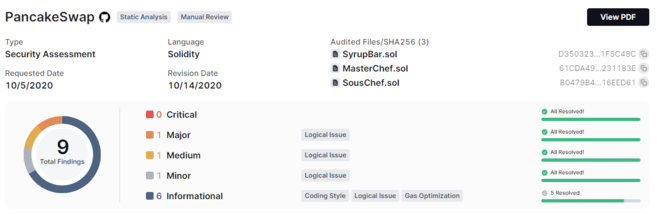
In addition, the vast majority of projects supported by Binance Labs have verified their contracts with CertiK. CertiK produces a list of verified projects, which allows you to compare each of them together with a security rating. Please note that in addition to Ethereum, CertiK also covers projects on BSC and Polygon.

ConsenSys Diligence
Led by Joseph Lubin, co-founder of Ethereum, ConsenSys is one of the cryptocurrency industry's biggest names in blockchain development. ConsenSys Diligence offers Ethereum smart contract audits. The company also provides an automated service that checks Ethereum Virtual Machine (EVM) contracts for common errors.
How much does a smart contract audit cost?
The exact cost of an audit depends on the number of smart contracts being audited. Typically, an audit will cost thousands of dollars. A large project audit can easily cost more than $10,000. The audit firm performing your audit and its reputation will also affect the amount of your fee.

Final thoughts
Fortunately for investors and users, smart contract auditing has become the gold standard. However, when it is present in every project, it is no longer just an indicator of value. This is why it is incredibly important to read the audit yourself. Even if you don't have technical knowledge, it's useful to look at the comments and the severity of potential problems.
When you come across an audit, it will at least make it easier for you to understand its content. As always, make sure you look at the whole picture and consider all the information before making any investment decision.