

TL;DR
The Ethereum Name Service (ENS) is a naming service for wallet addresses, hashes, and other types of machine-readable identifiers. This tool transforms hard-to-read data strings into readable addresses. It works in a similar way to the Domain Name System (DNS) used on websites.
Initially, ENS auctioned popular six-, five-, four- and three-letter domain names to interested users using the Vickrey auction format. Each name has the .eth suffix and can be attached to various cryptocurrency addresses, hashes, or other data and information.
It is now possible to buy names easily (without an auction) and rent them annually. Prices vary depending on the length of the name desired. Additionally, if by October 31, 2021, you owned an ENS domain, you are entitled to an airdrop of $ENS governance tokens. Redemption can be made until May 4, 2022.
Introduction
One of the biggest challenges of blockchain technology is improving its ease of use and accessibility. If we look at payments in Ethereum (ETH) or Bitcoin (BTC), new users (and even some more experienced ones) may find the long wallet addresses impractical and confusing. A computer has no difficulty with hexadecimal sequences of numbers, but reading is less intuitive for humans. The Ethereum Name Service (ENS) solves this problem and allows anyone to create simple, easy-to-remember/use addresses with a website-like format.

What is the Ethereum Name Service?
The Ethereum Name Service (ENS) is an Ethereum-based project launched on May 4, 2017, by Alex Van de Sande and Nick Johnson, members of the Ethereum Foundation. It allows users to transform long Ethereum public addresses into a simplified text format. This makes it easier to share, use and remember addresses and other data. Transforming machine-interpreted addresses, such as 0xAb5801a7D398351b8bE11C439e05C5B3259aeC9B, into human-readable alternatives is important for promoting the adoption of blockchain technology.
ENS is not limited to just wallet addresses. It can be used to represent transaction IDs, hashes, and metadata, which are information commonly found in the cryptocurrency industry. You may already be familiar with the Domain Name System (DNS), which acts as a sort of Internet phone book. DNS takes hard-to-remember IP addresses and attaches them to an easy-to-use URL like https://academy.binance.com. ENS acts as a DNS for the Ethereum blockchain.
ENS launched a governance token as part of its transition to a decentralized autonomous organization (DAO). Due to the considerable increase in the token's price, the project became trending and aroused a lot of interest.
How does the Ethereum Name Service work?
An ENS domain name uses ERC-721 Non-Fungible Tokens (NFTs) to represent a unique address. You can trade a domain by transferring or selling the NFT to someone else. Wallet addresses and other information are attached to each token, which can be managed by the owner. A top-level domain, such as .eth, is owned by a smart contract called a registrar, which controls the creation of subdomains. To create the BinanceAcademy.eth domain, you would need to interact with the .eth registrar.
To purchase an Ethereum domain name, you must check availability and rent it annually. However, popular names have already been auctioned. The user who buys the domain, with the highest bidder, can attach addresses, create subdomains and lend, rent or sell their domain name. For example, if you own BinanceAcademy.eth, you can also create learn.BinanceAcademy.eth for free.
What can you do with ENS?
If you have ever confused addresses when sending cryptocurrencies, you will understand the usefulness of ENS. In the same way you save a friend's phone number associated with their name, ENS allows users to turn long numbers into easy-to-remember words. This creates a more straightforward experience with less chance of errors.
An ENS domain owner can also create subdomains to which he or she can associate other data. This resource does not need to be used to be a wallet address. You can target the domain to a smart contract, transaction, or metadata.
How to get your own ENS domain?
Nowadays, to get an ENS name just check its availability at https://app.ens.domains/ and register it. Let's see an example of how to start this process. First, go to https://app.ens.domains/, connect your wallet and enter the domain you are interested in.

You will now see the availability of your chosen name. In our example, BinanceAcademy is available for registration.

After clicking the name, you will see instructions for registering the ENS domain. You can choose the registration period and also see the estimated fees. With Ether (ETH) in your wallet, follow the three steps indicated and request address registration.

In the early days of ENS, popular six-, five-, four- and three-letter names were auctioned through the Vickrey auction model. A smart contract ran the entire process for five days. Anyone can participate in a public auction and try to buy a domain name. In the first three days of the open auction, each interested party submits a transaction with their maximum bid.
Then the auction enters the reveal phase. Everyone must reveal their bids or lose their locked ETH balance. The highest bidder pays an amount equal to the second highest bid. All revealed bids receive a refund.
How much does an ENS domain cost?
The cost of an ENS domain is divided into two parts: auction costs and rental costs. The price of an ENS domain name at auction depends on the popularity of the name. Names like God, Car or ETH have higher prices. Typically, short three-letter words are the most expensive. Below we can see examples of some prices paid for domain names.

Once you own an ENS domain, you will need to pay an annual renewal cost, in ETH. Rates are stated in dollars but converted using an exchange rate provided by Chainlink's ETH/USD oracle. The renewal cost is $5 per year for names with five characters or more, however, the price will be higher for names with fewer characters.
How to redeem Ethereum Name Service airdrop?
Anyone with a .eth address identified during a snapshot (data collection) by October 31, 2021, is eligible to receive $ENS tokens. You can redeem them in a few simple steps. You have until May 4, 2022 to redeem your tokens before they are burned.
1. Access ENS Airdrop and connect your wallet by clicking [Connect] or [Connect wallet].

2. Select the wallet you want to connect with, such as MetaMask, WalletConnect, or another option you prefer.

3. Click [Get started] to proceed.
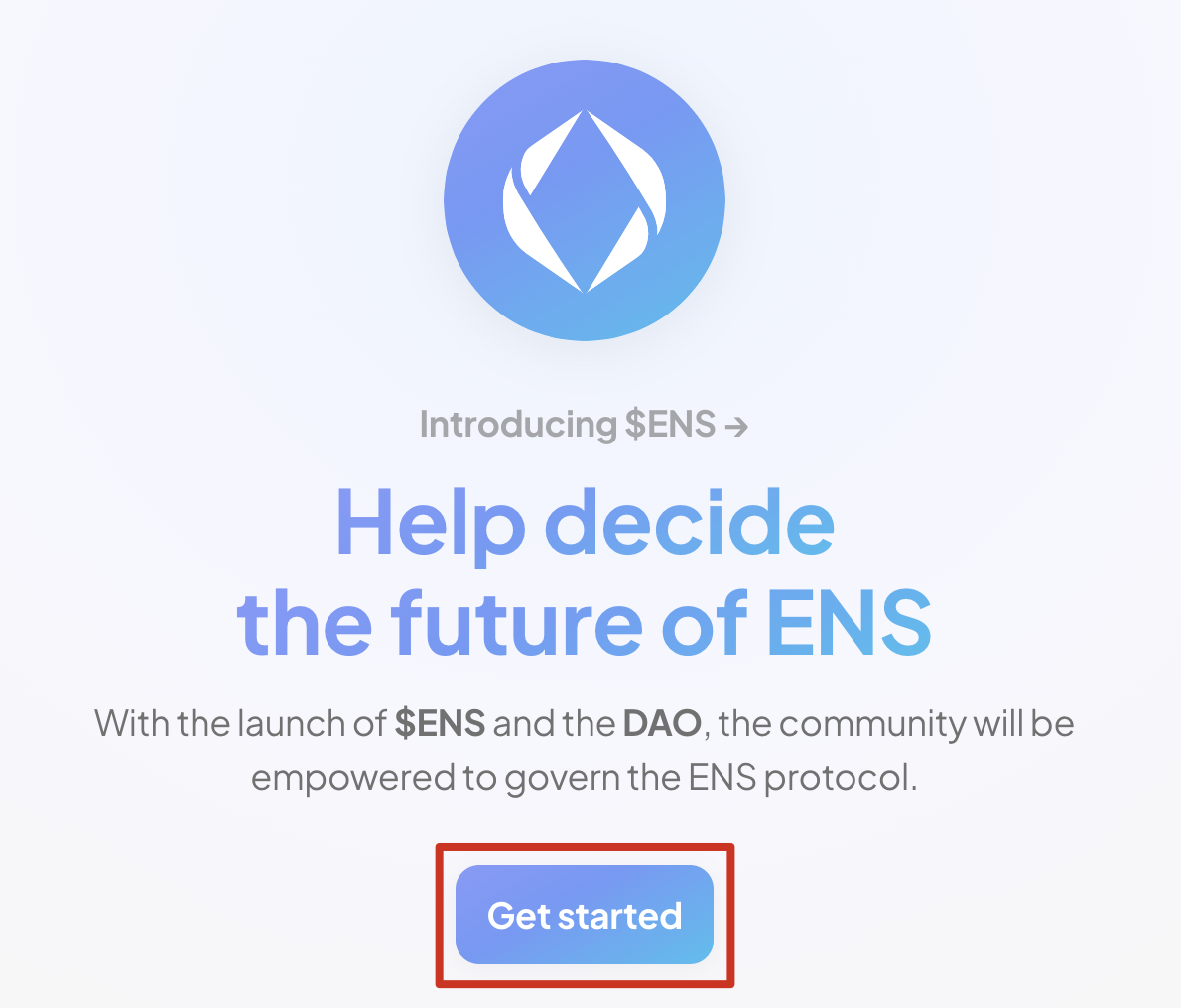
4. You will see the option [Start your claim process] and the amount available for redemption.
5. Be sure to read the educational information about $ENS and the terms of the Bylaws, which you will need to sign using your wallet.
6. Now, you can choose to delegate the voting power of your tokens to yourself or another user.
7. Before clicking [Claim], check the redemption value and delegate and pay the Gas fee to unlock your tokens.

Final considerations
In the world of decentralized networks, ENS is a huge step forward in creating easily accessible ways to interact with a blockchain. In the same way that we no longer use IP addresses to browse the web, the use of ENS names is likely to increase due to their usefulness and growing popularity. Since its airdrop, there has been a considerable increase in the cryptocurrency ecosystem's overall interest in the project.