

More SNS DAOs coming soon!
Open Chat SNS and SNS-1 are progressing well, both showing steady growth in activity around proposal submissions and token trading.
OpenChat has also introduced a new feature that allows the creation of Neuron-gated chat groups, meaning it is now possible to manage special groups that are restricted to community members who have governance rights.
Exciting developments are also happening with SNS-1, with the launch of ICPCoins the community has taken up the challenge of building something for this DAO, with the goal of the project being to build a dashboard for tracking the performance of tokens issued on the Internet Computer.

While OpenChat SNS and SNS-1 were the first SNS DAO releases, they certainly won’t be the last.
There are many more in the pipeline, with projects such as Catalyze, Hot or Not, Kontribute, Kinic, Nuance, and Sonic preparing to hand over control of their dapps to SNS DAOs.
Additionally, various dapps in the ecosystem are providing SNS Launchpad support beyond the NNS dapp: ICLighthouse is up and running, and Funded and Plug will be available soon.
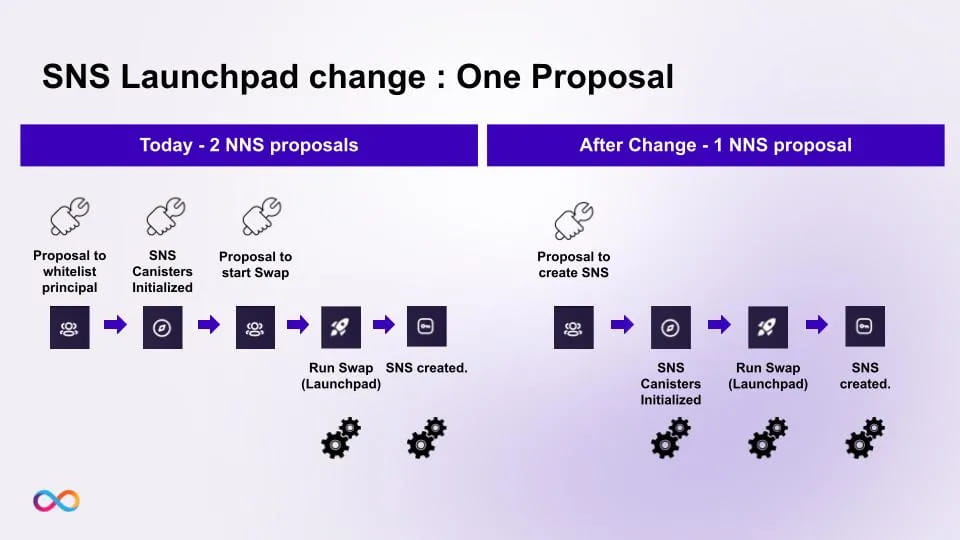
On the DFINITY side, the R&D team has been hard at work introducing new launchpad features, such as a single proposal mechanism.
This will reduce the current 3-step creation to one and greatly simplify the process for end users and developers. Another feature in the works is customizable geo-restrictions, which will allow projects to encode geo-restriction preferences into SNS proposals based on their requirements.
DFINITY has also published its SNS Voting Guidelines, which set out how the Foundation will participate in the launch of the SNS.
ckBTC in circulation
Since the full launch of ckBTC on April 3, 2023, the circulation of BTC has exceeded 1.7 million US dollars, and many dapps in the ecosystem currently support it.
Convert BTC to ckBTC and back via IC Lighthouse, ICP Swap, and DFX Command Line.
Trade ckBTC on DEXs like ICP Swap, Sonic, and ICDex, or use it to tip friends on DSCVR and OpenChat, and now you can use ckBTC to fund your favorite projects on Funded.
In addition to watching all the excitement in the community surrounding ckBTC, DFINITY also has plans to upgrade the ckBTC experience.
In the coming months, the R&D team will be working on and submitting various proposals to integrate more KYT providers, improve fee bookkeeping and the minter dashboard, streamline the BTC to ckBTC process, and introduce conversion support on the NNS frontend dapp.
A lot of work to do, but all of these improvements will definitely help boost adoption and awareness of ckBTC outside of the ICP ecosystem.

Transparent and sustainable blockchain
A key goal of the Internet Computer is to provide an energy-efficient computing platform that can be scaled around the world to build sustainable systems and services.
Thanks to a unique architecture and novel cryptography, the Internet Computer already hosts smart contract software, data, and computations at energy consumption levels comparable to traditional software running on Big Tech cloud services and orders of magnitude lower than competing blockchains.
In addition to providing green technology, a lot of work has been done over the past year to make the Internet Computer’s carbon emissions fully transparent and verifiable.
Last fall, DFINITY published a sustainability report with Carbon Crowd, and now has been accepted into Proof of Green, a collaborative initiative to develop an open-source, trustless standard for blockchain emissions measurement. The Internet Computer’s carbon footprint can now be verified and made transparent through the first real-time node energy consumption analysis tool on the newly released Carbon Crowd Dashboard.
While there is much to celebrate, the mission to decarbonize crypto continues.
Further research and collaboration are planned to enable all Internet Computer nodes to be displayed on a dashboard, optimize metrics for better computing comparisons across the industry, and clearly define scope and policy for blockchain sustainability.
Zama Collaboration
Zama and DFINITY’s research team have teamed up to explore the potential use of fully homomorphic encryption (FHE) technology on the Internet Computer. FHE, which enables computation on encrypted data, was first introduced in 1978 and has made great progress since then. This technology is very promising for achieving privacy on blockchains, especially for arbitrary computation on encrypted data.
The architecture of the Internet Computer is well suited for FHE as it already supports threshold cryptography and provides a rich execution environment that can be directly extended to allow dapps to compute on encrypted data. Possible use cases include confidential token transfers, sealed bid auctions, and privacy-preserving data mining.
Zama and DFINITY just released their first joint research paper:
CigDAO: Making Crypto Fun!
CigDAO is developing open source tools to simplify the creation of DAOs, and their “DAOBuilder” will provide the community with an easy-to-use command line to tokenize and decentralize applications on the Internet Computer.
The main purpose of the tool is to make DAOs easy to customize, deploy, and manage, and in the coming months, CigDAO plans to release various new features, including a coordinator DAO and an ETH token DAO.
Follow CigDAO on Twitter for the latest information.

Exchange Rate Canister(XRC)
The new Exchange Rate Canister (XRC) is a price oracle that fetches data from Web 2.0 servers using HTTPS outcalls and runs entirely on-chain.
The container interacts with major cryptocurrency exchanges using their public APIs to retrieve current or historical pricing information, and it also periodically queries the public APIs of global FX data providers to obtain FX rates.
This on-chain price oracle service provides functionality in a deterministic yet decentralized manner for various types of applications and for any pair of base or quote assets, whether crypto or fiat. Use cases include comparing exchange rates to market rates on a DEX and determining the value of assets managed in a container, for example, relative to fiat currencies.
Also, starting May 8, 2023, the Cycle Minting Container (CMC) will automatically extract the ICP/XDR exchange rate from the exchange rate container, which means that exchange rate updates will no longer require NNS proposals.
Since the usual 144 rate proposals (one every 10 minutes) are no longer required, voting rewards may no longer be released daily, instead rewards will be rolled over to the day a proposal is submitted to ensure voting neurons do not miss out on rewards.
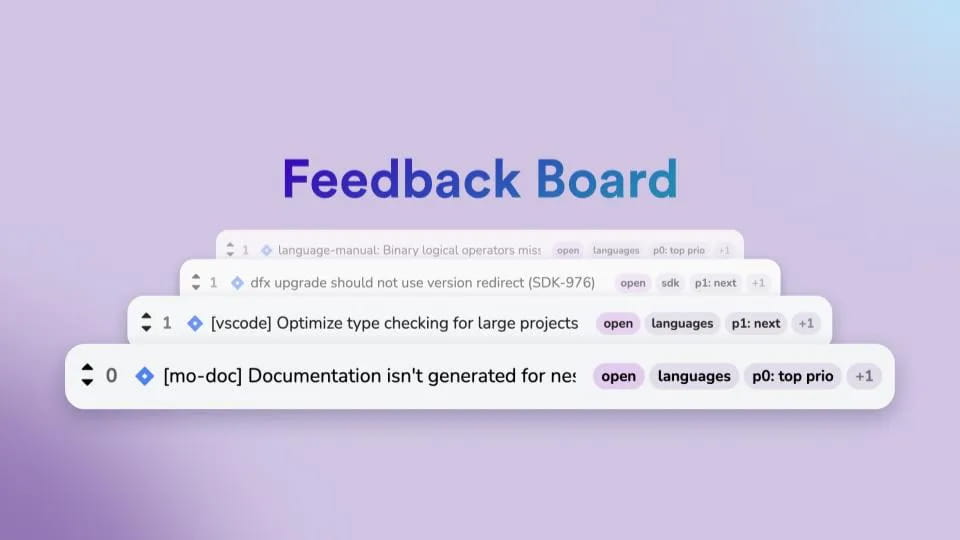
Developer Feedback Board
Got developer feedback? Please share it on the newly launched Developer Feedback Board. This new dapp hosted on the Internet Computer was launched to provide a single platform to collect feedback and requests from the ICP developer community and improve the overall developer experience.
ICP developers can use this platform to report bugs, submit feature requests, discuss developer concerns, or vote on issues. Working groups will be set up to handle and prioritize requests.
This feedback dapp is built 100% on-chain with Motoko, like it?
BUIDL Bitcoin Hackathon
Registration is now open for the Internet Computer BUIDL Bitcoin Hackathon, powered by Encode Club. The four-week global online event kicks off on May 22 and is designed to provide developers with the opportunity to learn, collaborate, and create groundbreaking projects, specifically around native Bitcoin integration.
Get more information about the track, seminars, prizes and registration here:
We hope you enjoyed this recap, and if you missed the last episode of Global Development or want to watch it again, please watch the video replay at the beginning of the article.
Register for the next Global R&D Conference:
internetcomputer.org/live-sessions
IC content you care about
Technology Progress | Project Information | Global Activities

Collect and follow IC Binance Channel
Get the latest news