


seasons
Introduction to Bitcoin
Where do bitcoins come from?
Get started with Bitcoin
Bitcoin halving
Common misconceptions about Bitcoin
Bitcoin scalability
Participation in the Bitcoin network
Chapter One - Introduction to Bitcoin
Contents
What is Bitcoin?
What is Bitcoin used for?
What makes Bitcoin valuable?
How does Bitcoin work?
What is blockchain?
Is Bitcoin legal?
Bitcoin history
Who founded Bitcoin?
Did Satoshi invent blockchain technology?
Digital money before Bitcoin
What is Bitcoin?
Bitcoin is a digital form of money. But unlike the fiat currencies you're used to, there's no central bank controlling them. Instead, Bitcoin's financial system is run by thousands of computers distributed around the world. Anyone can participate in the ecosystem by downloading open source software.
Bitcoin was the first digital currency, announced in 2008 (and launched in 2009). It provides users with the ability to send and receive digital money (Bitcoin is written with a lowercase b or so BTC). What makes it even more attractive is that it cannot be monitored money cannot be spent more than once and transactions can be made anytime and anywhere.
What is Bitcoin used for?
People use Bitcoin for many reasons. Many appreciate it due to its permissionless nature – anyone with an internet connection can send and receive it. It's a bit like cash in that no one can stop you from using it, but its digital status means it can be transferred globally.
What makes Bitcoin valuable?
Bitcoin is decentralized, censorship-proof, secure and borderless.
These features have made it attractive for use cases such as international transfers and payments where individuals do not want to reveal their identity (as they would with a debit or credit card).
Many do not spend their Bitcoins, instead, choosing to hold them for the long term (also known as hodling). Bitcoin has been called digital gold, because there is a limited number of coins available. Some investors see Bitcoin as a store of value. Because of its scarcity and difficulty in producing, it has been likened to precious metals such as gold or silver.
Long-term holders believe that these attributes – combined with global availability and high liquidity – make them the ideal way to store wealth for long periods. They believe that the value of Bitcoin will continue to increase over time.
How does Bitcoin work?
When Alice makes a transaction to Bob, she doesn't send the money the way you expect. It's not like the digital equivalent of handing him a banknote. It's like writing it down on a piece of paper (everyone can see it) that she's going to give $1 to Bob. When Bob goes to send this same money to Carol, she can see that Bob has it by looking at the paper.
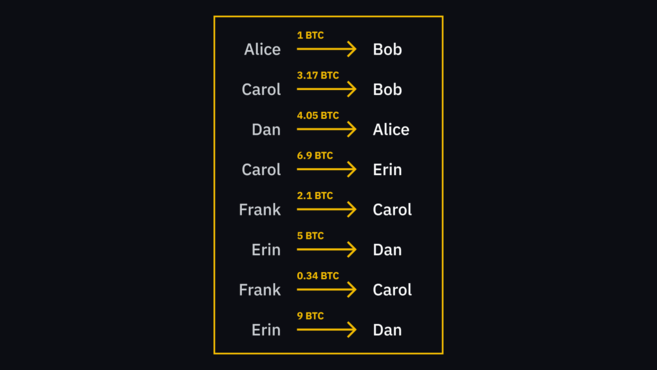
The paper is a specific type of database called a blockchain. All network participants have an identical copy of this sheet stored on their devices. Participants communicate with each other to synchronize new information.
When a user makes a payment, it streams it directly to the peer-to-peer network – there is no central bank or central institution to process the transfers. To add new information, the Bitcoin blockchain uses a special mechanism called mining. Through this process new blocks of transactions are recorded in the blockchain.
What is blockchain?
The blockchain is an append-only ledger: meaning only data can be added to it. Once information is added, it is very difficult to modify or delete it. The blockchain enforces this by including a pointer to the previous block in each subsequent block.
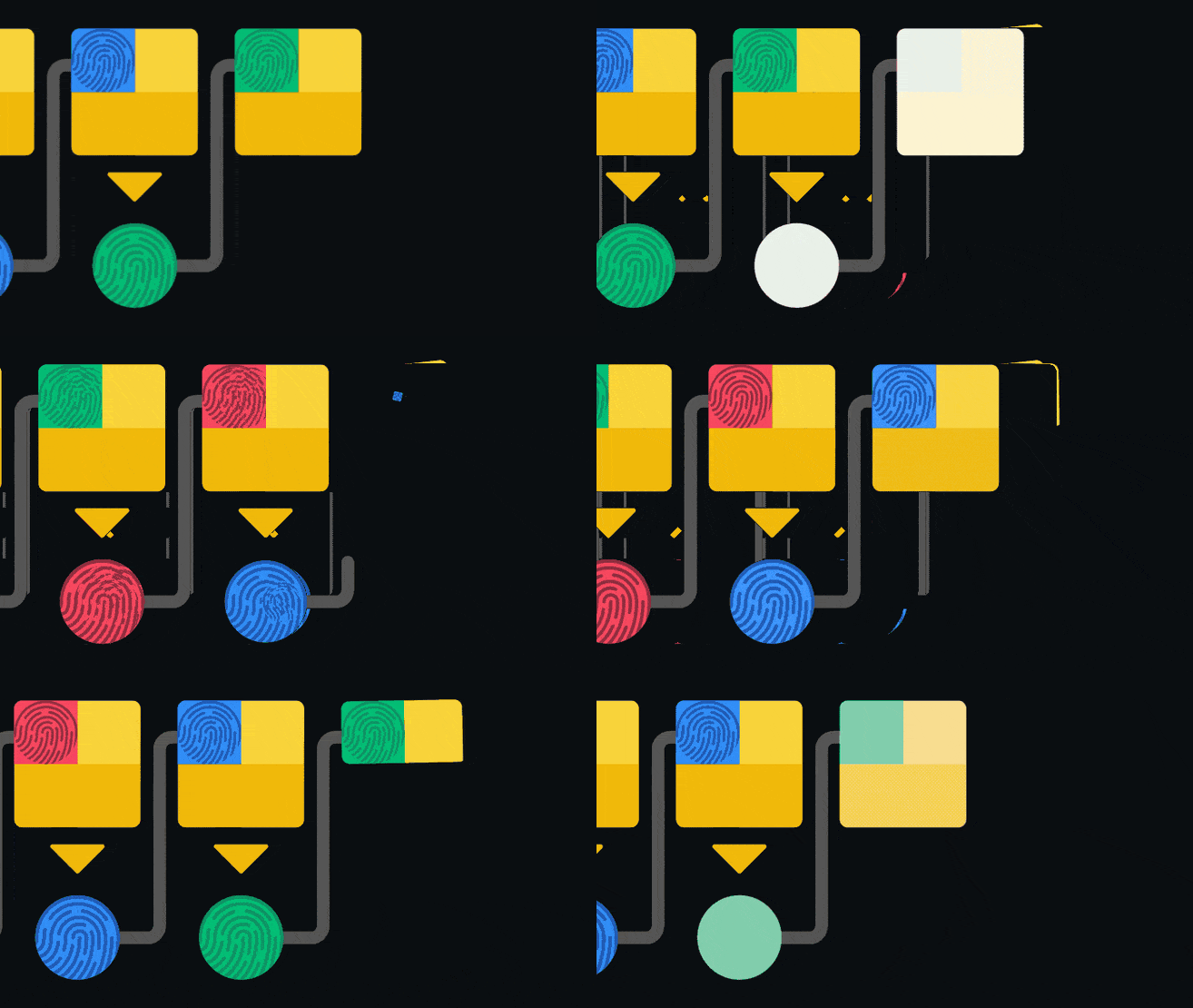
The pointer actually represents a hash of the previous block. Hashing involves passing data through a one-way function to produce a unique “fingerprint” of the input. If the input were modified slightly, a completely different fingerprint would appear. Because we chain blocks, there is no way for someone to modify an old entry without affecting subsequent blocks. A structure like this is one of the components that makes blockchain secure.
For a general introduction to blockchain, see The Ultimate Beginner's Guide to Blockchain Technology.
Is Bitcoin legal?
Bitcoin is completely legal in most countries. There are a few exceptions, however – be sure to read the laws of your jurisdiction before investing in cryptocurrency.
Countries whose legal entities have different approaches to taxation and compliance. The regulatory body is still generally lagging behind, and is likely to change significantly in the coming years.
Bitcoin history
Who founded Bitcoin?
no one knows! The creator of Bitcoin used the pseudonym Satoshi Nakamoto, but we know nothing about his identity. Satoshi can be a single person or a group of developers anywhere in the world. The name is of Japanese origin, but Satoshi's command of the English language has led many to believe that he is from an English-speaking country.
Satoshi published the Bitcoin whitepaper as well as the software. However, the mysterious founder disappeared in 2010.
Did Satoshi invent blockchain technology?
Bitcoin actually combines a number of existing technologies that have been around for some time. This concept of a chain of blocks was not born with Bitcoin. The use of immutable data structures can be traced back to the early 1990s when Stuart Haber and W.Scott Stornetta proposed a document authentication system. Like the current blockchain, it relied on encryption techniques to secure data and prevent tampering with it.
Interestingly, Satoshi's white paper did not use the term “blockchain.”
Read also: The history of blockchain.
Digital money before Bitcoin
Bitcoin was not the first attempt at digital cash, but it was certainly the most successful. Previous diagrams paved the way for Satoshi's invention:
DigiCash
DigiCash is a company founded by cryptographer and computer scientist David Chaum in the late 1980s. It was introduced as a privacy-oriented solution for online transactions based on a paper by Chaum (explained here).
The DigiCash model was a centralized system but it was nonetheless a fun experience. The company later went bankrupt, which Chaum believes was due to the model being introduced before e-commerce really took off.
B-money
B-money was initially described in a proposal by computer engineer Wei Dai published in the 1990s. It was cited in the Bitcoin white paper and it's not hard to see why.
B-money proposed a proof-of-work system (used in Bitcoin mining) and used a distributed database where users sign transactions. A second version of b-money also described an idea similar to staking which is used in other cryptocurrencies today.
Ultimately, b-money never took off because it never got past the draft stage. However, Bitcoin clearly takes inspiration from the concepts presented by Dai.
Bit gold
As similar as Bit Gold is to Bitcoin, some believe that its founder, computer scientist Nick Szabo, is Satoshi Nakamoto. At its core, Bit Gold consists of a ledger that records strings of data arising from the proof-of-work process.
Like b-money, it is not developed further. However, the similarities between Bit Gold and Bitcoin cemented its place as a “precursor to Bitcoin.”
Chapter Two - Where do Bitcoins come from?
Contents
How are new bitcoins produced?
How many bitcoins are there?
How does Bitcoin mining work?
How long does it take to mine a block?
How are new bitcoins produced?
Bitcoin has a limited supply, but not all units are in circulation yet. The only way to produce new coins is through a process called mining – the private mechanism for adding data to the blockchain.
How many bitcoins are there?
The protocol fixes the maximum supply of Bitcoin at twenty-one million coins. As of 2020, just under 90% of that number has been created but it would take more than a hundred years to produce the rest. This is due to periodic events known as halving which gradually reduce the mining reward.
How does Bitcoin mining work?
By mining, participants add blocks to the blockchain. To do this, they must devote computing power to solving the cryptographic puzzle. As an incentive, there is a reward available for anyone who suggests a valid block.
Creating a block is expensive, but cheap to check if it is valid. If someone tries to cheat with an invalid block, the network will reject it immediately, and the miner will not be able to recoup the mining costs.
The reward – often labeled as a block incentive – consists of two components: fees associated with transactions and block support. Block support is the only source of “new” bitcoins. With each block mined it adds a specific amount of coins to the total supply.
How long does it take to mine a block?
The protocol adjusts the mining difficulty so that it takes about ten minutes to find a new block. Blocks are not always found after exactly ten minutes – the time taken fluctuates around this target.
Chapter Three - Get Started with Bitcoin
Contents
How can I buy Bitcoin?
How to buy Bitcoin with debit/credit card
How to buy Bitcoin through peer-to-peer markets
What can you buy with Bitcoin?
Where can I spend Bitcoin?
What happens if I lose my bitcoins?
Can I refer to Bitcoin transactions?
Can I earn with Bitcoin?
How can I store Bitcoin?
Store your Bitcoin on Binance
Store your coins in a Bitcoin wallet
Hot wallets
Cold wallets
How can I buy Bitcoin?
How to buy Bitcoin with debit/credit card
Binance allows you to buy Bitcoin seamlessly from your browser. To do this:
Go to the Buy and Sell Cryptocurrency portal.
Choose the digital currency you want to buy and the currency you want to pay with.
Log in to Binance or create an account if you have not created one before.
Select the payment method that suits you.
If requested, enter your card information and complete the identity verification steps.
Here you are! Your Bitcoin will be credited to your Binance account.
How to buy Bitcoin through peer-to-peer markets
You can also buy and sell Bitcoin through peer-to-peer markets. This will allow you to buy coins from other users directly through the Binance app. To do that:
Open the application and log in or create an account.
Choose One Click buy sell, then the Buy box in the upper left corner of the user interface.
You will be presented with many different offers – click Buy on the one you want to choose.
You can pay with other digital currencies (By Crypto box) or with fiat currencies (By Fiat box).
Below you will be asked about your payment method. Choose what suits you.
Choose Buy BTC.
Now you have to complete the payment. When you're done, click Mark as paid and Confirm.
The transaction is completed when the selling party sends the coins to you.
Want to get started with cryptocurrencies? Buy Bitcoin on Binance!
What can you buy with Bitcoin?
There are a lot of things you can buy with Bitcoin. At this point, it may be difficult (though not impossible) to locate merchants that accept Bitcoin in physical stores. However, you will still be able to find websites that accept or allow you to purchase gift cards for other services.
For example, but not limited to, some of the things you can buy with Bitcoin are:
flight tickets
Hotel rooms
Real estate
Food & Drink
Clothing
Gift cards
Online subscriptions
Where can I spend Bitcoin?
You can cash out your Bitcoin in an increasing number of places! Let's see a few of them.
TravelbyBit
Save huge credit card fees while traveling the world! You can book flights and hotels using Bitcoin and other cryptocurrencies through TravelbyBit. Register and book via digital currencies with a 10% discount on your purchase.
He will spend
Spendabit is a search engine for products you can buy with Bitcoin. Just search for what you want to buy and get a list of merchants where you can buy what you want using Bitcoin.
Coinmap
Find all cryptocurrency merchants and ATMs around your area. If you are keen on spending your Bitcoin and are just looking for a place to spend it, this could be the perfect option for you.
Bitrefill
You can buy gift cards for hundreds of services and top up your phone using Bitcoin and other digital currencies here. It is very easy to do and you can also use the lightning network to pay.

Heat map of stores that accept cryptocurrencies as payment. Source: https://coinmap.org/
What happens if I lose my bitcoins?
Since there is no bank involved, you are responsible for keeping your coins safe. Some prefer to store it on trading platforms, while others save it in a variety of wallets. If you are using a wallet, it is important that you type in the seed phrase so you can retrieve it.
Can I reverse Bitcoin transactions after they have been made?
Once data is added to the blockchain, it is not easy to remove it (in fact, it is practically impossible). This means that when you make a transaction, it cannot be undone. You should always double and triple check that you are sending your money to the correct address.
For an example of how to theoretically reverse a transaction, see What is a 51% attack?
Can I earn with Bitcoin?
You can make money with Bitcoin, but you can also lose money with it. Typically, long-term investors buy and hold Bitcoin believing that the price will rise in the future. Others choose to actively trade Bitcoin against other cryptocurrencies for short to medium term profits. Both strategies are risky, but often more rewarding than the low-risk approach.
Some investors adopt hybrid strategies. They save bitcoins as a long-term investment while simultaneously trading (in a separate wallet) in the short term. There is no right or wrong way to allocate assets in your portfolio – every investor has a different risk appetite and different goals.
Lending is an increasingly common form of passive income. By lending your coins to someone else you can generate interest that they will pay later. Platforms like Binance Lending allow you to do this using Bitcoin and other cryptocurrencies.
How can I store Bitcoin?
There are many options for storing currencies, each with its own strengths and weaknesses.
Save your Bitcoin on Binance
A custodial solution refers to storage where the user does not physically hold the coins but trusts a third party to do so. To make transactions, they log in to the third-party platform. Trading platforms like Binance often use this model as it is more efficient for transactions.
Saving your coins on Binance allows you to easily access them for trading or lending purposes.
Save your coins in a Bitcoin wallet
Non-custodial solutions are the opposite – they put the user in control of their funds. To save money using this solution, you can use something called a wallet. The wallet does not hold your coins directly – it holds the cryptographic keys that connect you to them on the blockchain. You have two main options here:
Hot wallets
A hot wallet is software that somehow connects to the Internet. Generally, it will take the form of a mobile app or desktop app that allows you to easily send and receive currencies. A user-friendly example of a mobile wallet with a lot of supported currencies is Trust Wallet. Because they are connected to the Internet, hot wallets are usually more convenient for payments but are also more vulnerable to attack.
Cold wallets
Offline cryptocurrency wallets are known as cold wallets. They are less vulnerable to attack because there is no attack vector online but they therefore tend to provide an old-fashioned user experience. Examples include electronic wallets or paper wallets.
For a more detailed explanation of the types of wallets, be sure to review the explanation of the types of digital wallets.
Chapter Four - Bitcoin Halving
Contents
What is Bitcoin halving?
How does Bitcoin halving work?
Why does Bitcoin halving happen?
What is the effect of Bitcoin halving?
When will the next Bitcoin halving happen?
What is Bitcoin halving?
Bitcoin halving (also known as Bitcoin halving) is simply an event that reduces the block incentive. Once halving occurs, the reward for miners for installing new blocks is cut in half (they receive only half the usual). However, this does not affect the transaction fees.
How does Bitcoin halving work?
When Bitcoin was launched, miners were given 50 BTC for each valid block they found.
The first Bitcoin halving occurred on November 28, 2012. Then, the protocol reduced the block incentive from 50 BTC to 25 BTC. Then the second Bitcoin halving occurred on July 9, 2016 (from 25 BTC to 12.5 BTC). The next Bitcoin halving is expected to occur in May 2020 and will fall to 6.25 BTC.
You may notice a pattern here. A new halving occurs approximately every four years, sometimes a few months more or less than that. This is by design, but the protocol does not specify specific dates when halving will be performed. Instead, it occurs according to block height – every 210,000 blocks a halving occurs. Therefore, we can expect it to take about 2,100,000 minutes to halve the incentive (remember, a block takes about 10 minutes to be mined).

In the chart above, we can see the decline in block incentive over time and its relationship with total supply. At first, it may appear that the rewards have dropped to zero and the maximum supply is already in circulation. But this is not the case. The direction of the curves is incredibly close, but we expect support to reach zero around 2140.
Why does Bitcoin halving happen?
It's one of Bitcoin's main selling points, but Satoshi Nakamoto never explained why he considered capping the supply at twenty-one million units. Some speculate that it is just a product that starts with a block incentive equal to 50 BTC that is halved every 210,000 blocks.
Having a limited supply means that the currency is not susceptible to depreciation in the long term. It is in stark contrast to fiat money, which loses purchasing power over time as new units enter circulation.
It makes sense that there are limits on the speed at which participants can mine coins. After all, 50% had been mined at block number 210,000 (i.e. by 2012). If the subsidy had remained the same, all units would have been mined by 2016.
With the halving mechanism, there is an incentive to mine for more than 100 years. This gives the system enough time to attract users so that the graphics market can develop.
Want to get started with cryptocurrencies? Buy Bitcoin on Binance!
What is the effect of Bitcoin halving?
Those who are most affected by halving are miners. This makes sense, since the block incentive makes up a large portion of their revenue. When it is halved, they only get half of what they once did. The incentive also contains transaction fees but so far, these have only made up a fraction of the block incentive.
Therefore, halving can be unprofitable for some participants to continue mining. What this means for the broader industry is unknown. Reducing block incentives could lead to greater centralization of mining pools, or could promote more efficient mining practices.
If Bitcoin continues to rely on a proof-of-work algorithm, fees may need to rise to maintain mining profitability. This scenario is quite possible as blocks can hold many transactions. If there are a lot of pending transactions, the transactions with the highest fees will be listed first.
Historically, there has been a sharp rise in the price of Bitcoin after halving. Of course there's not a lot of data available because we've only seen two so far. Many attribute the price action to an appreciation of Bitcoin's scarcity by the market, a perception brought about by halving. Proponents of this theory believe that the value will increase significantly again after this event in May 2020.
Others disagree with this logic, arguing that the market has already taken halving into account (see the efficient market hypothesis). This event does not seem like a surprise event – participants have known for more than a decade that the incentive would decline in May 2020. Another point often raised is that the industry was extremely late during the first two halving events that occurred. Nowadays, the industry has a higher profile, provides sophisticated trading tools and is more suitable for a wider range of investors.
When will the next Bitcoin halving happen?
The next halving is expected to take place in May 2020 when the reward drops to 6.25 BTC. Watch the countdown with Binance Academy Bitcoin Halving Countdown.
Chapter 5 - Common misconceptions about Bitcoin
Contents
Is Bitcoin anonymous?
Is Bitcoin a scam?
Is Bitcoin an illusion?
Does Bitcoin use encryption?
Is Bitcoin anonymous?
Not right. Bitcoin may seem anonymous at first but that is not true. The Bitcoin blockchain is public and anyone can see transactions. Your identity is not linked to your wallet addresses on the blockchain, but any observer with the appropriate resources can potentially connect the two. It would be more accurate to describe Bitcoin as anonymous. Bitcoin addresses are viewable to everyone, but the names of their owners are not.
However, the system is relatively private and there are ways to make it more difficult for observers to know what you are doing with your bitcoins. Freely available technologies can create deniability to “break the link” between addresses. What's more, future updates may significantly enhance privacy – see Introduction to Confidential Transactions for an example.
Is Bitcoin a scam?
no. Just like fiat money Bitcoin can also be used for illegal activities. But this does not make Bitcoin a scam in itself.
Bitcoin is a digital currency that is not controlled by anyone. Critics have called it a pyramid scheme but it doesn't fit the definition. As a digital currency, it also operates at $20 per coin as well as $20,000 per coin. It is over a decade old and the technology has proven it to be very secure and reliable.
Unfortunately, Bitcoin is used in many scams that you should be aware of. These may include phishing and other social engineering schemes such as fake giveaways and free coin giveaways to multiple wallet addresses. As a rule of thumb: If something sounds too good to be true it's probably a scam . Never give your private keys or seed phrase to anyone, and be wary of schemes that offer you to double your funds with little risk on your behalf. If you send your coins to a scammer or fake giveaway they will be lost forever.
Is Bitcoin an illusion?
During the many parabolic increases in the price of Bitcoin, it was common to see people referring to it as a speculative bubble. Many economists have compared Bitcoin to periods such as the Tulip Mania or the dot-com boom.
Due to Bitcoin's unique nature as a decentralized digital commodity, its price is governed entirely by free market speculation. Therefore, while there are many factors that control the price of Bitcoin, they ultimately affect supply and demand in the market. Since Bitcoin is scarce and follows a strict issuance schedule, it is believed that long-term demand will exceed supply.
Cryptocurrency markets are also relatively small compared to traditional markets. This means that Bitcoin and other digital assets tend to be more volatile, and it is very common to see short-term market imbalances between supply and demand.
In other words, Bitcoin can be a volatile asset at times. But volatility is a part of financial markets, especially those that have relatively less size and liquidity.
Does Bitcoin use encryption?
no. This is a common misconception, the Bitcoin blockchain does not use cryptography. Every peer on the network needs to be able to read transactions to ensure they are valid. Instead, it uses digital signatures and hash functions. While some digital signature algorithms use cryptography this is not the case for Bitcoin.
However, it should be noted that many applications and digital wallets use encryption to protect users' wallets with passwords. However, these encryption methods have nothing to do with blockchain – they have only been integrated with other technologies that will benefit from them.
Chapter 6 - Bitcoin Scalability
Contents
What is scalability?
Why should Bitcoin expand?
How many transactions can Bitcoin process?
What is Lightning Network?
What are forks?
Soft prongs
Solid forks
What is scalability?
Scalability is a measure of a systems ability to grow to accommodate increasing demand. If you host a website whose capacity has been exceeded due to a large number of requests, you can change its capacity by adding more than one server. If you want to run applications that require higher operating requirements on your computer, you must update its components.
In the context of cryptocurrencies, we use the term to describe the ease with which the blockchain can be updated so that it can process a greater number of transactions.
Why should Bitcoin expand?
To work for everyday payments, Bitcoin must be fast. As it is, it has a relatively low throughput, meaning that a limited amount of transactions can be processed per block.
As you know from the previous chapter, miners receive transaction fees as part of the block incentive. Users add these fees to their transactions to incentivize miners to add their transactions to the blockchain.
Miners seek a return on their investments in hardware and electricity, so they prioritize transactions with high fees. If there are a lot of transactions in the networks’ “waiting room” (called a mempool) fees can rise dramatically as users bid to have their transactions selected. At its worst, the average fee was over $50.
How many transactions can Bitcoin process?
Based on the average number of transactions per block, Bitcoin can manage approximately five transactions per second at the moment. This is much lower than centralized payment solutions, but this is one of the taxes of a decentralized currency.
Because it is not managed by a data center that a single entity can update at will, Bitcoin must limit the size of its blocks. A new block size could be incorporated that would allow 10,000 transactions per second but it would harm decentralization in the network. Remember that full nodes need to download new information approximately every ten minutes. If it becomes too cumbersome for them to do this, their network connection will likely break down.
If the protocol is to be used for payments, Bitcoin enthusiasts believe that efficient scaling must be achieved in different ways.
What is Lightning Network?
The Lightning Network is a proposed solution for Bitcoin scaling. We call it a second layer solution because it moves transactions away from the blockchain. Instead of recording all transactions on the underlying layer they are processed by another protocol built on top of it.
The Lightning Network allows users to send money instantly and for free. There are no throughput restrictions (provided users have the ability to send and receive). To use the Bitcoin Lightning Network, participants save some coins in a private address. The address has a unique property – it only issues bitcoins if both parties agree.
From there, both parties maintain a private ledger that can redistribute the balances without announcing them on the main chain. They only publish a transaction to the blockchain when it is completed. The protocol then updates their balances accordingly. Note that they don't need to trust each other either. If someone tries to manipulate, the protocol will detect and punish them.
In total, a payment channel like this only requires two online transactions from the user – one to fund their address and one to exchange currencies later. This means that thousands of transfers can be made in the meantime. With further development and improvement, the technology could become an important component of large blockchain systems.
For a more detailed explanation of the scalability problem and its potential solutions, take a look at Blockchain Scalability – Sidechains and Payment Channels.
What are forks?
Since Bitcoin is open source anyone can modify the software. You can add new rules or remove old rules to suit different needs. But not all changes are created equal: some updates will make your node incompatible with the network, while others will be backward compatible.
Soft forks
A soft fork is a change in the rules that allows updated nodes to interact with older nodes. Let's take block size as an example. Let's say we have a block size of 2MB and half of the network commits a change – from now on all blocks should not exceed 1MB. Any mass exceeding this capacity will be rejected.
Older nodes can still receive or post these blocks. This means that all nodes remain part of the same network regardless of which version they are running on.
In the animated illustration below, we can see that smaller blocks are accepted by both old and updated nodes. However, newer nodes will not recognize 2MB blocks, because they already follow the new rules.

Bitcoin's Separate Witness (or SegWit) is an example of a soft fork. Using intelligent technology, he introduced a new format for blocks and transactions. Old nodes continue to receive blocks, but they do not validate the new transaction type.
Hard forks
The hard fork is more messy. Now let's assume that half the network wants to increase the block size from 2MB to 3MB. If you try to send a 3MB block to older nodes, the nodes reject it because the rules clearly state that 2MB is the maximum they can accept. Because the two networks are no longer in agreement, the blockchain splits into two networks.

The black chain in the picture above is the original chain. Block#2is where the hard fork occurred. Here, the updated nodes started producing larger blocks (the green ones). Older nodes do not recognize these blocks, so they continue to move in a different path. There are now two blockchains, but they share the ledger until block 2.
There are now two different protocols, each with a different currency. All balances on the old blockchain are cloned, which means that if you had 20 BTC on the original blockchain you have 20 new BTC on the new blockchain.
In 2017, Bitcoin went through a controversial hard fork in a similar scenario to the above. A minority of participants wanted to increase the block size to ensure more throughput and cheaper transaction fees. Others thought this was a poor strategy for expansion. Eventually, the hard fork created Bitcoin Cash (BCH) which broke away from the Bitcoin network and now has an independent community and roadmap.
To learn more about forks, see Hard Forks and Soft Forks.
Chapter Seven - Participation in the Bitcoin network
Contents
What is a Bitcoin node?
How does a Bitcoin node work?
Complete nodes
Light nodes
Mining contract
How to run a full Bitcoin node
How to mine Bitcoin
How long does it take to mine Bitcoin?
Who can participate in Bitcoin code?
What is a Bitcoin node?
A “Bitcoin node” is a term used to describe software that interacts with the Bitcoin network in some way. It could be anything from a mobile phone running a Bitcoin wallet to a dedicated computer that stores a complete copy of the blockchain.
There are several types of nodes, each of which performs specific functions. All of them act as a connection point to the network. Within the system, they transmit information about transactions and blocks.
How does a Bitcoin node work?
Complete nodes
A full node validates transactions and blocks if they meet certain requirements (for example, following rules). Most full nodes run the Bitcoin Core software, which is the reference implementation of the Bitcoin protocol.
Bitcoin Core is software released by Satoshi Nakamoto in 2009 – it was simply called Bitcoin at the time, but was later renamed to avoid any confusion. Other applications can also be used provided they are compatible with Bitcoin Core.
Full nodes are an integral part of Bitcoin's decentralization. They upload and verify blocks and transactions and publish them to the rest of the network. Since they independently verify the information provided to them, the user is not dependent on a third party for anything.
If a full node stores a complete copy of the blockchain it is referred to as an archive full node. Some users ignore old blocks in order to save space – Bitcoin's blockchain contains more than 200 GB of transaction data.

Global distribution of Bitcoin full nodes. Source: bitnodes.earn.com
Light nodes
Light nodes are not as capable as full nodes but they are also less resource intensive. It allows users to interact with the network without performing all the operations that a full node does.
While a full node uploads all the blocks to validate them, light nodes upload only a portion of each block (called the block header). Although the size of the block header is very small, it contains information that allows users to verify that their transactions are in a specific block.
Light nodes are ideal for devices with bandwidth or space limitations. It is common to see this type of contract used in desktop wallets and mobile wallets. Because they are unable to validate, light nodes depend on full nodes.
Mining contract
Mining nodes are full nodes that perform an additional task – producing blocks. As we touched on earlier, it requires specialized hardware and software to add data to the blockchain.
Mining nodes take pending transactions and hash them along with other information to create a number. If the number is less than the target set by the protocol then the block is valid and can be broadcast to other full nodes.
But in order to mine without relying on anyone else, miners need to run a full node. Otherwise, they won't be able to know which transactions to include in the block.
If a participant wants to mine but does not want to use a full node, he can connect to a server that will provide him with the information he needs. If you mine in a pool (that is, work with other miners) only one person needs to run a full node.
For a detailed explanation of the different types of knots, see What are knots?
How to run a full Bitcoin node
A full node can be useful to developers, merchants, and consumer users. Running the Bitcoin Core client on your own hardware gives you privacy and security benefits and strengthens the Bitcoin network overall. With a full node, you no longer depend on anyone else to interact with the ecosystem.
Some of the companies that rely on Bitcoin offer a plug-and-play contract. The built-in hardware is shipped pre-installed to the user who just needs to power it on to start downloading the blockchain. This may be more convenient for less technical users but is often much more expensive than setting it up yourself.
In most cases, an old PC or laptop will suffice. It is not recommended to run node on your computer that you use daily as it can slow it down greatly. The blockchain is constantly growing, so you will need to make sure you have enough space to load it all.
A 1TB hard drive will be enough for the next several years provided there is no significant change in the block size. Other requirements include 2 GB of RAM (most computers have more than this by default) and plenty of bandwidth.
From here, the full node running guide on bitcoin.org explains the process of setting up your node.
How to mine Bitcoin
In the early days of Bitcoin, it was possible to create new blocks with traditional laptops. The system was unknown at that point, so there was little competition in mining. Since the activity was so limited the protocol naturally specified a low mining difficulty.
As the network hashrate rose, participants needed to upgrade to better equipment to stay competitive. By moving across different types of hardware, the mining industry eventually entered what we might call the era of application-specific integrated circuits (ASICs).
As the name suggests, these devices are designed with a specific purpose in mind. It is very efficient but it is only able to perform one task. So, an ASIC miner is a specialized computer used for mining and nothing else. A Bitcoin ASIC can mine Bitcoin but cannot mine currencies that do not use the same algorithm.
Today's Bitcoin mining requires significant investments – not only in hardware but also in energy. At the time of writing, a good mining rig performs over ten trillion operations per second. Despite their high efficiency, ASIC miners consume huge amounts of electricity. Unless you have access to many mining rigs and cheap electricity you are unlikely to make profits through Bitcoin mining.
However, with the materials setting up the mining process is easy – many ASICs come with their own software. The most popular option is to direct miners towards mining pools where you work with others to find blocks. If successful, you will receive a portion of the block incentive proportional to the hash rate you provided.
You can also choose solo mining where you work alone. The probability of creating a block will be lower, but you will retain all incentives if you create a valid block.
How long does it take to mine Bitcoin?
It is difficult to give a one-size-fits-all answer because there are a number of variables to consider. The speed at which you can mine a coin depends on the amount of electricity and hash rate available to you. You will also need to determine the costs of actually running the mining rig.
To get an idea of the revenue generated from Bitcoin mining we recommend using a mining calculator to estimate costs.
Who can participate in Bitcoin code?
Bitcoin Core software is open source which means anyone can contribute to it. You can suggest or review new features to add to over 70,000 lines of Bitcoin code. You can also report errors or translate and improve documentation.
Changes to the program go through a rigorous review process. After all, software that handles hundreds of billions of dollars in value should be free of any vulnerabilities.
If you're interested in contributing to Bitcoin, be sure to check out developer Jimmy Song's blog on how to contribute, or the Bitcoin Core website.