


Summary
The bid-ask spread is the difference between the lowest asking price for an asset and the highest bid price. Liquid assets like Bitcoin have a lower spread than assets with less liquidity and trading volume.
Slippage occurs when the trade settles at an average price that differs from the initially requested price. This often happens when market orders are executed. If there is not enough liquidity to complete your order or the market is volatile, the final order price may change. To combat slippage in the price of low-liquid assets, you can try to break your order into smaller parts.
the introduction
When you buy and sell assets on a cryptocurrency trading platform, market prices are directly linked to supply and demand. Aside from the price, other important factors to consider are trading volume, market liquidity and order types. Depending on market conditions and the types of orders you use, you will not always get the price you want for your trade.
There is constant negotiation between buyers and sellers that results in a price differential between the two sides (the difference between the ask and offer price). Depending on how much of the asset you want to trade and how volatile it is, you may also experience slippage (more on this later). So to avoid any surprises, knowing some basic information about the order list in the trading platform will go a long way.
What is the difference between ask and offer price?
The bid-ask spread is the difference between the highest bid price and the lowest ask price in the order list. In traditional markets, spreads are often created by market makers or intermediary liquidity providers. In cryptocurrency markets, the spread is the result of the difference between limit orders from buyers and sellers.
If you want to make an immediate purchase at market price, you need to accept the lowest ask price from the seller. If you want to make an immediate sale, you will receive the highest bid price from the buyer. Assets with high liquidity (such as Forex) have a smaller spread between the ask and bid price, which means that buyers and sellers can execute their orders without causing significant changes in the price of the asset. This is due to the large volume of orders in the order list. A larger difference between the ask and bid price will lead to large price fluctuations when closing large volume orders.
Market makers and the difference between the ask and offer price
The concept of liquidity is important to financial markets. If you try to trade in low-liquidity markets, you may wait hours or even days for another trader to match your order.
Providing liquidity is important, but not all markets have sufficient liquidity from individual traders alone. In traditional markets, for example, brokers and market makers provide liquidity in exchange for arbitrage profits.
A market maker can profit from the difference between the ask and offer prices by simply buying and selling an asset at the same time. By selling at the higher ask price and buying at the lower bid price over and over again, market makers can leverage the price difference as arbitrage profits. Even a small price difference can provide big profits if traded in large quantities throughout the day. Assets with high demand have lower spreads as market makers compete and reduce the spread.
For example, a market maker may simultaneously offer to buy BNB at $350 per coin and sell BNB at $351, creating a spread of $1. Anyone who wants to spot trade in the market must meet the requirements for their trades. The spread is now a net arbitrage profit for the market maker who sells what he buys and buys what he sells.
Charts of buy and sell orders and the difference between the ask and offer prices
Let's look at some examples of real-world cryptocurrencies and the relationship between volume, liquidity, and the difference between the ask and offer price. In the Binance trading platform user interface, you can easily see the difference between the ask and offer price by switching to the [buy and sell orders] chart view. This button is located in the upper right corner of the chart area.
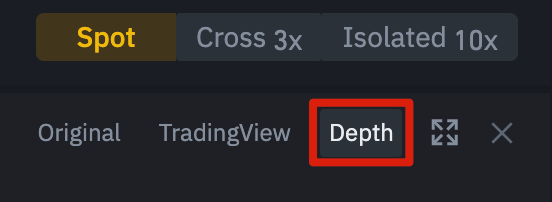
The [Order Chart] option shows a graphical representation of the order list for an asset. You can see the quantity and price of offers in green, in addition to the quantity and price of orders in red. The gap between these two areas is the difference between the ask and bid price, which you can calculate by subtracting the bid price in green from the ask price in red.

As mentioned before, there is an implicit relationship between liquidity and smaller spreads between the ask and bid prices. Trading volume is a commonly used indicator of liquidity, so expect to see higher volumes with smaller spreads between the ask and bid price as a percentage of the asset price. Heavily traded cryptocurrencies, stocks and other assets have much more competition among traders looking to profit from the difference between the ask and offer price.
The percentage difference between the ask and offer price
To compare the difference between the ask and offer price of different cryptocurrencies or assets, we must evaluate it in percentage terms. With a simple calculation:
(Ask Price - Bid Price) / Ask Price x 100 = The percentage difference between the Ask and Bid price
Let's take BIFI as an example. At the time of this writing, BIFI has an ask price of $907 and a bid price of $901. This difference gives us a spread between the ask and bid price of $6. $6 divided by $907, then multiplied by 100, gives us a percentage difference between the ask price and the final bid of approximately 0.66%.

Now assume that Bitcoin has a spread between the ask and offer price of $3. While this is half of what we saw in the BIFI example, when we compare it in percentage terms, the difference between the ask and offer price of Bitcoin is only 0.0083%. BIFI also has a much lower trading volume, which supports our theory that assets with less liquidity tend to have larger spreads between the ask and bid prices.
The lower price difference of Bitcoin allows us to draw some conclusions. An asset that has a lower percentage difference between the ask and offer price is likely to have more liquidity. If you want to place large market orders, there is usually less risk of having to pay a price you were not expecting.
What is slippage?
Slippage is a common occurrence in markets with high volatility or low liquidity. Slippage occurs when trading settles at a price different from the expected or requested price.
For example, let's say you want to place a large buy order in the market at a price of $100, but the market does not have the liquidity to execute your order at that price. As a result, you will have to take subsequent orders (with a value higher than 100 USD) until your order is fully filled. This will cause the average purchase price to rise above $100, and this is what we call slippage.
In other words, when you create a market order, the trading platform automatically matches your buy or sell transaction with limit orders in the order list. The order list will match your best existing price, but you will start moving up the order chain if there is insufficient volume for the price you want. This process causes the market to execute your order at different unexpected prices.
In the cryptocurrency space, slippage is a common occurrence on automated market makers and decentralized trading platforms. Slippage can be more than 10% of the expected price for volatile or low-liquidity altcoins.
Positive slippage
Slippage does not necessarily mean that you will end up with a worse price than expected. Positive slippage can occur if the price decreases while you create a buy order or increases if you create a sell order. Although uncommon, positive slippage may occur in some highly volatile markets.
Slip tolerance
Some trading platforms allow you to manually set the allowed slippage level to limit any slippage you may experience. You'll see this option in automated market makers like PancakeSwap on Binance Smart Chain and Uniswap on Ethereum.

The amount of slippage you specify can have an indirect impact on the time it takes for an order to clear. If you set the slippage to a low value, your order may take a long time to execute or not be executed at all. If you set it too high, another trader or bot may see your pending order and make an insider trade.
In this case, insider trading occurs when another trader sets a higher network transfer fee than you for purchasing the asset first. The insider trader then enters another trade to sell to you at the highest price you are willing to receive based on your slippage tolerance.
Reduce negative slippage
Although you can't always avoid slippage, there are some strategies you can use to try to reduce it.
1. Instead of creating a large order, try breaking it into smaller blocks. Monitor the order list closely to post your orders, and make sure not to place orders larger than the available size.
2. If you are using a decentralized trading platform, don't forget to keep transaction fees in mind. Some networks charge exorbitant fees based on blockchain congestion which may negate any gains you make, avoiding slippage.
3. If you deal with assets with low liquidity, such as a small liquidity pool, your trading activity may significantly affect the price of the asset. One transaction may experience a small amount of slippage, but many smaller transactions will affect the price of the next block of transactions you make.
4. Use limit orders. These orders ensure that you get the price you want or better when you trade. Even though you sacrifice the speed of the market order, you can be sure that you will not experience any negative slippage.

Concluding thoughts
When trading cryptocurrencies, do not forget that the difference between the ask and offer price or slippage can change the final price of your trades. You can't always avoid these changes, but it's worth taking into account when making your decisions. For smaller trades, this can be minimal but remember that when using high volume orders, the average price per unit may be higher than the expected price.
For anyone experimenting with DeFi, understanding slippage is an important part of trading basics. Without some basic knowledge, you risk losing money on insider trading or excessive slippage.