


Summary
DeFi is the only place where unicorns and sushi boxes face off in a battle for liquidity. Uniswap has been one of the most successful DeFi protocols for swapping tokens on Ethereum. It was created by a small team of passionate builders who made the code open source and available for anyone to fork. And that's exactly what SushiSwap did!
SushiSwap is a fork of Uniswap that added the SUSHI token, lets holders control the protocol, and pays them a portion of the fees. Let's see how you get on with this protocol!
the introduction
As the decentralized finance (or DeFi) space evolves, an increasing number of new financial platforms continue to emerge. We've seen how investors can take advantage of things like flash loans and yield mining (or liquidity mining) to make money.
Uniswap has cemented its position as one of the premier DeFi protocols with the largest trading volumes. Despite its decentralized nature and heavy reliance on smart contracts, users have little say when it comes to the direction of development.
SushiSwap came onto the scene with the promise of changing that. The value reserved in the protocol of more than $1 billion – just a few days after its launch – indicates that many are interested in this change. In this article, we will discuss the Uniswap fork that is sweeping the cryptocurrency trading space.

What is SushiSwap?
SushiSwap was launched in September 2020 by two anonymous developers, Chef Nomi and 0xMaki. It is one of the most popular decentralized applications on the Ethereum blockchain. SushiSwap adopts the automated market making (AMM) model of its decentralized trading platform (DEX) protocol. There is simply no order list on SushiSwap, instead, buying and selling cryptocurrencies is facilitated through smart contracts.
SushiSwap started out as a fork of Uniswap, and used Uniswap code to build its foundation while introducing a few key differences – most notably, distributing rewards in SUSHI tokens. Liquidity providers on SushiSwap are rewarded with the protocol's native token SUSHI, which is also considered a governance token. Unlike Uniswap (UNI), SUSHI holders can continue to earn rewards even after they stop providing liquidity.
When it first launched, SushiSwap incentivized liquidity providers to store Liquidity Pool (LP) tokens on Uniswap by paying out additional SUSHI rewards with a high annual return rate. Within a week, SushiSwap attracted over $1 billion in liquidity and the total value locked reached over $150 million. The stored liquidity pool tokens were then migrated from Uniswap to SushiSwap after two weeks. This means that all Uniswap liquidity pool tokens stored on SushiSwap have been redeemed to Uniswap for the tokens they represent. New liquidity pools have also been created on SushiSwap, marking the launch of the SushiSwap trading platform.
In the second quarter of 2021, the SushiSwap blockchain ecosystem unveiled its newest addition, a non-tradeable token (NFT) platform called Shoyu. In fact, the idea for Shoyu came from a SUSHI management member, who suggested making Shoyu an easy-to-use platform for non-tradable tokens. It aims to address current shortcomings in non-fungible token markets, such as limited file format options, limited image sizes, and high transaction fees on Ethereum.
What is SUSHI?
SUSHI is the native token of the SushiSwap platform. It is an ERC-20 token that is distributed to SushiSwap's liquidity providers via liquidity mining. The maximum stock of the SUSHI token is 250 million tokens. SUSHI stock is based on block rate. As of November 2021, generated at a rate of 100 tokens per block, the coins available for trading in the market already amount to nearly 50% of the total stock of 127 million tokens.
SUSHI entitles owners to management rights and a portion of the fees paid for the protocol. In a simplified way, we can say that the SUSHI community owns the protocol. Why did this spark so much interest? Well, community management is closely intertwined with the DeFi ethos. The growth of liquidity mining (revenue harvesting) as a valid way to distribute tokens has given rise to a lot of new token launches.
Fair token launch models aim to create parity for all participants, and often include no seed foundations, little or no founder allocation, and an equal distribution based on the amount of funds each user provides. In most cases, distributed tokens also grant management rights to token holders.
Okay, but what can token holders do with these management rights? On SushiSwap, anyone can submit a SushiSwap Improvement Proposal (SIP), which SUSHI owners can vote on. These can be minor or even major changes to the SushiSwap protocol. Instead of a more traditional team like Uniswap, SushiSwap development is in the hands of SUSHI token holders.
A strong community can be a powerful asset for any token project, but this is especially true for a DeFi protocol. MISO, or Minimum Initial Offering for SushiSwap, for example, is a product that arose from a management proposal. It represents a launchpad for tokens in the SushiSwap blockchain ecosystem designed to meet the expectations of the SUSHI community. MISO allows individuals and communities to launch tokens for their new projects through the SushiSwap platform.
How does SushiSwap work?
As mentioned, SushiSwap is an Automated Market Maker (AMM) protocol, which acts as a decentralized trading platform. There is no list of requests or central authority. Cryptocurrency trading on SushiSwap is processed through smart contracts in liquidity pools. The Liquidity Pool is where SushiSwap users become Liquidity Providers (LP) by staking their crypto assets. Anyone can be a liquidity provider on SushiSwap and earn rewards proportional to their stake in the pool. This is done by depositing the equivalent value of two tokens into the pool. Each pool operates like a marketplace, where other users can buy and sell tokens. For a more comprehensive explanation of how automated market makers work in decentralized exchange (DEX) protocols, see this Uniswap article.
On SushiSwap, you can swap ERC-20 tokens as you wish on other DEX protocols. For example, you can trade stablecoins like USDT and BUSD with cryptocurrencies like Bitcoin (BTC) and Ethereum (ETH). Also, there are different sushi-themed jobs to earn passive income. For example, you can store SUSHI in SushiBar and get xSUSHI. Stored xSUSHI allows holders to earn a 0.05% bonus fee for all trades from all liquidity pools. Following the launch of Shoyu, SUSHI holders who stake their tokens for xSUSHI will also be eligible to receive 2.5% of every NFT token trade on the NFT Market.
BentoBox is another feature for earning rewards on SushiSwap. It is an innovative treasury that allows users to take advantage of all the return earning tools available on SushiSwap. This means that by depositing your assets into BentoBox, you can automatically earn interest from storing them in SushiBar, as well as by lending them to other users. At the same time, xSUSHI owners can also earn rewards from transaction fees accrued from BentoBox.
Uniswap vs SushiSwap
It's no secret that cryptocurrencies are deeply rooted in the spirit of open source code. Many believe that Bitcoin and a growing number of DeFi protocols open to the public function as new types of public goods in the form of software. Since these projects are easily copied and relaunched with small changes, this naturally leads to competition between similar products. However, we can assume that this should ultimately result in providing the best products to the end user.
There is no doubt that the DeFi space owes its breakthrough to the Uniswap team. But we can see a future in which Uniswap and SushiSwap (or other spin-offs) thrive. Uniswap may remain at the forefront of innovation in the automated market maker space, while SushiSwap could provide an alternative that is more focused on the features the community wants to see.
However, splitting liquidity between similar protocols is not ideal. If you've read our article about Uniswap, you know that automated market makers work best with as much liquidity in the pools as possible. If too much liquidity in DeFi is split between too many different automated market maker protocols, it could lead to a worse end-user experience.
How to provide liquidity to SushiSwap?
So, you've decided you want to store tokens in exchange for SUSHI. The first step is to get those tokens. You can buy cryptocurrencies for storage from centralized crypto exchanges like Binance, or decentralized exchanges like Uniswap and 1inch.
In this example, we will provide liquidity for BNB-ETH, but feel free to follow the same steps for another trading pair (of course provided that the liquidity pool tokens are usable on SushiSwap).
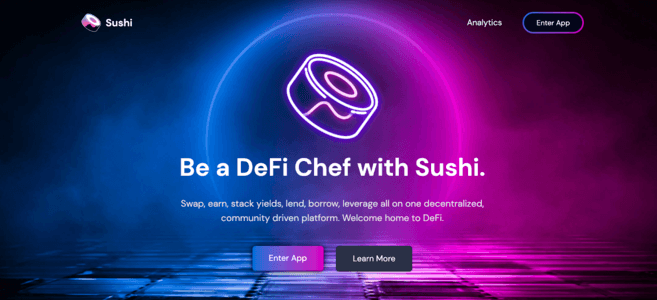
1. Go to Sushi and click [Enter App] to enter SushiSwap.
2. Go to [Complex] from the top navigation bar. You'll need to link your wallet to get started. You can use a Binance wallet, MetaMask, WalletConnect, or any other supported Ethereum wallet. In this example, we will use the Binance wallet.
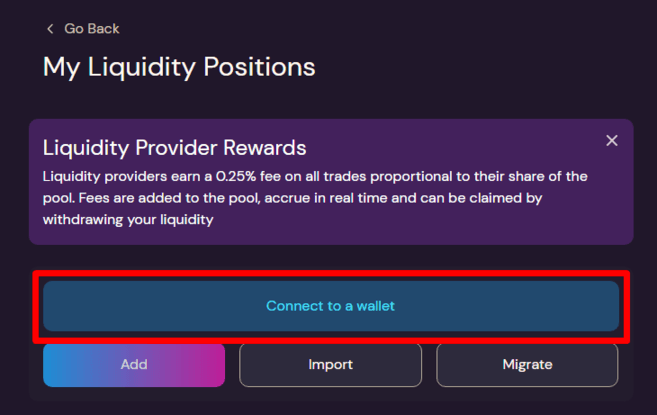
3. After clicking [Binance], a pop-up window will appear. Enter your password to open the wallet, or click [Create a new wallet] if you do not have a wallet.

4. Click [Link].

5. You will be redirected back to the SushiSwap pool. Click [Add] to add liquidity.

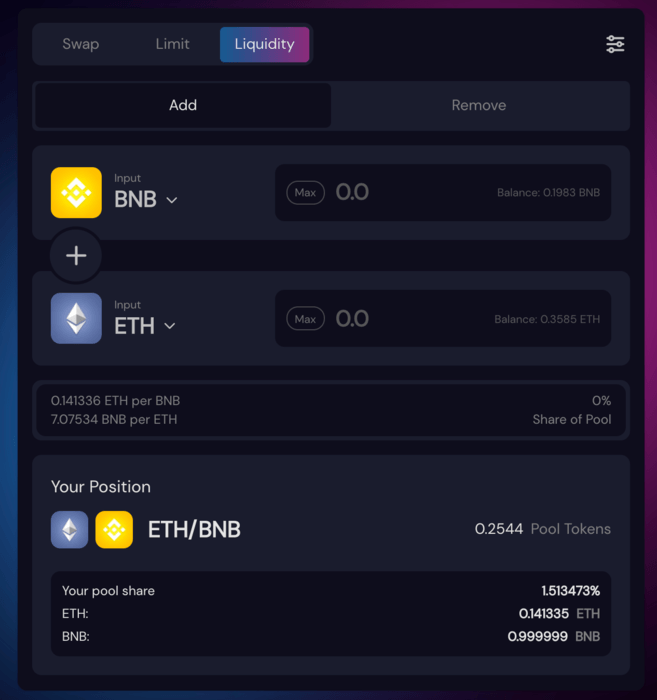
6. Click [Select Token] to find the cryptocurrency pair you want to provide liquidity for. Then enter the amount of one of the tokens (for example, 1 BNB). The system will automatically calculate the required amount for the other token.
You can also view your share of the pool below. Click [Approve ETH] to confirm.

7. Another pop-up window will appear containing the details and on-net transfer fees for this transaction. Click [Confirm] to agree, or click [Reject] to modify.

8. Click [Confirm Add Liquidity] then [Confirm Stock] to add liquidity to the BNB-ETH pool.
Note: Due to the possibility of a non-permanent loss, you may receive a different distribution of tokens upon redemption than you initially added. Make sure you understand the risks before adding liquidity.


9. Confirm the transaction in the pop-up window of your wallet.

10. You have successfully added liquidity to the BNB-ETH pool. You can see your deal and your stake in the pool. This means that when users trade BNB/ETH, you can get trading fee rewards.
11. To manage your trades, go to the [Aggregate] tab from the top navigation bar and click on your trade to add or remove liquidity.
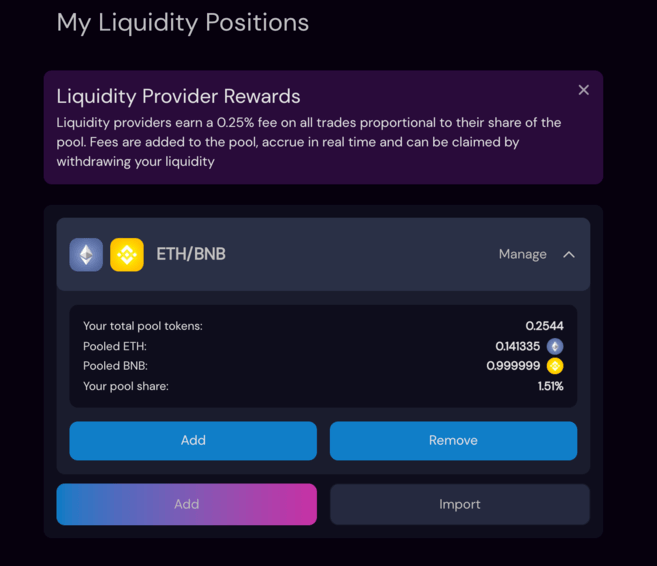
You will notice some SLP tokens in your wallet from the transaction. SLP tokens are Sushiswap LP tokens, which represent the stake you have deposited into the pool. All liquidity pools are named SLP on SushiSwap, but in reality they represent different pools.
How to buy or sell SUSHI on Binance?
Aside from earning SUSHI from SushiSwap, the token can be purchased from cryptocurrency exchanges like Binance. On the other hand, if you want to sell the SUSHI you received from SushiSwap, you can transfer it to your wallet and sell it on cryptocurrency trading platforms like Binance.
1. Log in to your Binance account, click [Trade] in the top navigation bar to choose the Classic or Advanced trading page.
2. On the right of the screen, type “SUSHI” in the search bar, and you will see the available trading pairs. In this example, we will use SUSHI/BUSD. Click on [SUSHI/BUSD] to open the trading page.

3. Scroll down to the [Instant] box. You can buy or sell SUSHI here. Enter the amount of SUSHI you want to buy or sell. Then select the order type for your order. In this example, we will use market order. Click [BUY SUSHI] or [SELL SUSHI] to confirm the order.

Is SushiSwap safe?
Depositing funds into a smart contract always carries a risk of bugs, and this applies to even the most reputable projects that have been subject to scrutiny. You should never deposit more than you can afford to lose and always do your own research before investing. Additionally, due to the high processing fee costs on Ethereum, a lot of collections can occur for small deposits before you can actually make a profit from them.

Concluding thoughts
SushiSwap is an exciting experiment that challenges the competitive advantage of the already successful DeFi protocol – Uniswap. Although it is a fork from Uniswap, SushiSwap has added new features to its protocol, with the main difference being community governance. In 2021, SushiSwap is also introducing a non-tradable token platform to capitalize on the booming non-tradable token market.
SushiSwap has quickly overtaken many other DeFi projects in terms of total value locked since its launch, and could continue to grow in popularity. No matter how successful SushiSwap ultimately turns out to be, it suggests that no product or service has an undisputed advantage in DeFi.