


Summary
The Ethereum Name Service (ENS) provides a service for naming wallet addresses, hashes, and other machine-ready identifiers. It turns difficult-to-read sequences of letters and numbers into easy-to-read titles. This service works in a similar way to the Domain Name Service (DNS) for websites.
Initially, the service offered unique domain names with six, five, four or three letters, via a Vickery auction format. Each name has the phrase .eth at the end, and can be linked to several addresses, hashes, or other information specific to digital currencies.
Names can now be easily purchased without entering into an auction and rented for a year, and the prices depend on the length of the name you wish to rent. If you own an ENS domain on October 31, 2021, you will be entitled to receive $ENS governance tokens via a free distribution. These codes are available until May 4, 2021.
the introduction
One of the biggest challenges facing blockchains is facilitating use and access to the network. If we look at payments using Ethereum (ETH) or Bitcoin (BTC), new users, and even experienced users, can find long wallet addresses confusing and unwieldy. Strings of numbers encoded in hexadecimal format are easy for computers to read, but difficult for human users. The Ethereum Name Service (ENS) solves this problem by allowing users to create simple URLs, such as URLs, for easy storage and use.

What is the Ethereum Name Service?
Ethereum Name Service (ENS) is an Ethereum-based project launched on May 4, 2017 by Alex van de Sande and Nick Johnson of the Ethereum Foundation. The project allows users to display Ethereum public addresses in a simple textual manner, making it easier to share, use and save addresses and other data. Converting machine-ready numbers like 0xAb5801a7D398351b8bE11C439e05C5B3259aeC9B into human-readable alternatives is an important step toward the widespread adoption of blockchains.
But the ENS service is not limited to wallet addresses only, but can be used to represent transaction identifiers, hashes, and metadata, which are widespread in the world of digital currencies. You're probably already familiar with the Domain Name System (DNS), the naming system that serves as a telephone directory on the Internet. The DNS service takes hard-to-memorize IP addresses and links them to a user-friendly URL, such as https://academy.binance.com. ENS is actually the DNS service for the Ethereum blockchain.
The ENS service then issued a unique governance token, as part of its transformation into a decentralized autonomous organization (DAO). Thanks to a significant increase in the price of this token, the project began to become popular and attract more attention.
How does the Ethereum Name Service work?
The ENS domain name uses ERC-721 non-fungible tokens (NFT) to represent a unique address. The domain can be traded by transferring ownership of the non-tradable token or selling it to someone else. Wallet addresses and other information are associated with each token, and are managed by the owner of that token. A top-level domain such as .eth is owned by a smart contract known as a registrar, which controls the creation of subdomains. If you want to create an address like BinanceAcademy.eth, you will have to deal with a .eth registrar.
To buy a domain name on Ethereum, you can check whether it is available or not, and rent it on a yearly basis. But popular domain names were sold at auction at the beginning of the project. The bidder who wins the domain can link addresses, create subdomains, and rent or buy the domain name. For example, someone who owns the BinanceAcademy.eth domain can create the address learn.BinanceAcademy.eth for free.
What can you do with the Ethereum Name Service?
If multiple addresses confuse you when sending cryptocurrencies, you'll understand why you need an Ethereum name service. Just as you save your friend's phone number in a contact named after him, the Ethereum Names service allows users to convert numbers into easy-to-memorize words. This results in a more direct experience with fewer errors.
The owner of a domain name on Ethereum can create subdomains to link other data to. Not just wallet addresses, the domain name can point to a smart contract, transaction, or metadata.
How do you get your own domain name from ENS?
Getting a domain name from ENS today is very easy, all you have to do is make sure the domain is available via https://app.ens.domains/ and register it. Let's look at an example of starting the process. First, head to https://app.ens.domains/, connect your wallet and type in the domain name you want.

You will now see if the name you want is available. In our case, a domain can be registered with the name BinanceAcademy.

Once you click on the name, you will see instructions for registering an Ethereum domain name. You can choose the registration period and get an estimate of the fees you will pay. Using the Ethereum (ETH) coins in your wallet, you can follow the three steps described and request an address registration.

In the early days of ENS, popular domain names with six, five, four or three letters were offered in Vickery-style auctions. A smart contract ran the process over five days, and anyone could participate in the auction and try to buy the same domain name. Each interested party must submit a transaction containing the maximum bid amount within the first three days of the open auction.
The auction then enters the reveal phase, where each person reveals the amount he bid or lost in the frozen Ethereum coins in the auction, and the winner will pay an amount equal to the second highest amount. Then all bidders will receive their amounts back.
How much does it cost to get an ENS domain name?
There are two parts to the cost of an ENS domain name: auction costs and leasing costs. The price of the ENS domain name in the auction was based on the popularity of the name. Well-known names like God, Car or ETH commanded higher prices, and short three-letter words were the most expensive. We can see examples below of the prices paid for domain names.

Once you own an ENS domain name, you will have to pay an annual renewal cost in ETH. Fees are set in US dollars but converted to Ethereum via Chainlink's ETH/USD middleware. The cost of annual renewal is estimated at five dollars for names consisting of five letters or more, but it increases with the number of letters.
How to get free Ethereum Name Service distribution?
Anyone who owned a .eth address at the time of the network snapshot on October 31, 2021 is eligible to obtain $ENS tokens in a few simple steps. It is available to obtain until March 4, 2022 before it is burned.
1. First, go to ENS Airdrop and connect your wallet via the [Receipt] or [Wallet Receipt] button.

2. Choose the wallet you would like to connect to, such as MetaMask, WalletConnect, or any other wallet.

3. Click [Start] to start.
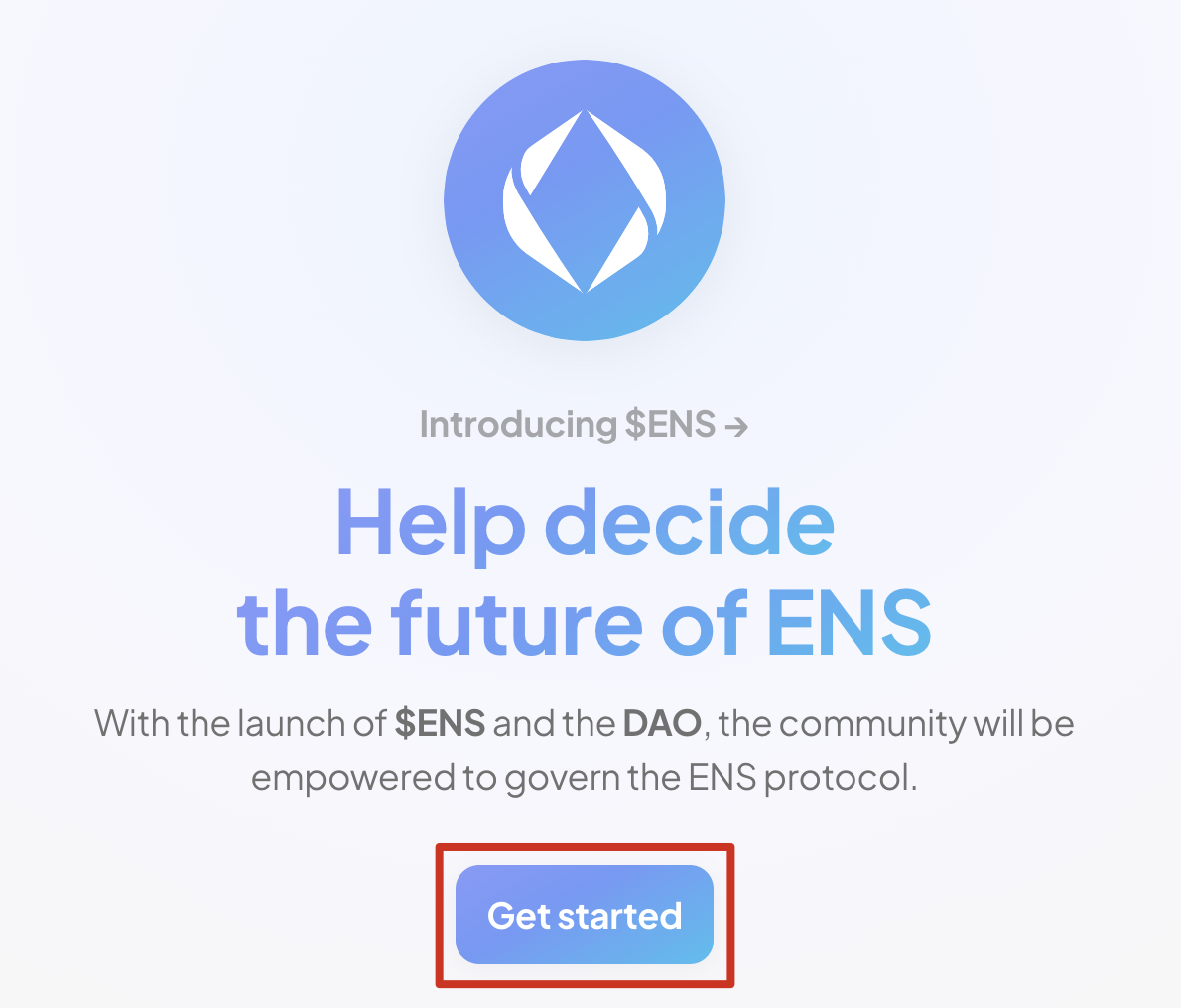
3. You will now see the option [Start the Claim Process] and next to it is the amount you will receive.
5. Make sure to read the information about the $ENS$ token, and then the governance constitution, which you will need to sign using your wallet.
6. Now, you can choose to delegate voting powers for icons to yourself or another user.
7. Finally, check the amount you will receive and who you have authorized, before clicking [Claim] and paying the transfer fee to get your tokens.

Concluding thoughts
In the world of decentralized networks, ENS is a step forward in making blockchains easier to operate with. Just as we no longer use IP addresses to browse the web, we may see an increase in Ethereum domain names thanks to their many benefits and growing popularity. Since the free distribution, the interest of users in the digital currency system in this project has increased.