


LayerZero is a full-chain interoperability protocol that enables lightweight messaging between blockchains, ensuring authentic, guaranteed delivery and scalable trustlessness. It acts as a translator and facilitates communication between blockchains.
In the volatile cryptocurrency world, while most digital assets have suffered severe downturns, LayerZero seems to have become one of the most popular projects in the bear market.
The latest round of funding for the blockchain infrastructure protocol includes several high-profile venture capitalists, including Andreessen Horowitz, Christie's, Sequoia Capital and Samsung Next. The round raised $120 million in Series B funding at a $3 billion valuation, three times the previous funding round.
Additionally, even investors are interested in LayerZero’s airdrop, leaving many scrambling to find out how they can get involved with the project and share in its future success.
In fact, these achievements make LayerZero stand out in the murky cryptocurrency market, showing that investors are still enthusiastic about infrastructure-focused crypto projects.
What is LayerZero
LayerZero is a full-chain interoperability protocol designed for delivering lightweight messages across chains. LayerZero provides authentic and guaranteed messaging with configurable trustlessness.
So, what exactly is LayerZero?
LayerZero is a platform for inter-blockchain communication. It can help transfer information between different blockchains by acting as a translator.
Just like people need translators to communicate with people who speak different languages, it is difficult for blockchains with different technology systems to communicate directly. This is where LayerZero comes into play, acting as a translator to enable clear communication between blockchains. Users can specify what information they want to send and to which blockchain, and LayerZero is then responsible for converting and transmitting the information between the two blockchains.
For example, if a user wants to send a message from Blockchain A to Blockchain B, the message is first sent to LayerZero. LayerZero acts as an intermediary and forwards messages to the person responsible for performing the task. They forward the message to the appropriate data node on blockchain B. Blockchain B verifies its authenticity and sends it to the designated receiving address.
In summary, LayerZero acts as a communication protocol or language translator, eliminating barriers between different blockchains and enabling efficient and accurate information exchange. Users don’t need to worry about the technical details of the two blockchains; they just need to specify the content and recipients, and LayerZero will handle the rest.
Why LayerZero?
LayerZero aims to address the limitations of existing interoperability protocols that rely on trusted intermediaries or custodians. Advantages of LayerZero include
Trustless transactions
LayerZero allows users to send and receive funds directly between different blockchains without relying on intermediaries. This reduces the risk of losing funds to hackers or dishonest custodians.
Easy cross-chain development
LayerZero provides developers with an easy way to build applications that work across multiple blockchains. This means they can create new decentralized exchanges, wallets and gambling platforms that are more flexible and innovative.
Native asset support
Using LayerZero, users can send their cryptocurrencies directly between different blockchains without converting them into another type of token. This makes using different blockchains easier and reduces costs.
better liquidity
LayerZero makes it easier for people to buy and sell different cryptocurrencies across multiple blockchains. This means people can get better prices and buy and sell various digital tokens more easily.
As a new cross-chain communication protocol, LayerZero has important advantages, such as enabling trustless transactions. But at the same time, it also faces challenges such as complex technology, difficulty in ecological construction, and potential safety hazards.
As the LayerZero team continues to optimize and improve the protocol, expand application scenarios, deepen cooperation with mainstream public chains, and improve security defense capabilities, LayerZero can play a vital role as the cornerstone of cross-chain technology.
How to get airdrop
Although LayerZero has not been officially announced, many are preparing for the upcoming airdrop. However, there are steps one can take to increase the likelihood of receiving airdropped tokens.
As a rule of thumb, here are some things people can do:
Actively participate in the official LayerZero Discord community by posting regularly and interacting with other users. LayerZero may reward more airdrop tokens based on community participation.
Increase engagement on Twitter by retweeting and commenting on LayerZero’s tweets more frequently. LayerZero may reward more airdrop tokens based on social influence on Twitter.
Trade more LayerZero related smart contracts to increase your chances of receiving airdrop tokens. LayerZero can allocate airdrop tokens based on trading volume.
Use the LayerZero test bridge to perform more testnet transactions. LayerZero may allocate more airdrop tokens based on the frequency of testnet usage.
In summary, although LayerZero has not officially announced its airdrop plan, community members can still actively participate in community activities, conduct transactions on the platform, and express support for the LayerZero project to increase their chances of receiving airdrop rewards.
Extract insights from data
So, what insights can we gain from the data?

Daily unique users on LayerZero
The increase in the number of unique users on LayerZero, especially since March, indicates growing interest in LayerZero’s technology. As of April 20, there were more than 866,000 unique users on LayerZero, according to Footprint Analytics. This is due to a sharp increase in the number of unique users since the end of March, likely due to a potential airdrop campaign pushing the technology forward and encouraging more users to use it.
LayerZero positions itself as a blockchain infrastructure provider with excellent transaction speeds and negligible fees. As a result, it is becoming an attractive option for developers and companies looking to build decentralized applications capable of handling large numbers of transactions and users.
As more users join LayerZero, it will likely attract more developers and applications, further increasing adoption and use cases for the network.
Trading Insights: Challenges and Opportunities in a Growing User Base
The rise in LayerZero transaction volume in March was likely due to a successful marketing campaign aimed at promoting the platform’s features and benefits.
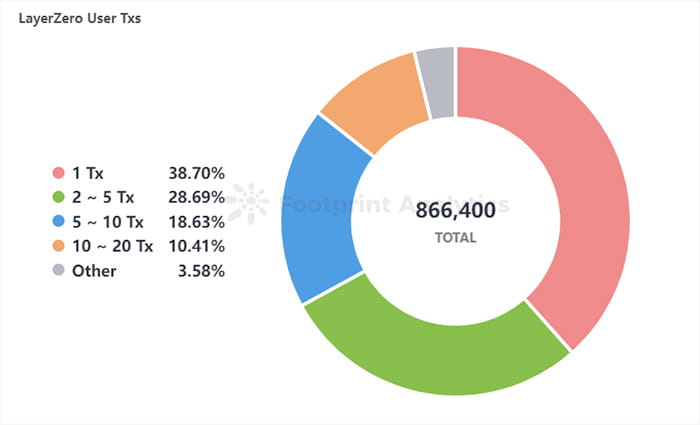
LayerZero user transactions
According to Footprint Analytics, 38.70% of all transactions are completed by users who complete only one transaction. This shows that the potential airdrop event has successfully attracted many new users to try the LayerZero protocol. However, as users become more familiar with the LayerZero protocol and transaction volume increases, the number of participating users will decrease.
Only a small percentage of users (3.58%) perform high-frequency trading, while the majority of users simply complete tasks rather than actively using LayerZero.
This user structure brings challenges and opportunities to the LayerZero protocol. The opportunity is that airdrop campaigns can quickly attract new users. The challenge is to convert more new users into loyal and highly active users, thereby increasing transaction volume on the platform. This requires LayerZero to continuously improve its technology, enrich use cases, and increase user stickiness.
Blockchain Insights: Layer 2 blockchain performs well
As the LayerZero protocol expands to different networks, Arbitrum stands out with the most unique users, followed by Optimism and Polygon.
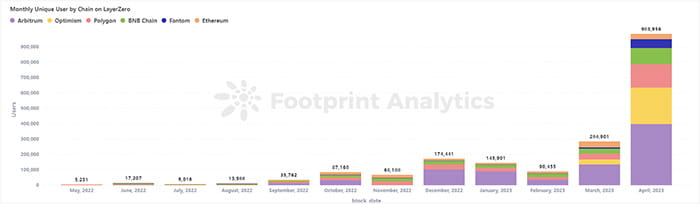
Monthly unique users of each chain on LayerZero
Projects currently integrating the LayerZero protocol include Stargate, Hashflow, Radiant Capital, SushiSwap and Rage Trade, etc., involving cross-chain transactions, lending, liquidity mining and NFT. These projects can use LayerZero’s protocol to implement asset transfers, contract calls, and message passing across different chains. LayerZero provides users on high-performance networks with specialized tools and services to further drive adoption of its technology and use cases.
All in all, data analysis of LayerZero’s user and transaction volume results show promising growth and adoption potential in the blockchain space. By increasing user engagement and retention, supporting high-performance networks, and expanding its reach, LayerZero is poised to become a leading blockchain infrastructure provider.
This article was contributed by the Footprint Analytics community.