


Due to the nature of the oracle project, the Pyth network has attracted the attention of various projects, which means that staking PYTH may receive potential airdrops. As of February 14, more than 1 billion PYTHs have been staked, and the number of staked addresses has exceeded 175,000. ZeroLend is one of the companies competing for PYTH stakers.
On January 30, the zkSync-based lending protocol ZeroLend announced an airdrop to Pyth Network stakers. It is reported that users need to complete the EVM address binding in advance on Pyth Network. ZeroLend will issue PT points to users based on the number of staked PYTH, and 1 PT point will be allocated for each staked PYTH. The points will be bound to ZeroLend's upcoming native token ZERO, which is reportedly expected to be launched in the first quarter of 2024.
Recently, ZeroLend also completed a $3 million seed round of financing on February 21 with a valuation of $25 million. Momentum 6, Blockchain Founders Fund, Morning Star Ventures, Banter Capital, Newman Capital, dVdT, Transform Capital, Cypher Capital, Bison Fund, Ozaru Ventures, iAngels, Krypital, Genblock, viaBTC, GBV and Asteroid Capital participated in the investment.
Since the announcement of the airdrop, ZeroLend TVL has been rising. According to official website data, as of the time of writing, ZeroLend's total locked value (TVL) has exceeded US$55.7 million.
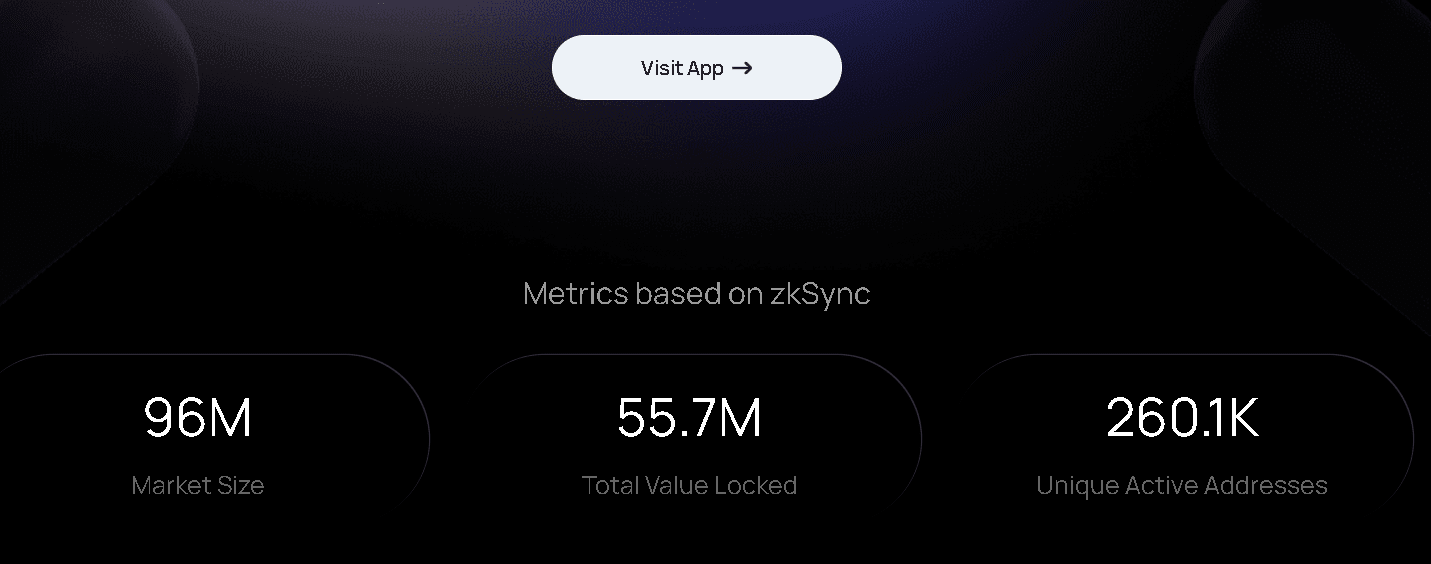
According to official documents, ZeroLend is the largest lending protocol on zkSync. When it is about to issue coins, in addition to PYTH pledgers being able to receive airdrops, those who use ZeroLend for mining will also have the opportunity to obtain the protocol itself, zkSync, and LayerZero airdrops.
Lending protocol built on zkSync and Manta
ZeroLend is a dynamic lending protocol whose ecosystem consists of DeFi lending, stablecoin ONEZ, governance token ZERO, support for real-world assets, account abstraction, and a privacy layer using zkStack. Among them, DeFi lending and account abstraction functions have been deployed, and the core product is a decentralized non-custodial liquidity market.
Notably, ZeroLend is the only lending protocol on zkSync that has its own insurance fund. A percentage of fees generated by the platform is allocated to this fund, ensuring that it grows over time. In the event of a major issue, such as a smart contract bug or unforeseen system failure, the insurance fund can be tapped to compensate affected users.
In addition, ZeroLend has integrated various zkSync native account abstraction functions.
Vitalik once described account abstraction as allowing Ethereum accounts to be controlled by smart contract code instead of private keys. His vision is that in the future everyone will switch from the current EOA wallet to a smart contract-based wallet. If successful, then managing a crypto wallet will become as simple as managing an email account.
Related reading: "Summary of Vitalik's EthCC speech: the history and future of account abstraction"
In recent years, account abstraction has made significant progress and has penetrated all parts of the Ethereum ecosystem, including applications, infrastructure, users, and developers. zkSync has also launched a native account abstraction solution, while ZeroLend has integrated various zkSync native account abstraction functions through Paymasters, social login and other authentication options, and delegated transactions.
Among them, Paymasters allows protocols to subsidize or allow users to pay transaction fees with ERC20 tokens without holding any ETH in their wallets. Social login and other authentication options allow users to have a wallet that controls their secure enclave devices (face ID, fingerprint scanner, etc.). Delegated transactions allow users to authorize ZeroLend to perform limited actions on their behalf without losing custody of their funds.
Stablecoin lending
Since ZeroLend was developed as a fork of the original Aave protocol, it is very similar to Aave V3. Its lending also provides an efficient mode and an isolated mode. The operation of the two modes can be found in "Aave V3 is officially launched, and the four important features of the new version are listed at a glance". On this basis, ZeroLend has added a credit delegation mode, which allows depositors to deposit funds into ZeroLend to earn interest while delegating their lending capacity (credit) to other users. The loan terms are agreed on the chain by depositors and borrowers through smart contracts.
ZeroLend plans to launch its stablecoin ONEZ this year, which is made by users who provide selected assets such as ETH and USDC as collateral. ONEZ is designed to earn native yields from lending protocols and has self-loan repayment capabilities, and currently runs on zkSync and Manta networks.
ONEZ will always be designed to be worth one dollar. When the market value exceeds the peg, users can mint 1 dollar of ONEZ with 1 dollar of debt and sell the remainder above the peg. This increases the supply of ONEZ and lowers the price of the asset. Conversely, if the market value falls below the peg, minters can buy 1 ONEZ for less than 1 dollar, offsetting the 1 dollar of debt, shrinking the supply of ONEZ, and increasing the price of the asset.
ONEZ ensures that each token is backed by more than $1 in collateral through an over-collateralization model, with a collateral ratio designed to be 150%, meaning the value of the collateral must be 1.5 times the value of the loaned or minted assets. This additional collateral is a safety measure that ensures there is enough value to repay the loan if the value of the collateral drops.
Meanwhile, ONEZ stablecoins can be used for mining on veSync, a community-driven ve(3,3) DEX built on zkSync. The core of veSync is the VS token, which users can exchange for veVS, vote on emissions and receive rewards.
L3 Hyperchain and Ve Token Economics
As the first phase of the project launch, ZeroLend will launch the ZERO token on zkSync, which will operate as the native currency of the chain and can also be used to pay transaction fees.
ZERO holders will manage Hyperchains. These are ultra-scalable, interoperable custom zk-chains that run on L1 or L2 networks while maintaining a critical connection to the main chain (L1) for security and finality. Hyperchains are the ZK version of OP Stacks Hyperchains, developed using ZkStack.
Hyperchains can be strategically designed as L3 dApps, providing features such as unlimited scalability, faster messaging between L1 to L2 to L3, and maintaining interoperability within the broader zkSync ecosystem. ZeroLend plans to introduce a hyperchain privacy layer in early 2025, which will prioritize user-level privacy in ZeroLend.
The ve-token economics mentioned above are also applied to the ZeroLend economic structure, which is divided into two modes: Single Stake and dLP (dynamic liquidity provision).
Single staking allows stakers to obtain veZERO by staking the native token ZERO, and the amount received is directly related to the duration of the token lockup. The dL model is designed for users who contribute to the liquidity pool. When users stake dLP tokens, the value of their ZERO portion is effectively doubled for staking purposes.
Assuming that a user's dLP tokens consist of 50% ZERO and 50% ETH, the weighting mechanism will treat the ZERO portion as a 100% contribution, in other words, when the stake is locked, the dLP weight of ZERO will be treated as twice its amount in dLP tokens. In addition, veZERO will also affect the secondary emission of ZERO.
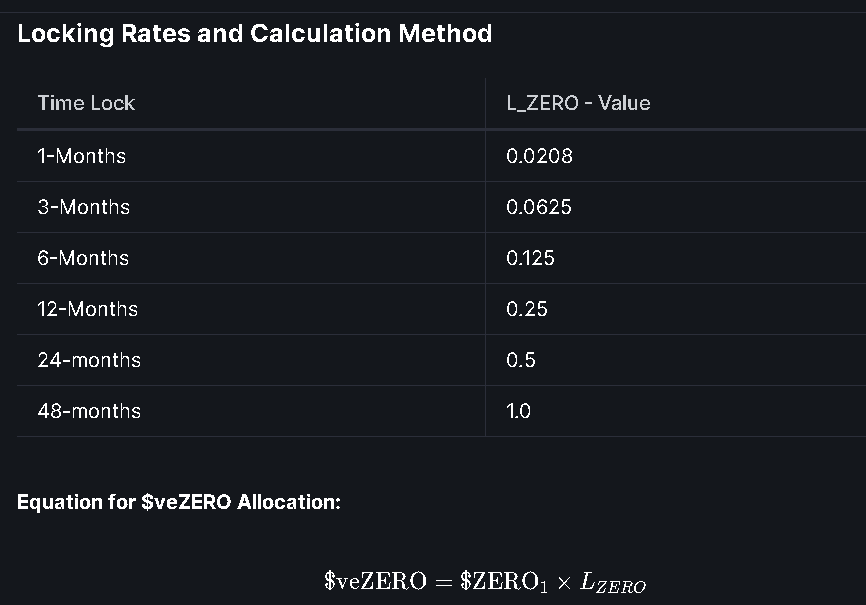
With a total supply of 100 billion, ZERO acts as both a utility token and a governance token in the ecosystem. The core of ve-token economics is that participants lock up ZERO tokens for a predetermined period of time and receive voting custody (ve) tokens in return. These ve tokens not only represent the user's rights, but also increase their returns in proportion to the lock-up period.
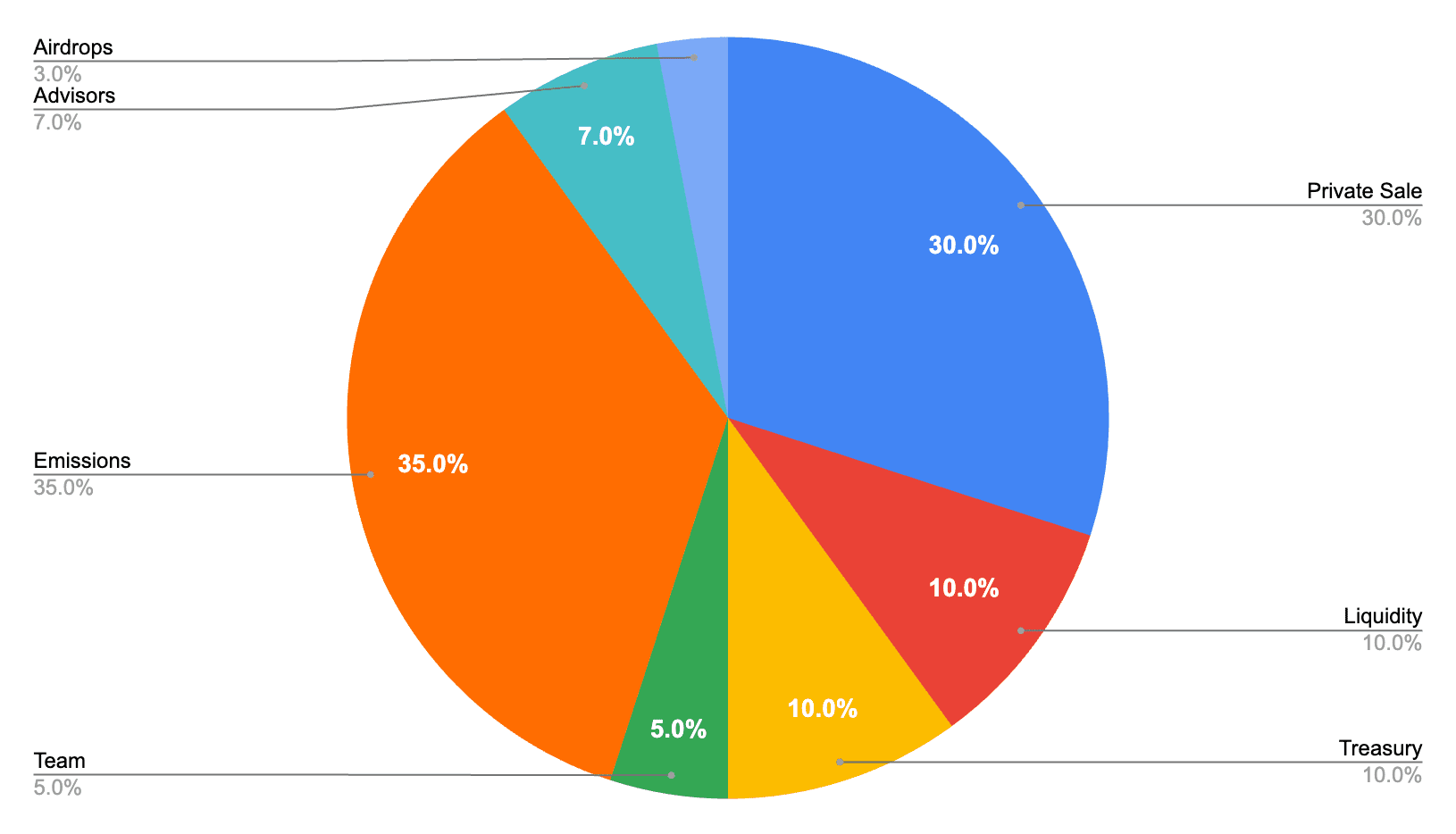
The TGE is expected to start in the first quarter of 2024, during which a certain portion of the ZERO supply will be released to the market and available for trading. Given that the project's initial FDV is set at $25 million and the initial circulation of the TGE is 18.8%, the initial circulating market value is approximately $4.7 million.
To ensure that the token economics of the ZERO token can be sustained over the long term, most of the ZERO token inflation (from liquidity, treasury, private placements, etc.) will end within the first year. By the end of the first year, approximately 78% of the token supply will be in circulation. After that, the annual emission will be reduced by half, with the remaining 22% being released over time with exponential decay, and the token economics will be designed to be almost unaffected by inflation.
ZeroLend Interactive Tutorial
According to official documents, ZeroLend is the largest lending protocol on zkSync. When it is about to issue tokens, in addition to PYTH pledgers being able to receive airdrops, those who use ZeroLend for mining will also have the opportunity to obtain airdrops for the protocol itself, zkSync, and LayerZero. PYTH holders can pledge on the official website. In addition to project shorts, pledgers can participate in the voting of Pyth Dao.
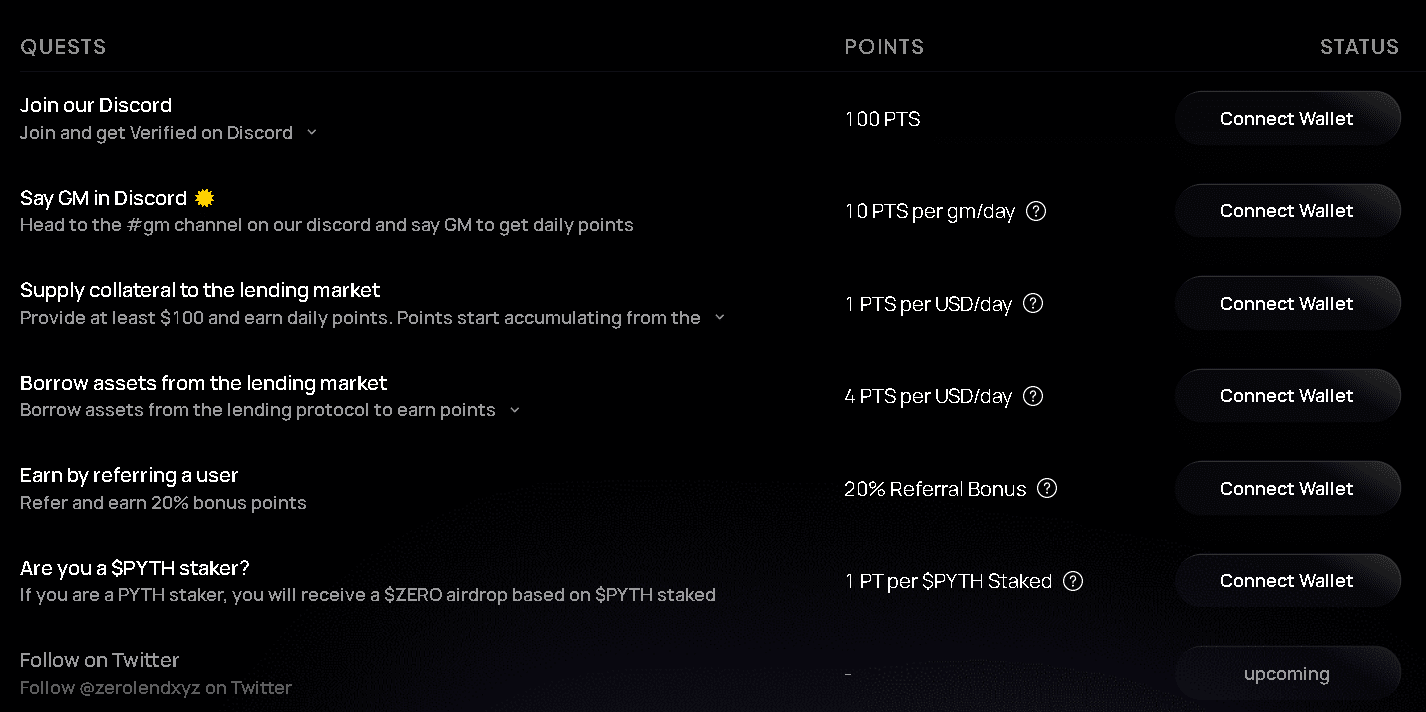
ZeroLend’s short program Zero Gravity uses a points system. On the airdrop website, after linking your wallet, you can accumulate points by completing tasks in sequence. If users accumulate 1% of all reward points, they will be entitled to 1% of the 3% of the entire $ZERO token supply.
You get 100 points for joining and getting verified on Discord, and 10 points for speaking daily in the GM channel on Discord.
Open the lending market, link your wallet, select a specified asset, and click "Details" on the right. You can only use the official cross-chain bridge to transfer assets to zkSync.
Providing collateral to the lending market and providing more than $100 of liquidity will earn you 1 point for every $1 provided per day. Borrowing assets from the lending protocol will earn you 4 points for every $1 borrowed per day.
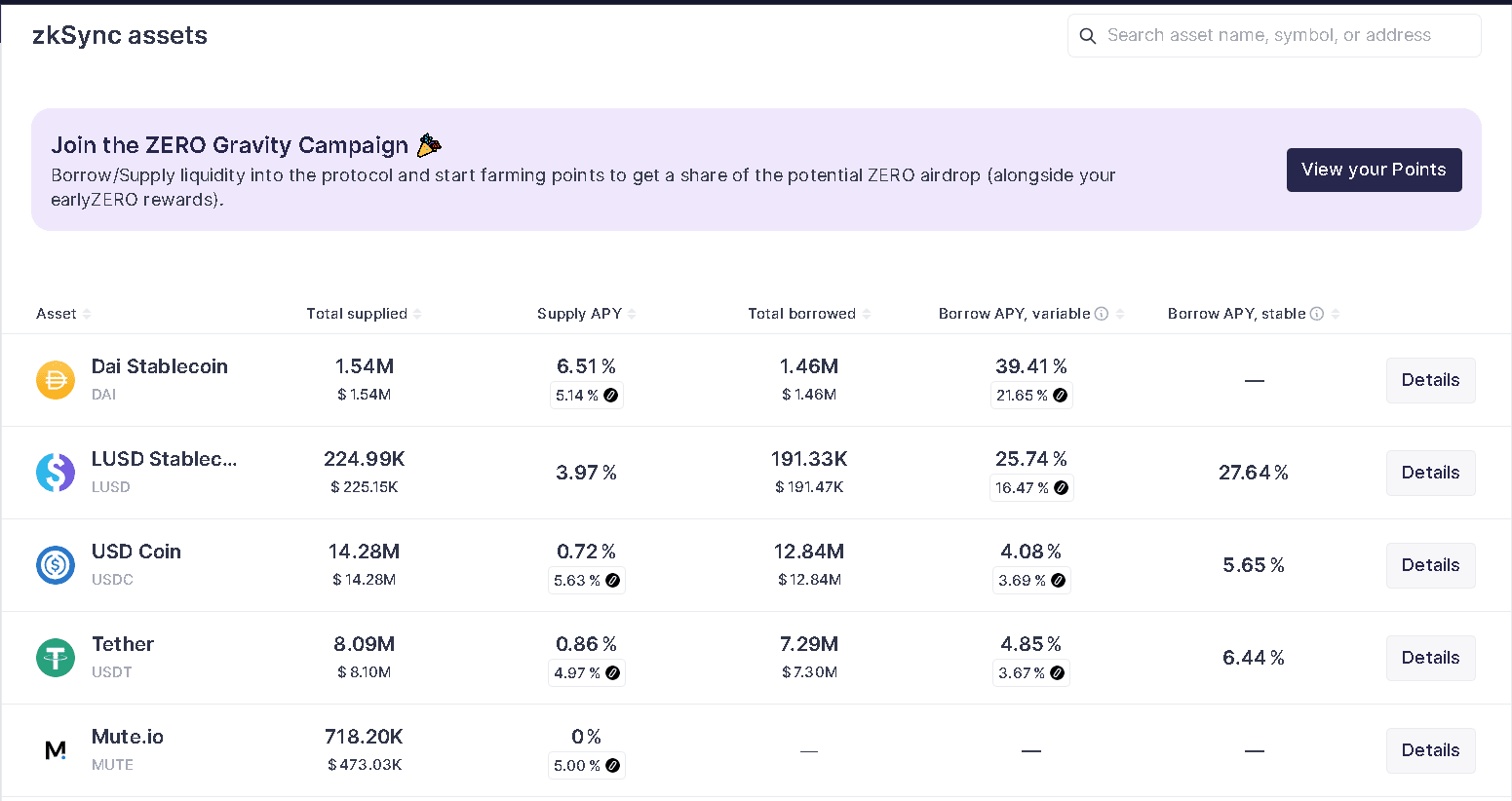
According to Zero Gravity’s yet-to-be-opened plan, in addition to PYTH stakers, MAHA, AAV, and LQTY/LUSD stakers also have the opportunity to earn points.
Additionally, any user who interacts with the lending protocol through the lending protocol will be eligible to receive a predetermined number of ZERO tokens as rewards. To allow for pre-TGE mining, users who provide liquidity can claim earlyZERO, a non-transferable ERC20 token that users can claim from the farming portal before the TGE.
Development Roadmap
The ZeroLend protocol roadmap consists of 6 unique phases. Currently, Phase 0 has been completed and we are in Phase 2, Phase 1, launching the lending protocol on zkSync and starting the pre-mining of tokens.
In Phase 2, ZeroLend will launch public and private sales and a Token Generation Event (TGE), after which ZERO will be available for trading on DEX and CEX. In this phase, various incentive mechanisms come into play. This includes staking, liquidity mining, etc. to further develop the protocol. This phase has been scheduled for Q1 2024.
In the rest of 2024, ZeroLend is expected to achieve Phase 3 and Phase 4. That is, it focuses on integrating real-world assets (RWA) such as treasuries, bonds, and real estate, thereby integrating traditional financial assets with the efficiency and accessibility of DeFi lending. Subsequently, based on account abstraction and zk hyperchain, it is committed to achieving low gas fees and enhancing user privacy, in line with the vision of providing an economical, efficient and secure DeFi environment.
In 2025, ZeroLend will focus on global expansion, aiming to position itself as a strong competitor to traditional banking by entering international markets and expanding its DeFi services around the world.