
Author: nobody (Twitter: @defioasis)
Disclosure: As an individual investor, the author holds NFT platform tokens and other related assets and has no interest in any platform or project.
This article is the second part of the study on the survival status of NFT trading platforms, exploring the difficulties and breakthroughs of trading and mining platforms LooksRare and X2Y2, and whether to just sit back and wait or go ahead.
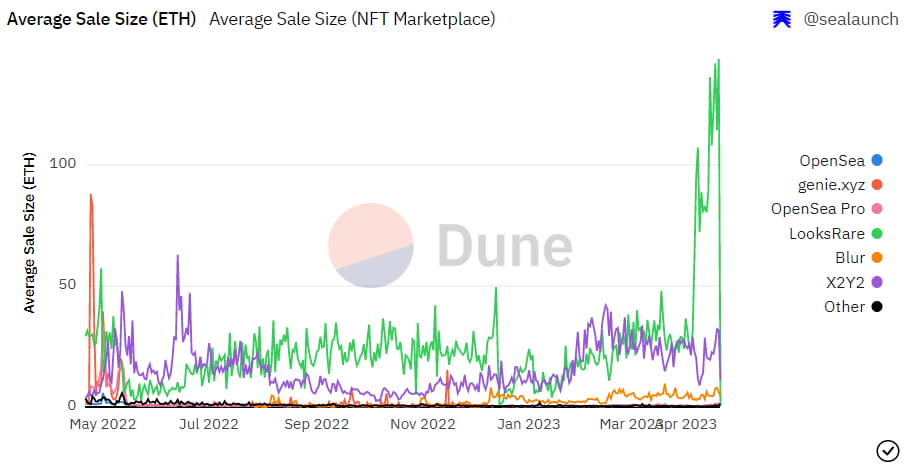
LooksRare and X2Y2 are representatives of the transaction mining model and are also the earliest practitioners and continue to this day. The distinctive feature of the transaction mining platform is the extremely high unit price of each transaction. In a bear market, this feature is also deeply reflected in the very small number of users, but it supports a huge platform transaction volume. @SeaLaunch_ data shows that for a period of time in April, the average transaction volume of LooksRare could exceed 100 ETH. Even under normal circumstances, the average transaction volume of LooksRare and X2Y2 is between 20-30 ETH. This is almost 40–60 times faster than OpenSea.
The core logic of transaction mining is not complicated, that is, 100% of the platform fees paid for each transaction are captured by the token pledger. Generally speaking, the team/foundation or treasury will retain some tokens to pledge and share the captured platform fees, so as to support the development of the protocol. In theory, the greater the transaction volume created by the platform, the more tokens users pledge, the greater the platform fees absorbed, and the more fee rewards captured. Therefore, transaction mining is easy to form a positive drive in the early stage from 0 to 1, obtaining airdrops for trading, the increase in transaction volume brings about an increase in platform fees, platform fees are captured by pledgers, the APY of pledge income increases, the token price rises, and the potential reward value of transaction mining increases, attracting more users to engage in transaction mining. However, with the depression of the overall environment, the emergence of competitors, changes in market share, and the reduction of token production, this set of transaction mining model can easily bring a negative spiral to tokens in turn.
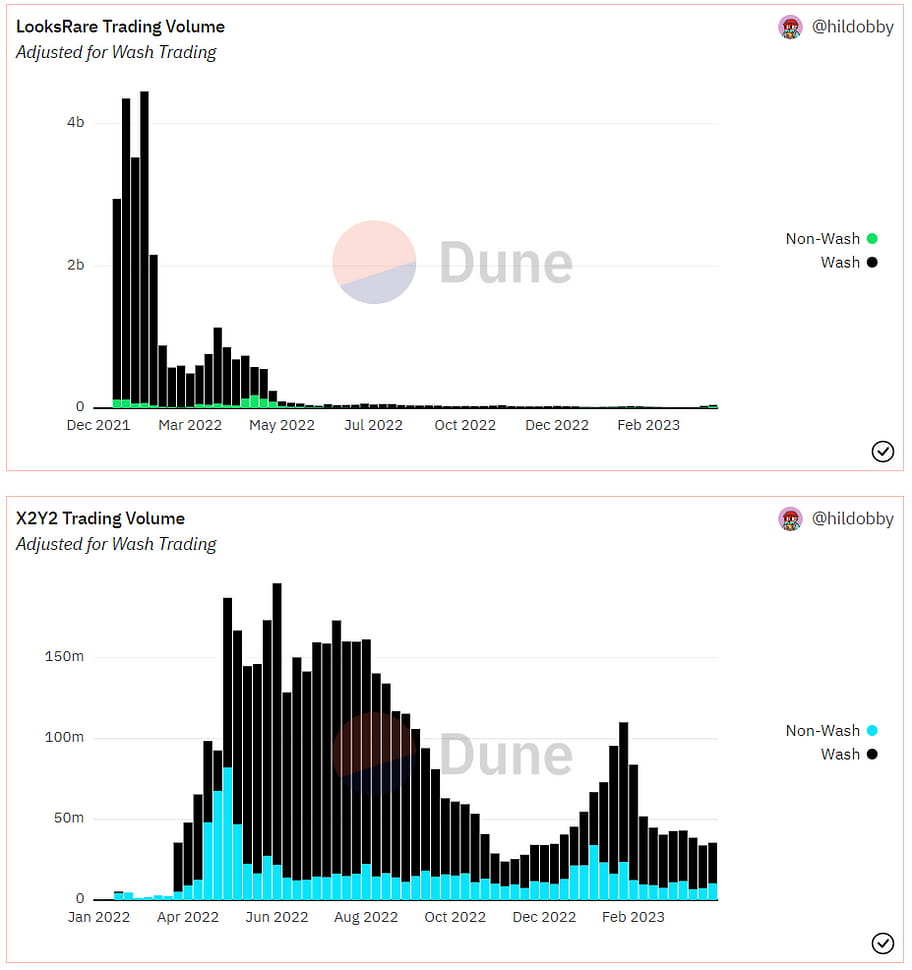
Wash-trade in trading mining is not as complicated as Blur. Most of them are large investors who trade back and forth in several wallets under their control. As long as the subsidized tokens can cover the pre-paid platform fees, it is profitable. Moreover, the subsidies are settled daily. After receiving the tokens, there will be almost no excessive loyalty. They will sell them as soon as they get them to recover the cost, and then weigh whether to continue selling the profits or pledge them for reinvestment. @hildobby_ The data panel shows that in the trading volume of last week (4.10-4.16), LooksRare's cumulative trading volume was $47,903,449, and wash-trade accounted for 45.6%; X2Y2's cumulative trading volume was $36,039,982, and wash-trade accounted for 69.6%. This wash-trade-based trading mining activity has brought continuous selling pressure to the platform tokens amid the sluggish demand in the bear market. The performance of LOOKS and X2Y2 has been difficult to describe for a long time, especially for X2Y2 which lacks market makers.
The long-term decline in token prices without support has brought a lot of negative emotions and FUD to the community, which is particularly evident in communities dominated by Chinese. However, even if it falls, unless the project party reshapes the token economics, it will be difficult to abandon this transaction mining model immediately in the short term, because the project party’s source of income is almost entirely dependent on the fees captured by the retained staked tokens. Therefore, if the token utility is not reshaped in token economics, and transaction mining is blindly cancelled, it will undoubtedly cut off one’s own source of income.
However, as more tokens are produced and flow into the market, it becomes more difficult to modify the token economics. According to Token Unlock data, 81.35% of LOOKS are currently in circulation and are expected to be fully produced on March 1, 2024; 72.17% of X2Y2 are in circulation and are expected to be fully produced on April 3, 2024. With less than a year left in production, that is, less than a year of incentives for mining, and as the reduction in production rewards continues to decrease, the two major exchanges that focus on trading and mining are in urgent need of finding new survival opportunities and development directions to regain market share.
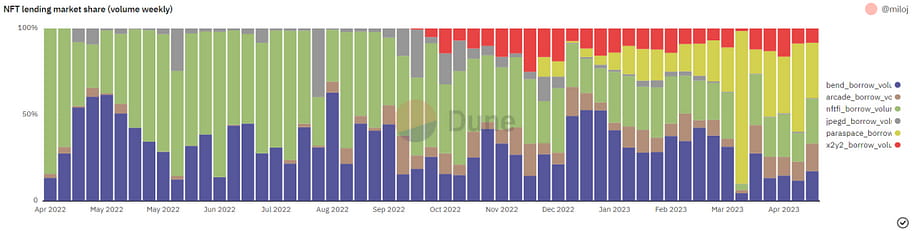
Under the situation of internal and external troubles, the two may be heading in different paths. X2Y2 is rethinking its market positioning, shifting from a single spot trading platform to a full financial ecosystem based on NFT. X2Y2 Loan is the first step and an important layout in NFTFI. Currently in the field of NFT lending, X2Y2 Loan occupies about 10%-15% of the market share. The second step is to expand allies and expand the ecological function circle with X2Y2 as the core. Dew, a transaction aggregator for NFT Traders based on Polygon, is the first partner, and it is expected that more partners representing a certain segment of NFT will join in the future. NFT futures contract trading may also be introduced in the future. However, due to the lack of communication with community users, users may not understand the change in strategic thinking, resulting in a large amount of community FUD, which is a point that the X2Y2 team urgently needs to reverse.
LooksRare is different. It is still more focused on the platform itself. Its current situation is relatively better than X2Y2, so it is relatively flat. This is first of all due to LooksRare's long-term good maintenance of the DeFi OG user group, which can be seen from the fact that BitMex CEO Arthur Hayes often intentionally or unintentionally calls orders in his blog. In addition, in my opinion, in the royalty war, LooksRare is relatively low-key, well preserved its strength, and has not lost too much user goodwill. Here is a very profound example. When Blur released an airdrop and published a blog post to officially declare war on OpenSea, X2Y2's untimely intervention made it the object of ridicule. This was originally a head-on confrontation between Blur and OpenSea, allowing users to choose between two options, and there was no direct collision with other platforms. However, at this time, X2Y2 suddenly intervened and said, "You can choose neither of them, choose me." Blur dared to challenge at this time because most of the core data levels have been close to or even exceeded OpenSea, and the core users are inseparable to some extent, so it has the strength to challenge. At that time, trading mining had already declined, and various data were far behind. To put it bluntly, X2Y2 was not at the same level as Blur and OpenSea at that time. The unclear market positioning and blind intervention brought negative effects. LooksRare did a better job in "watching the show" and choosing, and it was undoubtedly correct not to participate in the final showdown between Blur and OpenSea. Later, LooksRare and Blur jointly announced that by default, the marks of third-party platforms (including OpenSea blacklist marks) would not be displayed in the UI, which attracted the favor of many users. Today, LooksRare has also developed an APP terminal following the example of OpenSea, and a transaction aggregator similar to Blur is also in internal testing.