

Are you wondering what art tech trends and startups will soon impact your business? Explore our in-depth industry research on 1,253 art tech startups and scale-ups and get data-driven insights into technology-based solutions in our art tech innovation map!
While the worlds of art and technology are often separate, the post-pandemic impact is prompting businesses to rethink their hybrid potential, and the continued digitization of society is opening up new horizons for art through virtual worlds and new ways of transacting, start-ups and scale-ups. Businesses are bringing technological advancements like digital art, non-fungible tokens (NFTs), gamified museums, and 3D artwork scanning.
This article outlines the top ten global art tech trends for 2023, they range from blockchain and immersive technology to big data and robotics, read more to explore the latest developments in the art industry and how they can impact your business.
Innovation Map outlines 10 art-tech trends and 20 promising startups
To conduct in-depth research on top art technology trends and startups, we analyzed a sample of 1,253 global startups and scale-ups.
The result of this research is data-driven innovation intelligence that improves strategic decision-making by giving you an overview of emerging technologies and startups in the arts industry.
These insights are generated in partnership with our Big Data and AI-powered StartUs Insights Discovery Platform, which covers more than 2,500,000 startups and scale-ups around the world.
As the world's largest source of emerging company data, the SaaS platform enables you to quickly and exhaustively identify relevant startups, emerging technologies, and future industry trends.
In the Innovation Map below, you can get an overview of the top 10 art technology trends and innovations impacting 1,253 companies around the world. Additionally, the Art Tech Innovation Map reveals 20 handpicked startups working on emerging technologies that are advancing their respective fields.
Top 10 Art Tech Trends for 2023
immersive technology
Blockchain
AI
Mobile Applications
3D technology
Robot Art
Art workflow platform
Art Internet of Things
art analysis
Digital Collection Management
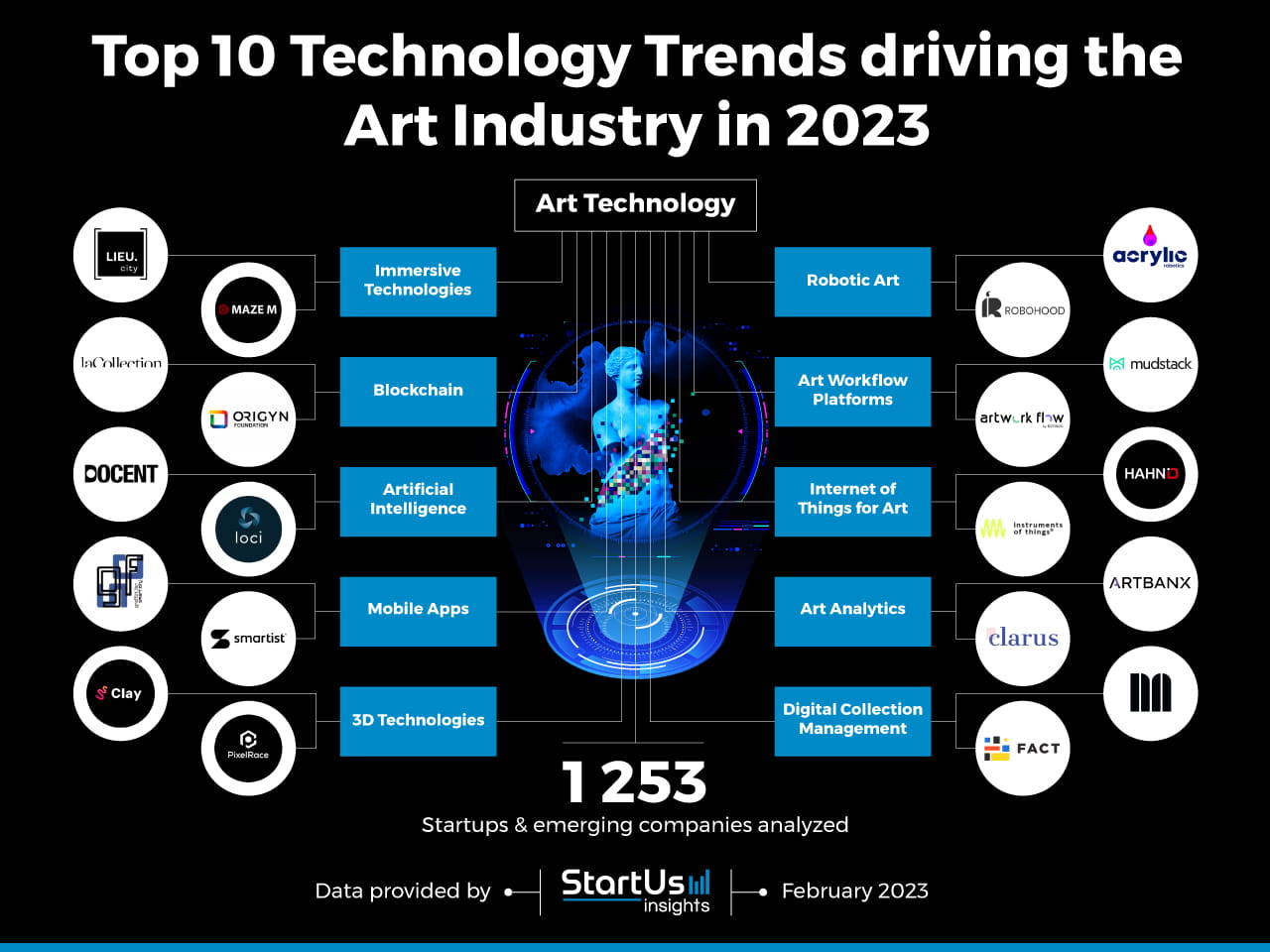
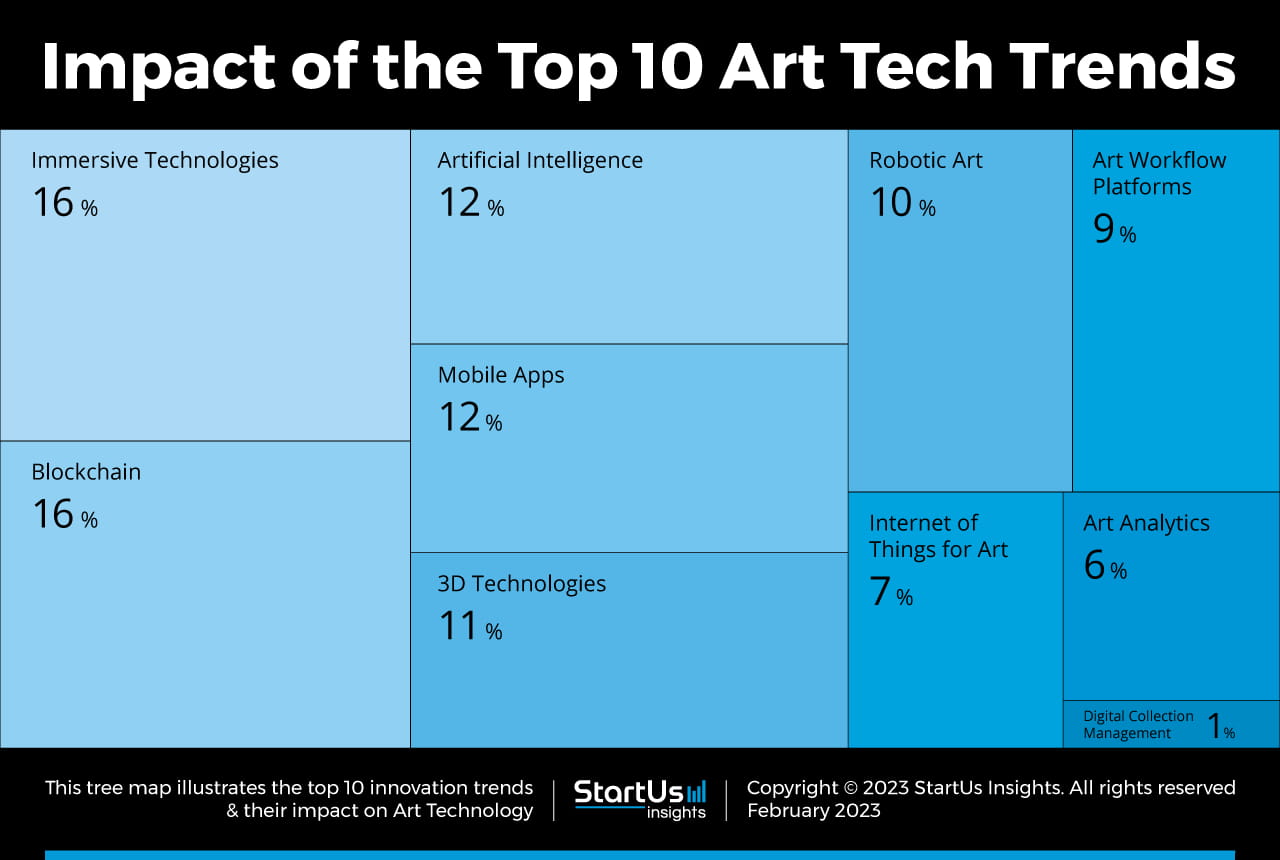
Treemap reveals impact of top 10 art tech trends
Based on the ArtTech Innovation Map, the tree diagram below illustrates the impact of the top ten ArtTech trends in 2023.
Startups and scale-ups are developing blockchain solutions to protect artworks from fraud and develop NFT-based trading systems.
Immersive technologies and mobile apps help artists and museums create virtual multi-sensory experiences.
With 3D technology, artists can improve their techniques, and museums can scan artworks for further preservation.
Other technologies, such as artificial intelligence (AI) and state-of-the-art analytics, provide market and visitor insights to support investors in developing financial strategies.
At the same time, digital collection management and robots simplify the creation, processing and archiving of art for collectors and dealers.
Finally, art workflow platforms and the Internet of Things (IoT) assist art enterprises with data management.
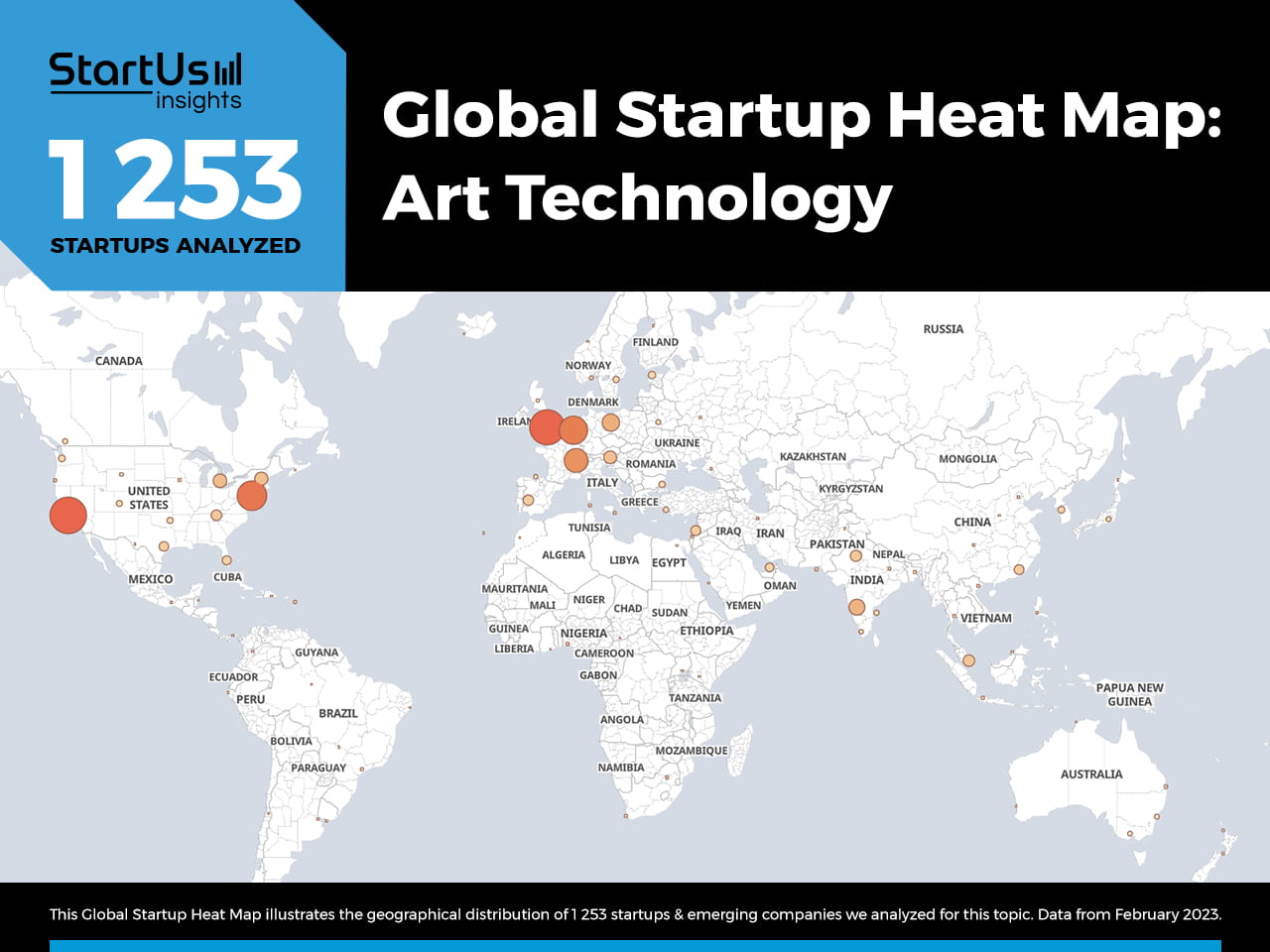
Global startup heat map covers 1,253 art tech startups and scale-ups
The global startup heat map below highlights the global distribution of the 1,253 typical startups and scale-ups we analyzed for this study, with the heat map created through the StartUs Insights Discovery Platform showing that Western Europe and the United States have the most startup activity.
Below, meet 16 of these 1,253 promising startups and scale-ups, and the solutions they develop.
These art tech startups are handpicked based on criteria such as year of founding, location, amount of money raised, and more, and your top picks may look completely different depending on your specific needs.
1. Immersive technology
The development of immersive technologies has transformed the art market by enabling multi-sensory experiences, and extended reality (XR) plays a key role in virtualizing museums and exhibitions, a process accelerated by the pandemic.
With VR, art lovers can explore their favorite artworks from home at a significantly reduced cost, and AR and the Metaverse expand the interaction between artist and audience by taking works outside of traditional spaces.
It also makes the arts more accessible to people with disabilities by creating virtual versions of museums, events, concerts and performances.
Additionally, artists develop new media concepts and installations that are more participatory and interactive, such that immersive approaches allow museums and artists to engage new audiences and build emotional engagement.
As a result, immersive technologies increase engagement and generate new revenue streams.
Maze-M simplifies museum gamification
Bulgarian startup Maze-M has created a platform to enhance museums with immersive video games, offering custom end-to-end AR and VR-based content development, 3D art modeling, 2D animation, character design, and more.
For example, as users explore ancient ruins, they also search for NFT artifacts around cities, and these carefully designed gamified environments enable museums and cultural sites to protect heritage values.
Additionally, this allows them to deliver an at-home experience and appeal to a wider and younger audience.
LIEU.city launches VR exhibition
Italian startup LIEU.city has developed a software program to generate VR exhibitions, creating virtual rooms in which artworks curated according to museum preferences are hung.
In addition, the startup provides museums with 3D models of real locations, guided tours and interactive teaching for young enthusiasts.
In this way, LIEU.city enables museums to create fully immersive virtual spaces while reducing travel, accommodation and setup costs.
2. Blockchain
One of the biggest challenges facing the art industry is verifying the authenticity and provenance of artworks, and to overcome this problem, startups and scale-ups are offering secure cryptography and smart contracts.
These advancements improve the traceability of high-value artworks by converting them into NFTs. Blockchain solves counterfeiting issues and ensures intellectual property protection by storing copyright information such as records, certificates, appraisals, etc. Cryptocurrencies also enable secure purchases. , trading and auction methods.
For example, museums and galleries can raise funds through fractional ownership without high-interest loans, and furthermore, the anonymity of blockchain transactions allows traders to operate privately.
Blockchain thus advances digital art by allowing artists, collectors, and investors to easily and transparently monetize their works.
laCollection creates an NFT platform
French startup laCollection connects art institutions with collectors through its NFT platform. It uses digital lithography to create digital twins of artworks. The platform then issues authenticated NFT certificates for these digital versions, which allows collectors to Featuring blockchain-certified art from museums, galleries and artists around the world.
In doing so, laCollection creates virtual ownership through alternative ways of buying, selling, and auctioning art, and in addition, NFTs attract new audiences and younger generations to museums, solving demographic issues and creating new revenue streams.
ORIGYN generates NFT biometric certificates
Swiss startup ORIGYN authenticates artworks using the owner’s biometric information, and the startup’s decentralized platform generates NFT certificates through digital twins.
It runs on the Internet Computer (IC), an Internet-scale and network-speed public chain with advanced cryptography, IC hosts large amounts of data in smart contracts, so all processes are in the blockchain.
Additionally, art experts verify the casting process, increasing transparency and trustworthiness.
In this way, ORIGYN enables digital media and collectibles stakeholders to offer fractional NFT ownership to a broader investor base.
3. Artificial Intelligence
Artificial intelligence is streamlining repetitive production processes and data processing workflows faster in the art industry. New forms of generative AI imitate painting styles and even create new styles. GPT3 AI Dall E is how artificial intelligence generates original works of art. A great example.
This helps amateurs produce images, sounds and text in less time, pushing the boundaries of human creativity. Machine vision can also identify, classify and recommend artworks based on user preferences.
In addition, startups have developed chatbots and analytics tools to improve the visitor experience in museums and art galleries. For example, AI can predict the number of no-shows and adjust ticket numbers in advance to increase capacity.
AI-driven digital twins preserve and replicate delicate objects through photogrammetry. In this way, AI enables museums and art collectors to eliminate inefficiencies and realize cost savings in art management.
Docent provides ML-based art recommendations
French startup Docent applies machine learning to create personalized art recommendations. The startup obtains reliable and accurate information about the artist to train the algorithm. Its computer vision algorithm then evaluates aesthetic and visual characteristics.
By incorporating natural language processing (NLP), algorithms analyze text-based information to capture themes and themes in artistic practice.
In this way, docents can enhance understanding of contemporary art and help institutions and private collections increase audience interest.
Loci enables automatic 3D asset search
UK startup Loci uses AI to automatically discover 3D assets. The startup’s solution allows users to tag, search and recommend 3D assets through a flexible taxonomy.
It also features a neural search engine that returns relevant results without manual tagging, plus a visual search that finds 3D assets based on uploaded images of the desired object.
In this way, Loci’s solution automatically interacts with visual assets, saving 3D artists significant time in categorizing and organizing their workflow.
4. Mobile applications
The expansion of wireless connectivity has opened up new opportunities for the art world by moving experiences to mobile devices, with 5G’s high data speeds and low latency making smartphone-optimized art more accessible.
5G-enabled mobile apps offer secure, customizable and engaging features such as extended reality and interactive maps with artist and artwork information.
5G also enables IoT networks to communicate effectively across devices, improve audience engagement and provide customer-specific data.
Graffiti for Smart City offers 5G-enabled digital murals
Italian startup Graffiti for Smart City installs 5G-enabled digital murals in cities. To form smart walls, the startup uses thin bio-based tiles, and 5G allows for quick connection to them via smartphones, thus embedding the Internet of Things. Murals allow users to discover points of interest, receive information, and more.
In addition, users can digitally paint on city walls, create art and share it, so 5G digital murals enable city managers to redevelop urban areas, create communities and provide services to citizens.
Smartist builds an art display app
US-based startup Smartist has developed an app that places artwork in a realistic and customizable environment. Users upload artwork and the app's smart crop feature straightens it without distortion.
Additionally, the app supports over 200 environments with editable wall colors, floor textures, and lighting, while providing multi-angle previews and automatic shading adjustments.
This approach simplifies photorealistic online visualizations for artists to enhance their marketing strategies and increase sales.
5. 3D technology
3D modeling, scanning, printing and engraving bring new opportunities to the creative industries, from 3D artwork models to 360-degree storytelling, 3D technology increases satisfaction and audience engagement.
In addition, curators and historians use high-resolution 3D laser scanning to record the colors and geometry of paintings, which allows them to preserve high-resolution information digitally.
Together with 3D printing, museums are able to process, archive and reproduce artworks more efficiently, and it is particularly useful for addressing cultural heritage sites in construction and restoration projects.
Additionally, 3D printing makes labor-intensive tasks for visual artists and sculptors less time-consuming, so 3D technology can help artists, collectors, museums, and art handlers scale up creative industries in a fast and safe manner.
Clay delivers collaborative 3D design software
US startup Clay offers collaborative 3D design software for artists, which allows users to organize, share and view 3D models in a centralized way.
The platform also enables artists to leave notes and drawings without sending screenshots, speeding up communication.
Additionally, users control access to internal and external collaborators to protect visible and editable content, so artists can create 3D models in real time, accelerating content production workflows.
PixelRace creates 3D scanned film assets
Polish startup PixelRace provides virtual filmmaking technology for 3D scanned products. Real-time virtual production consists of computer-generated photorealistic environments, rendered and synchronized with physical sets.
To create high-quality 3D scans, the startup uses Unreal Engine.
As a result, PixelRace makes filming easier, resulting in shorter filming times, fewer staff, and lower production costs.
6. Robot Art
Robotization offers novel forms of art creation, from music-playing robots to robot painting and choreography. Combining AI and ML, startups train robots to learn, analyze, and collaborate with human artists to replicate painting styles.
In addition to creating art, humanoid robots help museum visitors navigate, eliminate language barriers and facilitate knowledge sharing.
Additionally, robotics makes it possible to reconstruct broken artifacts from archaeological sites.
All of these advancements enable artists, curators, and museums to enhance their portfolios while making them more cost-effective.
Robohood offers robot painting
US startup Robohood develops robotic painting technology using AI algorithms. The startup's robots work in neuro-impressionism, where AI-powered computer vision evaluates digital images.
Algorithms then convert the images into strokes by programming the robot's movement path. Additionally, the technique includes schedulers and camera corrections to improve results.
Thus, Robohood enables artists to shorten the time from idea generation to implementation.
Acrylic creates textured paintings
Textured paintings are produced by Canadian startup Acrylic, which helps digital artists with robot-drawn creations.
Its technology trains robots to capture and reproduce an artist's painting style, including stroke sequence, pressure, tone and speed. This robot-enabled approach enables artists to transform their artistic processes in a fast and cost-effective way.
7. Art Workflow Platform
Cloud computing simplifies creative workflows and cross-platform collaboration in the art industry, with some solutions enabling digital asset management, real-time project communication and online proofing, through which designers and artists can easily store, access and share files.
Second, cloud-based tools provide an efficient way to accurately review, approve, and edit artwork, which is critical to project finalization.
In addition, cloud platforms provide secure storage for sensitive data, reducing data loss or theft.
The cloud-based art workflow platform improves collaboration, efficiency and accessibility of project data, making it more cost-effective and scalable.
Mudstack simplifies art asset management
US startup Mudstack provides an asset management and collaboration platform for digital artists. It combines cloud storage and provides an all-encompassing view of content, allowing creators to easily find and access their files using tags. The platform’s cross-file compatibility also Supports quick access to information.
As a result, Mudstack helps artists organize their assets and pipeline faster to eliminate process bottlenecks.
Artwork Flow provides a creative SaaS platform
Asset management, online proofing and creative collaboration are streamlined by US startup Artwork Flow, the startup's cloud-based team platform that reviews and approves creative projects in real time.
It centrally manages items such as artwork, labels, symbols, marketing materials, and more. The platform also features digital asset management, collaborative creative, brand consistency, and asset verification tools.
They streamline the creative process, helping design teams complete projects and launch products faster.
8. Art Internet of Things
Art IoT refers to the use of connected devices, sensors, and other devices in the art ecosystem that enhance communication with artworks, generate new art forms, and increase visitor engagement.
For example, interactive exhibitions apply smart sensors that respond to the viewer's movements to provide an immersive experience, and artists also use them to create responsive smart sculptures that change color or shape based on external input.
Additionally, IoT sensors monitor the museum environment to protect, preserve and store artworks according to regulatory conditions.
Overall, IoT helps artists, curators, and museum staff expand interactions and manage artworks in an efficient and reliable manner.
HAHN ID makes smart museums possible
German startup HAHN ID provides IoT technology to support smart museums. Its solution Global Artwork Monitoring consists of connected sensors for motion detection, climate monitoring, inventory management and interactive communications that ensure security by alerting staff to potential risks. Security of cultural relics and works of art.
They also monitor temperature, humidity, light, gases and fine dust to prevent damage. By using radio technology, museums are able to locate objects without contact, prevent theft and optimize staff work.
Overall, HAHN ID’s solution improves the performance of daily tasks while reducing costs for museum owners.
Instrument of Things makes motion music sensors
German startup Instrument of Things develops wearable IoT motion sensors that convert artists' movements into music, with its product SOMI-1 measuring multi-directional motion, tilt angle and acceleration to convert them into sound parameters in real time.
The startup's hub then captures the motion data via Bluetooth to connect to the user's music software, hardware, or mobile device.
In this way, Instrument of Things enables artists, performers, dancers and musicians to collaborate and expand artistic expression.
9. Artistic Analysis
Opacity, volatility and knowledge dependence are one of the main characteristics of the art market. Big data evaluates artwork value data while taking into account multiple variables such as artist performance, rarity, technology, conditions, materials, etc.
Based on data sets collected from social media and user-generated websites, the startup also predicts market trends and measures intrinsic value, which enables art institutions, dealers and artists to discover new business models, increase art sales and reduce investment risk.
ARTBANX provides art market data analysis
Swiss startup ARTBANX combines multiple data streams and machine learning to provide data analytics on the art market, which is difficult to assess compared to other industries due to multiple documentation systems and private art sales.
To solve this problem, the startup’s platform uses historical data from artists’ performances and sales to accurately assess and predict art value in real time. The platform also provides art pricing, market trends and forecasts, and private collection insights.
In this way, ARTBANX helps artists, collectors and financial institutions maximize returns through data-driven strategies.
Clarus provides social media insights
US-based startup Clarus builds an art discovery and data analytics platform to assess the value of art collections, connecting data from the real world and social media to analyze an artist’s influence.
The platform’s Social Insights feature tracks the social media interactions of over 250,000 artists, which helps stakeholders identify emerging artists and trends, enabling gallerists, collectors and dealers to improve decision-making.
10. Digital Collection Management
With massive digitization, art management is undergoing a major update, with novel tools simplifying inventory management through instant catalogs and optimized search engines.
For example, the Data Fabric collects relevant information about objects and artifacts presented in a way that is accessible to visitors and researchers, digital archiving digitizes works to protect them from damage, and automated reporting documents artwork condition, shipping history, and handling Require.
Additionally, along with cloud computing, such platforms become more resilient, agile, and secure.
In this way, digital collection management provides collectors with a more organized, cost-effective, and secure way to maintain their art.
Navigating.art builds a digital collection management platform
German startup Navigating.art has developed an all-in-one digital collection management platform that helps build, organize and preserve large amounts of digital archival materials.
Digital cataloging captures and stores object information through a guided process, while digital display tools publish artwork information on a responsive website. The platform includes the necessary functionality to efficiently handle inventory, condition reports, insurance, loans, publications, and more.
For example, it connects catalog facts with images and archival materials to draw evidence-based conclusions.
In this way, Navigating.art enables collectors and arts organizations to reduce publishing and maintenance costs.
FACT advances forensic arts certification
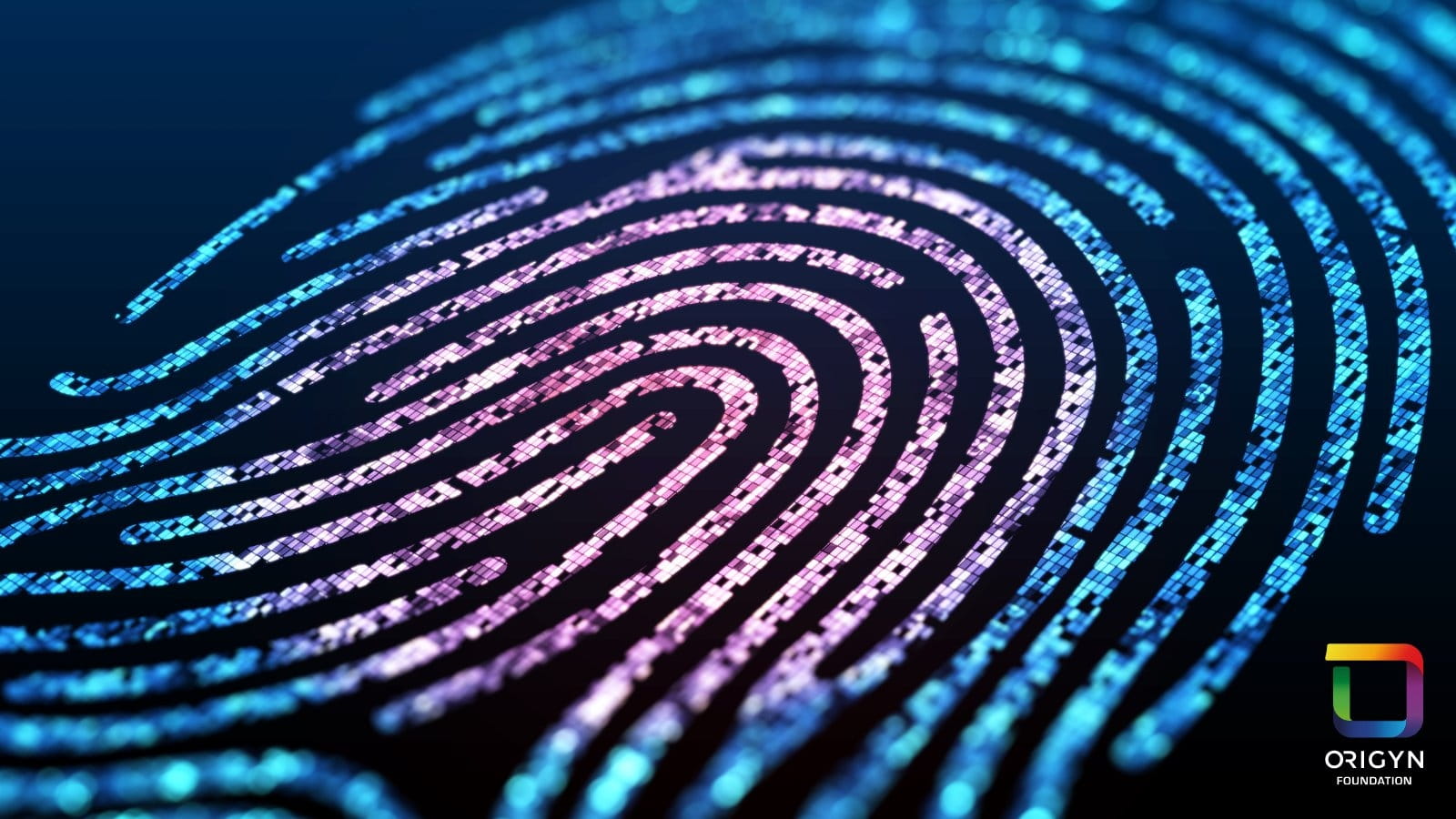
Canadian startup FACT leverages forensic imaging for collection management of fine art and collectibles, with the startup’s security device capturing, analyzing and storing ultra-detailed 3D digital fingerprints.
These fingerprints are topographic maps detailed down to the roughness of brushstrokes. Using non-contact, non-destructive white light interferometry, the device scans the artwork and then software evaluates them to estimate surface changes, wear and degradation.
Finally, the startup automatically reports artwork condition data and stores it on the blockchain.
This allows artists, collectors, dealers and auction houses to avoid damage prior to sale, thus adding value to potential buyers.
Discover all the art tech trends and startups
As the connection between art and technology continues to deepen, new ways of making art are emerging, with generative artificial intelligence, robotic dance and multi-sensory installations just to name a few examples.
Additionally, art analytics provide objective estimates of the art market for profitable financial investments, and advances in immersive technology, 3D, and gamification will lead to dematerialization through vivid sensory experiences.
The art technology trends and startups outlined in this report only scratch the surface of the trends we identified in our search for data-driven innovation and startups, among which blockchain, artificial intelligence and virtual reality will transform the industry as we know it today .
Identifying new opportunities and emerging technologies to implement into your business can go a long way in gaining a competitive advantage, get in touch and find the startups, technologies and trends that matter to you easily and in detail!
IC content you care about
Technology Progress | Project Information | Global Activities
Collect and follow IC Binance Channel
Stay up to date with the latest information