

Author: Satoshi
Ordinals has recently attracted attention in the crypto world. After OKX announced that its on-chain wallet began to support Ordinals, Binance immediately tweeted "Ordinals, made simple". With the participation of Web3 giants, the "Summer of Ordinals" may be coming soon.
Among the many PFP projects based on Ordinals, BTCDomain is a rare Ordinals domain name project. In short, BTCDomain provides a user experience similar to ENS while remaining completely based on Bitcoin. If Bitcoin remains a blockchain with more consensus and security than Ethereum for a long time to come, does BTCDomain have the potential to compete with ENS, the leading Ethereum domain name?
What are Ordinals and Inscriptions
To better understand Ordinals, we need to introduce the concept of inscription, which is similar to NFT and stores all data permanently on the first layer of Bitcoin. To better illustrate what inscription is, we can use the inscription of .btc as an example. Query any domain name on the BTCDomain official website, such as satoshi.btc, and click the hyperlink of the inscription id to which the domain name belongs, and you can jump directly to the ordinals browser.
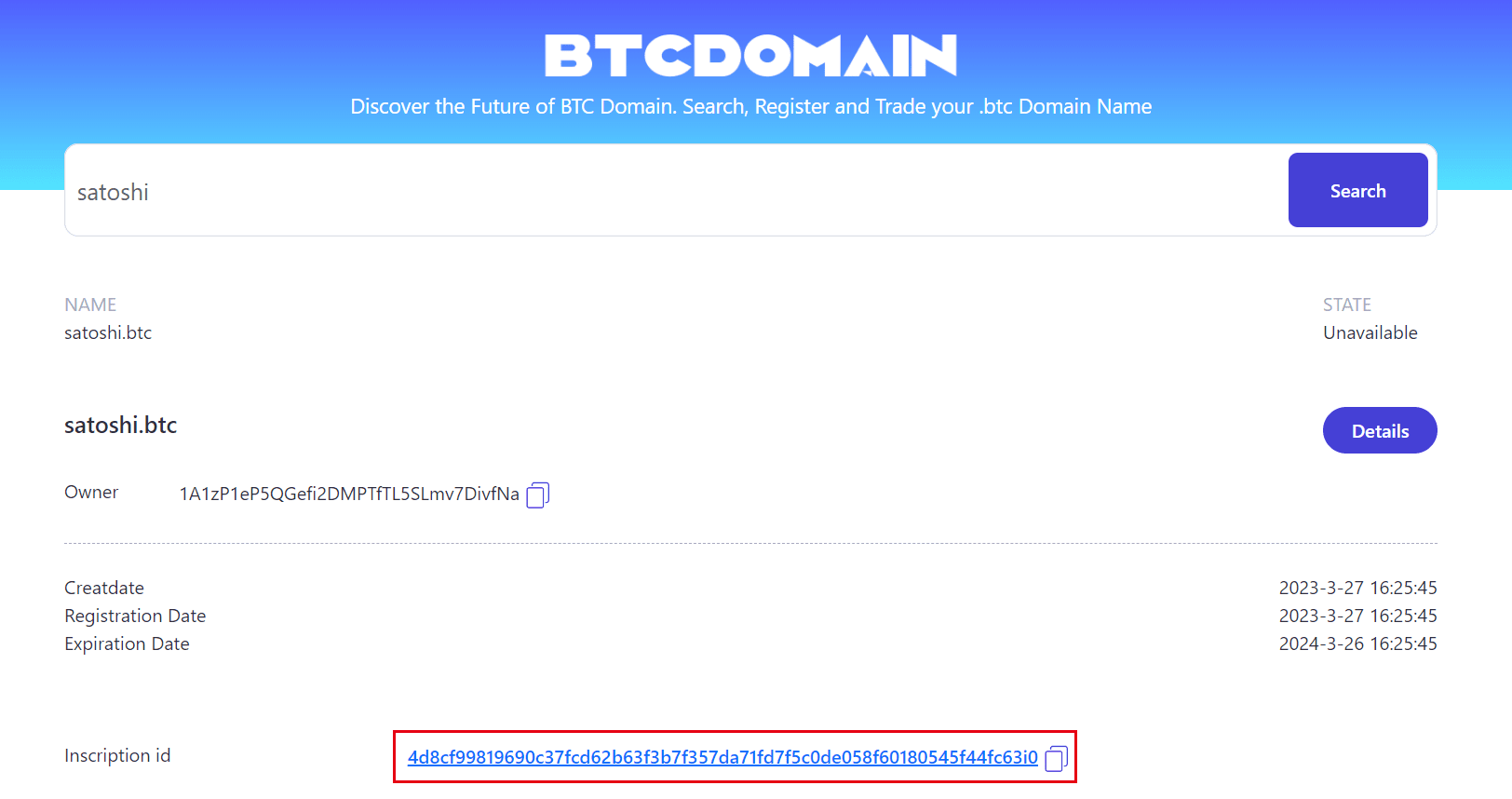
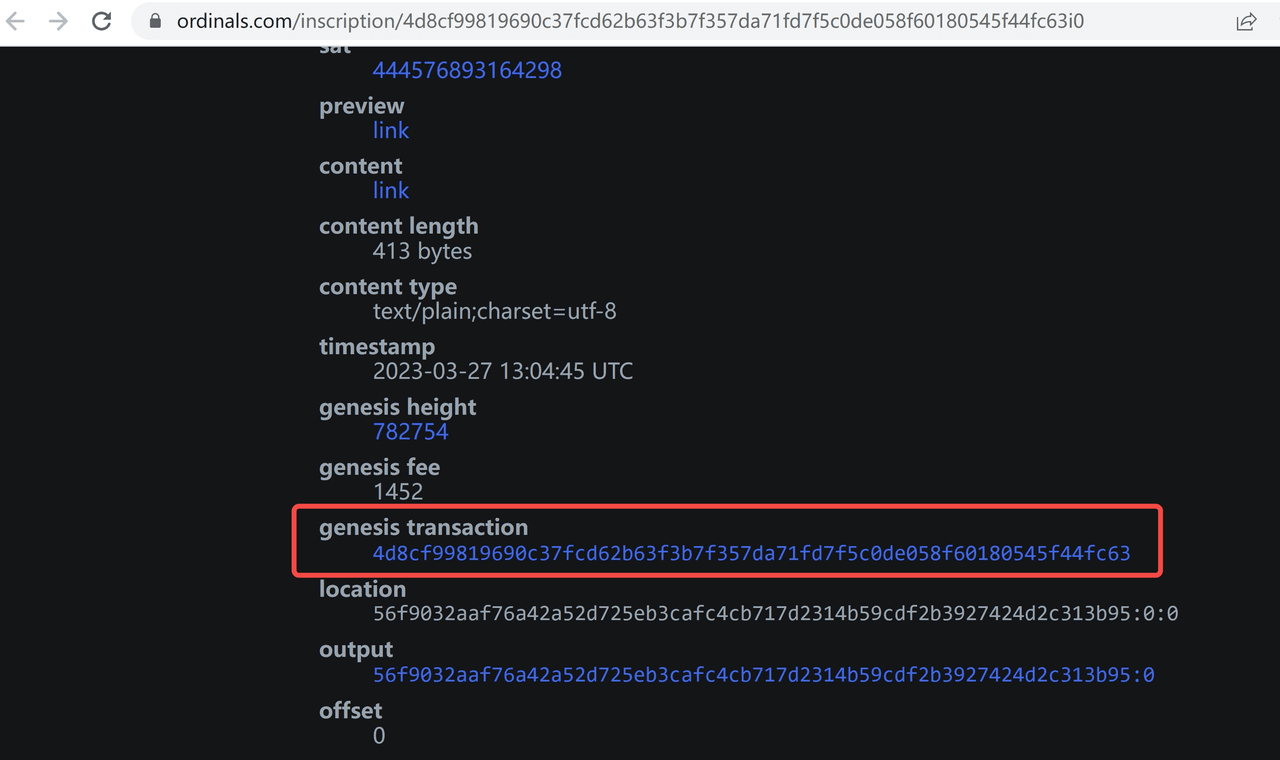
Since the satoshi.btc domain itself is an Ordinals inscription, you can view its details in Ordinal Explorer and get the Genesis transaction hash (4d8c...fc63) on this page.
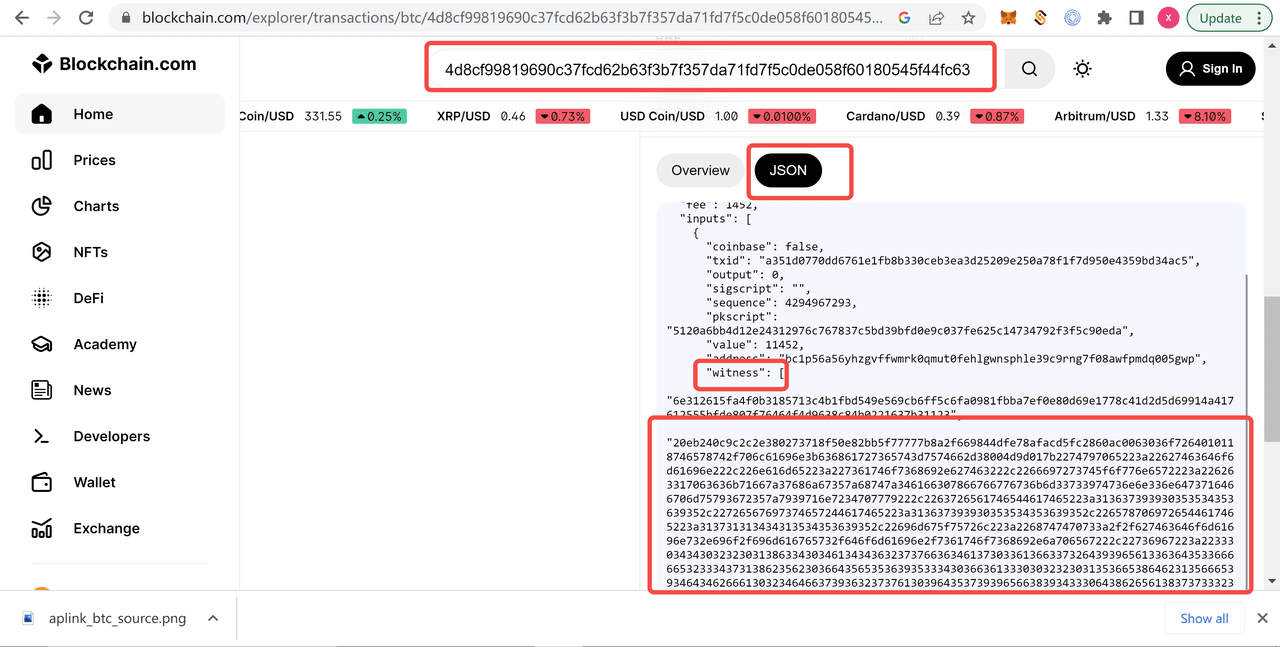
Paste the hash of the genesis transaction into a Bitcoin browser to view the raw data in json format. Copy the second part of the "witness" (20eb...d68), which is a hexadecimal text. Paste it into a hex to string tool to decipher the information engraved on the Bitcoin mainnet by BTCDomain.
It can be seen that the content of the satoshi.btc domain name engraved on the Bitcoin mainnet includes important information such as "name", "first_owner", and "expireDate".
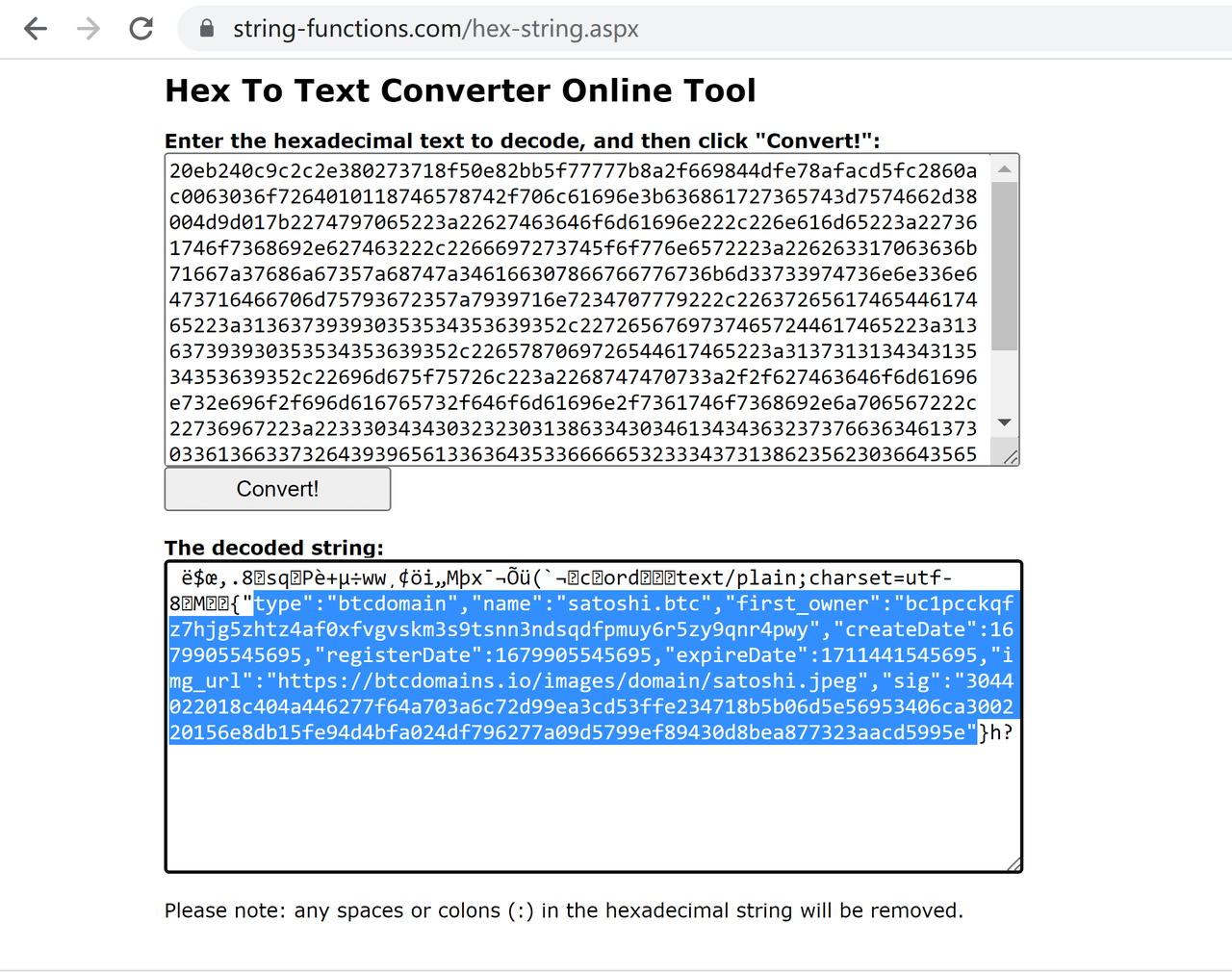
This small experiment can prove that all BTCDomain metadata is engraved on the Bitcoin chain. As long as Bitcoin exists, Bitcoin domain names can always be searched and used. Ordinals brings us a safe and reliable domain name storage solution.
Secondary market trading: PSBT
The transaction of domain name NFT is also an important part of the domain name ecosystem. As mentioned earlier, the user's domain name is associated with Satoshis through a serial number. When a user sends Satoshi to someone else, the related inscription will also be transferred. This operation makes domain name transactions easier.
In addition, "Partially Signed Bitcoin Transactions" (PSBT) is a useful feature of Bitcoin. This feature allows users to trade selected Satoshis with anyone who has a specific amount of BTC. By utilizing PSBT, they can trade domain names on trading platforms that support Ordinals technology such as MagicEden. The trading experience is comparable to Ethereum, but all transaction records and security are ultimately guaranteed by Bitcoin.
Is the BTCDomain domain name safe?
As a domain name system, BTCDomain is now fully resolvable. Users can now freely use domain names to receive and send inscriptions and bitcoins on the btcdomains.io official website. In addition, BTCDomain has built an easy-to-use domain name registration and management system. Some third-party applications are also integrating this new domain name resolution function.
Solving security issues has always been the key to the domain name system. Malicious domain name resolution can lead to huge BTC losses. Ordinals does help store data permanently in Bitcoin. However, the Bitcoin mainnet cannot run smart contracts. To achieve a completely trustless domain name resolution state, users need to build their own Bitcoin full node and Ordinals database. This requires users to have a good understanding of technology and about 7 days of preparation time. For ordinary users, this is completely unacceptable.
In this case, does it mean that there must be a trade-off between user-friendliness and security? One might also wonder how BTCDomain achieves usability on the Bitcoin blockchain, which lacks smart contracts? Does this undermine the basic trustless nature of the blockchain? Is BTCDomain an untrusted domain name system?
The answer is very clear. Even without smart contracts, BTCDomain has found a way to trustlessness by combining ZK with Ordinals.
ZK: A solution for trusted computing on Bitcoin
Zero-knowledge proof, also known as ZKP, is a very popular concept in the current crypto ecosystem. In short, ZK technology implements a trusted computing environment. It allows the program to generate a ZK proof in addition to the output. Anyone can verify the ZK proof to ensure that the program actually executed has not been tampered with and remains consistent with the open source version.
Although the computational power required to generate a ZK proof is high, almost every electronic device can afford the computing resources required to verify a ZK proof, such as a smartphone or a personal computer. The ZK algorithm effectively prevents data servers from performing unauthorized operations. You can find more details about ZK in the BTCDomains documentation.
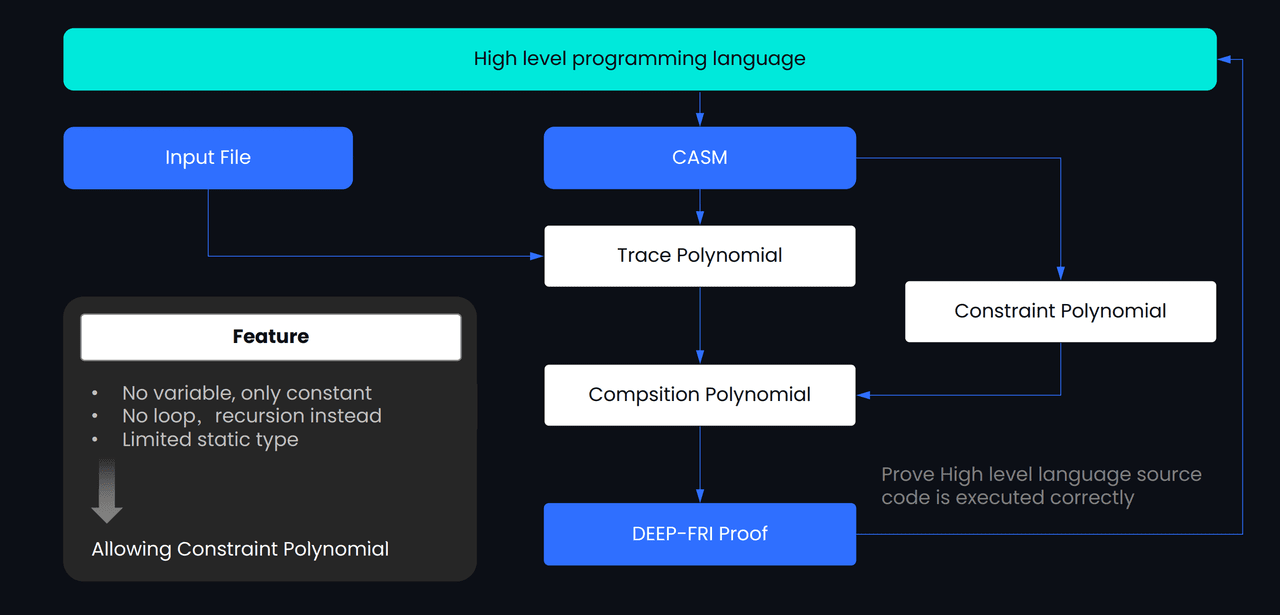
Detailed explanation of ZKVM technology under the STARK route
Combining ZK with the capabilities of Ordinals makes Bitcoin a usable data chain, creating a system similar to smart contracts that is completely native to Bitcoin. With ZK technology, users can confirm the security of the system through mathematical proof.
Therefore, ZK enables ordinary users to obtain trustless domain name resolution results without building a full Bitcoin node. In this way, Ordinals can be accepted by a wider range of users while remaining trustless.
Domain Names: The First Step to Smart Bitcoin
We have verified that BTCDomain can realize the domain name function on Bitcoin. However, domain names should not be the only application on Bitcoin. There are still many engineering problems to be solved, and many problems may also slow down the process of Bitcoin's intelligence.
However, BTCDomain has built confidence for developers that the existence of Bitcoin native trustless apps is possible. In the future, we may also see projects like Uniswap, Aave, and MakerDAO on Bitcoin. Of course, domain names are the first step towards smart Bitcoin and the identity symbol of the future smart Bitcoin chain.