

 The purpose of this article is to compare some of the main features of the following Layer 1 blockchains: Ethereum, Cardano, Solana, Binance Smart Chain, Zilliqa, Algorand, Internet Computer, and Avalanche.
 Layer 1 chains provide critical Web3 infrastructure
The blockchain trilemma
You may have heard of the famous blockchain technology trilemma: scalability, speed, and security. Many current Layer 1 blockchains solve two of these problems to a greater or lesser extent. Meeting all three requirements at the same time is complex, especially when you are trying to keep costs down at the same time.
Carefully constructed over several years by one of blockchain’s largest R&D institutions, the Internet Computer solves this trilemma better than any other blockchain, and as the following research will show, this was a fundamental reason why InfinitySwap decided to use the platform.
Although Polkadot is technically a layer 0 blockchain, referred to as a multi-chain protocol with heterogeneous sharding, it will still be included in this comparative analysis.
Comparison between Layer 1 blockchains
speed
Source: Ethereum, Polkadot, Ziliqa, Algorand, Avalanche, Internet Computer
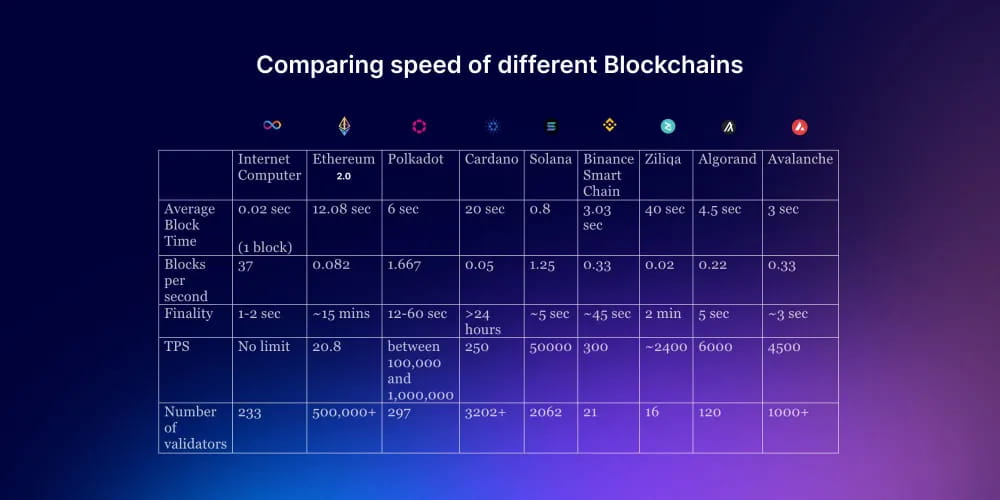
For bragging rights purposes, the parameters most cited by blockchain enthusiasts are those related to speed, which, unlike security or scalability, has easily measurable parameters that make it easier to rank the winners.
The Internet Computer takes the lead here, capable of delivering smart contracts at web speeds!
Transaction velocity is calculated using three metrics:
Block size: the amount of data that can be contained in a single block (in bytes);
Block time: the time it takes to create the next block in the blockchain;
Average Transaction Size: How big the average transaction size is on the blockchain network.
Typically, performing this calculation can be complicated because some blockchains have been gradually increasing the size of their blocks over the years to accommodate transaction needs.
The speed of a blockchain network directly affects the time it takes for an end user to make a transaction from one account to another. This time is measured by the parameter of “transaction finality”, which represents the amount of time we must wait to guarantee that a cryptocurrency transaction cannot be changed, reversed or cancelled after it is completed.
In order to position themselves in the market, some blockchains often use “Block Time” to refer to “Transaction Finality”. The former does not take into account parameters such as latency (the time it takes for the blockchain network to confirm a transaction), which are included in “Transaction Finality”. Check the actual speed of the blockchain in the figure above.
The last key metric is TPS, transactions per second refers to the number of transactions the network can process per second, which is just a theoretical number calculated by dividing the number of transactions per block by the block time.
Solana actively promotes itself with high transaction volume and low block time. Solana's block time is indeed very fast (the fastest after the Internet Computer), but this is very different from the finality of transactions.
It usually takes several blocks before a transaction is included in a block and committed to the consensus state. Solana uses "Optimistic Confirmation" which requires 32 votes, so "transaction finality" is about 5 seconds.
Additionally, Solana uses Proof of History as a tool in its Proof of Stake consensus, a technical innovation that solves a problem that other blockchains don’t even have to address, namely, blocks must be produced continuously, so Proof of History introduces a verifiable delay to synchronize the time of block production.
Algorand and Avalanche are two other projects worth mentioning in this section, and while neither has better block times than Solana, they equal or improve transaction finality times.
Therefore, it can be said that after the Internet Computer, the fastest blockchain in terms of data speed is Avalanche, and all other blockchains not mentioned in this paragraph still have a lot of work to do if they want to improve this metric (if indeed they can).
The Internet Computer uses its innovative Chain Key technology to complete transactions that update the state of smart contracts within 1-2 seconds. If you look at a famous study on tolerable waiting time, Miller believes that a person perceives waiting awareness after about 2 seconds, so the Internet Computer can be said to be the only L1 that can provide tolerable UX interactions through smart contracts.
Certain applications, such as online gaming, require responses to be provided to users within milliseconds. The Internet Computer solves this problem by splitting smart contract function execution into two types, called “update calls” and “query calls”:
Update calls are the ones we are already familiar with and take 1-2 seconds to complete their execution;
Query calls work differently in that any changes they make to state (in this case, the container's memory pages) are discarded after they run.
Essentially, this allows query calls to execute in milliseconds.
Additionally, at genesis, the “Network Nervous System” subnet launched with 28 nodes, and the application subnets had 7 nodes each, with the Network Nervous System, controlled by votes of Neuron holders, determining the size of a given subnet.
On the Internet Computer, a subnet is a set of blockchains cryptographically combined into a single blockchain.
The Internet Computer continues to grow exponentially, with thousands of nodes planned by the end of the year, and the transactions per second (TPS) of a single subnet will be multiplied by the number of subnets created, so there is no limit to how far TPS can go.
If you want to check the current data for the table above, please visit the official websites of the following chains: Internet Computer, Ethereum, Polkadot, Cardano, Solana, BSC, Zilliqa, Algorand, and Avalanche.
Scalability and storage
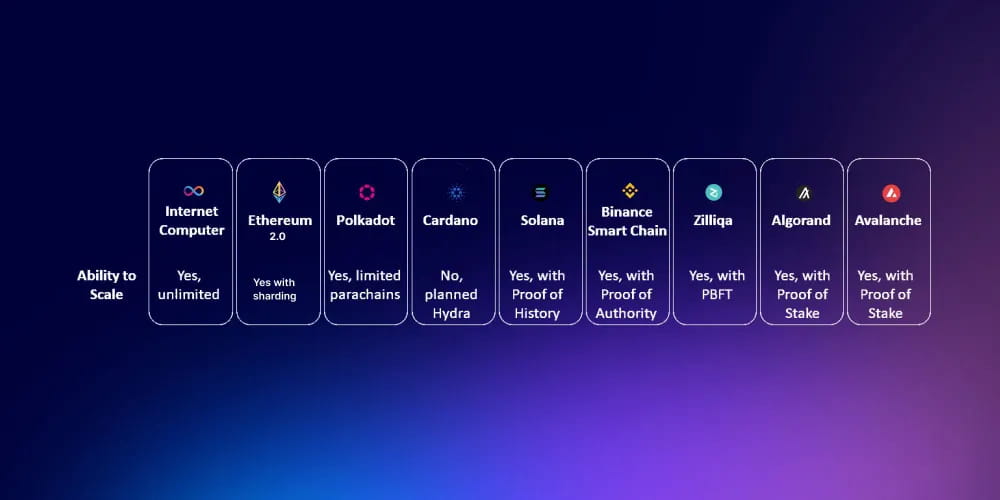
Scalability of a blockchain network is the ability to support high transaction throughput and future growth, which means that as the adoption of blockchain technology accelerates, the performance of a scalable blockchain will not be affected.
Bitcoin has had scalability issues over the past few years due to the limitations of its proof-of-work consensus model.
Currently, Ethereum can use layer 2 solutions to overcome scalability issues, but the nodes run on large tech cloud platforms such as Amazon Web Services (AWS), sacrificing decentralization.
Ethereum has moved from proof-of-work to proof-of-stake in its update called “London,” an update that allows it to increase the capacity and scalability of this blockchain with 64 shard chains (Ethereum 2.0 spreads the network load across 64 separate shards, with one beacon chain to rule them all).
These shards provide Ethereum with more capacity to store and access data, but they are not used to execute code.
Like Ethereum 2.0, Polkadot also has a main chain, called the relay chain, and several shards called parachains. The number of parachains is limited, currently estimated to be around 100.
As mentioned in the previous section, the subnets in the Internet Computer are blockchains, and Chain Key technology combines them into a single blockchain, with an unlimited potential number of subnets as demand increases its capacity (unlimited capacity) and provides a roadmap for unlimited scalability.
On the other hand, Binance Smart Chain achieves scalability by sacrificing decentralization. In its consensus model, it uses only 21 validators (Proof of Authority), which seems to make it the most centralized blockchain.
Meanwhile, Cardano is still waiting for Hydra, its layer 2 solution, the same solution that Matic (Polygon) has been providing for Ethereum for quite some time.
Just like how Bitcoin and Ethereum sacrificed scalability, Solana sacrificed decentralization. Its “innovative” Proof of History (PoH) adds new problems that other blockchains don’t have. Every day, the protocol creates a large amount of transaction history data that needs to be stored (over 2 TB per year).
It’s even larger than the total data accumulated by the top ten blockchain networks. Solana stores a large amount of data in Arweave (a decentralized storage network), so its validators only store data from the last two days.
In this way, Solana puts transaction history into the hands of another community-managed chain.
Additionally, Solana’s scalability has often been a focus of attention, and unfortunately, the network has experienced multiple outages, with the network sometimes unable to cope with surges in activity, an issue Solana calls “resource exhaustion.”
Finally, let’s take a look at Avalanche and Algorand. The Avalanche network is a platform built from three compatible blockchains: the exchange chain (X-Chain), the platform chain (P-Chain), and the contract chain (C-Chain).
Each subnet managed on P-Chain operates as a mini-network, and all mini-networks join together to form the broader Avalanche network, so scalability will depend on the number of subnets.
The downside is that Avalanche (and Algorand) do not offer their own data storage service, in which case they do not leverage it to store transaction history like Solana does.
They use this decentralized service to share files and store data, with Algorand using the Interplanetary File System (IPFS) and Avalanche using Arweave (through the Kyve network) and Ceramic.
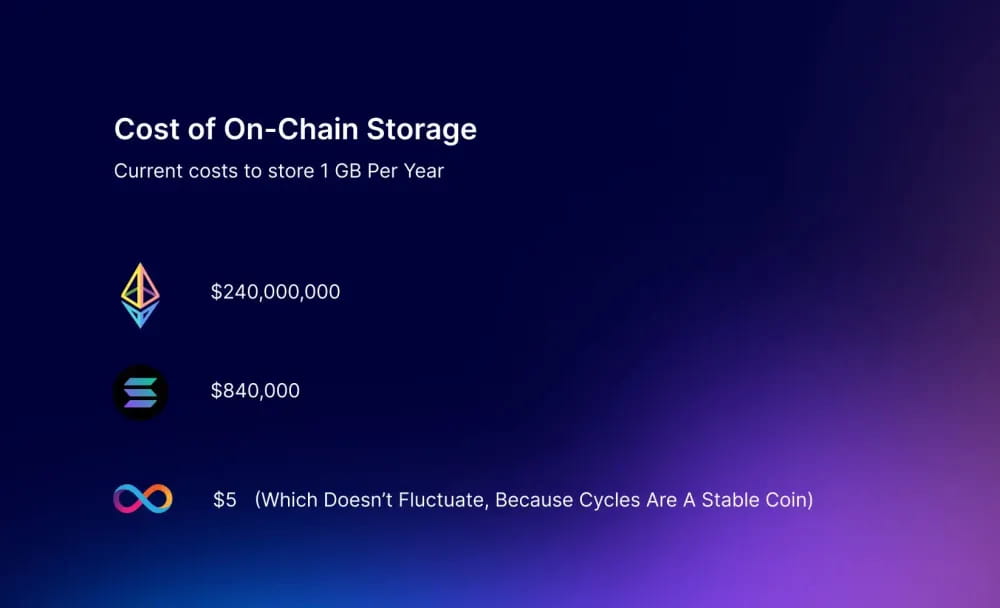
Code and data coexist on-chain on Internet computers, which is another significant advantage of scalability.
Additionally, 1 GB of on-chain storage costs about $240 million on Ethereum and $840,000 on Solana, while 1 GB costs about $5 on the Internet Computer.
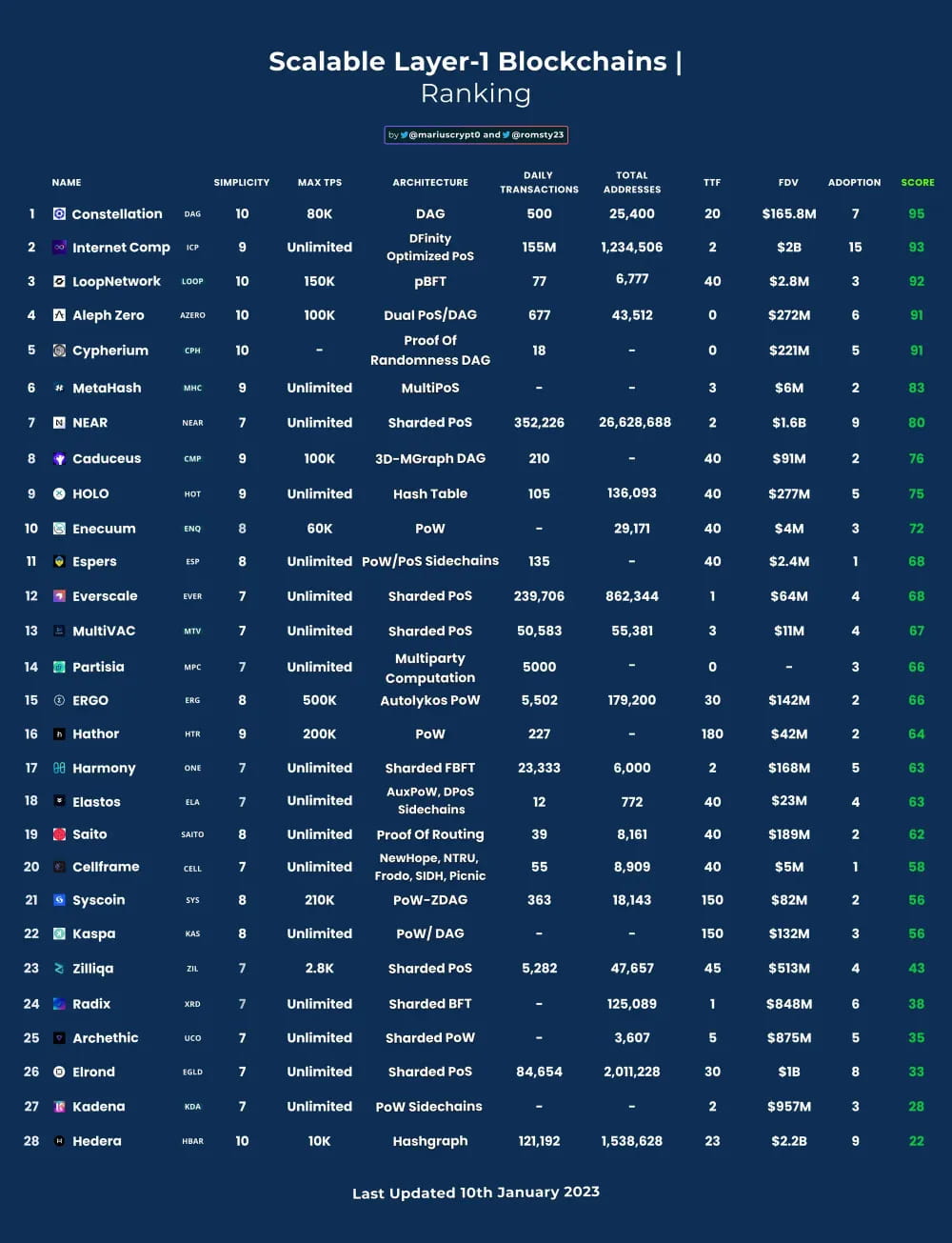
A post by James Bull, AKA @MariusCrypt0 went viral in January 2023 that ranked L1 blockchains for scalability, paying special attention to IC’s daily transactions relative to other chains.
He claims to have constructed the following infographic:
After 10 months of research, 60 million people seeing his tweets, and 5,000 comments, (Bull) has now finally completed his ranking of the 28 most decentralized, most scalable (50k+ TPS) L1 blockchains.
The Internet Computer continues to grow exponentially, with potentially thousands of nodes added by the end of the year, and the transactions per second (TPS) of a single subnet will be multiplied by the number of subnets created.
It uses its innovative Chain Key technology to complete transactions that update smart contract states within 1-2 seconds. At the time of genesis, the "Network Nervous System" subnet started with 28 nodes and the application subnets had 7 nodes each.
Anyone can view the progress of nodes and subnets on the Internet Computer Dashboard, which currently shows 1,235 nodes spread across 36 subnets at the time of writing.
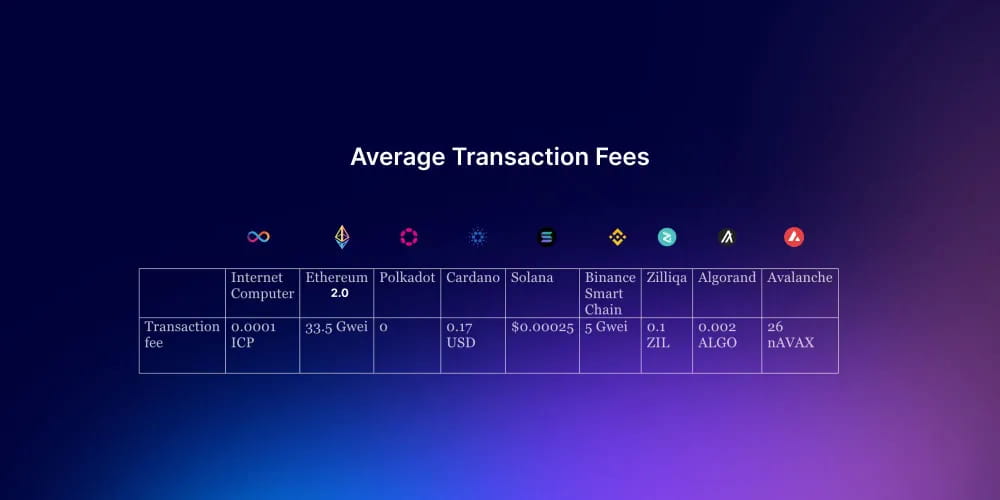
Average transaction fee
Source: Ethereum, Binance Smart Chain, Ziliqa, Algorand, Avalanche, Cardano, Internet Computer
Transaction fees reward miners (proof of work) or validators (proof of stake) who help confirm transactions.
While Bitcoin fees are based on the number of bytes of a transaction (not to be confused with the number of tokens sent), Ethereum transaction fees take into account the computing power required to process the transaction, known as Gas, which also has a variable price measured in ETH and is directly related to network traffic.
Binance Smart Chain (BSC) transaction fees are similar to those proposed by Ethereum, which is not surprising since BSC is essentially a copy of Ethereum and they simply changed the consensus model to improve some of the latter’s limitations (and, it must be said, worsen others, such as decentralization).
Finally, while other blockchains like Algorand and Internet Computer offer minuscule fixed fees based on the value of their tokens (0.001 ALGO and 0.0001 ICP respectively), there are no fees at all with Polkadot.
Consensus Mechanism
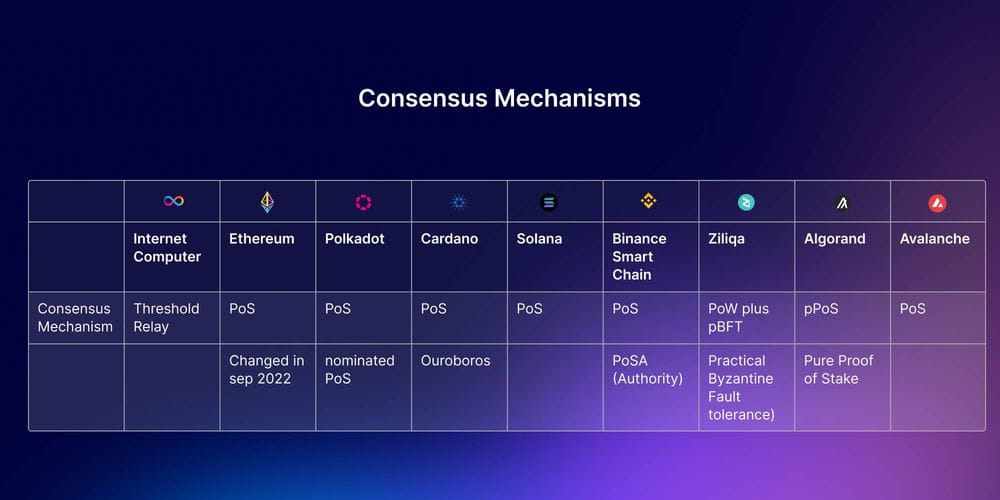
The purpose of the consensus mechanism is to verify that the information added to the ledger is valid, which ensures that the next block to be added is represented correctly and all transactions in the network are updated, which prevents double spending or invalid data from being recorded.
Proof of Work (PoW) is the most widely used consensus protocol in cryptocurrency, it first came into play with the invention of Bitcoin, Ethereum adopted an upgrade to this - Proof of Stake (PoS) in September 2022, which has been a long time in the making and represents a huge engineering undertaking and achievement.
Many of the initial blockchains copied the original Bitcoin code and therefore also used the proof-of-work model.
While proof of work is an innovative invention, it is by no means perfect. Not only does it require a lot of electricity, it is also subject to transaction limits, and few blockchains created so far utilize this type of consensus.
Proof of Stake (PoS) was created as an alternative to Proof of Work to address various issues associated with the latter.
The main advantage of proof of stake is that it reduces the massive electricity expenditures for securing the blockchain and increases the speed at which each block is created, which is done in seconds (milliseconds in Solana’s case, but it’s still 10x slower than the Internet Computer).
Solana, Binance Smart Chain, and Avalanche use a proof-of-stake consensus mechanism. Other blockchains use consensus algorithms based on proof-of-stake, such as:
Polkadot (Nominated Proof of Stake, NPoS)
Cardano(Ouroboros)
Algorand (Pure Proof of Stake, PPoS)
Zilliqa combines Practical Byzantine Fault Tolerance (PBFT) with Proof of Work. PBFT operates on the assumption that at most 1/3 of the nodes in each shard can be malicious before starting the protocol.
Most layer 1 blockchain networks operate using a Proof-of-Stake (PoS) consensus mechanism or a variation thereof. Examples include Ethereum, Cardano, Avalanche, Algorand, Tezos, and Peercoin, which all use the traditional PoS model.
On the other hand, some networks like Binance Smart Chain and Solana use variations of PoS.
The blockchain industry introduced the concept of PoS as a way for individual network nodes to participate in the network by submitting (or staking) some of their own cryptocurrency (called the network governance token or protocol token) to produce blocks and receive rewards based on the amount they staked.
The model is an improvement over Proof of Work (PoW), which requires significant investments in specialized hardware and electricity.
In terms of energy consumption, the Internet Computer is the most efficient, followed by Solana, which you can see details on here and in the infographic below.
As PoS becomes more common, it also exposes some challenges, one of which is that without the need for specialized hardware, network nodes (or “clients”) can be set up anywhere, including on company servers and cloud-based infrastructure, and can be activated simply by staking some cryptocurrency.
The majority of nodes on PoS networks are hosted in the cloud, which has raised concerns because it could allow both centralized and decentralized entities to gain control over network operations.
The Impact of Centralized Entities on PoS Chains
Last year, the incident in which German cloud service provider Hetzner banned Solana nodes, causing 40% of the network to disappear immediately, sparked a broader discussion in the crypto community about the growing influence of centralized service providers in controlling decentralized blockchain networks.
The disturbing incident highlights the potential for cloud providers to compromise nodes or even shut them down, raising more concerns about the dangers of running decentralized blockchains in the cloud.
Stealing tokens through price manipulation
Another problem with the PoS consensus mechanism is that cryptocurrencies are highly liquid, which can lead to rapid changes in token prices and power distribution, which attackers can exploit.
For example, by manipulating a decentralized finance (DeFi) platform or hacking an exchange, an attacker could potentially gain enough staked tokens to disrupt the network and profit from it.
Since PoS networks typically have mechanisms that make it easy to quickly set up new nodes in the cloud, a well-funded attacker can launch an attack by controlling network decisions and behavior.
Proof of Useful Work (PoUW)
The Internet Computer uses a consensus protocol that some describe as Threshold Relay while others prefer Proof of Useful Work (PoUW), a highly advanced mechanism that is far more efficient than the consensus methods used by other first-layer blockchain networks today.
Threshold relays emphasize transaction finality by implementing threshold relay technology in conjunction with the BLS signature scheme and notarization method to solve many problems associated with PoS consensus.
In the Internet Computer consensus, nodes generate a random number, called a "random beacon", which is used to select the next group of nodes and drive the platform's protocol. The consensus mechanism model of the Internet Computer solves the inherent problems of PoS.
It is now clear that any network running in the cloud is very different from the network built by participants and network members, exposing the inefficiencies of PoS.
This flaw is the reason why the Internet Computer developed a more complex and advanced Proof of Useful Work (PoUW) mechanism, which involves a blockchain generated by specialized hardware called "node machines" with similar standardized computing specifications.
These node machines run a highly complex consensus protocol that relies on the power of advanced cryptography, often referred to as chain-key cryptography.
Members and participants of the blockchain network establish membership by electing dedicated node machines in PoUW, which are not used for hashing, but for generating and processing blocks of transactions representing smart contract computations.
They are built to precise standardized specifications to ensure that node machines perform the same amount of computation and do not deviate from the group. They do not compete to perform more computation or hashing, but rather aim to achieve the same amount of computation, and deviation from this may cause the machine to terminate.
The role of deterministic decentralization
The members who control this consensus mechanism and the network come from a decentralized autonomous organization (DAO) that runs the Network Nervous System (NNS) on the Internet Computer blockchain.
The DAO’s responsibilities include combining node machines that create “subnet blockchains” and then connecting them into a single blockchain using chain key cryptography.
This approach has two fundamental benefits: first, by carefully selecting nodes based on their provider, the data center they are located in, and their geographic location, it is impossible for a single attacker to easily add a node to a subnet blockchain, which is a form of "deterministic decentralization"; second, NNS can remove (or "penalize") nodes that statistically deviate from the group.
This latest innovation is why Dominic Williams, CEO and Chief Scientist at DFINITY, said the PoUW model is 20,000 times more efficient than today’s best PoS chains.
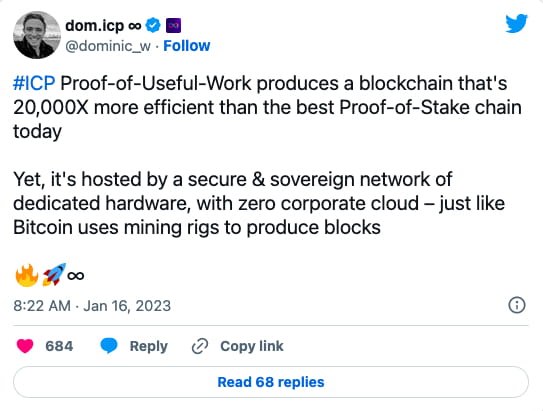
Due to its nature, the network is comprised of dedicated hardware that is not subject to interference from enterprise clouds or entities. This deterministic decentralization of NNS results in an efficient network created and maintained by its members — resulting in a fully decentralized blockchain.
Smart Contracts
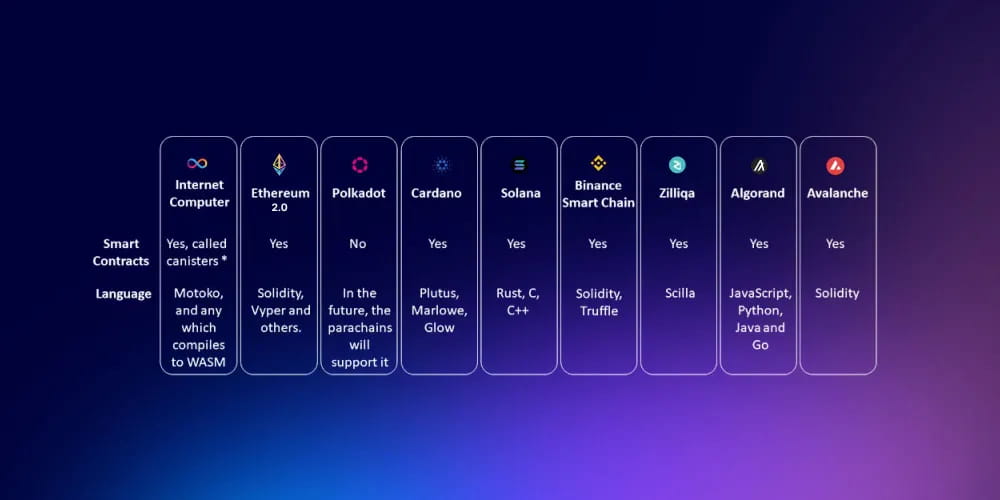
Blockchain ecosystems evolve at different speeds, and for some it may take months between basic updates, while others are much faster, such as the Internet Computer which recently made significant progress.
Since Ethereum launched its first smart contract in 2015, other blockchains have followed suit, with a notable example being Cardano, which recently successfully created its first smart contract through its “Alonzo hard fork” to provide the same service, but with no discernible improvements.
Internet computer smart contracts are called containers because they are bundles of WASM code and memory pages, and they are an evolution and specialization of smart contracts. The significant increase in their number indicates the increasing activity of developers on the network.
Containers remove bottlenecks using “orthogonal persistence”, which eliminates the need to maintain and manage external databases or storage volumes (code and data co-exist on-chain), other blockchains need to keep their data on other decentralized storage networks (besides the complexity, it also adds the problem of having two different trust domains).
At the time of writing, the Internet Computer hosts over 240,000 container smart contracts, but the key difference between these containers is that they deliver services at network speeds.
Smart contracts will rule the world
The Internet Computer community has also approved a proposal to increase the capacity of containers from 4GB to 300GB. Few applications will need more capacity, but if that is the case, you can build your service/system with as many contracts as you need.
If the container smart contract is limited to 4GB of memory, there are many use cases where 4GB of data is not enough, but the current capacity of the subnet (about 300GB) is more than enough.
In addition, an interface description language called Candid allows containers to interact with each other, regardless of the programming language they were developed in.
The Internet Computer has accomplished the monumental feat of adding smart contracts to Bitcoin at the end of 2022, made possible by the application of the network’s Chain Key cryptography that is directly integrated, smart contracts on the Internet Computer can now hold, send, and receive Bitcoin without the need for a private key.
On Ethereum, developers pay to deploy smart contracts and people pay to use them; the Internet Computer uses a “reverse gas model” where only developers provide the funds needed to run their applications/contracts that use their gas (called “Cycles”).
In short, containers are smart contracts without limits that can reimagine everything, such as interactive networks and on-chain dApps (blockchain singularity) instead of large technology clouds such as AWS, Google, Azure, etc.
Digital identity management
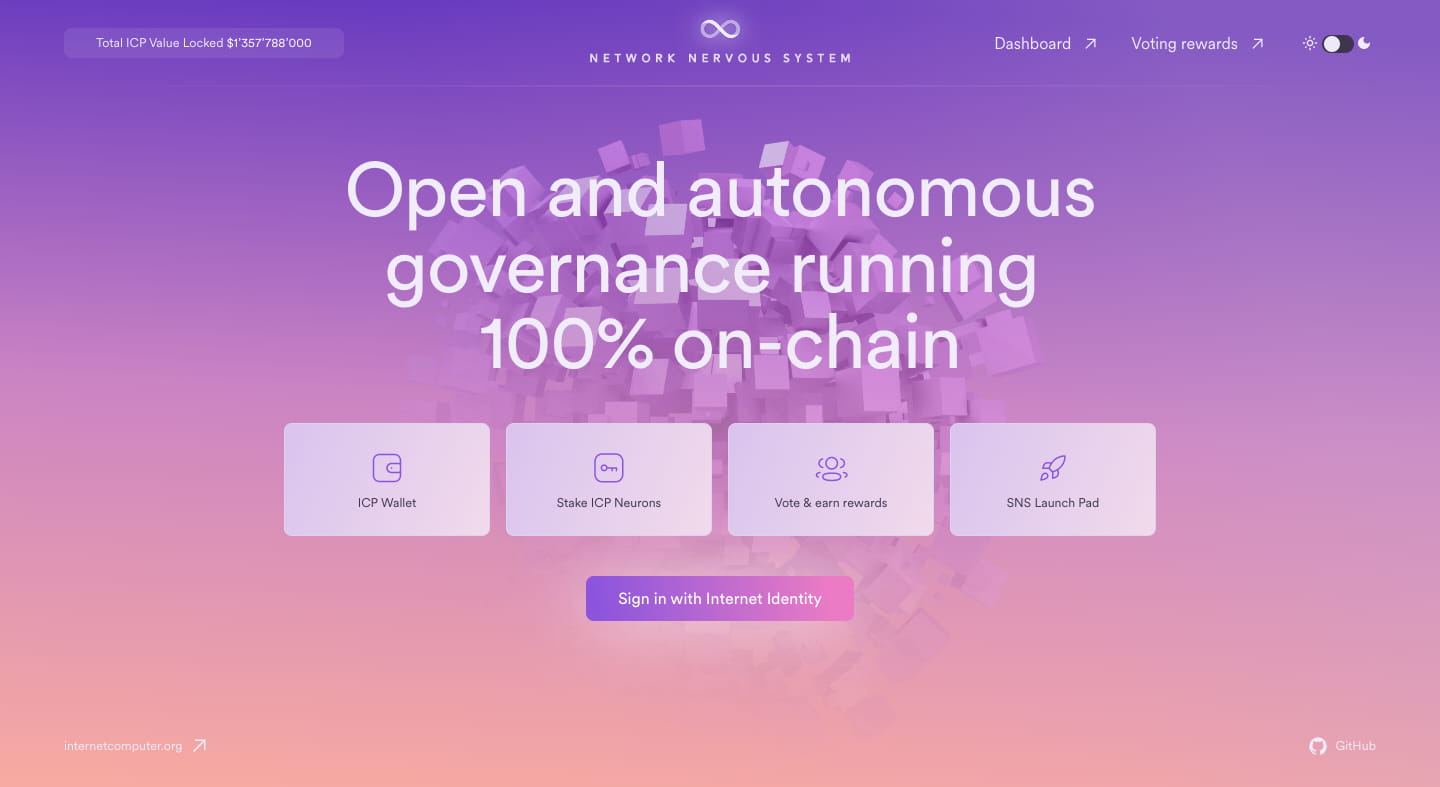
The Internet Computer brings a whole new meaning to identity management with its novel Internet Identity (II) system, an advanced blockchain authentication that ensures your data cannot be seen, tracked, or mined.
It enables you to authenticate securely and anonymously when you access a decentralized application (dApp) that uses the authentication system.
Authenticate to services using fingerprint sensors, Face ID, YubiKey, and more.
Internet identity is constantly being refined to make it compatible with more and more devices, and the official guide explains how to set up authentication for an existing identity anchor set up on a mobile phone or using a security key.
In other blockchains, such as Ethereum, users need external wallets like Metamask to interact with decentralized applications.
You can see the difference between Ethereum and the Internet Computer below.
Dapps on the Internet Computer:
Create an identity
Go to a website and use the Dapp for free
Or you can authorize using an IC native wallet, such as the de facto Bitfinity wallet
Dapps on Ethereum:
Download Metamask Wallet
Go to an exchange, create an account, and buy Ethereum
Send ETH to Metamask
Go to a website, log in to Metamask, and use the Dapp by paying with ETH
At the time of writing, Internet Identity has reached over 2,131,131 Internet Identity Anchors (accounts) and is being adopted exponentially.
On-chain governance
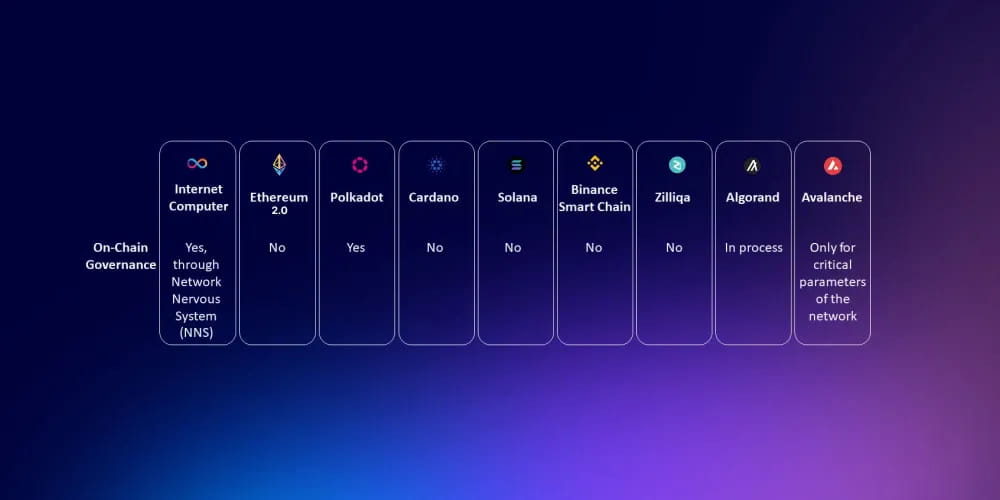
The Internet Computer uses an algorithmic governance system called the Network Nervous System (NNS), sometimes referred to as the “world’s largest DAO,” which allows ICP holders to lock up tokens in it to create “neurons.”
These neurons provide voting rights on proposals that affect the operation of the network and provide rewards to participants in the form of additional ICP tokens.
The network’s community actively works to make the network more efficient, faster, and easier for developers, with technical upgrades being approved through community discussion, voting, and motion proposals via the network’s nervous system.
Recently, Justin Bons concluded that only nine of the top 50 cryptocurrencies by market cap have their own on-chain governance.
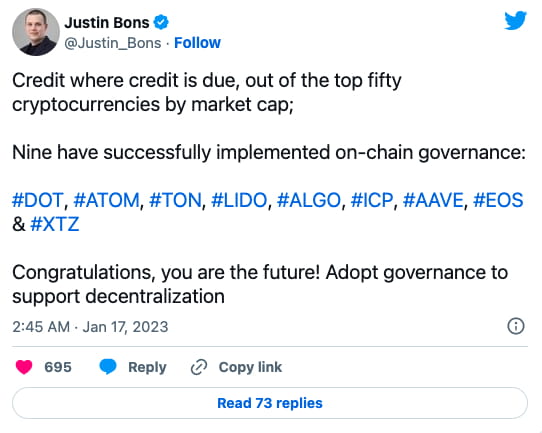
Of all the blockchains presented in this article, only Polkadot, Algorand, and ICP have governance systems, although Avalanche has a limited version that only governs key network parameters. Only a predetermined number of parameters can be modified through governance, such as minimum stake, minting rate, and other economic parameters, so it is not mentioned in Justin Bons' analysis.
According to DFINITY Chief Scientist Dominic Williams, there are currently more than 123 million ICPs locked up for up to 8 years, more than a quarter of the total supply, to generate governance rewards from voting (essentially a form of interest).

Staking Rewards
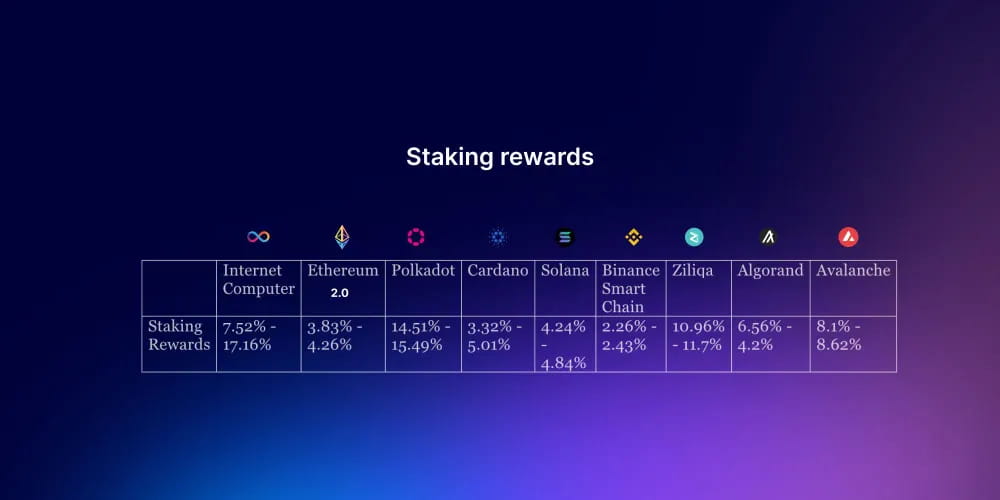
Staking is the process of locking up crypto assets for a specified period to earn rewards. Once you have staked your assets, you can earn staking rewards on top of your holdings and further increase them by compounding these future rewards.
As you can see in the table above, the Internet Computer offers the highest returns on long-term staking, ranging from 7.52% per year for a 6-month stake to 17.16% per year for an 8-year stake based on current data, which has led to the label of “the 8-year gang” in the ICP community due to the long-term passive income potential of long-term investments.
Check out the ICP Neuron Calculator to determine the returns you will earn based on your goals, and the official guide provides you with step-by-step instructions on how to stake ICP tokens using the Network Nervous System (NNS).
Availability and Release Dates
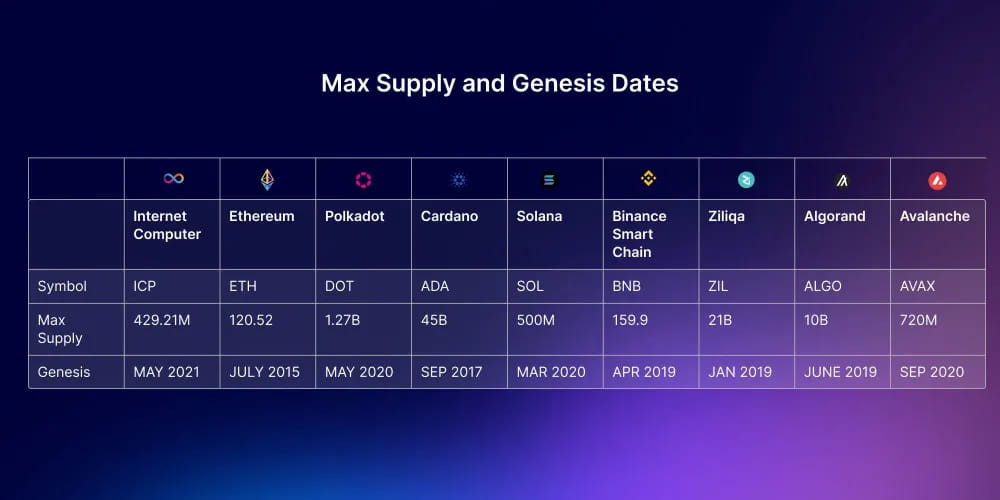
The current supply of ICP is 469.21 million, with inflation theoretically starting at 10% and then settling at 5%, although there is currently much discussion surrounding the actual number.
A December 2022 article in Internet Computer Review by DFINITY statistician Kyle Langham assumes that ICP inflation has been low over the past year.
ICP token inflation is caused by the minting of ICP to reward node providers and reward NNS governance participants. From January 2022 to December 2022, the annualized inflation rate of ICP is 3.6%, which is much lower than the target inflation rate of 8-9% annualized for governance rewards.
Many NNS participants have been accumulating their rewards as “maturity” (i.e., accumulating rewards in Neurons by voting on proposals) rather than converting them into ICP tokens.
As the number of daily active users increases, the Cycles powering dapps will become increasingly deflationary, so the more successful the ecosystem is in driving adoption and network effects, the more deflationary ICP will become, which obviously correlates with price action.
in conclusion
The main innovation behind the Internet Computer is chain key cryptography, which includes a number of new technologies, including consensus mechanism, non-interactive distributed key generation (NI-DKG), network neural system (NNS), Internet identity, etc. This technology is also the basis for the breakthrough integration of Bitcoin and Ethereum on the Internet Computer chain.
HTTP outcalls now also allow web3 and web2 to interact seamlessly on the IC, similar to Chainlink functionality.
Many so-called “Ethereum Killer” blockchains add changes that improve some of the features Ethereum offers, such as speed or fees.
However, the Internet Computer presents an innovative change on top of all that will transform existing technology, and the Internet Computer aims to enhance Ethereum’s position as a sister network rather than compete with it, thereby empowering the broader crypto space and healing tribal divisions.
Many of the blockchains mentioned in this article will coexist for the foreseeable time and gain first-mover advantage, after which those that bring the most advancements and solutions to prevalent problems in blockchain technology (such as hackable bridges in DeFi) will remain relevant.
The Internet Computer offers the world a new paradigm and technology, with revolutionary achievements such as the integration of Bitcoin and the implementation of HTTP outcalls, as well as the eagerly awaited Ethereum integration, which may be completed by the third quarter of 2023.
The Internet Computer is the fastest blockchain with 2-second finality and 100-ms query calls, and its container smart contracts provide a true Web 3.0 service that serves the network and interacts directly with users.
The scalability is limitless, it offers a highly adaptable blockchain, allows its community to vote on proposals through the network nervous system to govern the Internet Computer, these are just some of its innovative and powerful features!
Finally, with over 25% of the total supply already locked up for 8 years, dApps powered by Cycles will ultimately deflationary the ICP token.
Meanwhile, those who enter at a low entry price can lock in their ICP as an investment if they want to achieve an excellent ROI.
We hope we made it clear why we built on ICP and why it is so far ahead of other products.
We believe it’s only a matter of time before the wider crypto world realizes this and the network effects grow exponentially, and indeed, this appears to have already begun.
The future of the Internet Computer is bright, and InfinitySwap will leverage its outstanding technological achievements to bring the next generation of decentralized finance to the world through secure, high-speed, and low-fee transactions.
Note: Data, graphics, and information have been updated and edited based on the original viral post from the Dfinity community (now rebranded as Coinhustle), thanks to our partners for the original input on this joint publication.
Disclaimer: Please note that this list of L1s is not exhaustive, and more chains may be added in the future upon request. In fact, we aim to update this post every six months, at least, to add more analysis through constant iteration. Additionally, while the research is meticulous, we are willing to make edits where appropriate, especially if certain metrics (such as speed) change over time.

IC content you care about
Technology Progress | Project Information | Global Activities

Collect and follow IC Binance Channel
Get the latest news